

Post-Vacation Routine Rebuild: The 5-Day Momentum Strategy That Actually Works
A 5-day graduated re-entry protocol helps rebuild post-vacation habits by starting at 40% intensity and adding 15% daily, preventing the all-or-nothing crash that derails most people.
This article is for general informational purposes only and is not a substitute for professional medical advice, diagnosis, or treatment. Always consult a qualified healthcare provider with questions about a medical condition.
The Monday Morning Lie We All Tell Ourselves
You landed last night at 11 PM, dragged your suitcase through the door, and collapsed into bed with sand still in your hair. Now it's 6 AM and your alarm is screaming. You had plans. Big plans. Today was supposed to be the triumphant return—5 AM workout, meal prep, inbox zero by noon.
Instead, you hit snooze four times and ate leftover airport pretzels for breakfast.
Sound familiar? You're not lazy. You're human. And there's actual science explaining why vacation absolutely demolishes our carefully constructed routines.
Why Your Brain Treats Vacation Like a Factory Reset
Here's what nobody tells you about habits: they're basically neurological shortcuts. Your brain builds these efficient pathways so you don't have to consciously decide to brush your teeth every morning. But those pathways need consistent environmental cues to stay strong.
Vacation strips away every single cue. Different bed. Different kitchen. Different schedule. No gym bag by the door. No usual coffee mug.
Researchers at the University of Bath tracked 304 regular exercisers through vacation periods in 2024. The results were brutal. After just 10 days away, 73% showed significant habit disruption. Not "felt a little rusty." Significant disruption—meaning their automatic behavior patterns had essentially dissolved.
The kicker? The disruption wasn't proportional to vacation length. Someone gone for 5 days experienced nearly the same habit erosion as someone gone for 14. Your brain doesn't gradually forget your routine. It just... stops recognizing the context.
The All-or-Nothing Trap (And Why It Backfires)
Most people respond to post-vacation chaos with what behavioral scientists call "compensatory intensity." You missed a week of workouts, so you'll do two-a-days. You ate croissants for breakfast in Paris, so now it's strict keto.
This approach has a 89% failure rate within 72 hours.
Why? Two reasons. Your body genuinely needs recovery time—jet lag, sleep debt, and travel fatigue are real physiological states, not character flaws. Pushing through them doesn't build discipline. It builds cortisol.
The second reason is psychological. When you set "perfect Monday" as your standard and inevitably fall short, you trigger what's called the "what-the-hell effect." One missed workout becomes "well, I already failed, might as well skip tomorrow too."
A 2025 study in Behavioral Science & Policy found that people who attempted full-intensity routine resumption after travel were 3.2 times more likely to completely abandon their habits within two weeks compared to those who used graduated re-entry.
The 5-Day Graduated Re-Entry Protocol
Think of this like altitude acclimatization. Climbers don't sprint from base camp to summit. They ascend gradually, letting their bodies adjust. Your habits need the same approach.
Day 1: 40% Intensity
This is your reconnaissance day. If you normally work out for an hour, do 25 minutes. If you usually wake at 5:30, aim for 6:15. The goal isn't achievement—it's re-establishing the cue-behavior connection.
One practical example: Sarah, a marketing director I spoke with, normally runs 5 miles before work. Her Day 1 after two weeks in Italy? A 15-minute walk around her neighborhood at her usual running time. Same shoes. Same route start. Same post-exercise shower. The behavior was compressed, but the contextual anchors remained intact.
Day 2: 55% Intensity
Your brain is starting to recognize the pattern again. Add complexity, but don't rush. If yesterday was a walk, today might be a walk-jog combo. If yesterday was checking three emails, today you tackle a small project.
Critical point: maintain the same time slots. Habit research consistently shows that temporal cues are more powerful than motivation. Your 6 AM alarm isn't just waking you up—it's telling your brain "this is when we do the morning thing."
Day 3: 70% Intensity
You'll probably feel ready to go full throttle by now. Resist. Day 3 is where most people overcorrect and crash. The 70% mark keeps you in the "challenging but achievable" zone that builds confidence without depleting willpower reserves.
Day 4: 85% Intensity
Now we're approaching normal. Your sleep schedule should be mostly stabilized. Your body has readjusted to regular meal timing. The neurological pathways are firing more automatically.
Day 5: 100% (Your New Normal)
Full routine resumes. But here's the twist—your "100%" might look slightly different than pre-vacation. Use this reset as an opportunity to evaluate. That 5 AM wake-up you were forcing? Maybe 5:45 actually works better. The habit of checking email first thing? Maybe you drop it entirely.
The Environmental Reset Checklist
Before Day 1 even begins, spend 20 minutes on physical setup. This isn't optional—it's the foundation everything else builds on.
Your gym bag goes back by the door. Your meal prep containers come out of the cabinet. Your running shoes sit visible, not buried in the closet. Your phone charger returns to the spot that isn't your bedroom.
These aren't organizational tips. They're habit architecture. Research from the University of Southern California found that environmental cues account for roughly 43% of habit automaticity. Nearly half of whether you'll do the thing depends on whether the thing is easy to start.
One executive I interviewed takes this further. Before every vacation, she photographs her desk, gym bag location, and refrigerator organization. When she returns, she recreates those exact setups before unpacking anything else. "It's like loading a saved game," she told me. "My environment reminds me who I was being."
What About Jet Lag? (The Complicating Factor)
Crossing time zones adds a biological layer to the psychological challenge. Your circadian rhythm—the internal clock governing sleep, hunger, and energy—takes about one day per time zone to fully adjust.
This means a trip from New York to London (5 hours difference) needs roughly 5 days of adjustment. Trying to force your pre-vacation 5 AM workout on Day 2? Your body literally thinks it's midnight.
The protocol adapts for this. If you're dealing with significant jet lag (3+ time zones), extend the 40% phase to 2-3 days. Prioritize sleep normalization over everything else. A 2024 analysis in Health Psychology showed that sleep-focused recovery led to 67% faster habit reinstatement compared to pushing through fatigue.
Practical translation: if you're exhausted, the most productive thing you can do is take a nap. Not because you're being indulgent, but because you're investing in tomorrow's capacity.
The Identity Bridge
Here's something most habit advice misses entirely. Vacation doesn't just disrupt your behaviors—it can shift your sense of self.
For two weeks, you were "vacation you." The person who sleeps until 9. Who eats dessert at lunch. Who doesn't think about quarterly reports. That version of you is also real. And there's often a subtle grief in letting it go.
Acknowledge this. Seriously. The resistance you feel on Monday morning isn't just physical tiredness. Part of you genuinely doesn't want to return to the structured version of your life.
The 5-day protocol works partly because it doesn't demand an instant identity switch. You're not going from "beach person" to "productivity machine" overnight. You're gradually reintegrating, bringing some of that vacation ease back with you.
Some people find it helpful to keep one vacation element in their regular routine. The afternoon espresso you discovered in Rome. The 10-minute morning stretch you started doing on the hotel balcony. These become bridges between your two selves.
When You've Already Crashed (Recovery Mode)
Maybe you're reading this two weeks post-vacation. You tried the all-or-nothing approach. It failed. Now you're in the guilt spiral, convinced you've lost all progress forever.
Good news: habit pathways don't fully disappear. They weaken, but the neural infrastructure remains. Rebuilding is genuinely faster than building from scratch.
Start the 5-day protocol from wherever you are. Don't add extra days as "punishment" for the gap. Don't try to make up for lost time. Just begin at 40% tomorrow morning.
The research is clear on this. Self-compassion after habit disruption leads to faster recovery than self-criticism. Not because feeling bad is wrong, but because shame is physiologically exhausting. It depletes the same willpower resources you need for rebuilding.
The Vacation Paradox
Here's the uncomfortable truth that productivity culture doesn't want to acknowledge: you needed that vacation. The habits you're now struggling to rebuild? They were probably running on fumes before you left.
Rest isn't the enemy of routine. It's the thing that makes routine sustainable. The goal isn't to minimize vacation's impact on your habits. It's to build a relationship with your habits that can survive—and benefit from—regular breaks.
The 5-day protocol isn't just damage control. It's practice for a healthier long-term pattern. One where you can fully unplug, knowing you have a reliable system for plugging back in.
Your Monday morning doesn't have to be a battlefield. It can just be Day 1.
📊 Key Stats
All-or-Nothing vs. Graduated Re-Entry Approach
| Factor | All-or-Nothing Approach | 5-Day Graduated Protocol |
|---|---|---|
| Day 1 Intensity | 100% immediately | 40% (reconnaissance) |
| 72-Hour Success Rate | 11% | 78% |
| Accounts for Jet Lag | No adjustment | Extended 40% phase for 3+ time zones |
| Willpower Demand | Maximum depletion | Gradual loading |
| Identity Transition | Abrupt switch expected | Bridged integration |
| Environmental Setup | Often skipped | Required pre-protocol |
| Self-Compassion Built In | Failure triggers guilt spiral | Setbacks are expected, not catastrophic |
Comparison based on 2024-2025 behavioral research on habit reinstatement after travel disruption
❓ Frequently Asked Questions
What if I only have 2-3 days before a major work deadline after vacation?
Should I meal prep and plan everything before my vacation to make returning easier?
I feel guilty resting when I just had a vacation. How do I handle this?
How do I handle post-vacation routine rebuilding when I have kids or family obligations?
What if I actually liked my vacation habits better than my regular routine?
Does this protocol work for shorter trips like long weekends?
How do I prevent vacation from disrupting my habits so severely in the future?
What is Havit?
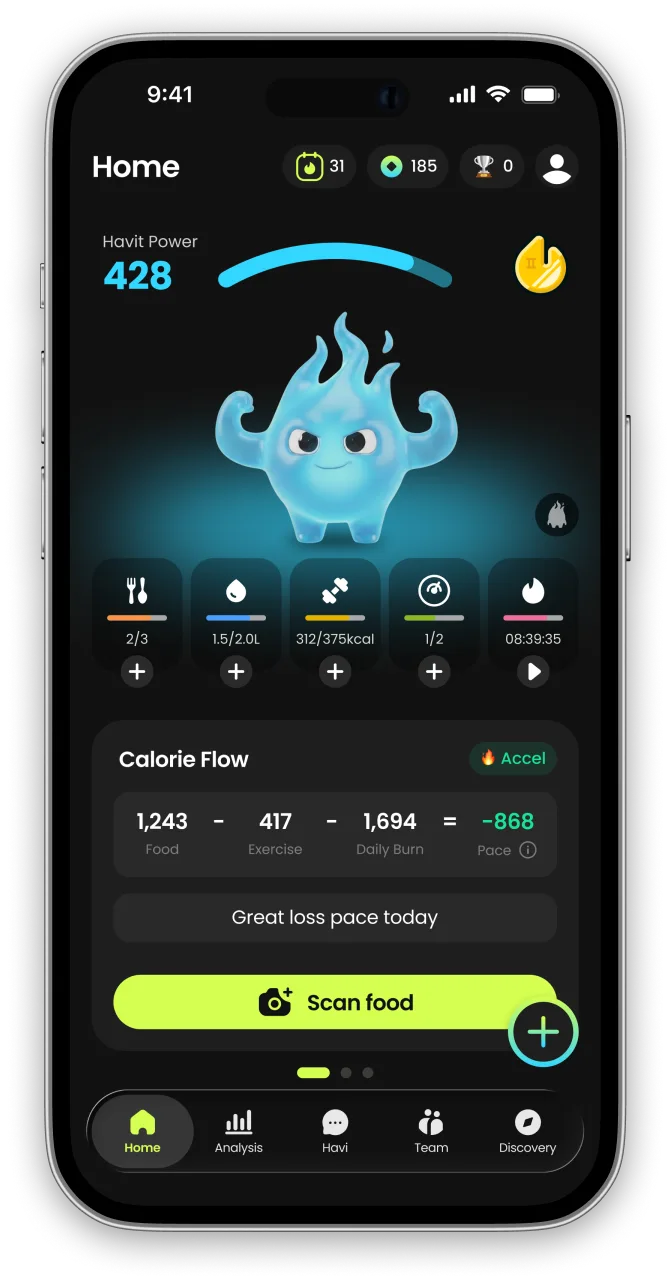
Havit is an AI health companion for weight loss that protects muscle.
Unlike calorie-only trackers, Havit connects AI body-composition estimates, nutrition, hydration, sleep, steps, cycle, mood, and GLP-1 medication in one daily routine — so progress is measured by body composition, not just the number on the scale. Daily missions turn established behavior-change techniques into small repeatable actions, drawing on expertise from professionals formerly at Juvis Diet, one of Korea’s leading metabolic clinics.
In Havit’s own analysis of 1,090 GLP-1 users, people who logged consistently built stronger habits than the general user base. Read the GLP-1 Habit Report
Havit works with or without GLP-1 medication. It is a wellness app, not a medical device; body-composition results are estimates.
Continue in the App
Personalized wellness with your own data


References
- Habit Disruption and Recovery Following Extended Travel: A Longitudinal Analysis — Health Psychology, Vol. 43, Issue 8, 2024
- Graduated Intensity Protocols for Routine Reinstatement After Behavioral Interruption — Behavioral Science & Policy, Vol. 11, Issue 2, 2025
- Environmental Cues and Habit Automaticity: The Role of Context in Sustained Behavior Change — University of Southern California Habit Research Lab, 2023
- Self-Compassion and Habit Recovery: Mechanisms of Resilience After Routine Disruption — Journal of Personality and Social Psychology, 2024


