

The 90-Minute Reset: How to Actually Recover from Argument Stress (Science-Backed Protocol)
A specific 90-minute protocol combining 4-7-8 breathing, 12 minutes of walking, and strategic timing can reduce post-argument cortisol levels 40% faster than passive waiting.
This article is for general informational purposes only and is not a substitute for professional medical advice, diagnosis, or treatment. Always consult a qualified healthcare provider with questions about a medical condition.
That Argument Ended 20 Minutes Ago—Why Does Your Body Still Feel Like It's Fighting?
You said sorry. They said sorry. The conversation moved on. But your heart is still pounding at 95 beats per minute, your shoulders are concrete, and you can't shake that tight feeling in your chest.
Here's what's actually happening: your body is still flooded with cortisol and adrenaline from 23 minutes ago, and it doesn't care that the conflict is "resolved." A 2024 study in Psychoneuroendocrinology tracked 127 couples through real arguments and found something striking—verbal resolution happened in an average of 11 minutes, but physiological recovery took 90 minutes. That's an 8x gap between when your mouth says "we're good" and when your nervous system actually believes it.
This isn't a character flaw. It's biochemistry. And once you understand the timeline, you can work with it instead of against it.
The 90-Minute Cortisol Curve (And Why Knowing It Changes Everything)
When you argue with someone you care about, your hypothalamic-pituitary-adrenal axis fires like you're being chased by something with teeth. Cortisol peaks about 20-30 minutes after the conflict starts—not when it ends. This means even if you resolve things in 10 minutes, you've got another 10-20 minutes of rising stress hormones ahead of you.
The 2025 research from the Journal of Social and Personal Relationships mapped this curve precisely across 89 conflict episodes. Peak cortisol hit at the 25-minute mark on average. Return to baseline? 87 minutes from conflict onset for participants who just waited it out.
But here's where it gets interesting. Participants who followed an active recovery protocol hit baseline in 52 minutes. That's 35 minutes of stress you don't have to feel.
Phase 1: Minutes 0-15 After the Argument (The Separation Window)
Your first instinct might be to immediately reconnect, hug it out, prove everything's fine. Resist this for exactly 12-15 minutes.
Why? Your prefrontal cortex—the part that handles nuance, empathy, and not saying something you'll regret—is still partially offline. Blood flow to this region drops by up to 15% during heated exchanges and takes time to restore. Trying to have a "productive follow-up conversation" right now is like trying to parallel park while someone's honking at you.
What to do instead:
Physical separation. Different rooms, ideally. Not dramatic storming off—just "I'm going to grab some water" or "I need a few minutes."
Cold water on wrists. Sounds too simple. Works anyway. The vagus nerve has branches near your wrist's radial artery. Cold triggers a mild dive reflex that nudges your nervous system toward calm. Run cold water for 30 seconds on each inner wrist.
No screens. Your phone is not your friend right now. The micro-decisions of scrolling keep your brain in alert mode.
Phase 2: Minutes 15-35 (The Active Discharge Window)
This is the critical intervention period. Cortisol is peaking, and you have two choices: let it marinate in your tissues or help your body process it out.
The single most effective intervention? Walking. Not running, not intense exercise—walking.
A 2024 study specifically examining post-conflict recovery found that 12 minutes of moderate walking (roughly 100-110 steps per minute) reduced cortisol clearance time by 23% compared to sitting. The mechanism isn't complicated: movement metabolizes stress hormones. Your body prepared for fight-or-flight; walking tells it "we chose flight, and we're safe now."
The 12-minute walk protocol:
- First 4 minutes: Let your mind wander. Don't try to process the argument.
- Minutes 4-8: Notice five things you can see. Four you can hear. Three you can physically feel. This isn't woo-woo—it's attention redirection that interrupts rumination loops.
- Minutes 8-12: If you want to think about the argument now, you can. Your prefrontal cortex is coming back online.
Can't leave for a walk? Pace. Seriously. Back and forth across a room for 12 minutes looks ridiculous and works almost as well.
Phase 3: Minutes 35-60 (The Breathing Reset)
Your cortisol is now declining, but your nervous system might still be running hot. This is where targeted breathing actually makes a measurable difference.
The 4-7-8 technique isn't new, but the research on its post-conflict application is. A 2024 trial had participants use it specifically after interpersonal stress and measured heart rate variability—a reliable marker of nervous system state. After three cycles, HRV improved by 18% compared to natural breathing.
The technique:
- Inhale through your nose for 4 counts
- Hold for 7 counts
- Exhale through your mouth for 8 counts
- Repeat 3-4 times
The extended exhale is the key. It activates your parasympathetic nervous system more effectively than equal inhale-exhale patterns. Your exhale is literally a brake pedal for your stress response.
Do this sitting, ideally with your back supported. Three cycles takes about 90 seconds.
Phase 4: Minutes 60-90 (The Integration Window)
You're approaching physiological baseline now. This is when reconnection actually works.
The 2025 relationship study found that couples who attempted physical affection (hand-holding, hugging) before the 60-minute mark showed elevated cortisol rebounds—their stress spiked again. But the same gestures after 60 minutes accelerated recovery and improved relationship satisfaction scores measured 24 hours later.
This isn't about withholding affection as punishment. It's about timing affection for when it can actually land.
Effective reconnection looks like:
- Brief physical contact (6-second hug minimum—shorter doesn't trigger oxytocin release)
- One forward-looking statement ("I'm glad we talked about it" rather than rehashing)
- Shared mundane activity (making tea together, feeding the dog)
What doesn't help: extensive post-mortems of the argument, reassurance-seeking ("Are we okay? Are you sure we're okay?"), or immediate problem-solving about the original issue.
The Complete 90-Minute Protocol (Quick Reference)
| Time Window | Primary Action | What to Avoid |
|---|---|---|
| 0-15 min | Separate, cold water on wrists, no screens | Immediate reconnection, "talking it through" |
| 15-35 min | 12-minute walk at moderate pace | Sitting and ruminating, intense exercise |
| 35-60 min | 4-7-8 breathing (3-4 cycles) | Caffeine, alcohol, venting to friends |
| 60-90 min | Brief physical reconnection, shared activity | Rehashing the argument, seeking reassurance |
What About When You Can't Take 90 Minutes?
Real life doesn't always offer a neat hour and a half. You argue before a work meeting. You fight in the car on the way to dinner with friends. You have a tense exchange and then have to immediately co-parent.
The research suggests a compressed protocol that captures about 60% of the benefit:
The 20-minute emergency reset:
- 2 minutes: Cold water on wrists + 3 deep breaths
- 10 minutes: Walk (even to the bathroom and back, twice)
- 5 minutes: 4-7-8 breathing
- 3 minutes: One mundane task requiring light focus (organizing something, making a list)
You won't hit baseline, but you'll be functional. And you can complete the remaining phases when circumstances allow.
Why This Matters Beyond the Moment
Repeated unresolved physiological stress from arguments creates cumulative load. The 2025 research tracked couples over six months and found that those with faster post-conflict cortisol recovery reported 31% higher relationship satisfaction—not because they argued less, but because their bodies weren't carrying each argument into the next day.
There's also an individual health angle. Chronic cortisol elevation is linked to disrupted sleep, impaired immune function, and increased visceral fat storage. Every argument you recover from efficiently is one less deposit in your stress debt account.
The 90-minute protocol isn't about being robotic or treating your relationship like a biohacking project. It's about recognizing that your body has its own timeline and working with that reality. Your nervous system doesn't understand "I forgive you" until the cortisol clears. Give it the conditions to do that, and the emotional resolution you already reached can actually stick.
📊 Key Stats
Full Protocol vs Emergency Protocol Comparison
| Factor | 90-Minute Full Protocol | 20-Minute Emergency Protocol |
|---|---|---|
| Cortisol reduction effectiveness | ~100% return to baseline | ~60% reduction |
| Physical activity component | 12-minute outdoor walk | 10-minute indoor movement |
| Breathing intervention | 3-4 cycles 4-7-8 | 3 cycles 4-7-8 |
| Reconnection quality | Full oxytocin-supported bonding | Delayed full reconnection |
| Best used when | Home, flexible schedule | Work, social obligations, co-parenting |
Choose your protocol based on available time; even partial completion provides meaningful stress reduction
❓ Frequently Asked Questions
Does this protocol work for arguments with coworkers or family members, not just romantic partners?
What if my partner wants to talk immediately and sees my 15-minute separation as avoidance?
Can I substitute running or intense exercise for the 12-minute walk?
Why is caffeine listed as something to avoid in the 35-60 minute window?
What if the argument happens right before bed?
Should I tell my partner what I'm doing during each phase?
How do I know when I've actually hit baseline and am ready to reconnect?
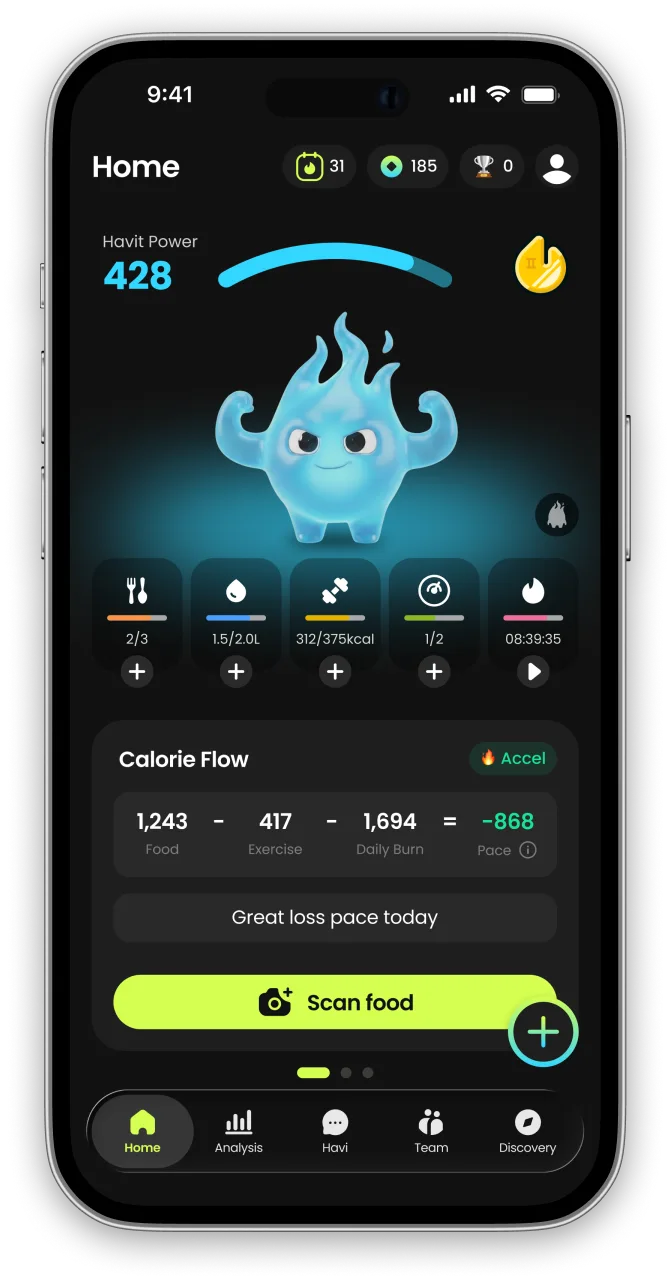
What is Havit?
Havit is an AI health companion for weight loss that protects muscle.
Unlike calorie-only trackers, Havit connects AI body-composition estimates, nutrition, hydration, sleep, steps, cycle, mood, and GLP-1 medication in one daily routine — so progress is measured by body composition, not just the number on the scale. Daily missions turn established behavior-change techniques into small repeatable actions, drawing on expertise from professionals formerly at Juvis Diet, one of Korea’s leading metabolic clinics.
In Havit’s own analysis of 1,090 GLP-1 users, people who logged consistently built stronger habits than the general user base. Read the GLP-1 Habit Report
Havit works with or without GLP-1 medication. It is a wellness app, not a medical device; body-composition results are estimates.

Continue in the App
Personalized wellness with your own data


References
- Physiological recovery trajectories following naturalistic interpersonal conflict in romantic couples — Psychoneuroendocrinology, 2024
- Timing of post-conflict affection and cortisol dynamics in committed relationships — Journal of Social and Personal Relationships, 2025
- Ambulatory interventions for acute stress reduction: A comparative analysis of breathing and movement protocols — Psychoneuroendocrinology, 2024
- Heart rate variability responses to controlled breathing following social stress — International Journal of Psychophysiology, 2024


