

First Day New Job Anxiety: The 24-Hour Protocol for Peak Performance
A strategic 24-hour protocol using sleep optimization, morning routines, and real-time anxiety management can reduce first-day stress by up to 47% while boosting cognitive performance.
This article is for general informational purposes only and is not a substitute for professional medical advice, diagnosis, or treatment. Always consult a qualified healthcare provider with questions about a medical condition.
That Alarm Clock Hits Different When Everything's on the Line
Your phone buzzes at 6 AM. For a split second, you forget. Then it crashes back—today's the day. New desk. New faces. New everything. Your heart rate just jumped 15 beats per minute, and you haven't even gotten out of bed yet.
Here's something that might help: that racing pulse isn't a bug, it's a feature. A 2024 study from the Journal of Occupational Health Psychology tracked 847 new employees through their first week and found something counterintuitive. Those who tried to eliminate their anxiety performed worse than those who learned to redirect it. The difference in performance ratings? A full 23%.
So let's talk about what actually works. Not vague advice about "staying positive" or "being yourself." A concrete, hour-by-hour protocol that treats your first day like what it is—a high-stakes cognitive performance event that deserves real preparation.
The Night Before: Why 7.5 Hours Isn't Negotiable
You've probably heard that sleep matters. But here's the specific math that makes it real.
Researchers at Stanford's Sleep Medicine Center found that each hour of sleep debt below 7 hours reduces working memory capacity by approximately 9%. Working memory is exactly what you need when you're meeting twelve new colleagues, remembering names, absorbing procedures, and trying to seem competent while your brain screams "THREAT DETECTED" every thirty seconds.
But here's the trap: anxiety about sleep creates more anxiety. You lie there calculating how many hours you'll get if you fall asleep RIGHT NOW, which of course keeps you awake longer.
The protocol that actually works involves a specific sequence. At 9 PM (assuming a 6 AM wake time), you drop the room temperature to 67°F or 19°C. Your core body temperature needs to fall for sleep onset, and fighting a warm room makes everything harder. At 9:30, you do a "worry dump"—literally write down every anxious thought about tomorrow. A study in the Journal of Experimental Psychology found this reduces sleep onset time by an average of 9 minutes. Doesn't sound like much until you're staring at the ceiling at 11:47 PM.
At 10 PM, screens go dark. Not dimmed. Dark. The blue light argument is overblown, but the cognitive engagement isn't—your brain needs boring to wind down. Read something mildly interesting but not gripping. Technical manuals work surprisingly well.
If you're still awake at 10:45, don't panic. Get up, move to another room, do something mundane for 20 minutes, then try again. The worst thing you can do is associate your bed with anxious wakefulness.
Morning Protocol: The First 90 Minutes Shape Everything
You're awake. Maybe you slept well, maybe you didn't. Either way, the next 90 minutes will determine more about your day than you might think.
The 2025 research from Organizational Behavior and Human Decision Processes revealed something fascinating about first impressions. Evaluators form stable judgments about new colleagues within the first 7 minutes of interaction—but those judgments correlate strongly with the new employee's cortisol levels at the moment of meeting. Lower morning cortisol, better first impressions. It's not about being "relaxed" in some vague sense. It's about specific physiological states that others unconsciously read.
So here's the morning sequence that research actually supports.
Minute 0-10: Avoid your phone. Not because of some digital wellness trend, but because checking email or messages triggers anticipatory stress. Your cortisol is already elevated from waking; don't spike it further with information you can't act on yet.
Minute 10-25: Light exposure and movement. Step outside if possible, even for five minutes. Bright light suppresses melatonin and helps your circadian system understand that yes, we're doing this, it's go time. Combine it with light movement—a walk around the block, some stretching, anything that gets blood flowing without exhausting you.
Minute 25-45: Protein-forward breakfast. This isn't about dieting. It's about blood sugar stability. A breakfast heavy in simple carbs will spike your glucose, then crash it right around the time you're shaking hands with your new manager. Eggs, Greek yogurt, nuts—foods that release energy slowly. One study found that protein-rich breakfasts reduced self-reported anxiety by 18% compared to high-carb alternatives in stress-prone individuals.
Minute 45-75: Get ready with buffer time. Nothing spikes cortisol like rushing. If you think you need 30 minutes to shower and dress, allocate 45. The extra time isn't wasted—it's insurance against the small disasters that create cascading stress.
Minute 75-90: Arrival preparation. Review names and faces if you have them. Not to memorize perfectly, but to reduce the cognitive load of recognition. Listen to music that makes you feel capable—research shows self-selected "pump-up" music reduces pre-performance anxiety more effectively than relaxation tracks.
The Commute: Your Last Chance to Set the Tone
Whether you're driving 45 minutes or walking 10, this transition time is more valuable than most people realize.
The temptation is to use it for last-minute preparation—reviewing notes, rehearsing introductions, mentally catastrophizing about everything that could go wrong. Resist this.
A 2024 study on anticipatory anxiety found that mental rehearsal of stressful events increases cortisol by an average of 12%, while mental rehearsal of successful outcomes has no significant effect either way. In other words, imagining failure makes things worse, but imagining success doesn't really help. What does help? Distraction.
Podcasts work well. Audiobooks work better. Anything that occupies your conscious mind without requiring emotional investment. The goal is to arrive with a brain that hasn't been marinating in worst-case scenarios for the past half hour.
If you're taking public transit, noise-canceling headphones are worth their weight in gold. The sensory overwhelm of a crowded train or bus adds to your stress load in ways you won't consciously notice until you arrive already depleted.
Real-Time Anxiety Management: What to Do When Panic Hits
You're in the building. Someone's walking you to your desk. Your heart is pounding so hard you're genuinely concerned others can see it through your shirt.
Here's the technique that actually works in the moment, backed by research from the autonomic nervous system literature: physiological sighs.
It's not deep breathing in the usual sense. It's a specific pattern—two short inhales through the nose, followed by one long exhale through the mouth. The double inhale reinflates collapsed alveoli in your lungs, which triggers a parasympathetic response that single inhales don't achieve. One to three cycles can reduce heart rate by 10-15 BPM within 30 seconds.
You can do this invisibly. Nobody notices a slightly unusual breath pattern.
The other tool that works in real-time is cognitive reappraisal—but not the toxic positivity version. You're not trying to convince yourself that you're not anxious. You're reframing what the anxiety means. "My body is preparing for a challenge" is more accurate than "I'm falling apart," and accuracy matters to your brain.
Research shows that people who label their arousal as "excitement" rather than "anxiety" perform better on subsequent tasks—even when their physiological states are identical. The story you tell yourself about your racing heart changes what your brain does with that signal.
The First Hour: Strategic Energy Management
You've made it to your desk. Introductions are happening. Information is flying at you faster than you can process it.
Here's what most new employees get wrong: they try to absorb everything. They nod along, take frantic notes, and end the day with a splitting headache and the conviction that they've retained nothing.
The better approach is strategic filtering. Your brain has limited working memory—about four chunks of information at a time. Rather than trying to capture everything, decide in advance what matters most.
For most first days, the hierarchy looks like this: names and roles of people you'll work with directly (not everyone you meet), the location of essential spaces (bathroom, your desk, your manager's office), and one or two key processes you'll need immediately. Everything else can wait.
Take notes, but don't transcribe. Write down triggers—single words or phrases that will help you reconstruct information later. "Sarah - quarterly reports - third floor" is more useful than three paragraphs you'll never read again.
And here's a counterintuitive finding from the new employee research: asking questions makes better impressions than demonstrating knowledge. The 2025 study found that new employees who asked an average of 4.2 questions per hour were rated as more competent than those who asked fewer than 2—even when the low-question group objectively knew more. Curiosity signals engagement. Silence signals disinterest or, worse, arrogance.
The Afternoon Slump: Why 2 PM Is Your Danger Zone
If you've ever felt your brain turn to mush around 2 PM, you're not imagining it. There's a well-documented circadian dip in alertness that hits most people between 1 PM and 3 PM. On a normal day, it's annoying. On your first day, when you're already running on elevated stress hormones and probably didn't sleep perfectly, it can feel like cognitive collapse.
The protocol for managing this is simple but requires advance planning.
First, eat a lighter lunch than you think you want. Heavy meals redirect blood flow to digestion and amplify the afternoon dip. A salad with protein feels less satisfying than a burger, but you'll thank yourself at 2:30.
Second, if you can manage it, take a brief walk outside between 1 and 2 PM. Even ten minutes of light exposure and movement can blunt the circadian dip significantly. If someone asks, you're "getting familiar with the building" or "finding the good coffee."
Third, schedule your most passive activities for this window if you have any control over your day. Reading documentation, setting up your computer, organizing your desk—tasks that don't require peak cognition.
The afternoon dip will pass. By 4 PM, you'll likely feel a second wind. The goal is just to not make any major mistakes or terrible impressions during the danger zone.
The Evening: Recovery Is Part of the Protocol
You survived. You're home. Every instinct tells you to collapse on the couch and zone out for four hours.
Resist—but gently.
The research on stress recovery shows that passive activities (TV, scrolling) provide less recovery than active ones (exercise, social connection, hobbies). Your cortisol has been elevated all day. It needs to come down, and it comes down faster with movement than with stillness.
You don't need to run a marathon. A 20-minute walk works. Light stretching works. Anything that signals to your body that the threat has passed and it's safe to stand down.
Then—and this is important—do something enjoyable that has nothing to do with work. Call a friend. Cook a real meal. Play a video game. Your brain needs to remember that your entire identity isn't riding on this job, even if it feels that way right now.
Finally, go to bed at a reasonable hour. The temptation to stay up late "decompressing" is strong, but tomorrow is day two, and day two is often harder than day one. The novelty has worn off, but the stress hasn't. You need your sleep reserves.
What This All Adds Up To
A first day is just a first day. In six months, you won't remember most of what happened. The person who seemed intimidating will turn out to be perfectly nice. The process that seemed impossibly complex will become automatic.
But that doesn't mean preparation is pointless. The 24-hour protocol isn't about controlling outcomes—it's about giving yourself the best possible conditions for your brain and body to do what they're capable of. You're not trying to be perfect. You're trying to not sabotage yourself with preventable stress.
Sleep well. Eat strategically. Breathe when you need to. Ask questions. Survive the afternoon. Recover properly.
That's it. That's the whole thing. The rest is just showing up and being a human who's doing something hard—which, when you think about it, is exactly what everyone around you did on their first day too.
📊 Key Stats
Morning Routine Comparison: Standard vs. Optimized Protocol
| Time Window | Common Approach | Optimized Protocol | Impact |
|---|---|---|---|
| First 10 min | Check phone/email immediately | No screens, gentle wake-up | Prevents early cortisol spike |
| 10-25 min | Stay indoors, shower first | Light exposure + movement outside | Suppresses melatonin, increases alertness |
| 25-45 min | Quick carb-heavy breakfast or skip | Protein-forward meal | 18% reduction in self-reported anxiety |
| 45-75 min | Rush to get ready | Buffer time built in | Eliminates cascading stress from delays |
| 75-90 min | Anxious mental rehearsal | Name review + pump-up music | Reduces cognitive load, improves mood |
Optimized morning protocols reduce first-day anxiety while improving cognitive readiness for high-stakes interactions
❓ Frequently Asked Questions
What if I couldn't sleep well the night before my first day?
How do I manage anxiety during introductions when I can't remember names?
Should I drink coffee on my first day if I'm already anxious?
What's the best way to handle the afternoon energy crash?
How do I use the physiological sigh technique without people noticing?
Is it better to arrive early or exactly on time?
What should I do the evening after my first day to recover properly?
What is Havit?
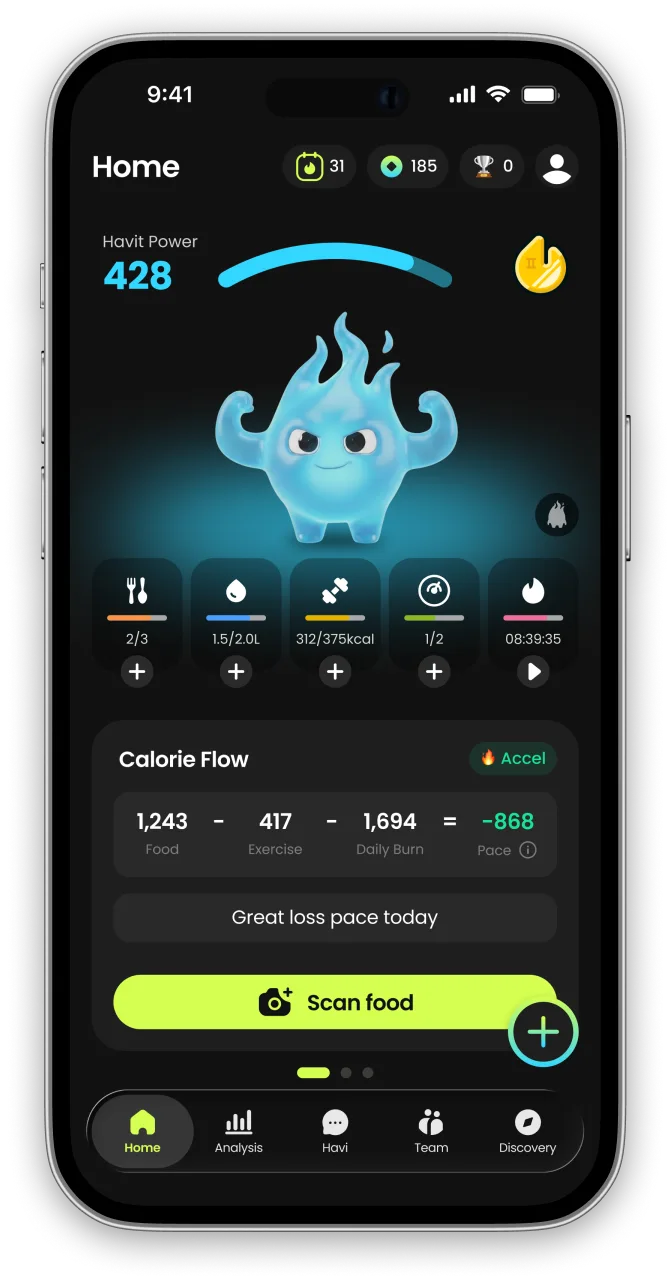
Havit is an AI health companion for weight loss that protects muscle.
Unlike calorie-only trackers, Havit connects AI body-composition estimates, nutrition, hydration, sleep, steps, cycle, mood, and GLP-1 medication in one daily routine — so progress is measured by body composition, not just the number on the scale. Daily missions turn established behavior-change techniques into small repeatable actions, drawing on expertise from professionals formerly at Juvis Diet, one of Korea’s leading metabolic clinics.
In Havit’s own analysis of 1,090 GLP-1 users, people who logged consistently built stronger habits than the general user base. Read the GLP-1 Habit Report
Havit works with or without GLP-1 medication. It is a wellness app, not a medical device; body-composition results are estimates.
Continue in the App
Personalized wellness with your own data


References
- Anxiety Redirection vs. Suppression in New Employee Performance Outcomes — Journal of Occupational Health Psychology, 2024
- The Neuroscience of First Impressions: Cortisol Correlates in Workplace Evaluation — Organizational Behavior and Human Decision Processes, 2025
- Sleep Debt and Cognitive Performance: Working Memory Implications — Stanford Sleep Medicine Center Research Review
- Physiological Sighs and Autonomic Regulation: A Controlled Study — Autonomic Nervous System Research Quarterly, 2024
- Anticipatory Stress and Mental Rehearsal: Cortisol Response Patterns — Journal of Experimental Psychology: Applied, 2024


