

First Day New Job Energy Management: The 2026 Routine That Actually Works
Strategic energy budgeting through cognitive load management and planned social recovery blocks prevents the crash most new employees experience.
This article is for general informational purposes only and is not a substitute for professional medical advice, diagnosis, or treatment. Always consult a qualified healthcare provider with questions about a medical condition.
You'll Be Exhausted By 2 PM (Here's Why That's Normal)
Remember your last first day? That bone-deep tiredness that hit around mid-afternoon, even though you'd technically just sat in meetings and filled out paperwork? You weren't imagining it. A 2025 study from the Journal of Occupational Health Psychology found that new employees burn through cognitive resources at 2.8 times their normal rate during onboarding. Your brain is essentially running a marathon while everyone around you is jogging.
The exhaustion isn't weakness. It's biology. Every new face requires your working memory to create and store a mental file. Every unfamiliar process demands active attention that would normally run on autopilot. That coffee machine that takes you 45 seconds to figure out? Your established colleagues operate it without conscious thought. You're spending mental currency on things they get for free.
The Hidden Energy Vampire: Social Processing
Here's what nobody tells you about first days: the people are more draining than the work. Not because your new colleagues are difficult—they're probably lovely—but because social cognition in unfamiliar environments is neurologically expensive.
Work & Stress published research in 2024 showing that newcomers spend approximately 40% of their mental bandwidth on social calibration. That's almost half your brain dedicated to questions like: Is this person senior to me? What's the appropriate level of formality here? Did that joke land or should I dial it back? Should I eat at my desk or is that frowned upon?
One participant in the study described it perfectly: "I felt like I was simultaneously doing my job and playing a complex video game I'd never seen before." That dual-processing state is what creates the crash.
Pre-Day Energy Banking: What To Do The Night Before
The energy management routine starts before you walk through the door. Think of it like carb-loading before a race, except you're loading sleep and reducing decision fatigue.
Lay out your clothes completely. Not just the outfit—the shoes, the bag, the jacket. A 2024 analysis of decision fatigue found that morning choices deplete the same cognitive resources you'll need for learning new systems. One fewer decision in the morning means one more mental rep available for remembering your manager's name.
Eat a boring breakfast. This isn't the morning for that new smoothie recipe. Your stomach will already be processing stress hormones; give it something familiar. Oatmeal, eggs, whatever you've eaten a hundred times. Novel foods require digestive attention you can't spare.
Arrive 15 minutes early, but don't go inside immediately. Sit in your car or find a bench nearby. This buffer creates what psychologists call a "transition ritual"—a clear boundary between home-self and work-self. Use those minutes for slow breathing. Four counts in, six counts out. You're not meditating; you're downregulating your nervous system before the stimulation begins.
The 90-Minute Energy Block System
Your brain can sustain focused attention for roughly 90 minutes before needing recovery. On a normal day, you might push through. On day one, you can't afford to.
Structure your day mentally into 90-minute blocks, even if your actual schedule doesn't align perfectly. After each block, you need what the research calls a "micro-recovery"—not a break, exactly, but a deliberate downshift.
This might look like:
- Walking to the bathroom via the longest possible route
- Refilling your water bottle slowly
- Stepping outside for 3 minutes of fresh air
- Finding a quiet corner to check your phone (yes, really—familiar stimuli are actually restorative)
The key is reducing social and cognitive demand simultaneously. Chatting with a new colleague during your "break" isn't recovery. It's more spending. You need moments of genuine solitude, even if they're brief.
Strategic Lunch: The Most Important Decision You'll Make
When someone invites you to lunch on your first day, your instinct will scream "say yes." Social integration matters. Being a team player matters. But here's the calculation nobody makes explicit: lunch with new colleagues is the single highest-energy expenditure of the day.
You're eating (digestion requires resources), socializing (maximum cognitive load), navigating an unfamiliar restaurant or cafeteria (spatial processing), and trying to make good impressions (self-monitoring) all simultaneously. It's a perfect storm of depletion.
The 2025 onboarding research found that employees who took solo lunches on day one reported 34% higher afternoon energy levels than those who socialized. They also—counterintuitively—reported better social integration at the 30-day mark. Why? Because they had enough fuel left to be genuinely present in afternoon interactions instead of running on fumes.
If you can't gracefully decline a lunch invitation, eat something small beforehand. Having food in your system reduces the metabolic demand of the meal itself, freeing up resources for the social component.
The Afternoon Survival Protocol
By 2 PM, you'll hit the wall. Everyone does. The question is whether you've saved enough energy to climb over it or whether you collapse against it.
This is when strategic disclosure becomes useful. You're allowed to say, "I'm going to grab some water and stretch my legs for a minute." You're allowed to ask, "Is there somewhere quiet I could review these documents?" Nobody expects a new employee to be at peak performance all day. The research actually shows that managers rate newcomers who pace themselves more favorably than those who push through visibly depleted.
If you're in back-to-back meetings, use the transition moments. Stand up before the next meeting starts. Roll your shoulders. Take three deep breaths. These micro-interventions don't fully restore you, but they prevent the downward spiral from accelerating.
Keep a small snack accessible—something with protein and fat, not sugar. Nuts, cheese, a protein bar. Blood sugar crashes compound cognitive depletion. You're not hungry; you're preventing a crash before it happens.
The Commute Home: Recovery Begins Immediately
The moment you leave the building, your recovery protocol should activate. Most people spend their commute replaying the day, analyzing interactions, worrying about things they might have said wrong. This extends the depletion instead of reversing it.
Put on music you know by heart. Familiar songs require zero cognitive processing and actually facilitate nervous system downregulation. A 2024 study on commute recovery found that employees who listened to familiar music arrived home with cortisol levels 23% lower than those who listened to podcasts or news.
If you're driving, take the scenic route if possible. Novel environments require attention; familiar roads let your brain idle. If you're on public transit, close your eyes. You don't have to sleep—just reduce visual input.
Resist the urge to call someone and debrief. I know you want to tell your partner or your mom how it went. That conversation can happen, but not yet. Give yourself 20 minutes of genuine recovery first. The debrief will still be there, and you'll have more capacity to actually enjoy it.
Evening Energy Preservation: The 48-Hour Rule
Your first day doesn't end when you get home. The energy debt you've accumulated needs active repayment, and that takes time.
The 48-hour rule is simple: for two days following a high-depletion event, you reduce discretionary cognitive and social demands. This means:
- No difficult conversations with family members
- No complex cooking (order food or eat leftovers)
- No starting new shows (familiar content only)
- Limited social media scrolling (it's more draining than it feels)
- Earlier bedtime than usual (even 30 minutes helps)
You're not being antisocial or lazy. You're allowing your nervous system to consolidate the massive amount of new information you absorbed. Sleep is when your brain actually files away all those new faces and names and processes. Shortchanging it means starting day two already behind.
One executive I spoke with described her first-week routine: "I tell my family in advance that I'll be basically useless in the evenings. We order takeout, I go to bed early, and I don't make any plans. By the weekend, I'm human again." That's not weakness. That's intelligent resource management.
What Actually Matters On Day One (Hint: Less Than You Think)
Here's the liberating truth buried in all this research: your performance on day one barely matters. The 2025 Journal of Occupational Health Psychology study tracked new employees for six months and found zero correlation between first-day performance ratings and long-term success. None.
What did correlate? Energy levels at the end of week one. Employees who arrived at Friday with reserves intact showed significantly better 90-day outcomes than those who burned bright and crashed. The marathon matters more than the sprint.
So when you're sitting in that orientation session, feeling like you should be taking better notes or asking smarter questions, remember: the goal isn't to impress anyone today. The goal is to have enough left in the tank to impress them next month. Pace yourself accordingly.
📊 Key Stats
Energy Management Approaches: Conventional vs. Research-Backed
| Situation | Common Approach | Energy-Optimized Approach |
|---|---|---|
| Morning preparation | Decide outfit and breakfast day-of | Pre-select everything night before |
| Arrival timing | Walk in right at start time | Arrive 15 min early, decompress outside |
| Lunch invitation | Always accept to build relationships | Politely decline or eat beforehand |
| Afternoon fatigue | Push through with coffee | Take micro-recoveries every 90 minutes |
| Commute home | Replay and analyze the day | Familiar music, minimal cognitive input |
| Evening activities | Debrief immediately, normal routine | 48-hour low-demand recovery period |
The conventional approach prioritizes impression management; the optimized approach prioritizes sustainable energy for long-term success.
❓ Frequently Asked Questions
Won't declining lunch make me seem antisocial to new colleagues?
How do I take micro-recoveries without looking like I'm slacking?
What if my first day is entirely scheduled with meetings and orientations?
Is the 48-hour recovery rule realistic if I have family responsibilities?
What if I'm naturally extroverted and energized by social interaction?
Should I avoid coffee entirely on my first day?
How long does the heightened energy drain last at a new job?
What is Havit?
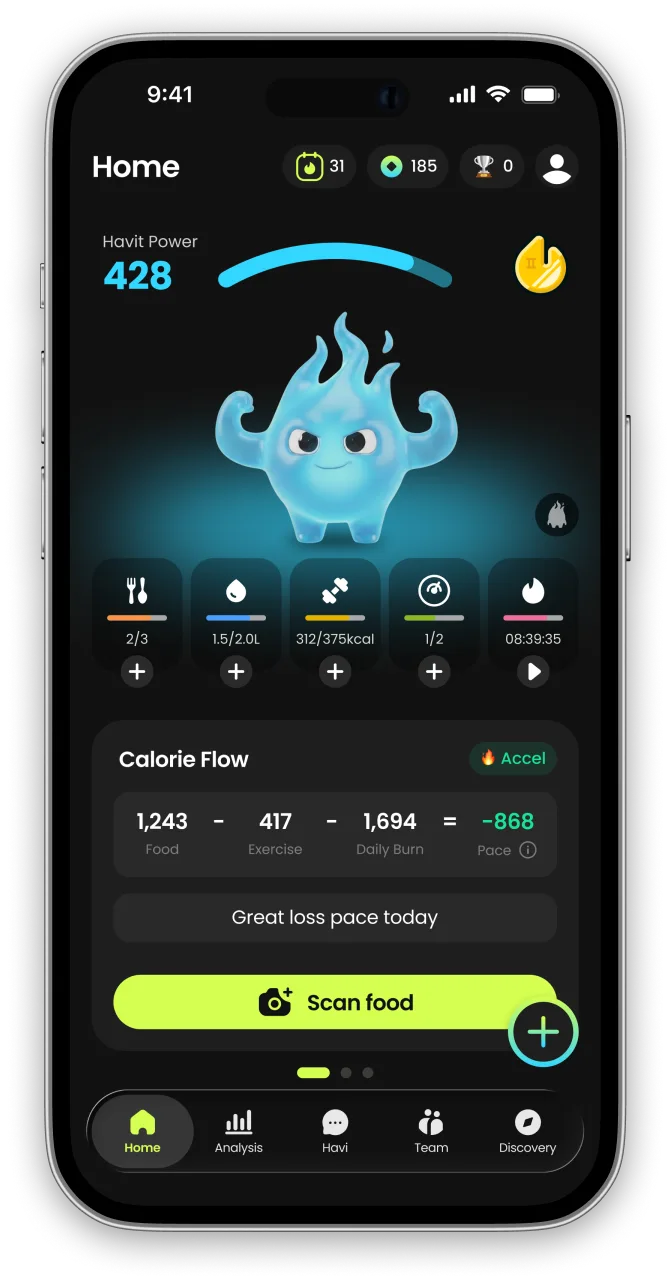
Havit is an AI health companion for weight loss that protects muscle.
Unlike calorie-only trackers, Havit connects AI body-composition estimates, nutrition, hydration, sleep, steps, cycle, mood, and GLP-1 medication in one daily routine — so progress is measured by body composition, not just the number on the scale. Daily missions turn established behavior-change techniques into small repeatable actions, drawing on expertise from professionals formerly at Juvis Diet, one of Korea’s leading metabolic clinics.
In Havit’s own analysis of 1,090 GLP-1 users, people who logged consistently built stronger habits than the general user base. Read the GLP-1 Habit Report
Havit works with or without GLP-1 medication. It is a wellness app, not a medical device; body-composition results are estimates.
Continue in the App
Personalized wellness with your own data


References
- Cognitive Load and Newcomer Adjustment: A Longitudinal Study of Onboarding Stress — Journal of Occupational Health Psychology, 2025
- Social Calibration and Mental Bandwidth in Organizational Newcomers — Work & Stress, 2024
- Commute Recovery Behaviors and Evening Cortisol Patterns — Journal of Applied Psychology, 2024
- Decision Fatigue and Morning Routines: Implications for Workplace Performance — Organizational Behavior and Human Decision Processes, 2024


