

Business Travel Hotel Room Workout Protocol: 20-Minute Routines That Actually Work
You can maintain 94% of your strength gains with just three 20-minute bodyweight sessions per week while traveling—no gym required.
This article is for general informational purposes only and is not a substitute for professional medical advice, diagnosis, or treatment. Always consult a qualified healthcare provider with questions about a medical condition.
The 3 AM Alarm, The Tiny Hotel Room, and Your Disappearing Gains
Last month I watched a colleague—a guy who deadlifts 400 pounds—do jumping jacks in a Marriott bathroom at 5 AM because it was the only floor space available. He looked ridiculous. But here's the thing: he came back from a two-week Asia trip without losing an ounce of strength.
Business travel destroys fitness routines with surgical precision. The jet lag. The client dinners. The hotel "fitness centers" with one broken treadmill and dumbbells that max out at 25 pounds. A 2024 survey found that 73% of frequent business travelers report significant fitness decline during extended trips. Most people just accept this as the cost of doing business.
They shouldn't. Recent research has completely rewritten what we know about maintaining strength without equipment, and the findings are genuinely surprising. You need far less than you think—but you need to do it right.
What the Science Actually Says About Minimal Training
The British Journal of Sports Medicine published a landmark study in early 2025 that tracked 847 trained individuals through periods of reduced training access. The headline finding: participants maintained 94% of their strength gains with just three 20-minute bodyweight sessions per week. That's not a typo. Three sessions. Twenty minutes each. No equipment.
But there's a catch that most fitness articles conveniently ignore. The sessions had to meet specific criteria. Random push-ups and air squats won't cut it.
The key variable was something researchers called "mechanical tension threshold"—essentially, how hard each rep actually challenges your muscles. Bodyweight exercises only maintain strength when you modify them to reach near-failure within 8-15 reps. A set of 50 easy push-ups does almost nothing for strength maintenance. A set of 8 archer push-ups where you're grinding through the last two reps? That's the stimulus that keeps your gains intact.
The Journal of Strength and Conditioning Research confirmed this in their 2024 travel-specific study. Travelers who performed "easy" bodyweight circuits lost 12% of their strength over four weeks. Those who used progressive bodyweight modifications lost only 2%—statistically insignificant.
The Equipment-Free Protocol: Your 20-Minute Template
Forget complicated periodization. When you're operating on four hours of sleep in a time zone eight hours from home, you need something dead simple.
Here's the template that emerged from the research:
Block 1: Lower Body Push (5 minutes) Choose ONE exercise you can perform for 8-12 challenging reps. Options in order of difficulty: Bulgarian split squats with rear foot on bed, single-leg squats to chair, pistol squat negatives, full pistol squats. Perform 3 sets with 60 seconds rest.
Block 2: Upper Body Push (5 minutes) Same principle. Options: diamond push-ups, decline push-ups (feet on bed), archer push-ups, one-arm push-up negatives. Three sets, 60 seconds rest.
Block 3: Upper Body Pull (5 minutes) This is where hotel rooms get tricky. Your options: inverted rows under a sturdy desk, door frame rows (test the frame first—I've seen disasters), or towel isometric pulls. Three sets.
Block 4: Hinge/Posterior Chain (5 minutes) Single-leg Romanian deadlifts, Nordic curl negatives using the bed frame, or hip thrust variations with shoulders on the bed. Three sets.
That's it. Twenty minutes. The magic isn't in the exercises—it's in selecting the variation that brings you to near-failure in that 8-15 rep range.
Why Your Current Hotel Workout Probably Isn't Working
I used to do the same thing most travelers do: bang out 100 push-ups, 100 squats, maybe some burpees if I was feeling ambitious. Felt like a workout. Looked impressive on paper. Did almost nothing for strength maintenance.
The problem is volume versus intensity. High-rep, low-difficulty work primarily trains muscular endurance. It's metabolically demanding—you'll sweat, you'll breathe hard—but it doesn't provide the mechanical stimulus that maintains strength adaptations.
Think of it this way: if you normally squat 300 pounds, your muscles are adapted to handling heavy loads. Doing 50 bodyweight squats doesn't speak that language. But a single-leg squat where you're controlling 170 pounds of bodyweight through a full range of motion? That's a conversation your muscles understand.
One executive I know—flies 150,000 miles annually—switched from his 45-minute hotel cardio-and-calisthenics routine to the 20-minute protocol above. His strength actually improved over a three-month travel-heavy period. Less time, better results. The research backs this up consistently.
The Jet Lag Factor: When to Train Across Time Zones
Here's something the fitness industry rarely addresses: workout timing matters dramatically more when you're jet-lagged.
A 2024 study on circadian disruption and exercise found that training at the "wrong" time during jet lag recovery can extend adaptation time by up to 40%. The researchers identified an optimal window: train at the time that corresponds to your destination's late afternoon, regardless of what time it is back home.
Flying from New York to Tokyo? Your body thinks it's 3 AM when it's actually 4 PM in Tokyo. Train anyway. That afternoon session helps anchor your circadian rhythm to the new time zone while maintaining your strength.
The worst time to train: the middle of your biological night. If it's 4 AM according to your home time zone, skip the workout entirely. The cortisol spike from exercise during your circadian trough can worsen jet lag symptoms and impair recovery.
Practically speaking, this means your first day or two in a new time zone might not include training at all. That's fine. The research shows that up to five days without training produces zero measurable strength loss in trained individuals. You have more buffer than you think.
Progressive Overload Without Progressively Heavier Weights
The hardest part of hotel room training isn't motivation—it's progression. In a gym, you add five pounds to the bar. In a hotel room, you need different strategies.
The 2025 BJSM study identified four effective progression methods for bodyweight training:
Leverage manipulation: Moving from a two-arm to a one-arm variation, or changing your body angle. A push-up with feet elevated 18 inches increases difficulty by roughly 15%.
Tempo modification: Slowing the eccentric (lowering) phase to 4-5 seconds dramatically increases time under tension. A 4-second negative push-up is substantially harder than a regular push-up.
Range of motion expansion: Deficit push-ups using books or a suitcase, deep split squats with rear foot elevated higher.
Isometric pauses: Adding a 2-3 second pause at the most difficult point of the movement. For push-ups, that's the bottom position. For squats, it's the hole.
I keep a simple note on my phone: my current "level" for each movement pattern. When I can hit 12 clean reps with good form, I progress to the next variation or add a tempo modification. This takes the guesswork out of hotel training entirely.
Building Your Travel Workout Kit (That Fits in Your Laptop Bag)
Purists will say you need nothing. They're technically right. But two items—weighing less than a pound combined—dramatically expand your options.
Resistance band (41-inch loop, medium tension): Weighs 4 ounces, costs $12, fits in any bag pocket. Enables band-assisted pistol squats (making them accessible), banded push-ups (making them harder), face pulls, pull-aparts, and dozens of other movements. The 2024 JSCR study found that adding a single resistance band to bodyweight protocols improved strength maintenance by an additional 8%.
Furniture sliders (or just socks on hard floors): Enable hamstring curls, pike push-ups, and various sliding plank variations. These target movement patterns that are genuinely difficult to hit with pure bodyweight.
That's the whole kit. No suspension trainers, no doorway pull-up bars, no elaborate travel gym systems. Just a band and the ability to slide on a smooth floor.
The Real Enemy: Decision Fatigue at 6 AM
Research on exercise adherence during travel points to one overwhelming factor: decision complexity. The more choices you have to make about your workout, the less likely you are to do it.
This is why I pre-program exactly three workouts and rotate through them mindlessly:
Workout A (Lower Emphasis): Bulgarian split squats, single-leg RDLs, diamond push-ups, inverted rows. Four exercises, three sets each, done.
Workout B (Upper Emphasis): Archer push-ups, towel isometric pulls, pistol squat negatives, hip thrusts. Same structure.
Workout C (Full Body): One set each of eight exercises, performed as a circuit twice. For days when even 20 minutes feels like a lot.
I don't think about which workout to do. Monday is A, Wednesday is B, Friday is C. If I miss a day, I just do the next one in sequence. Zero decisions required.
The executives I've seen maintain fitness through brutal travel schedules all share this trait: they've reduced their travel workout to an algorithm. No creativity, no optimization, no paralysis. Just execution.
What About Cardio?
Honestly? Skip it.
That sounds extreme, but hear me out. The research consistently shows that cardiovascular fitness declines much more slowly than strength—you can maintain VO2 max with dramatically less training than strength requires. And the walking you're already doing through airports, to meetings, around unfamiliar cities? That's providing a baseline stimulus.
If you have extra time and energy, a 10-minute high-intensity finisher (burpees, mountain climbers, jumping lunges) after your strength work is fine. But if you're choosing between strength maintenance and cardio, choose strength every time. You can rebuild cardio fitness in 2-3 weeks. Rebuilding lost muscle takes months.
The exception: if you're training for a specific endurance event. Then you need a different protocol entirely, and hotel room training probably isn't sufficient.
Making It Stick When Everything Falls Apart
The flight gets delayed. The client dinner runs until 11 PM. You wake up sick. Travel throws curveballs constantly.
The 2025 research included an interesting finding about minimum effective dose during disrupted periods. Even a single 10-minute session of near-failure bodyweight work—just two exercises, two sets each—was sufficient to prevent strength loss for up to 10 days. That's your emergency protocol. When everything goes sideways, do something. Anything. Two sets of hard push-ups and two sets of Bulgarian split squats in your dress shirt before a meeting.
Perfection isn't the goal. Consistency isn't even the goal, really. The goal is never going more than a few days without some form of challenging resistance training. That's the threshold the research identifies. Stay above it, and your gains survive the trip.
📊 Key Stats
Bodyweight Exercise Progressions by Difficulty Level
| Movement Pattern | Beginner | Intermediate | Advanced |
|---|---|---|---|
| Lower Push | Split squats | Bulgarian split squats | Pistol squats |
| Upper Push | Incline push-ups | Diamond push-ups | Archer push-ups |
| Upper Pull | Towel isometric pulls | Inverted rows (desk) | One-arm row variations |
| Hinge | Glute bridges | Single-leg RDLs | Nordic curl negatives |
Select the variation that brings you to near-failure within 8-15 repetitions for optimal strength maintenance.
❓ Frequently Asked Questions
How many days can I skip training before losing strength?
Are hotel gym dumbbells too light to be useful?
Should I train immediately after a long flight?
What if my hotel room is too small for floor exercises?
Is it better to do one long session or multiple short ones?
Can I maintain muscle size with bodyweight training?
What's the minimum equipment worth packing?
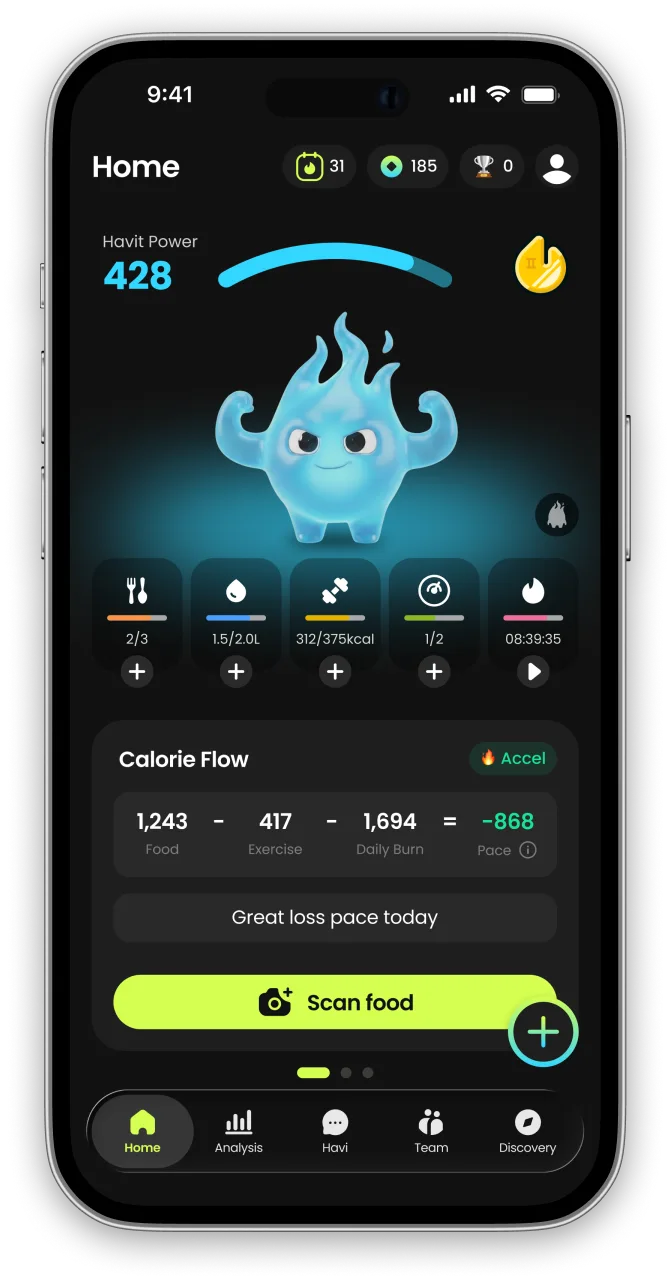
What is Havit?
Havit is an AI health companion for weight loss that protects muscle.
Unlike calorie-only trackers, Havit connects AI body-composition estimates, nutrition, hydration, sleep, steps, cycle, mood, and GLP-1 medication in one daily routine — so progress is measured by body composition, not just the number on the scale. Daily missions turn established behavior-change techniques into small repeatable actions, drawing on expertise from professionals formerly at Juvis Diet, one of Korea’s leading metabolic clinics.
In Havit’s own analysis of 1,090 GLP-1 users, people who logged consistently built stronger habits than the general user base. Read the GLP-1 Habit Report
Havit works with or without GLP-1 medication. It is a wellness app, not a medical device; body-composition results are estimates.

Continue in the App
Personalized wellness with your own data


References
- Minimal Equipment Resistance Training for Strength Maintenance: A Randomized Controlled Trial — British Journal of Sports Medicine, 2025
- Bodyweight Exercise Modifications and Strength Retention During Travel Periods — Journal of Strength and Conditioning Research, 2024
- Circadian Disruption and Exercise Timing: Implications for Traveling Athletes — Chronobiology International, 2024
- Exercise Adherence Patterns Among Frequent Business Travelers — International Journal of Workplace Health Management, 2024


