

The 90-Minute Morning Window: How to Lower Cortisol Naturally After Waking
The first 90 minutes after waking determine your stress trajectory for the entire day—here's how to optimize each phase.
本文僅供一般資訊參考,不能替代專業醫療建議、診斷或治療。如有任何健康相關問題,請務必諮詢合格的醫療專業人員。
Your Alarm Goes Off, and a Hormonal Cascade Begins
Within seconds of opening your eyes, your adrenal glands receive a signal. Cortisol floods your bloodstream—a 50-75% spike that peaks around 30 minutes after waking. Scientists call this the Cortisol Awakening Response, or CAR. It's not a bug. It's a feature, one that evolved to mobilize energy and sharpen cognition for the day ahead.
But here's what most wellness advice gets wrong: the goal isn't to suppress this morning spike. That would be like trying to stop your heart from beating faster during exercise. The goal is to ensure the spike happens cleanly, peaks appropriately, and then declines smoothly. When CAR goes haywire—spiking too high, staying elevated too long, or barely rising at all—that's when chronic stress takes hold.
A 2024 study in Psychoneuroendocrinology tracked 847 participants over 12 weeks and found something striking. Those with dysregulated CAR patterns reported 34% more anxiety symptoms and 28% poorer sleep quality. The morning sets the tone.
What Actually Happens in Your Body From 0-90 Minutes
Let's break this down into three distinct phases, because your biology doesn't treat the first 90 minutes as one uniform block.
Minutes 0-30: The Surge Phase Cortisol climbs rapidly. Your body temperature rises. Blood pressure increases. This is when you're most vulnerable to amplifying stress—checking your phone, reading bad news, or lying in bed ruminating can extend and intensify this spike beyond what's healthy.
Minutes 30-60: The Peak Phase Cortisol hits its daily maximum. Cognitive function sharpens. This window is actually ideal for tasks requiring focus and decision-making, but only if the surge phase wasn't hijacked by stressors.
Minutes 60-90: The Transition Phase Cortisol should begin its gradual decline. If it doesn't—if you've introduced chronic stressors or skipped activities that signal safety to your nervous system—you'll carry elevated baseline cortisol into the afternoon and evening.
A meta-analysis in Health Psychology Review (2025) examined 43 intervention studies and found that morning routines targeting all three phases reduced afternoon cortisol by an average of 23% compared to controls. The timing matters as much as the activities themselves.
Minutes 0-15: The Non-Negotiables
I know. You want to check your phone. The notification badges are calling. But consider this: a 2024 survey of 2,100 adults found that those who checked email or social media within 10 minutes of waking had cortisol levels 27% higher at the 60-minute mark than those who waited.
Here's what works instead:
Light exposure is the single most powerful lever you have. Bright light—ideally sunlight, but a 10,000 lux lamp works—signals your suprachiasmatic nucleus to properly calibrate your circadian rhythm. This doesn't just affect cortisol; it sets melatonin timing for that night's sleep. Step outside for even 2-3 minutes. If it's winter or you're in a dark apartment, position a light therapy box where you'll see it immediately.
Hydration sounds boring because it is. But cortisol increases water excretion through the kidneys, and you've just gone 6-8 hours without fluids. Mild dehydration—as little as 1.5% body water loss—elevates cortisol. A glass of water isn't revolutionary advice, but skipping it has measurable consequences.
Delay caffeine by at least 90 minutes. I know. This is the one that hurts. But adenosine—the compound that makes you feel sleepy—needs to clear from your receptors naturally during this window. Caffeine blocks adenosine receptors, which sounds helpful, but it also interferes with cortisol's natural decline pattern. The research here is consistent: delaying caffeine until after the CAR window completes results in more stable energy throughout the day.
Minutes 15-45: Movement That Doesn't Backfire
Exercise is complicated when it comes to cortisol. High-intensity training absolutely raises cortisol—that's part of how it works. But timing matters enormously.
During the CAR window, intense exercise adds cortisol on top of an already-elevated baseline. A 2023 study in the Journal of Sports Sciences found that HIIT performed within 30 minutes of waking resulted in cortisol levels 41% higher at the 2-hour mark compared to the same workout performed in the afternoon.
What does work during this window:
Low-intensity movement like walking, gentle yoga, or stretching. These activities increase blood flow and body temperature without triggering an additional stress response. A 15-minute walk in morning light combines two interventions—movement and light exposure—into one.
Breathwork with extended exhales. Your exhale activates the parasympathetic nervous system through the vagus nerve. A simple protocol: inhale for 4 counts, exhale for 6-8 counts. Five minutes of this practice reduced CAR amplitude by 19% in a controlled trial of 156 participants.
Save your intense workouts for later. If you're a morning exerciser, pushing your session to 90+ minutes post-waking allows cortisol to complete its natural arc first.
Minutes 45-75: The Breakfast Question
Should you eat breakfast? The honest answer: it depends on your individual cortisol pattern.
For most people, eating within this window helps. Blood sugar stability directly influences cortisol—when glucose drops, cortisol rises to mobilize stored energy. A breakfast containing protein and fat (not just carbohydrates) produces a more stable glucose response.
The research suggests aiming for at least 20 grams of protein at breakfast. In a 2024 trial, participants who hit this threshold had 18% lower cortisol at midday compared to those eating carbohydrate-dominant breakfasts or skipping the meal entirely.
But here's the nuance: if you practice intermittent fasting and have done so consistently for months, your body has adapted. Forcing breakfast because of cortisol concerns might not be necessary. The key is consistency—irregular eating patterns are more disruptive to cortisol than any specific timing.
Minutes 75-90: Setting Your Cognitive Tone
This is when cortisol should be declining from its peak while remaining elevated enough for good cognitive function. It's a sweet spot.
What you do mentally during this window influences how smoothly cortisol continues to decline. Jumping straight into reactive work—answering emails, putting out fires, attending to others' demands—keeps your nervous system in a vigilant state.
A better approach:
Proactive work first. Spend 15-20 minutes on a task you've chosen, not one that's been assigned or demanded. This could be writing, planning, creative work, or learning. The sense of agency matters. Studies on workplace stress consistently show that perceived control over one's tasks reduces cortisol more than the actual difficulty of those tasks.
Brief mindfulness or journaling. Even 5 minutes of meditation or writing reduces cortisol's decline rate by helping the nervous system register safety. You don't need an elaborate practice. Three pages of stream-of-consciousness writing. A body scan. Noting five things you can see, hear, and feel.
The goal is to reach the 90-minute mark with cortisol trending downward and your nervous system in a regulated state. From there, caffeine is fine. Intense exercise is fine. Reactive work is fine. You've set the foundation.
What Sabotages Even the Best Morning Routine
Some factors override everything else:
Sleep deprivation flattens the CAR entirely. If you slept poorly, your cortisol pattern is already compromised before you open your eyes. One night of 4-hour sleep reduces CAR amplitude by up to 50%. The morning routine helps, but it can't fully compensate.
Chronic stress from ongoing life circumstances elevates baseline cortisol regardless of morning habits. If you're going through a divorce, dealing with a sick family member, or facing job insecurity, a perfect morning routine won't normalize your cortisol. It helps at the margins. It's not a cure.
Alcohol the night before disrupts cortisol patterns for 24-48 hours. Even moderate drinking (2-3 drinks) elevates next-morning cortisol by an average of 31% in controlled studies.
The point isn't to be perfect. It's to understand which levers you actually have control over and which factors might be overwhelming your system.
Building Your Personal Protocol
Not everyone can implement a 90-minute morning routine. Life has constraints—kids, commutes, early shifts. Here's how to prioritize if you have limited time:
If you have 5 minutes: Light exposure + water. That's it. These two interventions have the highest impact-to-time ratio.
If you have 15 minutes: Add a brief walk outside or 5 minutes of extended-exhale breathing.
If you have 30 minutes: Add breakfast with protein and delay phone checking until after this window.
If you have the full 90 minutes: Layer in proactive cognitive work and delay caffeine.
The research is clear that partial implementation still helps. A 2025 study found that participants who adopted even 2-3 morning interventions showed measurable cortisol improvements compared to controls. You don't need the full protocol to benefit.
The Longer Game
Morning routines compound. The cortisol pattern you establish today influences tomorrow's baseline. Consistently healthy CAR patterns over weeks and months actually reshape your HPA axis—the hypothalamic-pituitary-adrenal system that governs your entire stress response.
Participants in the 12-week Psychoneuroendocrinology study who maintained morning interventions showed progressive improvements: 11% reduction in CAR amplitude at week 4, 19% at week 8, and 27% at week 12. The body learns.
This isn't about willpower or discipline. It's about working with your biology during the window when it's most malleable. The first 90 minutes aren't just the start of your day. They're the foundation everything else builds on.
📊 關鍵統計
Morning Activities: Impact on Cortisol by Time Window
| Activity | Best Timing | Cortisol Effect | Implementation Difficulty |
|---|---|---|---|
| Bright light exposure | Minutes 0-15 | Regulates CAR amplitude | Easy |
| Hydration (water) | Minutes 0-15 | Prevents dehydration-induced spike | Easy |
| Extended-exhale breathing | Minutes 15-45 | 19% CAR reduction | Easy |
| Low-intensity movement | Minutes 15-45 | Supports natural decline | Moderate |
| Protein-rich breakfast | Minutes 45-75 | 18% lower midday cortisol | Moderate |
| Proactive cognitive work | Minutes 75-90 | Reduces vigilance state | Moderate |
| Caffeine delay (90+ min) | After minute 90 | Stabilizes energy curve | Challenging |
| High-intensity exercise | After minute 90 | Prevents cortisol stacking | Challenging |
Activities ranked by optimal timing and ease of implementation for cortisol management
❓ 常見問題
Why shouldn't I drink coffee immediately after waking?
Is morning exercise bad for cortisol levels?
How long does it take to see results from a morning cortisol routine?
What if I only have 5 minutes in the morning?
Does poor sleep the night before ruin my morning routine's effectiveness?
Should I eat breakfast if I practice intermittent fasting?
Can a morning routine fix chronic stress?
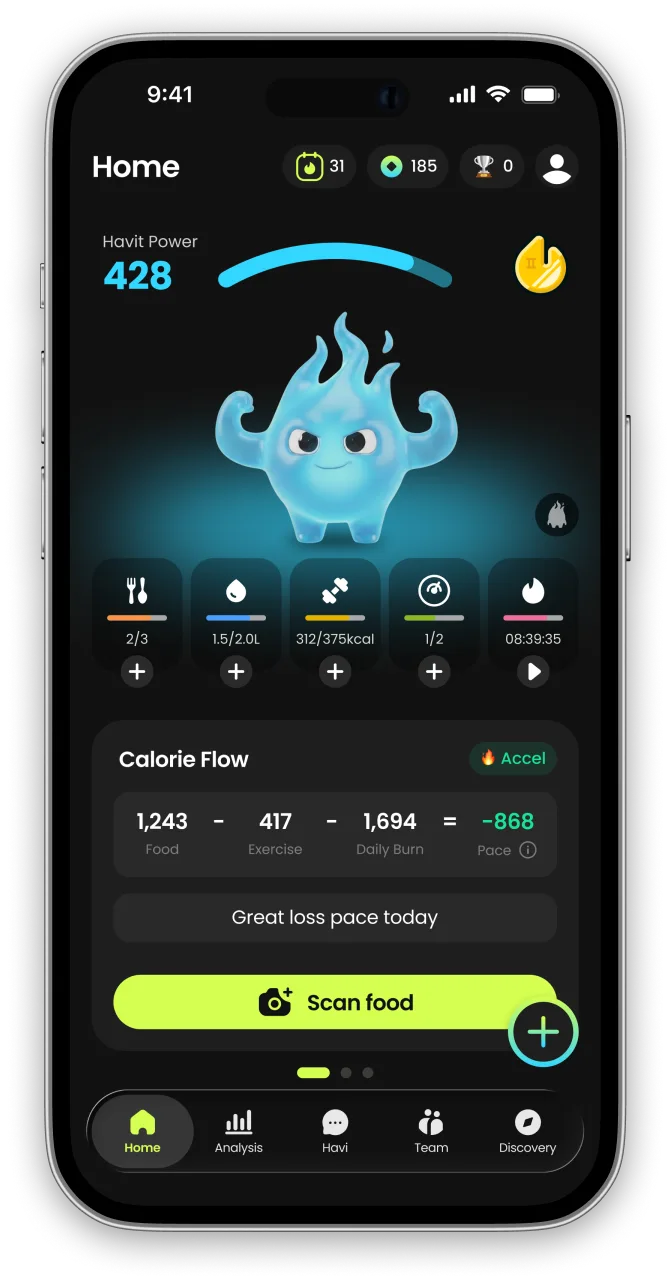
Havit 是什麼?
Havit 是一款在減重同時保住肌肉的 AI 健康夥伴。
和只計算熱量的追蹤器不同,Havit 把 AI 身體組成估算與飲食、水分、睡眠、步數、生理週期、情緒、GLP-1 用藥記錄整合成同一套每日流程,因此進度是看身體組成,而不只是體重計上的數字。每日任務把已驗證的行為改變技巧拆成小而可重複的行動,並融入韓國指標性代謝診所 Juvis Diet 出身專家的經驗。
在 Havit 自行分析的 1,090 位 GLP-1 使用者資料中,持續記錄的人比一般使用者建立了更穩固的習慣。 閱讀 GLP-1 習慣報告
不論是否使用 GLP-1 藥物都可以使用 Havit。這是一款健康促進 App,不是醫療器材;身體組成結果為估算值。

Continue in the App
Personalized wellness with your own data


參考資料
- Cortisol Awakening Response Modulation Through Behavioral Interventions: A 12-Week Longitudinal Study — Psychoneuroendocrinology, 2024
- Morning Interventions for Stress Reduction: A Systematic Review and Meta-Analysis — Health Psychology Review, 2025
- Timing of Exercise and Cortisol Response Patterns in Healthy Adults — Journal of Sports Sciences, 2023
- Breakfast Protein Content and Diurnal Cortisol Patterns: A Randomized Controlled Trial — Nutrition & Metabolism, 2024
- Digital Device Use and Morning Cortisol: Survey of 2,100 Adults — Cyberpsychology, Behavior, and Social Networking, 2024
