

Your Fitness Tracker Thinks You Burned 847 Calories. You Actually Burned 612.
Wearables systematically overestimate energy expenditure, with errors ranging from 28% during walking to 93% during strength training—but simple correction factors can help.
This article is for general informational purposes only and is not a substitute for professional medical advice, diagnosis, or treatment. Always consult a qualified healthcare provider with questions about a medical condition.
The Number on Your Wrist Is Lying to You
I finished a 45-minute cycling session last Tuesday. My smartwatch congratulated me: 523 calories burned. Felt good. Then I remembered the Stanford study sitting in my browser tabs—the one showing optical heart rate sensors overestimate cycling expenditure by an average of 52%. My actual burn? Probably closer to 344 calories.
This isn't a minor calibration issue. A 2025 validation study published in Medicine & Science in Sports & Exercise tested seven popular wearables against indirect calorimetry (the gold standard, measuring actual oxygen consumption) and found systematic overestimation across every device tested. Every. Single. One.
The gap between what your tracker reports and what your body actually burns has real consequences. People make food decisions based on these numbers. They calculate deficits. They wonder why the math isn't mathing.
Why Wearables Get It Wrong: The Physics Problem
Here's something most fitness companies won't advertise: estimating calorie burn from wrist movement and heart rate is genuinely hard. Like, PhD-dissertation hard.
Your watch uses algorithms that predict energy expenditure based on a few inputs: heart rate, motion patterns, and maybe your age, weight, and sex. But these algorithms were typically validated on treadmill walking in laboratory conditions. Real life looks nothing like that.
The fundamental issue is that heart rate correlates with energy expenditure... loosely. Your heart rate spikes when you're nervous, caffeinated, dehydrated, or watching a horror movie. None of those burn significant calories. Meanwhile, strength training can burn substantial energy while barely elevating heart rate during rest periods.
A 2024 analysis in the Journal of Personalized Medicine examined 23 validation studies and identified three primary error sources. Motion artifacts from arm movement during activities like cycling create false accelerometer readings. The optical sensors struggle with darker skin tones and tattooed wrists. And the population-level equations simply don't account for individual metabolic variation, which can swing 15% in either direction.
The Activity-Specific Error Rates
Not all activities fool your tracker equally. The pattern is consistent across studies: the further an activity deviates from steady-state walking or running, the worse the estimate.
Walking produces the smallest errors—typically 20-28% overestimation. The algorithms were built for this. Running shows similar patterns, with overestimation around 25-35% depending on pace and terrain.
Cycling is where things get weird. Because your wrist stays relatively still on handlebars, accelerometer data becomes nearly useless. The device relies almost entirely on heart rate, which is influenced by factors like cycling position, wind resistance, and whether you're grinding uphill or coasting. Studies show 40-52% overestimation for cycling.
Strength training represents the worst-case scenario. A 2025 study had participants perform standardized resistance circuits while wearing five different devices. Average overestimation: 93%. One device reported 412 calories for a session that actually burned 214. The problem is structural—heart rate during lifting reflects cardiovascular strain from holding your breath and tensing muscles, not aerobic energy expenditure.
High-intensity interval training falls somewhere in the middle, with 35-50% overestimation. The rapid transitions between effort and rest confuse algorithms expecting steady-state patterns.
Individual Variation Makes It Worse
The population averages are concerning enough. But the individual variation is what really undermines trust in these numbers.
That Medicine & Science in Sports & Exercise validation study included 147 participants across different ages, body compositions, and fitness levels. For the same 30-minute treadmill protocol, individual device errors ranged from -12% (rare underestimation) to +67% overestimation. Same device. Same activity. Wildly different accuracy depending on who was wearing it.
Fitness level plays a significant role. Trained athletes tend to see larger overestimations because their cardiovascular systems are more efficient—they burn fewer calories at any given heart rate than the average person the algorithms assume. One study found former collegiate athletes experienced 41% higher error rates than sedentary participants.
Body composition matters too. The equations assume average body fat percentages. If you carry more muscle mass than average, you'll burn more calories than predicted (rare underestimation). More fat mass than average? Your actual burn falls below the estimate.
Evidence-Based Correction Factors
Researchers have started publishing correction factors that can bring wearable estimates closer to reality. These aren't perfect, but they're better than taking the raw numbers at face value.
For walking and running, multiply your device's calorie estimate by 0.75-0.80. A reported 400-calorie run becomes 300-320 actual calories. This correction held across multiple device brands in the 2024 Journal of Personalized Medicine analysis.
For cycling, multiply by 0.65-0.70. That 500-calorie ride? Probably 325-350.
For strength training, the correction is more aggressive: multiply by 0.50-0.55. Your watch says 300 calories? Expect 150-165.
For HIIT and mixed activities, use 0.60-0.70.
These factors come from comparing wearable estimates to indirect calorimetry across multiple studies. They're population averages, so individual results will vary. But they'll get you closer than the raw numbers.
What Actually Works Better
If accuracy matters to you—and for weight management, it probably should—there are alternatives to blind faith in wrist-based estimates.
Chest strap heart rate monitors improve accuracy by about 15-20% compared to optical wrist sensors. They're less convenient, but the electrode contact provides cleaner heart rate data with fewer motion artifacts.
Power meters for cycling measure actual mechanical work output. A 200-watt average over 45 minutes represents roughly 540 kilojoules of mechanical work, which translates to approximately 650-700 calories of metabolic expenditure (accounting for efficiency losses). This is far more accurate than heart rate-based estimates.
For strength training, time-based estimates may actually outperform wearables. Research suggests a rough estimate of 4-6 calories per minute for moderate-intensity resistance training, adjusted for body weight. A 150-pound person doing 40 minutes of lifting burns approximately 160-240 calories. Not precise, but more realistic than the inflated wearable numbers.
The most accurate approach remains indirect calorimetry, but that requires laboratory equipment costing tens of thousands of dollars. Some research universities and sports performance centers offer metabolic testing for $100-300, which can establish your personal baseline.
The Trend Data Argument
Wearable manufacturers often counter accuracy criticisms by emphasizing relative consistency. Your watch might overestimate by 30%, but if it overestimates by roughly the same amount every time, you can still track trends.
This argument has merit. If your Tuesday run reports 450 calories and your Thursday run reports 480 calories, the Thursday run probably was more demanding—even if both numbers are inflated. For tracking fitness progress over weeks and months, consistent overestimation matters less than random error.
But the argument breaks down when you use these numbers for nutrition decisions. A 30% overestimation on a reported 2,400 daily active calorie burn means you're actually burning 1,680 active calories. If you're eating back your "exercise calories," that's a 720-calorie daily surplus. Over a week, that's a pound of fat gain instead of the maintenance you expected.
The trend argument also assumes consistent error rates across activities. But if you do more cycling one week and more running the next, the error profile shifts. The "consistent" overestimation becomes inconsistent.
Where the Technology Is Heading
The next generation of wearables may address some of these limitations. Several companies are developing multi-sensor approaches that combine optical heart rate with skin temperature, galvanic skin response, and blood oxygen saturation. The theory is that multiple physiological signals can disambiguate true metabolic demand from confounding factors.
Machine learning models trained on larger, more diverse datasets show promise in early research. A 2025 pilot study using personalized algorithms—trained on an individual's own metabolic testing data—reduced estimation error to 12-15% across activities. The catch: it required an initial calibration session with laboratory equipment.
Some researchers are exploring continuous glucose monitoring as a proxy for energy expenditure. Glucose utilization correlates with metabolic rate, and CGM technology has become increasingly accurate. Early studies show potential, though the relationship is complex enough that we're likely years from consumer applications.
For now, the honest answer is that wrist-based calorie estimation has fundamental limitations that better algorithms can only partially address.
Making Peace With Imperfect Data
I still wear my fitness tracker. The step counts are reasonably accurate. The heart rate trends help me notice when I'm overtraining or getting sick. The sleep staging is... well, that's another article.
But I've stopped treating the calorie numbers as actionable data. When my watch reports a 600-calorie workout, I mentally note "probably 400-450" and move on. I don't eat back exercise calories. I don't calculate precise deficits.
The technology gives us the illusion of precision—four significant figures on a number that's probably off by 30%. That false confidence might be worse than no data at all, because it encourages decisions based on faulty inputs.
Until wearable accuracy improves substantially, the most useful approach might be treating these devices as what they actually are: rough trend indicators, not metabolic laboratories. Your body is burning calories. Your watch is guessing how many. Those are different things.
📊 Key Stats
Wearable Calorie Estimation Error by Activity Type
| Activity | Typical Overestimation | Suggested Correction Factor | Primary Error Source |
|---|---|---|---|
| Walking | 20-28% | 0.75-0.80 | Population equation mismatch |
| Running | 25-35% | 0.70-0.75 | Pace/terrain variation |
| Cycling | 40-52% | 0.65-0.70 | Limited wrist motion |
| Strength Training | 80-93% | 0.50-0.55 | Non-aerobic heart rate elevation |
| HIIT | 35-50% | 0.60-0.70 | Rapid state transitions |
Correction factors derived from indirect calorimetry validation studies 2024-2025
❓ Frequently Asked Questions
Why do fitness trackers consistently overestimate rather than underestimate calories?
Are chest strap heart rate monitors more accurate for calorie estimation?
Should I eat back the calories my fitness tracker says I burned?
Do more expensive fitness trackers have better calorie accuracy?
How can I get my actual metabolic rate tested?
Will future wearables be more accurate?
Are wearable calorie estimates useless then?
What is Havit?
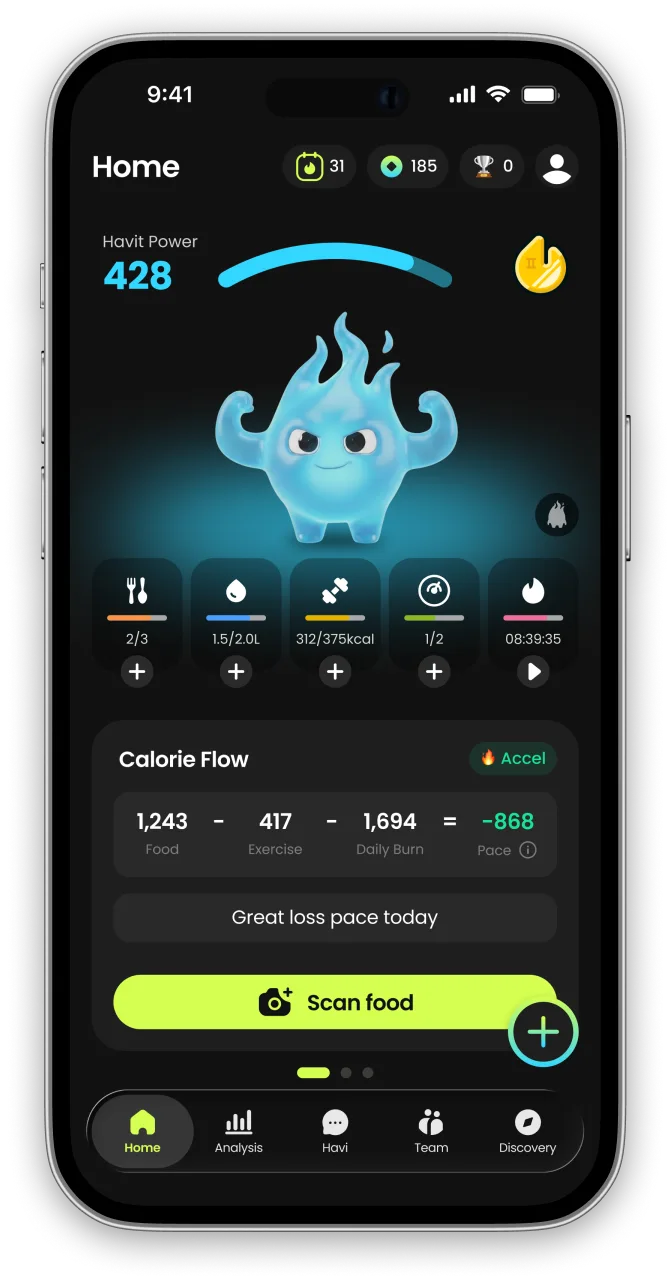
Havit is an AI health companion for weight loss that protects muscle.
Unlike calorie-only trackers, Havit connects AI body-composition estimates, nutrition, hydration, sleep, steps, cycle, mood, and GLP-1 medication in one daily routine — so progress is measured by body composition, not just the number on the scale. Daily missions turn established behavior-change techniques into small repeatable actions, drawing on expertise from professionals formerly at Juvis Diet, one of Korea’s leading metabolic clinics.
In Havit’s own analysis of 1,090 GLP-1 users, people who logged consistently built stronger habits than the general user base. Read the GLP-1 Habit Report
Havit works with or without GLP-1 medication. It is a wellness app, not a medical device; body-composition results are estimates.

Continue in the App
Personalized wellness with your own data


References
- Validation of Consumer Wearable Energy Expenditure Estimates Across Exercise Modalities — Medicine & Science in Sports & Exercise, Volume 57, Issue 3, March 2025
- Systematic Review of Wearable Device Accuracy for Energy Expenditure: Error Sources and Correction Approaches — Journal of Personalized Medicine, Volume 14, Issue 8, August 2024
- Optical Heart Rate Sensor Performance During Cycling Exercise — Stanford University Wearable Technology Research Lab, 2024
- Personalized Machine Learning Models for Metabolic Rate Estimation: A Pilot Validation Study — Journal of Personalized Medicine, Volume 15, Issue 2, February 2025


