

Active Calories vs Total Calories Burned: What Your Fitness Tracker Actually Measures
Total calories include your body's baseline burn (BMR) plus activity; focus on weekly trends rather than daily numbers for meaningful insights.
This article is for general informational purposes only and is not a substitute for professional medical advice, diagnosis, or treatment. Always consult a qualified healthcare provider with questions about a medical condition.
Your Watch Is Showing You Two Numbers—Here's Why That Matters
You finished a 45-minute run, checked your wrist, and saw two different calorie figures staring back at you. One says 387. The other says 2,847. Both claim to be "calories burned." Which one should you actually care about?
This confusion trips up millions of people daily. The fitness tracking industry has done a remarkably poor job explaining what these numbers mean, why they differ so dramatically, and—perhaps most importantly—how much you should trust either one.
Let's untangle this.
The Fundamental Split: What Your Body Burns Just Existing
Your body is a 24/7 operation. Right now, as you read this sentence, you're burning calories. Your heart pumps. Lungs expand. Brain processes these words. Cells divide and repair. This never stops, even during sleep.
This baseline energy expenditure goes by several names: Basal Metabolic Rate (BMR), Resting Metabolic Rate (RMR), or sometimes just "resting calories." For most adults, this accounts for somewhere between 60-75% of everything they burn in a day.
A 35-year-old woman weighing 140 pounds might have a BMR around 1,400 calories. A 45-year-old man at 185 pounds could sit closer to 1,800. These aren't small numbers. Before taking a single step, your body has already claimed the majority of your daily energy budget.
Total calories burned = BMR + thermic effect of food + all physical activity
Active calories = only the energy from movement above your baseline
So when your watch shows 387 active calories from that run, it's saying: "This is the extra energy you spent beyond what you'd have burned lying on the couch." The 2,847 total includes everything—your run plus the ~2,400 calories your body would have used anyway.
Why Wearables Calculate These Separately
Fitness trackers didn't always make this distinction. Early pedometers just counted steps. The first Fitbits gave you a single calorie number and called it a day.
The split emerged because people use these numbers for different purposes. Someone trying to create a caloric deficit needs total burn to compare against intake. An athlete tracking workout intensity cares more about active calories—they want to know if Tuesday's session outperformed Monday's.
There's also a psychological component manufacturers discovered through user research. Seeing "You burned 3,200 calories today!" feels more motivating than "Your workout added 450 calories." The big number validates effort. The small number, while more actionable, can feel deflating after an hour of sweating.
Most modern devices now display both, letting users choose their poison.
The Accuracy Problem Nobody Wants to Talk About
Here's where things get uncomfortable. A 2024 analysis published in Medicine & Science in Sports & Exercise examined calorie estimates across 11 popular wearable devices during various activities. The findings weren't encouraging.
For walking and running—activities these devices were essentially designed to track—error rates averaged 27.4% compared to indirect calorimetry (the gold standard involving oxygen consumption measurement). Some devices overestimated. Others underestimated. The direction wasn't even consistent across activities.
Cycling showed worse accuracy, with errors climbing to 40-50% on several devices. Strength training? The International Journal of Obesity's 2025 comprehensive review found wearables essentially guessing, with some estimates off by more than 90% during resistance exercises.
Why such poor performance? Wearables primarily rely on heart rate and accelerometer data, then apply population-based algorithms. But your heart rate during a deadlift doesn't correlate with calorie burn the same way it does during a jog. And accelerometers can't distinguish between lifting 50 pounds and 150 pounds—the arm movement looks identical.
What Actually Drives These Calculations
Pull back the curtain on any fitness tracker's calorie algorithm, and you'll find a surprisingly simple foundation. Most start with a BMR equation—typically Mifflin-St Jeor or Harris-Benedict—using your age, weight, height, and sex.
From there, movement data gets layered on. Steps multiply against an estimated energy cost per step (usually around 0.04-0.05 calories per step per pound of body weight). Heart rate zones trigger different multipliers. GPS data might adjust for elevation changes.
The problem? These are all estimates built on population averages. Your personal calorie burn during a 5K could differ from the "average" by 20% or more based on your running efficiency, muscle fiber composition, and metabolic adaptations from training.
A recreational runner and an elite marathoner covering the same distance at the same heart rate will burn different amounts of energy. The elite runner has spent years becoming more efficient—their body wastes less energy on unnecessary movement. But your watch doesn't know which one you are.
The Case for Ignoring Daily Numbers Entirely
I'm going to suggest something that might sound counterintuitive: stop caring about what your watch says you burned today.
Individual daily readings carry too much noise to be useful. Did you wear the watch slightly loose? That affects heart rate accuracy. Was it unusually hot? Your heart rate elevated independent of effort. Did you drink coffee before your workout? Same issue.
The International Journal of Obesity review made an important observation: while absolute accuracy remains poor, relative accuracy tends to be better. Meaning if your watch says you burned 400 active calories on Monday and 500 on Wednesday, you probably did work harder on Wednesday—even if neither number is precisely correct.
This is why weekly and monthly trends matter more than daily totals. If your seven-day average active calories has climbed from 350 to 425 over two months, that's a meaningful signal. Your fitness is improving. You're moving more. The exact numbers are less important than the direction.
Practical Applications: When Each Number Helps
Different goals call for different metrics.
For weight management: Total calories burned gives you the denominator for your energy balance equation. Pair it with food tracking, but build in a buffer. If your watch says you burned 2,500 total calories, consider planning intake around 2,300-2,400 to account for likely overestimation.
For workout comparison: Active calories let you evaluate sessions against each other. Did your interval training burn more than steady-state cardio? Active calories tell that story better than totals, which get muddied by varying BMR estimates.
For recovery planning: Higher active calorie days should generally mean more attention to sleep and nutrition. A 700-calorie workout demands different recovery than a 250-calorie session.
For motivation: Honestly? Use whichever number keeps you moving. If seeing 3,000 total calories gets you out the door tomorrow, that's the right number for you.
The Metrics That Actually Predict Fitness Progress
Calories get all the attention, but they're arguably the least reliable number your wearable produces. Several other metrics offer better insight into your fitness trajectory.
Resting heart rate trends downward as cardiovascular fitness improves. A drop from 72 to 65 bpm over three months tells you more than any calorie count. Heart rate recovery—how quickly your pulse drops after intense effort—similarly tracks aerobic adaptation.
Active minutes or "zone minutes" in elevated heart rate ranges provide a cleaner signal than calorie estimates. You either spent 35 minutes above 130 bpm or you didn't. There's less algorithmic interpretation involved.
Step counts, for all their simplicity, remain remarkably useful. Research consistently links daily step counts to health outcomes, and the measurement itself is highly accurate on modern devices. Aiming for 8,000-10,000 steps gives you a concrete, reliable target.
Setting Realistic Expectations for Your Data
Your fitness tracker is a tool, not an oracle. It provides estimates—educated guesses based on limited inputs and population-level assumptions. Treating its calorie outputs as precise measurements leads to frustration and potentially counterproductive decisions.
The 2025 wearable accuracy research suggested a useful mental model: consider your device's calorie estimates accurate within a range of plus or minus 25-30%. That 400-calorie workout might have actually burned anywhere from 280 to 520 calories. Both are plausible.
This uncertainty isn't a flaw to fix—it's an inherent limitation of trying to measure complex biological processes with a wrist-worn sensor. Even laboratory-grade equipment carries error margins.
Use the numbers directionally. Trust the trends. And remember that the most important thing your fitness tracker does isn't calculating calories—it's keeping you aware of your movement patterns and motivated to improve them.
The best workout is the one you actually do. Whether it burned 387 calories or 412 matters far less than whether you'll do it again tomorrow.
📊 Key Stats
Active Calories vs Total Calories Burned: Key Differences
| Aspect | Active Calories | Total Calories Burned |
|---|---|---|
| What it includes | Only energy from movement and exercise | BMR + food digestion + all activity |
| Typical daily range | 200-800 for most adults | 1,800-3,500 for most adults |
| Best use case | Comparing workout intensity day-to-day | Calculating energy balance for weight goals |
| Accuracy concerns | High variability by activity type | Compounds BMR estimation errors with activity errors |
| Motivational impact | Can feel discouraging (smaller numbers) | Often feels more rewarding |
| Trend reliability | Good for relative comparisons | Better for long-term patterns |
Both metrics serve different purposes—neither is universally 'better' than the other
❓ Frequently Asked Questions
Should I eat back my active calories or total calories burned?
Why does my watch show different calories than the gym machine?
Do active calories include walking or just intentional exercise?
Why are my active calories so low even when I feel exhausted?
How accurate is my fitness tracker's BMR estimate?
Should I focus on active calories or total calories for weight loss?
Do calories burned while sleeping count as active or total?
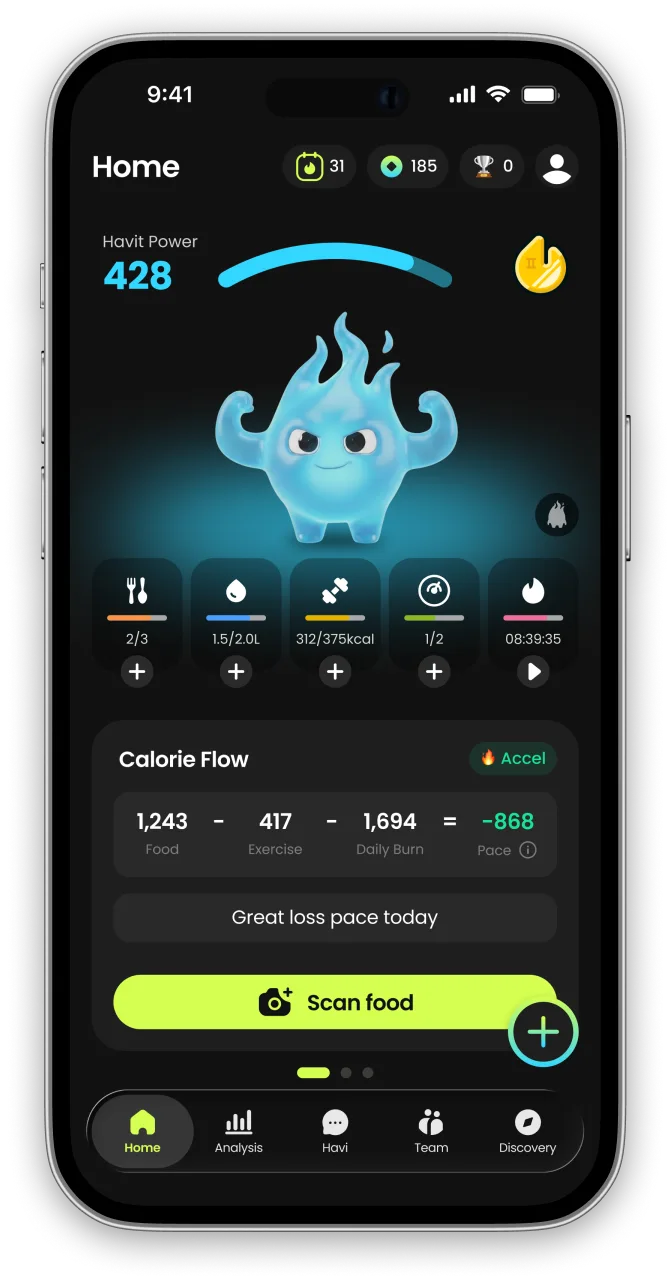
What is Havit?
Havit is an AI health companion for weight loss that protects muscle.
Unlike calorie-only trackers, Havit connects AI body-composition estimates, nutrition, hydration, sleep, steps, cycle, mood, and GLP-1 medication in one daily routine — so progress is measured by body composition, not just the number on the scale. Daily missions turn established behavior-change techniques into small repeatable actions, drawing on expertise from professionals formerly at Juvis Diet, one of Korea’s leading metabolic clinics.
In Havit’s own analysis of 1,090 GLP-1 users, people who logged consistently built stronger habits than the general user base. Read the GLP-1 Habit Report
Havit works with or without GLP-1 medication. It is a wellness app, not a medical device; body-composition results are estimates.

Continue in the App
Personalized wellness with your own data


References
- Accuracy of Wearable Devices for Estimating Energy Expenditure: A Systematic Review and Meta-Analysis — International Journal of Obesity, 2025
- Validity of Consumer-Based Physical Activity Monitors for Estimating Caloric Expenditure — Medicine & Science in Sports & Exercise, 2024
- Resting Metabolic Rate: Measurement and Clinical Applications — Journal of the American Dietetic Association, 2023
- Heart Rate-Based Estimation of Energy Expenditure: Limitations and Practical Considerations — Sports Medicine, 2024


