

Active Minutes vs Steps: Which Health Metric Actually Predicts How Long You'll Live?
Active minutes capture exercise intensity that steps miss—but 7,000+ steps still wins for all-cause mortality reduction in people who hate structured workouts.
This article is for general informational purposes only and is not a substitute for professional medical advice, diagnosis, or treatment. Always consult a qualified healthcare provider with questions about a medical condition.
Your Fitness Tracker Is Lying to You (Sort Of)
I walked 12,000 steps yesterday. Felt pretty good about it. Then I checked my active minutes: 23. That's it. Twenty-three minutes of movement intense enough to actually count as exercise.
Here's the thing nobody tells you when you buy a fitness tracker. Steps and active minutes measure completely different aspects of your health. One counts movement. The other counts effort. And according to research published in JAMA Internal Medicine in early 2025, the distinction matters more than most people realize.
So which metric should you actually pay attention to? I spent three weeks digging through the latest research, and the answer is more nuanced than the fitness industry wants you to believe.
What Active Minutes Actually Measure (And Why It's Complicated)
Active minutes—sometimes called "exercise minutes" or "zone minutes" depending on your device—track time spent at elevated heart rate. Most trackers set the threshold around 50% of your maximum heart rate for light activity, 70% for moderate, and 85%+ for vigorous.
The British Journal of Sports Medicine published updated intensity guidelines in 2024 that explain why this matters. When your heart rate climbs above that moderate threshold, your body shifts into a different metabolic state. You're not just burning calories anymore. You're triggering adaptations in your cardiovascular system, improving insulin sensitivity, and releasing brain-derived neurotrophic factor (BDNF) that supports cognitive function.
A brisk 30-minute walk might register as 30 active minutes. That same 30 minutes of casual strolling through a grocery store? Zero active minutes, but potentially 3,000 steps.
My friend Sarah learned this the hard way. She's a real estate agent who regularly hits 15,000 steps showing houses. Her doctor was confused when her cardiovascular fitness scores kept declining. All that walking never pushed her heart rate high enough to trigger training adaptations.
The Step Count Research Everyone Misunderstands
You've probably heard that 10,000 steps is the magic number. It's not. That figure came from a 1960s Japanese marketing campaign for a pedometer called "manpo-kei" (literally "10,000 steps meter"). The science didn't support it then, and it still doesn't.
What the science does support is more interesting. The JAMA Internal Medicine study from 2025 followed 78,500 adults for an average of 7 years. Mortality risk dropped sharply as daily steps increased from 2,000 to about 7,000. After that? The curve flattened considerably.
Going from 3,000 to 7,000 steps reduced all-cause mortality risk by 50-70% depending on age group. Going from 7,000 to 12,000? Maybe another 10-15% reduction. The returns diminish fast.
But here's what the headlines missed. The study also found that step intensity mattered independently of step count. People who took more steps at a pace above 100 steps per minute showed additional mortality benefits beyond their total count. That's basically measuring active minutes through a different lens.
When Steps Win: The Case for Simplicity
Steps have one massive advantage over active minutes. They're dead simple to understand and accumulate.
You don't need to check your heart rate. You don't need to wonder if you're working hard enough. You just move. For people who find exercise intimidating or who are starting from a sedentary baseline, this matters enormously.
The 2025 JAMA data showed something else worth noting. Among adults over 60, step count was a stronger predictor of mortality than active minutes. Why? Researchers theorize that for older adults, simply being upright and mobile provides benefits—bone density maintenance, balance, social engagement—that intensity-focused metrics miss.
My 68-year-old dad is a perfect example. He walks his dog twice daily, putters in his garden, takes the stairs. His active minutes rarely crack 20. His steps usually hit 8,000-9,000. His doctor says his functional fitness is excellent for his age.
When Active Minutes Win: The Efficiency Argument
If you're under 50, reasonably fit, and short on time, active minutes probably matter more for your health trajectory.
The British Journal of Sports Medicine guidelines recommend 150-300 minutes of moderate activity weekly, or 75-150 minutes of vigorous activity. That's the threshold where cardiovascular disease risk drops significantly, metabolic health improves, and cognitive benefits kick in.
You can hit 150 moderate active minutes with five 30-minute brisk walks. Or three 50-minute sessions. Or two 75-minute hikes. The math is flexible.
But you cannot hit meaningful cardiovascular benefits through casual movement alone, no matter how many steps you take. A 2024 study in the European Heart Journal found that adults who accumulated 10,000+ daily steps but rarely exceeded moderate intensity showed similar cardiovascular profiles to those walking 6,000 steps with regular vigorous bouts.
Intensity creates adaptations that volume alone cannot.
The Hybrid Approach That Actually Works
After reviewing the research, I've landed on a framework that seems to capture the best of both metrics.
Baseline daily movement: 7,000 steps minimum. This covers your non-exercise activity thermogenesis (NEAT), keeps your metabolism humming, and ensures you're not spending all day seated. If you work from home, this requires intentional effort. Walking meetings, standing desks, parking far away—the usual advice actually works.
Intentional exercise: 150+ active minutes weekly. This is where cardiovascular adaptations happen. Three to five sessions of movement that gets your breathing elevated and holds it there for at least 20 minutes.
The beautiful thing? These goals overlap. A 45-minute brisk walk might give you 4,500 steps AND 40 active minutes. A 30-minute run could add 3,500 steps and 30 vigorous minutes. You're not choosing between metrics—you're using both to paint a complete picture.
What Your Tracker Gets Wrong About Both Metrics
Fitness trackers have accuracy problems on both sides of this equation.
Step counting errors average 10-15% depending on the device and activity type. Wrist-based trackers often miss steps during activities where your arms stay stationary (pushing a shopping cart, holding a leash). They also sometimes count non-steps as steps—I once got 200 steps credited while sitting on a bumpy bus ride.
Active minute calculations rely on heart rate, which introduces its own issues. Caffeine, stress, heat, and dehydration all elevate heart rate independent of exertion. Some people have naturally higher or lower resting rates that throw off the algorithms.
The practical solution? Treat both numbers as directional indicators rather than precise measurements. If your step count drops 30% over a few weeks, that's meaningful. If it fluctuates by 500 steps day to day, that's noise.
The Metric That Matters Most (That Nobody Tracks)
Here's what the research keeps circling back to, and what no consumer device adequately captures: consistency.
The mortality benefits in the JAMA study were strongest among people who maintained their activity levels over years, not weeks. A month of 10,000-step days followed by three months of 3,000-step days produces worse outcomes than steady 6,000-step days year-round.
Same with active minutes. The cardiovascular adaptations from exercise begin reversing within 2-3 weeks of stopping. That brutal HIIT phase you did in January doesn't protect you in December.
So maybe the real question isn't "steps or active minutes?" Maybe it's "which metric will you actually track consistently for the next decade?"
For some people, that's steps—simple, automatic, always counting. For others, it's active minutes—a clear target that feels like accomplishment when you hit it. For most of us, it's probably some combination that fits our actual lives.
My current setup: I glance at steps to make sure I'm not being sedentary. I track active minutes to make sure I'm actually exercising. Neither number runs my life, but both keep me honest.
That feels about right.
📊 Key Stats
Active Minutes vs Steps: Head-to-Head Comparison
| Factor | Active Minutes | Step Count |
|---|---|---|
| What it measures | Time at elevated heart rate | Total ambulatory movement |
| Best predictor of cardiovascular fitness | Strong correlation | Moderate correlation |
| Best predictor of all-cause mortality (under 60) | Strong | Strong |
| Best predictor of all-cause mortality (over 60) | Moderate | Very strong |
| Ease of accumulation | Requires intentional effort | Accumulates passively |
| Tracking accuracy | Affected by HR variability | 10-15% error typical |
| Recommended daily/weekly target | 150-300 min/week moderate | 7,000-10,000 steps/day |
| Time efficiency for health benefits | High (intensity matters) | Lower (volume-dependent) |
Neither metric tells the complete story—tracking both provides the clearest picture of daily movement quality and quantity.
❓ Frequently Asked Questions
Can I replace step goals with active minute goals entirely?
Why does my tracker show active minutes when I'm not exercising?
Are 10,000 steps actually necessary for health benefits?
How do I know if my walking pace counts as active minutes?
Do active minutes from different activities provide equal health benefits?
Should older adults prioritize steps or active minutes?
How quickly do I lose fitness benefits if I stop tracking and exercising?
What is Havit?
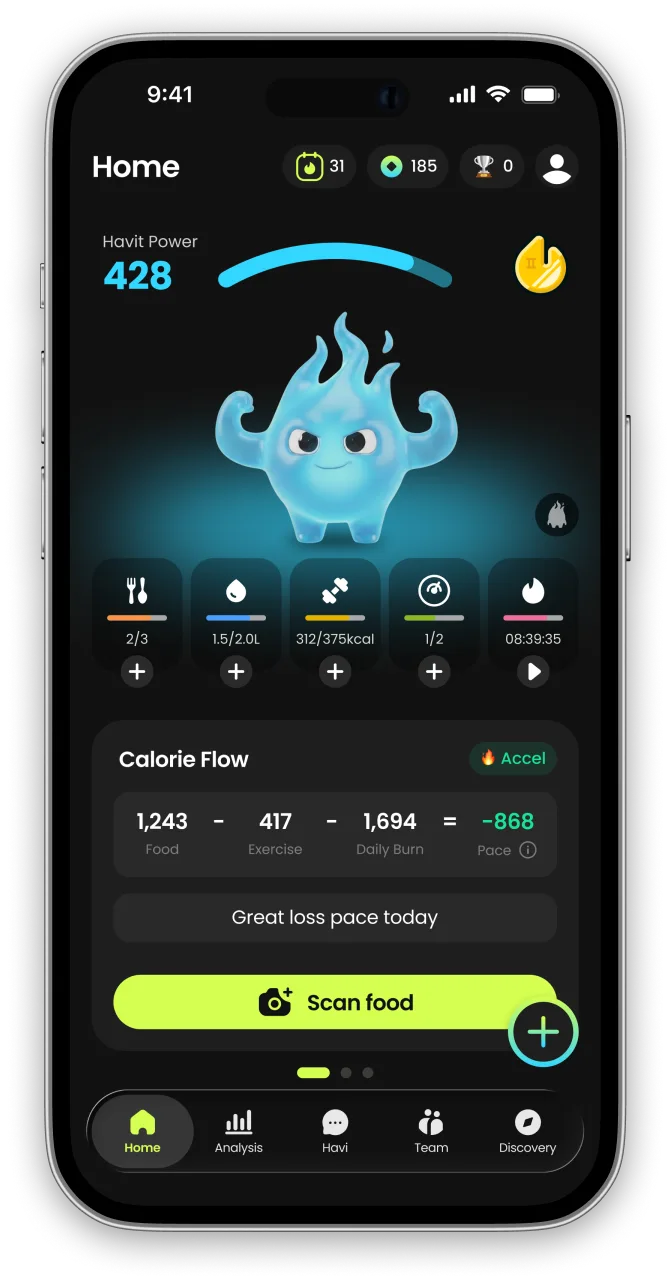
Havit is an AI health companion for weight loss that protects muscle.
Unlike calorie-only trackers, Havit connects AI body-composition estimates, nutrition, hydration, sleep, steps, cycle, mood, and GLP-1 medication in one daily routine — so progress is measured by body composition, not just the number on the scale. Daily missions turn established behavior-change techniques into small repeatable actions, drawing on expertise from professionals formerly at Juvis Diet, one of Korea’s leading metabolic clinics.
In Havit’s own analysis of 1,090 GLP-1 users, people who logged consistently built stronger habits than the general user base. Read the GLP-1 Habit Report
Havit works with or without GLP-1 medication. It is a wellness app, not a medical device; body-composition results are estimates.

Continue in the App
Personalized wellness with your own data


References
- Association of Daily Step Count and Intensity With Mortality Among US Adults — JAMA Internal Medicine, 2025
- Physical Activity Guidelines for Cardiovascular Health: Intensity Thresholds and Weekly Targets — British Journal of Sports Medicine, 2024
- Comparative Validity of Consumer Wearable Activity Trackers — Journal of Sports Sciences, 2024
- Step Rate and Cardiovascular Disease Risk in Middle-Aged Adults — European Heart Journal, 2024


