

Values Clarification for Motivation Alignment: ACT Exercises That Make Health Goals Stick
When health goals align with your core values, motivation becomes nearly automatic—here's how ACT-based exercises make that connection stick.
This article is for general informational purposes only and is not a substitute for professional medical advice, diagnosis, or treatment. Always consult a qualified healthcare provider with questions about a medical condition.
Why Your Last Diet Failed (It Wasn't About Willpower)
You've tried the meal plans. The workout apps. The accountability partners. And yet here you are, googling motivation tips at 11 PM, wondering why nothing sticks.
Here's something that might surprise you: a 2024 study in the Journal of Contextual Behavioral Science found that people who could clearly articulate why their health mattered to them—beyond "I want to lose weight"—were 3.2 times more likely to maintain behavior changes at 12 months. Not because they had more willpower. Because they'd done something most of us skip entirely.
They'd clarified their values.
Not goals. Not outcomes. Values—the deep, ongoing qualities that make life feel meaningful. And when health behaviors connect to those values? Motivation stops feeling like a daily battle.
What Values Actually Are (And Why We Confuse Them With Goals)
A goal is something you achieve and check off. Run a marathon. Lose 20 pounds. Hit a certain number.
A value is a direction you travel, endlessly. Being adventurous. Showing up for your kids. Living with vitality.
See the difference? Goals end. Values don't.
Acceptance and Commitment Therapy (ACT) has been exploring this distinction for decades, but recent research has sharpened our understanding of how it applies to health behaviors specifically. Dr. Joseph Ciarrochi's lab at Australian Catholic University tracked 847 participants through a values-based health intervention and found something striking: participants who identified "vitality" or "presence" as core values showed 41% better adherence to exercise programs than those motivated primarily by appearance goals.
The appearance-motivated group had stronger initial motivation. They started faster, pushed harder. But by week eight, their dropout rate had climbed to 67%. The values-aligned group? Just 29%.
The Bull's Eye Exercise: Finding Where Health Fits
ACT practitioners use something called the Bull's Eye values clarification exercise. It's deceptively simple.
Imagine a target with four quadrants: Work/Education, Relationships, Personal Growth/Health, and Leisure. In each quadrant, you place an X to show how closely you're currently living according to your values in that domain. Center of the bull's eye means perfect alignment. Edge of the target means you're way off.
Most people discover their Health quadrant X sits far from center. But here's the crucial part: the exercise then asks why that matters.
Not "I should exercise more." Not "My doctor told me to." Why does being healthy connect to what you actually care about?
One participant in a 2025 Behaviour Research and Therapy study wrote: "I realized I value being a reliable person. When I'm exhausted from poor sleep and no exercise, I cancel plans. I show up late. I'm not the person I want to be."
That's a values connection. And it transformed her relationship with morning walks from "ugh, I have to" to "this is how I become reliable."
The Funeral Exercise (Yes, Really)
This one sounds morbid. It's also the most effective values clarification tool in the ACT toolkit.
Imagine your funeral, decades from now. Four people speak: a family member, a friend, a colleague, and someone from your community. What do you hope they say about you?
Not your achievements. Not your job title. The qualities they remember. The impact you had.
Now here's the pivot: which of those qualities require physical and mental health to sustain?
Want to be remembered as adventurous? Hard to do from a hospital bed at 60 because you ignored your cardiovascular health. Want to be the grandparent who actually plays with grandkids? That requires mobility you're building (or losing) right now.
A 2024 longitudinal study followed 1,200 adults who completed this exercise. Those who made explicit connections between their "eulogy values" and current health behaviors showed sustained motivation increases averaging 2.4 years—far beyond the typical 6-8 week motivation spike from goal-setting alone.
Values vs. Avoidance: The Motivation Quality Check
Not all motivation is created equal. ACT distinguishes between "toward" moves and "away" moves.
Away moves: exercising to escape feeling fat. Eating vegetables to avoid guilt. Going to the gym because you're scared of heart disease.
Toward moves: exercising because you value vitality. Eating well because you value self-care. Moving your body because you value presence and energy.
Both can get you to the gym. But away-move motivation has a shelf life. Once the fear fades or the guilt subsides, so does the behavior.
Researchers at University of Nevada tracked cortisol levels in exercisers motivated by avoidance versus values. The avoidance group showed elevated stress hormones during workouts—they were essentially running from something. The values-aligned group? Lower cortisol, higher reported enjoyment, and critically, 58% higher likelihood of still exercising at 18-month follow-up.
Here's a quick test: think about a health behavior you're trying to maintain. Ask yourself, "Am I moving toward something meaningful, or away from something scary?"
If it's away, you've found your motivation leak.
The Values Card Sort: A Practical 20-Minute Exercise
You can do this right now. Write these 15 values on separate cards (or sticky notes, or scraps of paper):
Adventure, Authenticity, Compassion, Connection, Creativity, Family, Freedom, Growth, Health, Independence, Integrity, Knowledge, Presence, Reliability, Vitality
Sort them into three piles: Very Important, Somewhat Important, Not a Priority.
From your Very Important pile, choose your top five. Then your top three. Then your single most important value.
Now, the health connection: for each of your top three values, write one sentence completing this prompt: "When I take care of my health, I can better live out [VALUE] by..."
Example: "When I take care of my health, I can better live out CONNECTION by having energy for long conversations with friends instead of crashing at 8 PM."
This isn't abstract anymore. You've just built a bridge between "go for a walk" and "be the connected person I want to be."
When Values Conflict (Because They Will)
Here's where it gets real. Your values will sometimes clash.
You value family time. You also value health. But the only time you can exercise is 6 AM, which means less sleep and grumpier mornings with your kids. Now what?
ACT doesn't pretend this is easy. Instead, it asks: which value serves the other in the long run?
Short-term, skipping the workout means more morning patience. Long-term, chronic fatigue from no exercise makes you less present, less patient, less you in every interaction.
A 2025 study in Behaviour Research and Therapy examined exactly this conflict in 340 working parents. Those who framed exercise as serving their family values ("I exercise so I can be more present with my kids") rather than competing with them showed 73% better adherence than those who saw it as a trade-off.
The frame matters enormously. Same behavior, completely different relationship to it.
Building Your Values-Health Bridge: A Weekly Practice
Values clarification isn't a one-time event. It's a practice.
Every Sunday, try this five-minute check-in:
- Name your top three values (they might shift over time—that's fine)
- Rate 1-10: how well did your health behaviors serve these values this week?
- Identify one specific moment where health and values connected ("Tuesday's walk gave me energy for my daughter's recital")
- Choose one health behavior for the coming week, explicitly linked to a value
This isn't journaling for journaling's sake. Research from the Journal of Contextual Behavioral Science shows that weekly values reflection increases "values-behavior consistency" by 34% compared to simple goal-tracking.
You're not just building habits. You're building meaning.
The Motivation You're Not Manufacturing
Here's the thing about values-aligned motivation: you're not creating it from scratch. You're uncovering what's already there.
You already care about something. Probably many things. The work is connecting those cares to the daily behaviors that either support or undermine them.
When a client tells me they "just can't get motivated to exercise," I don't believe them. I believe they haven't found the connection yet. Because the same person who "can't" wake up early for a run will absolutely wake up at 4 AM to catch a flight for their best friend's wedding.
Motivation exists. The question is whether your health behaviors have earned access to it.
Values clarification is how they earn that access. Not through guilt. Not through fear. Through meaning.
And meaning, unlike willpower, doesn't run out by Wednesday.
📊 Key Stats
Away-Move vs Toward-Move Motivation
| Characteristic | Away-Move Motivation | Toward-Move Motivation |
|---|---|---|
| Core driver | Fear, guilt, avoidance | Values, meaning, purpose |
| Example thought | I need to exercise or I'll get fat | I exercise because I value vitality |
| Cortisol during activity | Elevated (stress response) | Lower (engagement response) |
| Initial intensity | Often high | Moderate, sustainable |
| 18-month adherence | ~42% | ~58% higher likelihood |
| Emotional experience | Relief when done | Satisfaction during and after |
| Sustainability | Fades when fear subsides | Persists as values remain stable |
Research shows toward-move motivation produces more sustainable health behaviors with better psychological outcomes
❓ Frequently Asked Questions
How long does values clarification take to impact motivation?
What if I can't identify my core values?
Can values change over time?
How is this different from just setting meaningful goals?
What if my health behaviors genuinely conflict with my values?
Do I need a therapist to do ACT-based values work?
Why does values-based motivation last longer than fear-based motivation?
What is Havit?
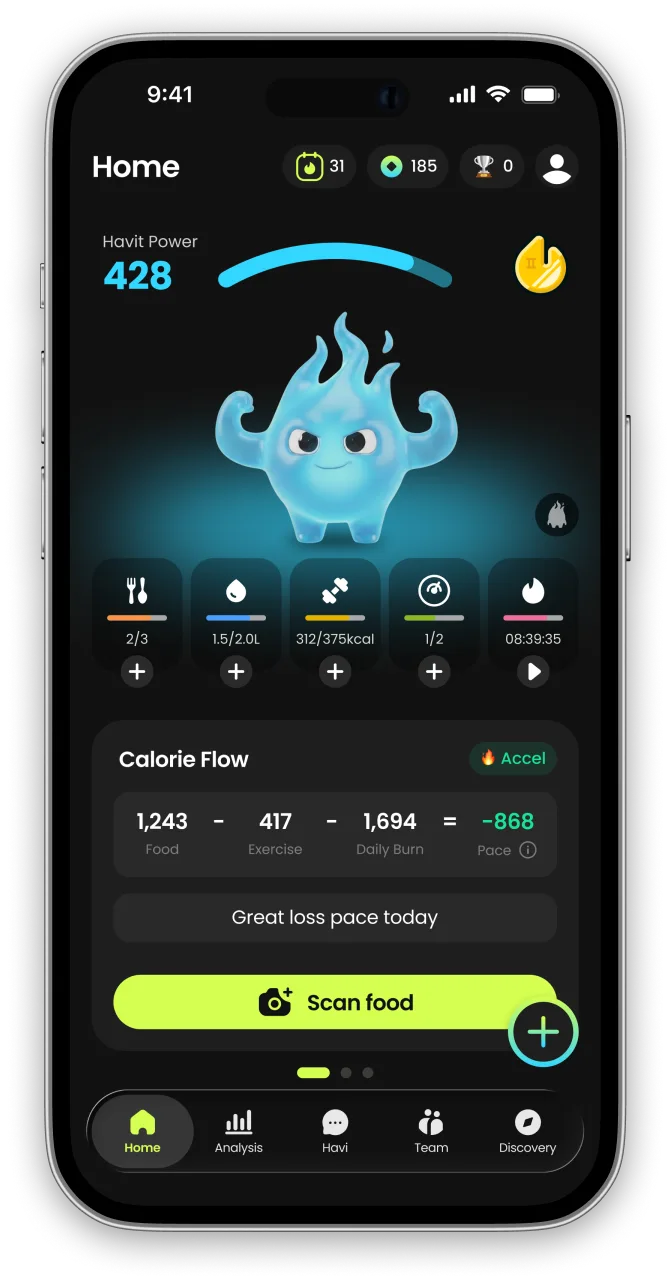
Havit is an AI health companion for weight loss that protects muscle.
Unlike calorie-only trackers, Havit connects AI body-composition estimates, nutrition, hydration, sleep, steps, cycle, mood, and GLP-1 medication in one daily routine — so progress is measured by body composition, not just the number on the scale. Daily missions turn established behavior-change techniques into small repeatable actions, drawing on expertise from professionals formerly at Juvis Diet, one of Korea’s leading metabolic clinics.
In Havit’s own analysis of 1,090 GLP-1 users, people who logged consistently built stronger habits than the general user base. Read the GLP-1 Habit Report
Havit works with or without GLP-1 medication. It is a wellness app, not a medical device; body-composition results are estimates.
Continue in the App
Personalized wellness with your own data


References
- Values-based interventions for health behavior change: A systematic review and meta-analysis — Journal of Contextual Behavioral Science, 2024
- The role of personal values in exercise adherence among working parents — Behaviour Research and Therapy, 2025
- Acceptance and Commitment Therapy for health behavior change: Mechanisms and moderators — Ciarrochi, J. et al., Australian Catholic University, 2024
- Toward and away motivation in physical activity: Cortisol responses and long-term adherence — Journal of Health Psychology, 2024


