

Self-Compassion vs Self-Esteem: Why One Builds Lasting Resilience (2026 Research)
Self-compassion provides stable emotional benefits without the fragility and narcissism risks that come with chasing high self-esteem.
This article is for general informational purposes only and is not a substitute for professional medical advice, diagnosis, or treatment. Always consult a qualified healthcare provider with questions about a medical condition.
The Pep Talk That Backfired
I spent most of my twenties telling myself I was amazing. Affirmations in the mirror. Vision boards. "You're a winner" mantras before job interviews. And you know what? It worked—until it didn't. The moment I actually failed at something that mattered, my entire psychological house of cards collapsed. Turns out, I'd been building my mental health on quicksand.
Psychologist Kristin Neff has been studying this exact problem for over two decades. Her research reveals an uncomfortable truth: the self-esteem movement that dominated Western psychology since the 1980s may have been solving the wrong problem entirely. What if the antidote to self-criticism isn't self-praise, but something gentler and far more durable?
What Self-Esteem Actually Measures (And Why It's Fragile)
Self-esteem, at its core, is an evaluation. It's the grade you give yourself based on how you stack up against others, how well you meet your own standards, and whether you feel worthy of good things happening to you.
The problem? This evaluation depends entirely on circumstances. A 2024 longitudinal study published in Self and Identity tracked 847 adults over three years and found that self-esteem fluctuated by an average of 23% in response to career setbacks, relationship changes, and health challenges. People with the highest baseline self-esteem actually showed the steepest drops during difficult periods.
Think about what this means practically. You nail a presentation at work, and your self-esteem spikes. You bomb the next one, and it craters. You're essentially riding an emotional rollercoaster that someone else is operating.
There's another wrinkle. To maintain high self-esteem, you need to feel special—better than average in some meaningful way. Psychologists call this the "better-than-average effect," and it creates a mathematical impossibility. We can't all be above average. So self-esteem often requires a subtle (or not so subtle) devaluation of others. That coworker who got promoted instead of you? They must have been lucky, or political, or somehow less deserving.
Self-Compassion: A Different Operating System
Self-compassion works on completely different principles. Neff defines it through three components: self-kindness (treating yourself the way you'd treat a struggling friend), common humanity (recognizing that suffering and imperfection are universal), and mindfulness (acknowledging painful feelings without drowning in them).
Notice what's missing from this definition: any comparison to others. Any evaluation at all. Self-compassion doesn't ask "Am I good enough?" It asks "Am I hurting, and what do I need right now?"
A comprehensive review in the Journal of Personality (2025) analyzed 78 studies involving over 31,000 participants and found that self-compassion correlated with lower anxiety, depression, and stress across virtually every demographic group studied. The effect sizes were substantial—people in the top quartile of self-compassion showed 41% lower rates of clinical anxiety symptoms compared to those in the bottom quartile.
But here's what really caught my attention: unlike self-esteem, self-compassion remained stable during adversity. It didn't spike when things went well or crash when they didn't. It was more like a foundation than a weather vane.
The Motivation Myth: Does Self-Compassion Make You Lazy?
This is the objection I hear most often. "If I'm too kind to myself, won't I just accept mediocrity? Don't I need that inner critic to push me forward?"
The research says no—emphatically. A 2023 study at the University of Texas followed 312 students through a challenging organic chemistry course. Students who scored higher on self-compassion measures at the start of the semester earned grades that were, on average, 0.4 points higher on a 4.0 scale. They also reported studying more hours per week, not fewer.
Why would treating yourself kindly lead to more effort? Think about how you respond when someone else criticizes you harshly. Do you feel energized and motivated? Or do you feel defensive, anxious, and inclined to avoid the whole situation?
Self-criticism triggers the threat-defense system. Your body floods with cortisol. Your thinking narrows. You become focused on protecting yourself rather than growing. Self-compassion, by contrast, activates the mammalian care system—the same neurological pathway that makes you want to help a crying child. It creates feelings of safety that allow for risk-taking, learning, and genuine effort.
Real-World Applications: How Self-Compassion Shows Up
Let me give you a concrete example. Sarah, a 34-year-old marketing manager I interviewed for this piece, had struggled with perfectionism her entire career. Her inner monologue after any mistake was brutal: "You're an idiot. Everyone saw that. They're probably already talking about replacing you."
She started practicing self-compassion after her therapist recommended Neff's work. Now, when she makes a mistake, her self-talk sounds different: "That was painful. Anyone would feel embarrassed right now. What can I learn from this, and what do I need to move forward?"
The shift seems small, but Sarah reports that her anxiety has decreased significantly. She's also taking on more ambitious projects—something she avoided before because the stakes of failure felt too high.
Athletes show similar patterns. A 2024 study of 156 collegiate swimmers found that those with higher self-compassion bounced back faster after poor race performances. They were back to baseline motivation within 48 hours, compared to 5-7 days for low self-compassion athletes.
The Narcissism Problem With Self-Esteem
Here's something that rarely gets discussed in pop psychology: the self-esteem movement may have contributed to rising narcissism rates. Jean Twenge's research tracking personality traits across generations found that narcissistic personality inventory scores increased by 30% among college students between 1982 and 2009—precisely the decades when self-esteem programs dominated American schools.
This doesn't mean self-esteem causes narcissism. But the pursuit of high self-esteem can easily slide into narcissistic territory. When your psychological wellbeing depends on feeling special and superior, you're incentivized to inflate your accomplishments, dismiss criticism, and devalue others.
Self-compassion has no such risk. You can't become narcissistic by acknowledging that you're struggling and that struggle is part of being human. There's nothing to inflate, nothing to defend.
The Self and Identity longitudinal study found that participants who increased their self-compassion over the three-year period showed no corresponding increase in narcissistic traits. Those who focused on boosting self-esteem showed modest but statistically significant increases in entitlement and exploitativeness.
How to Actually Practice Self-Compassion
Knowing about self-compassion intellectually is different from embodying it. Here are approaches that research suggests actually work.
The self-compassion break is Neff's simplest technique. When you notice you're suffering, you pause and say three things to yourself: "This is a moment of suffering" (mindfulness), "Suffering is part of life" (common humanity), and "May I be kind to myself" (self-kindness). It sounds almost embarrassingly simple, but neuroimaging studies show it activates the parasympathetic nervous system within seconds.
Writing exercises also show strong effects. In one study, participants who wrote self-compassionately about a recent failure for 20 minutes showed reduced cortisol levels and improved mood compared to those who wrote about the failure in a self-critical or self-esteem-boosting way.
Physical touch matters too. Placing your hand over your heart while practicing self-compassion increases oxytocin release. Your body doesn't fully distinguish between comfort from others and comfort from yourself.
The key is consistency. Self-compassion is a skill, and like any skill, it strengthens with practice. Most intervention studies showing significant benefits involved at least 8 weeks of regular practice.
When Self-Esteem Still Has Its Place
I don't want to completely dismiss self-esteem. Feeling good about yourself isn't inherently problematic. The research suggests that self-esteem works best when it's a byproduct rather than a goal—when it emerges naturally from living according to your values and treating yourself with compassion.
The problems arise when self-esteem becomes the target. When you chase the feeling of being special, you end up on that unstable rollercoaster. When you simply try to treat yourself kindly regardless of performance, stable positive feelings often follow.
Think of it this way: self-compassion is the foundation, and healthy self-esteem can be built on top of it. But self-esteem without self-compassion is a house built on sand.
The Shift That Changes Everything
What strikes me most about this research is how counterintuitive it feels. We're taught that pushing ourselves harder leads to better results. That we need to earn self-acceptance through achievement. That being too easy on ourselves is a recipe for stagnation.
The data tells a different story. People who treat themselves with kindness work harder, recover faster from setbacks, and experience more stable wellbeing. They're not letting themselves off the hook—they're giving themselves the psychological safety needed to take risks and grow.
I think back to my twenties, to all those affirmations and vision boards. I was trying so hard to convince myself I was worthy. What I actually needed was much simpler: permission to be human, to fail, to struggle, and to treat myself with the same basic kindness I'd offer anyone else going through a hard time.
That permission doesn't require any special achievement. It's available right now, in this moment, regardless of how your last project went or what your bank account looks like. And according to two decades of research, it might be the most powerful mental health tool we have.
📊 Key Stats
Self-Compassion vs Self-Esteem: Key Differences
| Dimension | Self-Compassion | Self-Esteem |
|---|---|---|
| Basis | Kindness toward self regardless of performance | Evaluation based on achievements and comparisons |
| Stability | Remains consistent during adversity | Fluctuates with successes and failures |
| Social comparison | Not required | Often depends on feeling better than others |
| Narcissism risk | No correlation | Modest positive correlation when pursued directly |
| Effect on motivation | Increases effort through psychological safety | Can decrease effort after failures due to ego threat |
| Response to failure | Acknowledgment + kindness + learning | Defensiveness, avoidance, or self-criticism |
Based on Neff's research framework and 2024-2025 longitudinal findings
❓ Frequently Asked Questions
Is self-compassion the same as self-pity?
Can you have both high self-compassion and high self-esteem?
How long does it take to develop self-compassion?
Does self-compassion work for everyone?
Will being self-compassionate make me accept mediocrity?
How is self-compassion different from positive affirmations?
Can self-compassion help with perfectionism?
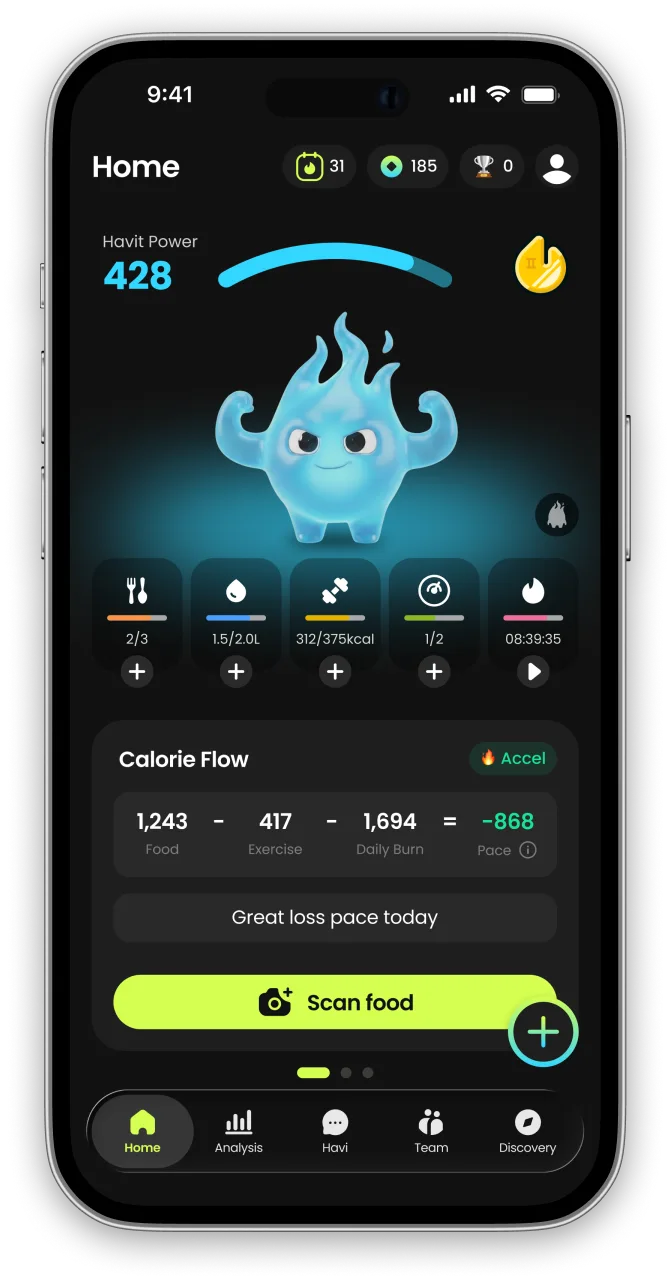
What is Havit?
Havit is an AI health companion for weight loss that protects muscle.
Unlike calorie-only trackers, Havit connects AI body-composition estimates, nutrition, hydration, sleep, steps, cycle, mood, and GLP-1 medication in one daily routine — so progress is measured by body composition, not just the number on the scale. Daily missions turn established behavior-change techniques into small repeatable actions, drawing on expertise from professionals formerly at Juvis Diet, one of Korea’s leading metabolic clinics.
In Havit’s own analysis of 1,090 GLP-1 users, people who logged consistently built stronger habits than the general user base. Read the GLP-1 Habit Report
Havit works with or without GLP-1 medication. It is a wellness app, not a medical device; body-composition results are estimates.

Continue in the App
Personalized wellness with your own data


References
- Longitudinal stability of self-esteem and self-compassion across life transitions — Self and Identity, 2024
- Self-compassion and psychological wellbeing: A comprehensive meta-analytic review — Journal of Personality, 2025
- Self-Compassion: The Proven Power of Being Kind to Yourself — Kristin Neff, PhD
- Generation Me: Why Today's Young Americans Are More Confident, Assertive, Entitled—and More Miserable Than Ever Before — Jean Twenge, PhD


