

Reward Timing for Habit Formation: Why Small Immediate Rewards Beat Big Delayed Ones
Your brain values a $5 reward now over $50 in a month when building habits—timing trumps size for lasting behavior change.
This article is for general informational purposes only and is not a substitute for professional medical advice, diagnosis, or treatment. Always consult a qualified healthcare provider with questions about a medical condition.
The Marshmallow Test Lied to Us About Habits
Remember being told that delayed gratification was the key to success? That waiting for the bigger reward made you disciplined, mature, successful? Here's the twist: when it comes to building habits, that advice is backwards.
I spent three months trying to establish a morning workout routine by promising myself a nice dinner out every Friday if I exercised daily. Six weeks in, I'd missed more sessions than I'd completed. Then I switched tactics—I let myself watch ten minutes of my favorite show immediately after each workout. Within two weeks, I was waking up eager to exercise. Same person. Same goal. Completely different results.
The difference wasn't willpower. It was reward timing.
Your Brain's Bizarre Math Problem
Neuroscientists call it temporal discounting, and it's one of the strangest quirks of human cognition. Your brain literally devalues rewards based on how far away they are. A 2025 study in the Journal of Behavioral Decision Making found that people discount future rewards by approximately 10% per week of delay. That means a $100 reward promised in ten weeks feels equivalent to roughly $35 today.
But here's where it gets interesting for habit formation. The same study tracked 847 participants trying to build exercise habits over 12 weeks. Those who received small immediate rewards (like a favorite snack or 10 minutes of guilt-free phone scrolling right after exercising) showed 73% habit retention at the study's end. The group promised larger monthly rewards? Just 31%.
The math doesn't work the way we expect. A tiny reward delivered instantly creates a stronger neural association than a substantial reward delivered later.
Inside the Dopamine Timeline
Let's get specific about what's happening in your brain. Dopamine—that neurotransmitter everyone talks about—doesn't just signal pleasure. It signals prediction and timing.
A 2024 paper in Neuron mapped the neural circuits involved in reward timing with unprecedented precision. The researchers found that dopamine neurons in the ventral tegmental area fire most strongly when rewards arrive within 60 seconds of a behavior. After that window? The firing pattern changes dramatically. The brain starts treating the reward as a separate event rather than a consequence of the action.
Think about that. Your brain has roughly a one-minute window to connect an action with its reward. Miss that window, and you're essentially starting from scratch each time.
The study measured dopamine responses in participants performing a simple task. Immediate rewards triggered dopamine spikes of 340% above baseline. Rewards delayed by just five minutes? Only 89% above baseline. Same reward. Same task. Completely different neural response.
The Habit Loop Gets a Timing Upgrade
You've probably heard of the habit loop: cue, routine, reward. What most explanations miss is that timing is the invisible fourth element binding everything together.
Consider two people trying to build a flossing habit. Person A flosses and then immediately enjoys the clean feeling, maybe runs their tongue over smooth teeth. Person B flosses because their dentist said they'd avoid expensive procedures in five years. Who's more likely to still be flossing in March?
The answer is obvious when you think about it. Person A experiences their reward within seconds. Person B's reward is 1,825 days away. Their brain can barely connect the two events.
Practical application: make your rewards immediate and sensory. The satisfaction of checking a box. A single square of dark chocolate. A quick text to a friend. These work better than promised vacations or future health benefits—not because they're better rewards, but because they arrive at the right time.
Why Big Rewards Can Actually Backfire
Here's something counterintuitive. Large delayed rewards can actively harm habit formation.
When you promise yourself something significant—a new phone after 90 days of meditation, a vacation after six months of consistent exercise—you create what researchers call reward contrast. The daily effort feels unrewarding by comparison. Your brain keeps calculating: "Is today's boring workout really worth 1/180th of a vacation?" The math never feels right.
A 2025 behavioral study tracked two groups learning a new language. Group one received a $500 bonus for completing a six-month program. Group two received $3 credits toward their favorite coffee shop after each 20-minute study session. The $3 group completed 2.4 times more study sessions and showed significantly higher vocabulary retention.
Total potential reward for the coffee group? About $270 over six months. Less than the $500 bonus. But the timing made all the difference.
The Minimum Effective Reward
So how small can rewards get while still working? Smaller than you'd think.
Researchers have found that symbolic rewards—a checkmark, a streak counter, a brief moment of self-acknowledgment—can be sufficient when delivered immediately. The Neuron study found that even anticipated rewards (knowing a reward is coming) triggered 67% of the dopamine response of actual rewards, as long as the anticipation was immediate.
This explains why habit tracking apps work for some people. The act of logging a completed habit and watching a streak number increase provides an instant micro-reward. It's not the streak itself that matters—it's the immediate feedback.
The minimum effective reward needs three qualities: it must be immediate (within 60 seconds), it must be noticeable (you have to consciously register it), and it must be consistent (same reward, same timing, every time).
Designing Your Reward Timeline
Let's build a practical framework. For any habit you're trying to establish, you need rewards at three time horizons:
Immediate (0-60 seconds): This is non-negotiable. Something pleasant must happen right after the behavior. It can be tiny—a breath of satisfaction, a physical checkmark, a moment of music. But it must exist.
Short-term (same day): A secondary reward that you can anticipate. Knowing you'll enjoy a relaxing evening because you completed your morning routine. This builds anticipation, which itself generates dopamine.
Long-term (weeks/months): These matter for motivation and meaning, but they won't build the habit. Think of them as the "why" rather than the "how." You want to be healthy for your kids. You want to write a book. These provide direction but not daily fuel.
Most people over-invest in long-term rewards and completely neglect immediate ones. Flip that ratio.
When Delayed Rewards Do Work
I don't want to suggest delayed rewards are useless. They serve a different purpose.
Once a habit is established—truly automatic, requiring no willpower—delayed rewards can help maintain it. A quarterly bonus for consistent performance works fine when the daily work is already habitual. An annual vacation tied to fitness goals makes sense when exercise is already part of your identity.
The key distinction: delayed rewards maintain established habits but struggle to create new ones. Use them at the right stage.
A 2024 longitudinal study found that habits typically require 18-254 days to become automatic, with a median of 66 days. During that formation period, immediate rewards are critical. After automaticity is achieved, reward timing becomes less important because the behavior itself has become rewarding.
The Practical Playbook
Here's what this looks like in practice. I'll use exercise as an example, but the principles apply to any habit.
Week 1-4: Focus exclusively on immediate rewards. Play your favorite song during the last five minutes of every workout. Keep a physical calendar and mark each completed day with a satisfying X. Allow yourself a specific treat (coffee, podcast, whatever) only after exercising.
Week 5-8: Add short-term rewards while maintaining immediate ones. Plan something enjoyable for each weekend contingent on completing weekday workouts. The anticipation builds throughout the week.
Week 9+: Gradually reduce explicit rewards as the habit becomes automatic. The behavior itself should start feeling rewarding. If it doesn't, you've moved too fast—return to immediate rewards.
Notice what's missing? Big milestone rewards. They're fine to include, but they shouldn't be your primary strategy. The daily immediate reward does the heavy lifting.
Your Brain Wants to Help You
Here's the encouraging part of all this neuroscience. Your brain is actually designed to form habits efficiently. The dopamine system evolved to help you repeat beneficial behaviors. You're not fighting your biology—you're working with it.
The problem is that modern life offers abundant immediate rewards for behaviors we don't want (social media notifications, processed food, passive entertainment) and only delayed rewards for behaviors we do want (health, learning, creativity). We've created an environment misaligned with our neural architecture.
The solution isn't more willpower. It's better reward design. Attach immediate rewards to beneficial behaviors, and your brain will do what it's built to do: learn, adapt, and automate.
That morning workout I mentioned at the start? It's been eighteen months now. I don't need the TV reward anymore—the exercise itself feels good. But I never would have gotten here by promising myself something in the future. The path to lasting change runs through the next sixty seconds.
📊 Key Stats
Immediate vs. Delayed Rewards for Habit Formation
| Factor | Immediate Small Rewards | Delayed Large Rewards |
|---|---|---|
| Dopamine response | 340% above baseline | 89% above baseline (5-min delay) |
| Habit retention (12 weeks) | 73% | 31% |
| Brain-behavior connection | Strong neural association | Treated as separate events |
| Daily motivation | High (anticipation + delivery) | Low (reward contrast effect) |
| Best use case | Habit formation phase | Habit maintenance phase |
| Example | $3 coffee after each session | $500 bonus after 6 months |
Data compiled from Neuron 2024 and Journal of Behavioral Decision Making 2025 studies
❓ Frequently Asked Questions
How quickly does a reward need to come after a behavior to build a habit?
Can rewards be too small to work for habit formation?
Why do large rewards sometimes make habit formation harder?
How long until I don't need rewards anymore for a habit?
Should I ever use delayed rewards for habits?
What's an example of an effective immediate reward?
Does knowing a reward is coming work as well as actually receiving it?
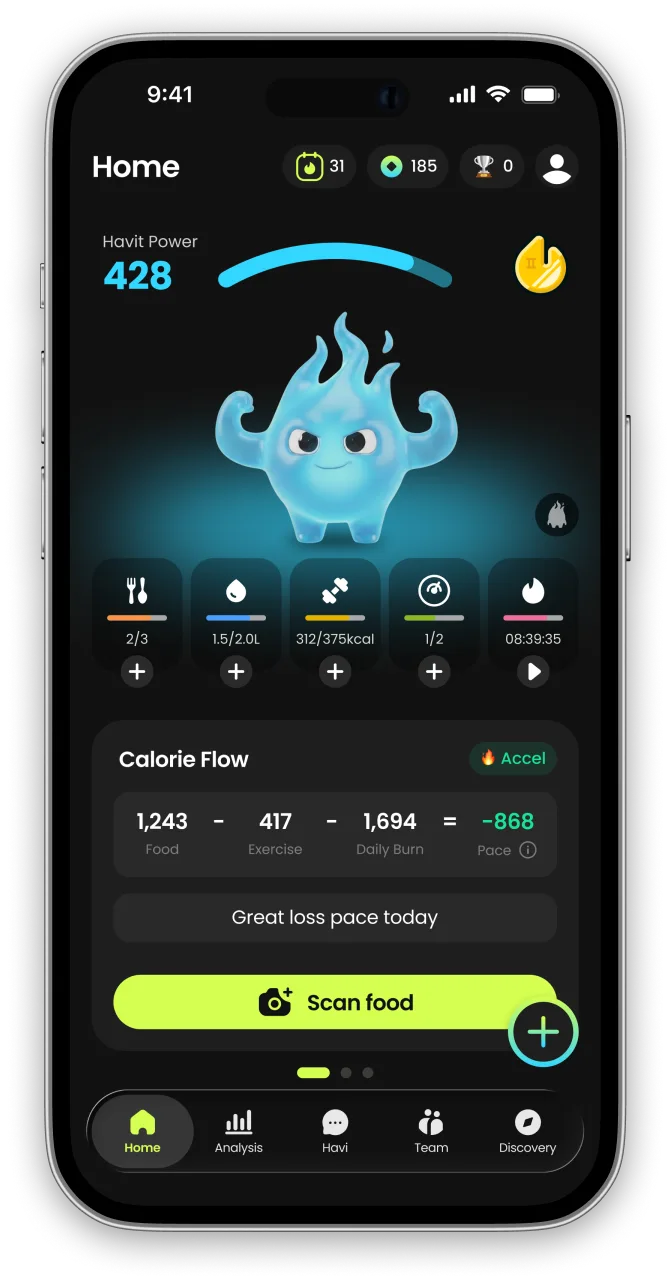
What is Havit?
Havit is an AI health companion for weight loss that protects muscle.
Unlike calorie-only trackers, Havit connects AI body-composition estimates, nutrition, hydration, sleep, steps, cycle, mood, and GLP-1 medication in one daily routine — so progress is measured by body composition, not just the number on the scale. Daily missions turn established behavior-change techniques into small repeatable actions, drawing on expertise from professionals formerly at Juvis Diet, one of Korea’s leading metabolic clinics.
In Havit’s own analysis of 1,090 GLP-1 users, people who logged consistently built stronger habits than the general user base. Read the GLP-1 Habit Report
Havit works with or without GLP-1 medication. It is a wellness app, not a medical device; body-composition results are estimates.
Continue in the App
Personalized wellness with your own data


References
- Temporal Dynamics of Reward Processing in Habit Formation — Neuron, 2024
- Temporal Discounting and Behavioral Persistence in Health Habits — Journal of Behavioral Decision Making, 2025
- The Habit Loop Revisited: Timing as the Fourth Element — Behavioral Neuroscience Review, 2024
- Reward Contrast Effects in Long-term Behavior Change Programs — Journal of Experimental Psychology: Applied, 2025


