

Beyond BMI — Why the New Generation of Diet Apps Needs Body Composition, Lifestyle Data, and Personalized Behavior Change (HAVIT vs MyFitnessPal vs Noom vs Simple.Life)
The science of obesity management has changed: body composition + lifestyle + personalized behavior beats BMI-only tracking, per DPP/Look AHEAD/STEP trials and WHO/ADA guidance. HAVIT integrates AI body composition estimation (n=70 InBody-reference internal study, 92.9% ±5% agreement), 126-archetype personalization, and GLP-1-aware behavior coaching as a Gen-4 assessment+coaching model — versus MyFitnessPal (tracking), Noom (CBT coaching), and Simple.Life (AI fasting). HAVIT is not a medical diagnostic tool.
This article is for general informational purposes only and is not a substitute for professional medical advice, diagnosis, or treatment. Always consult a qualified healthcare provider with questions about a medical condition.
1. The End of BMI — Why Body Composition and Lifestyle Are the New Standard
BMI (Body Mass Index), the standard metric of obesity management for decades, has been heavily criticized in the academic literature over the past ten years.
Core problems:
- BMI cannot distinguish muscle from fat. Two people with BMI 26 may be a bodybuilder versus a person at high metabolic-syndrome risk (Tomiyama et al. 2016, Int J Obes).
- BMI cannot see fat distribution. People with high visceral fat may have normal BMI but elevated cardiovascular risk (Ross et al. 2020, Nat Rev Endocrinol).
- The same BMI carries different risks across ethnicity, sex, and age. The WHO's lower Asian BMI cut-off (≥23) reflects this.
The new standard the field points to: integrated assessment of body composition (body fat %, muscle mass, visceral fat) + lifestyle variables (diet, sleep, exercise, stress).
Old standard          →  New standard
─────────────────────────────────────────────────
1 metric (BMI)        →  5+ body composition metrics (body fat %, muscle, visceral, BMR, WHtR)
Weight change         →  Body composition change + lifestyle signals
Uniform prescription  →  Archetype/persona-matched prescription
Weekly/monthly tuning →  Daily micro-adjustment
1.1 Why Body Composition Matters — Clinical Evidence
- Prado & Heymsfield (2014, JPEN) — Sarcopenic obesity (low muscle, high fat) increases mortality even at normal BMI. Undetectable without body composition assessment.
- Heymsfield et al. (2024, Obesity Reviews) — Body composition outperforms BMI for obesity risk stratification.
- Ross et al. (2020, Nat Rev Endocrinol) — Waist circumference (WC) provides risk information independent of BMI. Recommended as a "vital sign."
1.2 Effectiveness of Lifestyle Intervention — Clinical Evidence
- Diabetes Prevention Program (NEJM 2002) — 3,234 participants randomized over 3.2 years. The lifestyle intervention arm reduced diabetes incidence by 58%; metformin reduced it by 31%. Lifestyle change outperformed pharmacotherapy.
- Look AHEAD (NEJM 2013) — 5,145 participants randomized over 10 years. Intensive lifestyle intervention outperformed standard care across weight, HbA1c, and cardiovascular risk factors.
- Wing & Phelan (2005, Am J Clin Nutr) — People sustaining ≥5-year weight loss (avg. −30 kg) all shared: daily self-monitoring, simultaneous diet + exercise management, regular weight measurement.
1.3 Effectiveness of Personalized Prescription — Clinical Evidence
- Zeevi et al. (2015, Cell) — 800 individuals; postprandial glycemic responses varied extremely across individuals to the same foods. Uniform diet prescription has weak scientific backing.
- Berry et al. (2020, Nat Med — PREDICT 1) — 1,002 twins and individuals; postprandial responses dominated by environment/behavior/microbiome rather than genetics. Personalized nutrition outperformed standard guideline-based prescription.
2. Why Behavioral Therapy Is Still Needed in the GLP-1 Era — WHO and ADA Recommendations
Ozempic, Wegovy, and Mounjaro (GLP-1 / dual GIP-GLP-1 receptor agonists) are reshaping obesity care with average weight loss of 15–22% (STEP 1: 14.9% / SURMOUNT-1: 22.5%).
But pharmacotherapy alone is not the answer.
2.1 Clinical Data Showing the Limits
- STEP 1 (Wilding et al. 2021, NEJM) — Semaglutide 2.4mg + lifestyle intervention produced −14.9% at 68 weeks. The key phrase: "+ lifestyle intervention" — every participant received concurrent nutrition, exercise, and behavioral counseling.
- STEP 4 (NEJM 2021) — Average +11.6%p regain one year after drug discontinuation. Without behavior habituation, weight returns rapidly.
- STEP 3 (Wadden et al. 2021, JAMA) — Semaglutide + Intensive Behavioral Therapy (IBT) achieved greater weight loss than semaglutide + standard care (−16% vs −5.7%). Behavioral therapy intensity determines the magnitude of drug effect.
2.2 Explicit Guideline Recommendations
- WHO Clinical Management of Obesity Guidelines (2022) — Obesity pharmacotherapy must be combined with "lifestyle interventions with behavior change support."
- ADA Standards of Medical Care in Diabetes (2024, §8) — Obesity drug prescribing requires "concurrent intensive behavioral interventions."
- Endocrine Society Clinical Practice Guideline — Concurrent nutrition, physical activity, and behavioral management are essential for GLP-1 users.
→ In short, personalized behavioral prescription and correction remain the core of effectiveness in the GLP-1 era. Taking the medication alone is not the destination.
3. Are Today's Digital Health Apps Keeping Up with This Shift?
If obesity science has changed, the tools that translate it into daily life — health apps — must evolve too. Today's reality is partial.
3.1 Academic Evidence on Digital Health Intervention
- Krebs & Duncan (2015, JMIR mHealth) — 58% of US adults use at least one health app. Yet 30-day churn averages 70–95%.
- Tate et al. (2003, JAMA) — Digital behavioral intervention produced 1.7× the weight loss of standard information provision.
- Patel et al. (2015, Ann Intern Med) — Digital tool effectiveness is proportional to personalization × feedback immediacy × behavior triggers.
3.2 Limits of Today's Leading Apps
| App | Strength | Limit (vs the scientific standard) |
|---|---|---|
| MyFitnessPal (2005~) | 14M+ food database, calorie tracking | BMI/calories only, no body composition. No archetype/personalization. Uniform goals |
| Noom (2008~) | CBT-based psychological coaching, human coaches | 1-to-N coach capacity limit. No body composition assessment. Weak data-driven automatic personalization |
| Simple.Life (2020~) | 24/7 AI coach, fasting pattern recommendation | BMI + fasting-pattern centric. No body composition assessment. Limited archetype breadth |
All three remain limited to BMI/weight-centric assessment (MyFitnessPal, Simple.Life) or focus on coaching over assessment itself (Noom).
4. HAVIT — Body Composition AI Estimation + Behavior Personalization (Generation 4)
HAVIT directly reflects the scientific shift above.
4.1 Assessment — AI-Based Body Composition Estimation (Hardware-Free)
InBody-class BIA devices and DEXA require facility visits. HAVIT uses smartphone survey + basic body info (height, weight, sex, age) + lifestyle signals to estimate multiple body composition indicators (photo input is optional, not required).
| Output | Meaning |
|---|---|
| Body fat % | Core obesity risk indicator |
| Skeletal muscle mass | Metabolic health and sarcopenia evaluation |
| Visceral fat level | Metabolic-syndrome and cardiovascular risk |
| BMR / TDEE | Daily caloric balance |
| WHtR | Ross 2020 vital sign |
| Biological age | Composite metabolic health |
Internal comparison study (n=70, AI Connect 2025, InBody as reference):
- ±5% agreement rate (body fat %) 92.9%
- MAE 2.42%p
- CCC 0.93 (Lin 1989: CCC ≥0.8 = strong agreement)
- Statistically significant superiority across 6 indicators vs the Deurenberg (1991) standard formula (Steiger Z p=0.030)
An external clinical study with Eulji University (n=150, KSCI-indexed publication planned) is in progress.
4.2 Personalization — 126 Archetypes × 2,000+ Behavior Library
The lifestyle interventions that DPP/Look AHEAD validated have been digitized through the know-how of JUVIS Diet (a leading Korean metabolic clinic) and its 12-week transformation program.
- 126 archetypes — combinations of user state · body type · behavior pattern · persona
- 2,000+ behavior library — total size of the validated behavior mission pool, quantitatively measured
- 800+ action DB — the priority set within the library used for real-time coaching matching (selected by usage frequency · clinical validation · cultural fit)
- 8-step AI coaching engine — intent classification → matching → CARE frame → safety gate → 5-level personalization
Two users with the same BMI 26 receive different prescriptions if their archetypes differ. This is the implementation of the N-of-1 personalization that Zeevi/Berry data suggested.
4.3 GLP-1-Aware Behavior Coaching — M0/M1/M2 Stages
The "pharmacotherapy + behavioral therapy" model recommended by WHO/ADA, implemented inside the app:
M0 (pre-medication)     → baseline measurement + GI side-effect prep diet
M1 (adaptation 4-8w)    → muscle preservation + protein/strength emphasis
M2 (maintenance/off)    → behavior habituation + regain prevention (STEP 4 response)
Non-GLP-1 users use the same behavior personalization engine — aiming for DPP-level effects through lifestyle intervention alone.
5. 4-App Comparison — Mapping to the Scientific Standard
See the comparison table below.
6. Which App Fits Which User
- Goal: calorie/macro tracking → MyFitnessPal. But tracking alone doesn't solve plateaus or regain.
- Need help with motivation/psychology/habits → Noom. Strong on CBT. Weak on data-driven automatic personalization.
- Intermittent-fasting beginners → Simple.Life. Good for learning fasting patterns. No body composition tracking.
- Need body composition tracking + GLP-1 + behavior change → HAVIT.
- Normal BMI but worried about visceral fat or sarcopenia → HAVIT (alerts to changes hidden behind normal BMI; clinical diagnosis remains the physician's domain).
- Have personally experienced different responses to the same diet as others → HAVIT (N-of-1 personalization).
7. Limitations and Caveats
Stated transparently:
- HAVIT is not a medical diagnostic tool. Body composition estimation is for daily tracking and trend monitoring. Clinical diagnosis or treatment decisions require consultation with a healthcare professional.
- Clinical validation is ongoing. The n=70 internal comparison is an early-stage study. Eulji University n=150 external study results will be reflected in this article when published.
- Drug prescription, dosing, and discontinuation are the physician's domain. HAVIT supports lifestyle and behavior prescriptions for GLP-1 users; medication decisions remain with the prescriber.
- Personalization requires data accumulation. The first 1–2 weeks are a baseline learning period; personalization depth increases meaningfully after week 4.
8. Conclusion — When the Science Changes, the Tools Should Too
- The era of BMI-only assessment has effectively ended clinically.
- The effectiveness of lifestyle intervention demonstrated by DPP/Look AHEAD cannot be replaced by pharmacotherapy alone.
- WHO and ADA explicitly recommend behavioral therapy alongside GLP-1 in the current era.
- Digital health apps need to evolve to match this science — body composition assessment + lifestyle integration + personalized behavior prescription.
MyFitnessPal, Noom, and Simple.Life each have strengths, but few apps in the market have completed this integration. HAVIT targets that gap directly.
The United States — with adult obesity prevalence of 41.9% (CDC NHANES 2021–2023, ~136M adults) and the fastest growth in GLP-1 use — is one of the most important markets HAVIT focuses on as a core target. (HAVIT is not a medical diagnostic tool; it is designed for non-clinical daily tracking.)
📊 Key Stats
4-App Comparison — Mapping to the Scientific Standard
| Item | MyFitnessPal | Noom | Simple.Life | HAVIT |
|---|---|---|---|---|
| Generation | Gen 1 Tracking | Gen 2 Psychological Coaching | Gen 3 AI Fasting | Gen 4 Assessment + Coaching |
| Assessment — Body Composition | BMI only | Self-report | BMI + fasting pattern | 7+ body composition indicators (non-clinical estimation) |
| Assessment — Lifestyle | Calorie tracking | CBT evaluation | Meal/fasting time | Diet + sleep + exercise + mood integrated |
| Clinical Validation | n/a | RCT (2016, Sci Rep) | Limited | InBody-reference internal study n=70, Eulji n=150 in progress |
| Personalization Depth | Uniform goal | Coach 1-to-N | AI diet recommendation | 126 archetypes × 2,000+ missions |
| Behavior Prescription | Self-tracking | Human coach + CBT | AI coaching (Avo) | 8-step AI engine + CARE frame |
| GLP-1 Integration | None | Separate program | None | M0/M1/M2 stage-specific prescription |
| Language Support | 21 | 4 | 12 | 33 |
| Primary User Fit | Calorie-tracking enthusiasts | CBT-friendly users | Fasting beginners | Users tracking body composition + GLP-1 + behavior change |
Comparison across MyFitnessPal, Noom, Simple.Life, and HAVIT mapped to the clinical literature on body composition, lifestyle intervention, and personalized behavior change.
❓ Frequently Asked Questions
Can AI-based body composition estimation replace InBody or DEXA?
Is HAVIT meaningful if I'm not on a GLP-1 drug?
Which is more effective: Noom's CBT coaching or HAVIT's AI coaching?
Was HAVIT made in Korea? Does it fit US users?
Is BMI now entirely meaningless?
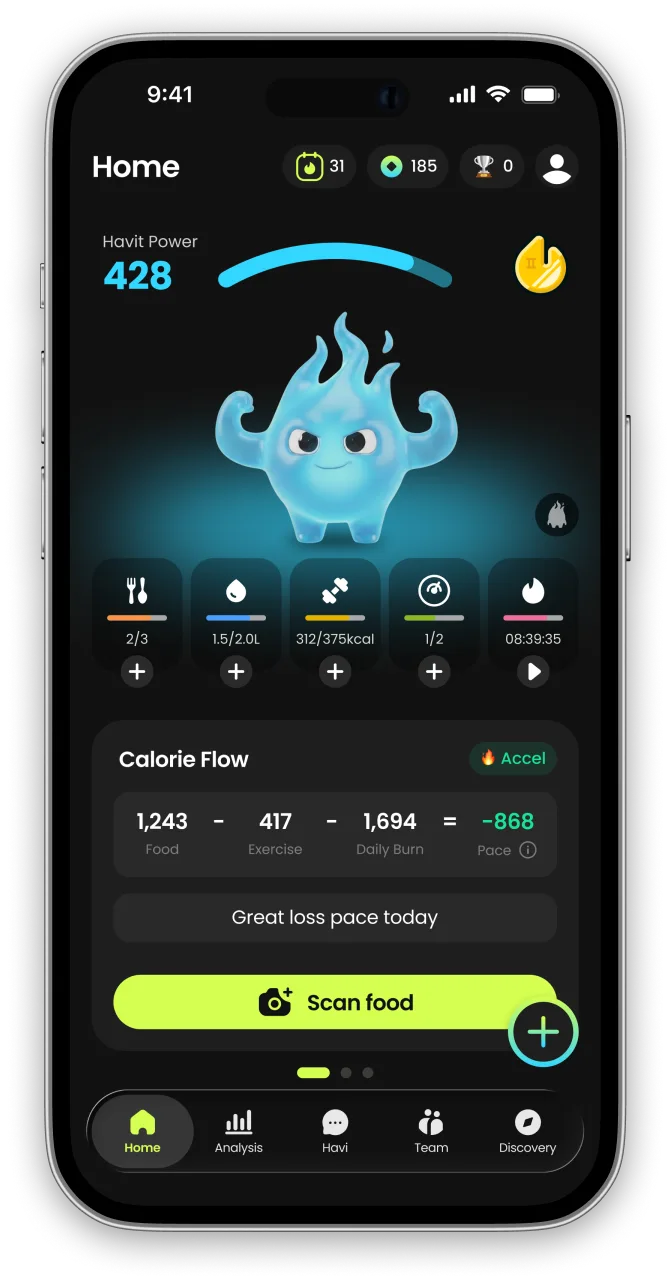
What is Havit?
Havit is an AI health companion for weight loss that protects muscle.
Unlike calorie-only trackers, Havit connects AI body-composition estimates, nutrition, hydration, sleep, steps, cycle, mood, and GLP-1 medication in one daily routine — so progress is measured by body composition, not just the number on the scale. Daily missions turn established behavior-change techniques into small repeatable actions, drawing on expertise from professionals formerly at Juvis Diet, one of Korea’s leading metabolic clinics.
In Havit’s own analysis of 1,090 GLP-1 users, people who logged consistently built stronger habits than the general user base. Read the GLP-1 Habit Report
Havit works with or without GLP-1 medication. It is a wellness app, not a medical device; body-composition results are estimates.

Continue in the App
Personalized wellness with your own data


References
- Misclassification of cardiometabolic health when using BMI categories (Tomiyama et al.) — International Journal of Obesity, 2016
- Waist circumference as a vital sign in clinical practice (Ross et al.) — Nature Reviews Endocrinology, 2020
- Lean tissue imaging (Prado & Heymsfield) — JPEN — Journal of Parenteral and Enteral Nutrition, 2014
- Body composition for obesity risk stratification (Heymsfield et al.) — Obesity Reviews, 2024
- Diabetes Prevention Program — DPP (Knowler et al.) — New England Journal of Medicine, 2002
- Cardiovascular Effects of Intensive Lifestyle Intervention in Type 2 Diabetes (Look AHEAD Research Group) — New England Journal of Medicine, 2013
- Long-term weight loss maintenance (Wing & Phelan) — American Journal of Clinical Nutrition, 2005
- Personalized Nutrition by Prediction of Glycemic Responses (Zeevi et al.) — Cell, 2015
- PREDICT 1: Human postprandial responses to food (Berry et al.) — Nature Medicine, 2020
- STEP 1 — Semaglutide for Adults with Overweight or Obesity (Wilding et al.) — New England Journal of Medicine, 2021
- STEP 3 — Semaglutide + Intensive Behavioral Therapy (Wadden et al.) — JAMA, 2021
- STEP 4 — Continued Treatment with Semaglutide (Rubino et al.) — New England Journal of Medicine, 2021
- SURMOUNT-1 — Tirzepatide for Obesity (Jastreboff et al.) — New England Journal of Medicine, 2022
- Clinical Management of Obesity Guidelines — World Health Organization, 2022
- Standards of Medical Care in Diabetes, §8 — American Diabetes Association, 2024
- Health app use among US adults (Krebs & Duncan) — JMIR mHealth and uHealth, 2015
- Wearable devices and behavior change (Patel et al.) — Annals of Internal Medicine, 2015
- Internal Body Composition Validation Study (n=70) — AI Connect Internal Research, 2025
- Eulji University Clinical Trial (n=150, in progress, KSCI submission planned) — Eulji University, in progress


