

The Hidden Calorie Burn: How Fidgeting and Spontaneous Movement Shape Your Metabolism
Fidgeting and spontaneous movement (NEAT) can account for up to 2,000 calories daily, with lean individuals naturally moving 2.5 hours more than those with obesity—and these patterns can be modified.
This article is for general informational purposes only and is not a substitute for professional medical advice, diagnosis, or treatment. Always consult a qualified healthcare provider with questions about a medical condition.
That Coworker Who Can't Sit Still Might Be Onto Something
You know that person in every office. The one whose leg bounces under the desk during meetings. Who paces while on phone calls. Who seems physically incapable of staying in one position for more than three minutes.
Turns out, their body might be doing something remarkably clever.
A 2024 study published in Science tracked 150 adults in a metabolic chamber for 72 hours, measuring every twitch, shift, and fidget. The results were striking: the most restless participants burned an additional 352 calories per day compared to the stillest ones—without any intentional exercise. That's equivalent to a 40-minute jog, happening automatically while they answered emails and attended Zoom calls.
This phenomenon has a name: Non-Exercise Activity Thermogenesis, or NEAT. And it might be one of the most underappreciated factors in why some people seem to maintain their weight effortlessly while others struggle despite similar diets.
What Exactly Counts as NEAT?
NEAT encompasses every calorie you burn through movement that isn't sleeping, eating, or deliberate exercise. The list is surprisingly long.
Walking to the bathroom. Gesturing while talking. Standing up to grab a coffee. Typing. Cooking dinner. Folding laundry. Even the micro-movements you make while sitting—shifting your weight, crossing and uncrossing your legs, turning your head.
Dr. James Levine at Mayo Clinic, who pioneered much of this research, describes NEAT as "the energy expenditure of daily living." His team found that NEAT can range from 15% to 50% of total daily energy expenditure, depending on the individual and their occupation. A restaurant server might burn 1,400 calories through NEAT alone. A desk worker? Maybe 300.
The gap is enormous. And it's almost entirely unconscious.
The Lean vs. Overweight Movement Gap
Here's where the research gets genuinely fascinating—and a bit uncomfortable.
A landmark study from Obesity journal in 2025 used sophisticated motion-tracking sensors on 287 adults for two weeks. Participants wore the devices 24/7, capturing every movement from major walking bouts to tiny postural adjustments during sleep.
The findings revealed a consistent pattern: lean individuals spent an average of 152 minutes more per day in light physical activity compared to participants with obesity. That's 2.5 extra hours of movement, accumulated in hundreds of small bursts throughout the day.
But which came first? Do lean people fidget more because they're lean, or are they lean because they fidget more?
The same research team attempted to answer this through an overfeeding experiment. They gave participants an extra 1,000 calories daily for eight weeks. Some people's NEAT increased dramatically—their bodies seemed to "waste" the extra energy through increased movement. Others showed almost no change in spontaneous activity. The high-NEAT responders gained an average of 1.4 kg. The low-NEAT responders? 4.3 kg.
Genetics plays a role. So does early life activity patterns. But the encouraging news: NEAT isn't entirely fixed.
Your Brain's Movement Thermostat
The hypothalamus—that almond-sized region controlling hunger, temperature, and dozens of other functions—also regulates spontaneous movement. Think of it as a movement thermostat with a set point.
Some people's thermostats are cranked high. They feel physically uncomfortable sitting still. Their legs bounce. They pace. They take the long route to the printer without consciously deciding to.
Others have thermostats set low. Sitting feels natural. Movement requires deliberate effort. Their bodies conserve energy automatically.
Research from the 2024 Science study identified specific neural circuits involved. Dopamine signaling in the basal ganglia appears crucial—the same circuits involved in motivation and reward. This might explain why stimulant medications often increase fidgeting, and why depression (associated with reduced dopamine function) often decreases spontaneous movement.
But here's the key insight: set points can shift. Not overnight, and not dramatically, but meaningfully.
Environmental Architecture Matters More Than Willpower
Trying to consciously fidget more is exhausting and unsustainable. You'll do it for a day, maybe two, then forget entirely.
The more effective approach: design your environment to require movement.
Researchers at Cornell tested this with office workers. One group received standing desks with anti-fatigue mats. Another got desks positioned farther from printers and bathrooms. A third received both interventions. After three months, the combined group had increased their daily NEAT by an average of 287 calories—without feeling like they were trying.
Small architectural changes compound. A printer down the hall instead of beside your desk. Glasses of water that need refilling every hour. A phone charger in another room. Parking at the far end of the lot.
None of these feel like exercise. That's precisely the point.
The Sitting Disease Paradox
Here's something counterintuitive from the research: people who exercise regularly but sit for long periods still show metabolic problems. A 2024 meta-analysis in The Lancet found that 60 minutes of daily exercise didn't fully offset the effects of 8+ hours of sitting.
But people with high NEAT—even without formal exercise—showed better metabolic markers.
The difference seems to be in how glucose and fat are processed. Muscle contractions, even tiny ones, activate enzymes that help clear fat from the bloodstream. Lipoprotein lipase, for instance, drops by 90% after just one hour of sitting. Fidgeting helps maintain its activity.
This doesn't mean exercise is pointless. It means movement throughout the day might matter as much as concentrated exercise sessions. The ideal? Both.
Practical NEAT Boosters That Actually Stick
Forget advice to "take the stairs." That's been said a million times and rarely changes behavior long-term.
Here's what the research suggests actually works:
Phone call pacing. Set a rule: all phone calls happen while walking. Average call time is 4 minutes. If you take 10 calls daily, that's 40 minutes of walking you weren't doing before.
The water bottle trick. Use a small glass instead of a large bottle. The frequent refills add steps without requiring decisions.
Standing during specific tasks. Not all day—that causes its own problems. But designate certain activities as standing activities. Email review. Video calls. Reading documents.
Commercial break movement. If you watch TV, stand and stretch during ads. Or do this during loading screens if you're a gamer. The interruptions are already built in.
Cooking from scratch. Meal prep involves constant movement—chopping, stirring, reaching, cleaning. Microwaving a frozen dinner? Not so much. The NEAT difference between home cooking and reheating can exceed 100 calories.
Can You Actually Increase Your Set Point?
The honest answer: probably, but modestly.
A 2025 intervention study tracked 89 sedentary adults who adopted NEAT-boosting strategies for six months. At the start, researchers measured their baseline spontaneous movement. At the end, they removed all the environmental modifications and measured again.
Spontaneous movement had increased by 23% even without the environmental cues. The participants' bodies had partially recalibrated. They reported feeling more restless when forced to sit still—something they hadn't experienced before.
The effect wasn't huge. It wasn't transformative. But 23% more NEAT, sustained over years, adds up to meaningful calorie differences.
The researchers hypothesized that consistent movement creates new habits at a neurological level. The basal ganglia, highly involved in habit formation, may gradually encode movement as a default state rather than stillness.
The Genetics Question
Yes, some people are born fidgeters. Twin studies suggest NEAT has a heritability of around 40%—significant, but far from deterministic.
That leaves 60% influenced by environment, habits, and choices.
If you're naturally still, you're working against a slight headwind. You won't become a leg-bouncer through sheer will. But you can absolutely increase your movement through environmental design and habit stacking.
Think of it like introversion. An introvert won't become an extrovert, but they can absolutely build social skills and enjoy social situations. A naturally still person won't become a compulsive fidgeter, but they can absolutely move more throughout their day.
What This Means for Weight Management
NEAT isn't a magic solution. You can't fidget your way out of a 1,000-calorie daily surplus.
But for the margins—the difference between slow weight gain and maintenance, or between maintenance and slow loss—NEAT matters enormously. A 300-calorie daily difference, sustained over a year, equals roughly 14 kg of body weight.
The research increasingly suggests that successful long-term weight maintenance involves high NEAT. A 2024 registry study of people who'd maintained 15+ kg weight loss for over five years found they averaged 2.3 hours more daily light activity than matched controls who'd regained weight.
They weren't running marathons. They were pacing while thinking. Standing while reading. Walking to talk to a colleague instead of sending an email.
Small movements, repeated thousands of times, adding up to something significant.
The leg-bouncer in your office might be onto something after all.
📊 Key Stats
NEAT Response to Overfeeding: High vs. Low Responders
| Characteristic | High NEAT Responders | Low NEAT Responders |
|---|---|---|
| NEAT increase with +1000 kcal/day | +350-500 kcal/day | +50-100 kcal/day |
| Weight gain over 8 weeks | 1.4 kg average | 4.3 kg average |
| Spontaneous standing time | Increased 45 min/day | No significant change |
| Fidgeting frequency | Increased 2.1x | Increased 1.2x |
| Post-study weight retention | Lost 60% of gain in 4 weeks | Retained 80% of gain |
Data from Obesity 2025 overfeeding experiment (n=287, 8-week intervention)
❓ Frequently Asked Questions
How many calories does fidgeting actually burn?
Can I train myself to fidget more?
Why do some people naturally move more than others?
Does a standing desk help with NEAT?
Can exercise compensate for sitting all day?
What's the difference between NEAT and regular exercise?
Do lean people have higher NEAT because they're lean, or vice versa?
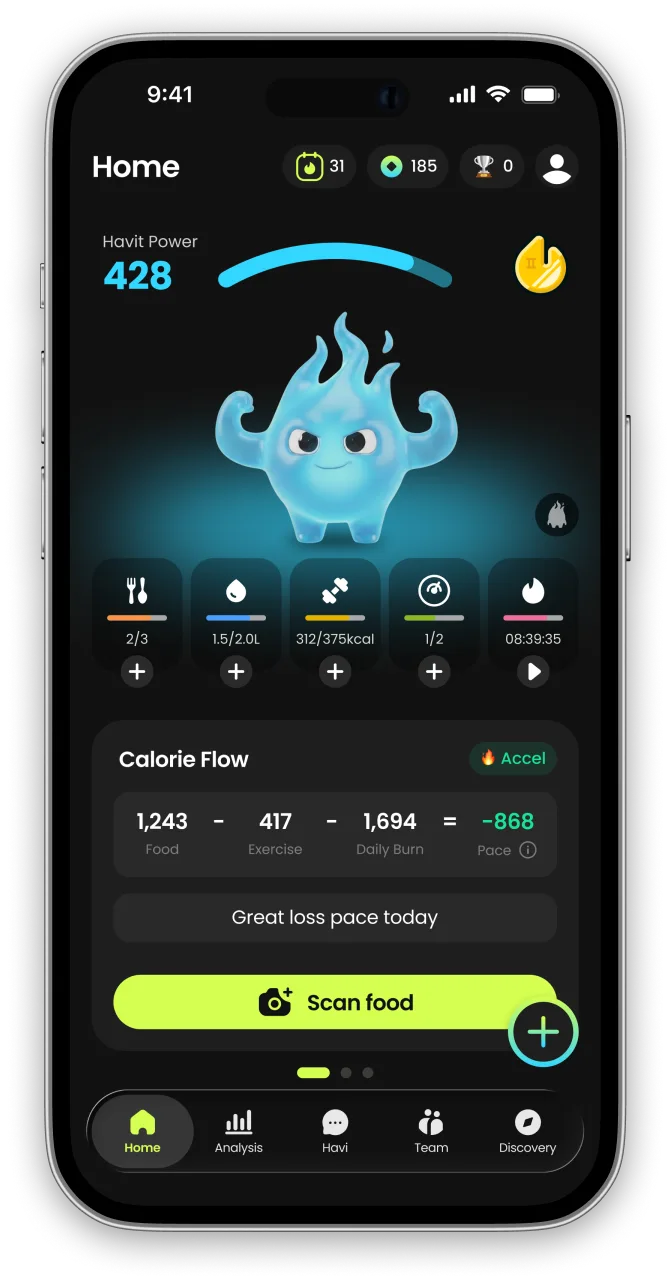
What is Havit?
Havit is an AI health companion for weight loss that protects muscle.
Unlike calorie-only trackers, Havit connects AI body-composition estimates, nutrition, hydration, sleep, steps, cycle, mood, and GLP-1 medication in one daily routine — so progress is measured by body composition, not just the number on the scale. Daily missions turn established behavior-change techniques into small repeatable actions, drawing on expertise from professionals formerly at Juvis Diet, one of Korea’s leading metabolic clinics.
In Havit’s own analysis of 1,090 GLP-1 users, people who logged consistently built stronger habits than the general user base. Read the GLP-1 Habit Report
Havit works with or without GLP-1 medication. It is a wellness app, not a medical device; body-composition results are estimates.

Continue in the App
Personalized wellness with your own data


References
- Individual Variation in Non-Exercise Activity Thermogenesis: A Metabolic Chamber Study — Science, 2024
- Spontaneous Physical Activity Patterns in Lean and Obese Adults: A Motion-Tracking Analysis — Obesity, 2025
- The Role of Non-exercise Activity Thermogenesis in Human Energy Balance — Levine JA, Mayo Clinic Proceedings
- Sedentary Time and Cardiometabolic Health: A Meta-Analysis of Prospective Studies — The Lancet, 2024
- Environmental Modifications and Workplace NEAT: A Randomized Controlled Trial — International Journal of Obesity, 2024


