

Diet Breaks Explained: Why Planned Pauses Actually Accelerate Long-Term Fat Loss
Taking planned 1-2 week breaks at maintenance calories every 4-8 weeks of dieting can preserve metabolic rate and improve long-term fat loss by up to 50% compared to continuous restriction.
This article is for general informational purposes only and is not a substitute for professional medical advice, diagnosis, or treatment. Always consult a qualified healthcare provider with questions about a medical condition.
What If Eating More Could Help You Lose More?
Here's a number that stopped me cold: 80% of people who lose significant weight regain it within five years. Not because they lack willpower. Not because they stopped caring. Because their bodies fought back—and won.
But buried in the research is a counterintuitive finding that's changing how smart dieters approach fat loss. People who strategically pause their diets lose more weight long-term than those who white-knuckle through continuous restriction. The key word is strategic.
This isn't about cheat days or falling off the wagon. It's about planned metabolic resets that keep your body from sabotaging your progress.
Your Body Has a Thermostat (And It's Fighting You)
When you cut calories, your body doesn't just passively burn fat. It adapts. Aggressively.
Within weeks of sustained calorie restriction, several things happen simultaneously. Your thyroid hormone T3 drops, slowing your metabolic rate. Leptin—the hormone that signals fullness—plummets. Ghrelin, the hunger hormone, spikes. Your NEAT (non-exercise activity thermogenesis) decreases, meaning you fidget less, take fewer steps, and generally move less without even noticing.
This phenomenon has a name: adaptive thermogenesis. And it's remarkably powerful. A 2024 study in the International Journal of Obesity found that participants on continuous calorie restriction experienced metabolic adaptation averaging 15% beyond what their weight loss alone would predict. Their bodies were burning significantly fewer calories than expected.
The cruel irony? The more successful your diet, the harder your body fights to undo it.
The MATADOR Study Changed Everything
In 2017, researchers at the University of Tasmania ran an experiment that made nutrition scientists sit up straight.
They took 51 obese men and split them into two groups. Both groups ate the same total calories over the study period—a 33% deficit from their maintenance needs. The difference? One group dieted continuously for 16 weeks. The other alternated: two weeks of dieting, two weeks at maintenance calories, repeated until they'd accumulated the same 16 weeks of actual restriction.
The results weren't subtle. The intermittent group lost 47% more weight. But here's what really mattered: six months after the study ended, the intermittent group had maintained significantly more of their loss. Their metabolic rates hadn't crashed as severely.
This study launched a wave of research into what we now call intermittent energy restriction—strategic breaks designed to give your metabolism a breather.
How Diet Breaks Actually Work
The mechanism isn't magic. It's hormonal.
When you return to maintenance calories for 1-2 weeks, several things normalize. Leptin levels partially recover, reducing the constant hunger that makes diets fail. Thyroid function improves. Cortisol drops. Your body stops perceiving a famine and relaxes its death grip on your fat stores.
A 2025 analysis published in Obesity examined 12 controlled trials on diet breaks and found consistent patterns. Participants who incorporated planned maintenance phases showed 23% less metabolic adaptation compared to continuous dieters. Their resting metabolic rates stayed closer to predicted values.
There's a psychological component too. Knowing a break is coming makes the restriction tolerable. One study participant described it as "running toward a finish line instead of running forever." That mental shift matters more than most people realize.
The Practical Protocol: What Actually Works
Research points to a few evidence-based approaches.
The 2:1 method involves two weeks of calorie deficit followed by one week at maintenance. This is gentler and works well for moderate deficits (15-20% below maintenance). The MATADOR-style protocol uses two weeks on, two weeks off, which produced the strongest results in research but requires patience—your timeline doubles.
For most people, a middle ground works best: 4-6 weeks of deficit followed by 10-14 days at maintenance. This balances momentum with metabolic recovery.
During your break, the goal is maintenance—not surplus. You're not trying to gain. You're eating at the calorie level your body would need to stay stable at your current weight. For someone who's been eating 1,800 calories in a deficit, that might mean 2,200-2,400 during the break.
Protein stays high. Training stays consistent. You're just giving your hormones room to recalibrate.
Who Benefits Most From Diet Breaks?
Not everyone needs them equally.
If you're losing 0.5-1% of body weight weekly and feeling fine, you might push 8-10 weeks before your first break. But certain signs suggest you need one sooner: persistent fatigue that sleep doesn't fix, strength declining in the gym despite adequate protein, hunger that's become genuinely intrusive, sleep quality tanking, or mood changes that your partner has started commenting on.
People with more weight to lose often benefit from longer diet phases. Those already lean—say, under 20% body fat for men or under 28% for women—typically need more frequent breaks because their bodies resist further loss more aggressively.
One telling pattern from the research: women often need breaks more frequently than men, likely due to greater hormonal sensitivity to energy restriction. A 2024 paper noted that female participants showed metabolic adaptation markers approximately two weeks earlier than male participants on identical protocols.
Common Mistakes That Sabotage Diet Breaks
The biggest error is treating the break as a free-for-all. Maintenance means maintenance. Going into surplus for two weeks erases much of your progress and doesn't provide additional metabolic benefit.
Another mistake: cutting the break short because you feel guilty. The hormonal recovery takes time. Leptin, for instance, requires about 10-14 days of adequate calories to meaningfully recover. A three-day break does almost nothing physiologically—it's just a mental reset.
Some people also drop their training intensity during breaks, figuring they need complete rest. This backfires. Resistance training during maintenance phases helps partition incoming calories toward muscle rather than fat. Keep lifting.
Finally, don't weigh yourself obsessively during the break. You will see the scale jump—sometimes 3-5 pounds in the first few days. This is water, glycogen, and food volume. It's not fat. Panic-restricting in response defeats the entire purpose.
The Long Game: Why This Matters for Maintenance
Here's what makes diet breaks genuinely important: they train you for maintenance.
Most diets fail not during the restriction phase but afterward. People don't know how to eat at maintenance. They've spent months in deficit mode, and when they hit their goal, they either keep restricting (unsustainable) or overcorrect into surplus (regain).
Diet breaks give you practice. Every break is a rehearsal for the rest of your life. You learn what maintenance calories feel like. You prove to yourself that eating more doesn't mean instant weight gain. You build the skills you'll need forever.
The 2025 Obesity paper noted something striking: participants who used intermittent energy restriction reported significantly higher confidence in maintaining their weight loss compared to continuous dieters. They'd already done it—multiple times, during their breaks.
Putting It Together: A Sample Timeline
Imagine someone starting at 200 pounds, aiming to lose 30 pounds. A continuous approach might take 20-25 weeks of grinding restriction, followed by regain because their metabolism has adapted and they're exhausted.
An intermittent approach looks different. Weeks 1-5: deficit. Week 6-7: maintenance break. Weeks 8-13: deficit. Weeks 14-15: break. Continue the pattern. Total calendar time might be 35 weeks instead of 25—but the weight stays off.
The research suggests this isn't just about total pounds lost. It's about the quality of weight loss. Intermittent dieters in the MATADOR study lost proportionally more fat and less muscle than continuous dieters. Their body composition improved more favorably.
That matters. Losing 30 pounds of mostly fat is completely different from losing 30 pounds that includes significant muscle. The first leaves you leaner and stronger. The second leaves you lighter but metabolically worse off.
The Counterintuitive Truth About Patience
Diet culture sells speed. Lose 10 pounds in 10 days. Six-week transformations. Before-and-after photos that compress months into a swipe.
But the research tells a different story. The people who keep weight off aren't the fastest losers. They're the strategic ones. They understand that a body fighting against you is a body that will eventually win.
Diet breaks aren't a sign of weakness or lack of commitment. They're a sign you understand the game. Your metabolism isn't your enemy—it's a system responding to signals. Send better signals, get better results.
The 80% regain statistic doesn't have to be your story. But avoiding it requires playing a longer, smarter game than most people are willing to play.
📊 Key Stats
Continuous vs. Intermittent Dieting Approaches
| Factor | Continuous Restriction | Intermittent (Diet Breaks) |
|---|---|---|
| Total weight lost (16 weeks of deficit) | Baseline | 47% more in MATADOR study |
| Metabolic adaptation severity | Higher (15%+ beyond predicted) | Lower (23% reduction) |
| Muscle preservation | Lower | Higher |
| Hunger/leptin recovery | None during diet | Partial recovery each break |
| Calendar time required | Shorter | Longer (roughly 1.5-2x) |
| Long-term maintenance success | Lower confidence reported | Higher confidence reported |
| Psychological sustainability | Often decreases over time | Maintained or improved |
Comparison based on controlled trials including MATADOR (2017) and subsequent research through 2025
❓ Frequently Asked Questions
How long should a diet break last?
Will I gain weight during a diet break?
How do I calculate maintenance calories for my break?
Can I still lose weight during a diet break?
How often should I take diet breaks?
Should I change my exercise routine during a diet break?
Are diet breaks the same as refeed days?
What is Havit?
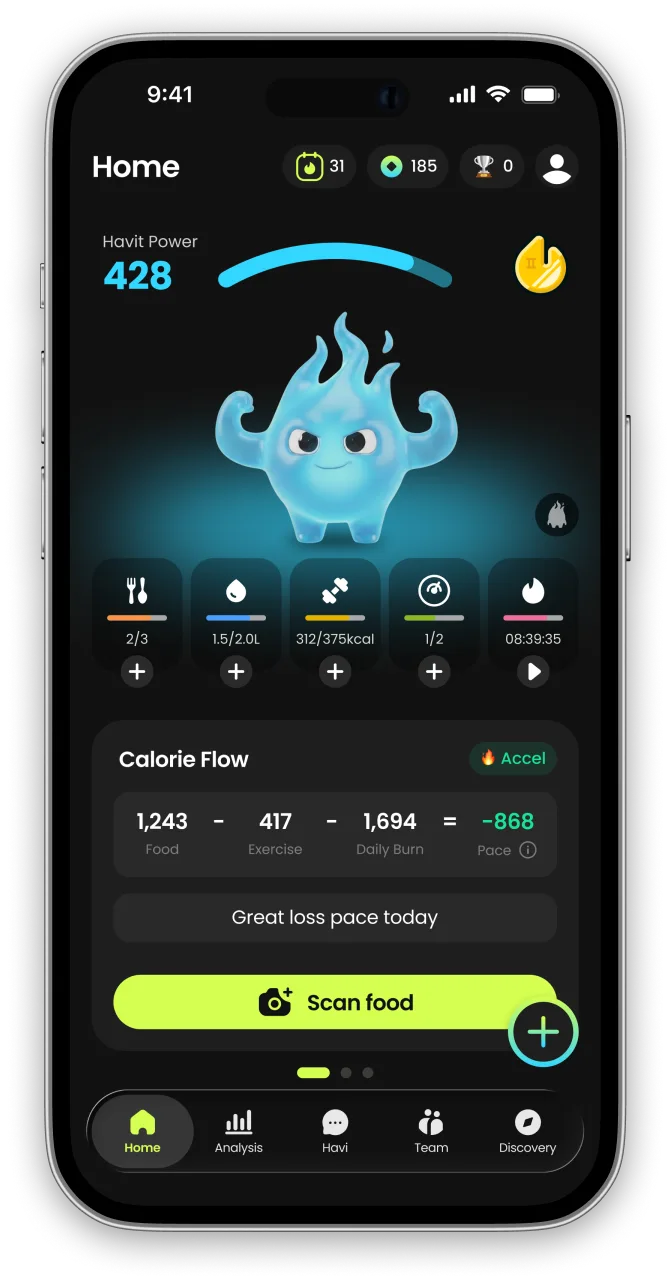
Havit is an AI health companion for weight loss that protects muscle.
Unlike calorie-only trackers, Havit connects AI body-composition estimates, nutrition, hydration, sleep, steps, cycle, mood, and GLP-1 medication in one daily routine — so progress is measured by body composition, not just the number on the scale. Daily missions turn established behavior-change techniques into small repeatable actions, drawing on expertise from professionals formerly at Juvis Diet, one of Korea’s leading metabolic clinics.
In Havit’s own analysis of 1,090 GLP-1 users, people who logged consistently built stronger habits than the general user base. Read the GLP-1 Habit Report
Havit works with or without GLP-1 medication. It is a wellness app, not a medical device; body-composition results are estimates.

Continue in the App
Personalized wellness with your own data


References
- Intermittent energy restriction improves weight loss efficiency in obese men: the MATADOR study — International Journal of Obesity, Byrne et al., 2017
- Metabolic adaptation to intermittent versus continuous energy restriction: a systematic review — International Journal of Obesity, 2024
- Diet break protocols and long-term weight maintenance outcomes — Obesity, 2025
- Adaptive thermogenesis in humans: mechanisms and clinical implications — International Journal of Obesity, Rosenbaum & Leibel, 2010
- Leptin and the regulation of body weight in mammals — Nature, Friedman & Halaas, 1998


