

Creatine from Food vs Supplements: Why You'd Need 2 Pounds of Steak Daily
Getting 5g of creatine from food alone would require eating roughly 1kg of raw beef daily, making supplementation the only practical option for performance doses.
This article is for general informational purposes only and is not a substitute for professional medical advice, diagnosis, or treatment. Always consult a qualified healthcare provider with questions about a medical condition.
The Steak Math Nobody Wants to Hear
Here's a question that kept me up last night: if creatine is "naturally found in meat," why does anyone bother with supplements?
I decided to do the actual math. And let me tell you, the numbers are absurd.
The standard creatine dose that research supports—the one that actually improves strength and power output—is 3 to 5 grams per day. Your body makes about 1 gram on its own. So you need to get the rest somewhere. Simple enough, right?
Except when you look at how much creatine is actually in food, the whole "just eat more meat" argument falls apart spectacularly.
What's Actually in Your Protein Sources
Raw beef contains roughly 4.5 grams of creatine per kilogram. That sounds decent until you realize we're talking about raw weight—and that cooking destroys about 30% of the creatine content. A 2024 analysis in the Journal of the International Society of Sports Nutrition confirmed this thermal degradation problem.
So your cooked 8-ounce ribeye? It's delivering maybe 1 gram of creatine. Maybe.
Herring is actually the creatine champion of the food world, packing 6.5 to 10 grams per kilogram raw. But unless you're eating pickled herring for breakfast, lunch, and dinner (some Scandinavians might, no judgment), this isn't practical either.
Pork sits around 5 grams per kilogram raw. Salmon offers about 4.5 grams. Chicken breast? A measly 3.4 grams per kilogram—and that's before you grill it.
The Grocery Bill From Hell
Let's calculate what hitting 5 grams daily from food alone actually requires.
To get 5 grams of creatine from beef, accounting for cooking losses, you'd need to consume approximately 1.1 kilograms (2.4 pounds) of cooked beef. Every single day.
At current U.S. beef prices averaging $7.50 per pound for decent cuts, that's $18 daily. $540 per month. Just for creatine.
A tub of creatine monohydrate costs about $25 and lasts two months.
I'm not a financial advisor, but one of these options seems slightly more sustainable.
The Vegetarian Creatine Problem
If you don't eat meat, your situation is even more complicated. A 2025 study in Nutrients examining dietary creatine sources found that vegetarians and vegans have 20-30% lower muscle creatine stores than omnivores.
Plant foods contain essentially zero creatine. None. Your body can synthesize creatine from amino acids (glycine, arginine, and methionine), but the production rate maxes out around 1-2 grams daily regardless of how much protein you eat.
This isn't a moral judgment about diet choices. It's just chemistry. If you want the performance benefits that research consistently shows at 3-5 gram doses, and you don't eat meat, supplementation isn't optional—it's the only path.
What the Research Actually Shows About Dosing
The International Society of Sports Nutrition's 2024 position stand reviewed over 500 studies on creatine. Their conclusion: 3-5 grams of creatine monohydrate daily is effective for increasing muscle creatine stores, improving high-intensity exercise performance, and supporting muscle recovery.
Some people do a "loading phase" of 20 grams daily for 5-7 days to saturate muscles faster. Others just take 5 grams daily and reach the same saturation point in about 4 weeks.
Either way, we're talking about amounts that food simply cannot deliver without turning every meal into a competitive eating challenge.
The Absorption Reality Check
Here's something that makes the food-vs-supplement comparison even more lopsided: creatine monohydrate powder has near-perfect bioavailability. Your gut absorbs almost all of it.
Creatine from whole food sources? The absorption rate varies wildly depending on the protein matrix, cooking method, and what else you ate with it. That herring creatine might be impressive on paper, but your actual uptake could be 60-80% of the theoretical amount.
A 2025 Nutrients review noted that the "effective creatine" from food is consistently lower than raw content numbers suggest, though exact absorption rates vary by individual.
Who Actually Needs Supplemental Creatine
Not everyone does. If you're not doing high-intensity training, not trying to maximize strength gains, and not concerned about the cognitive benefits (yes, creatine helps your brain too), then the 1-2 grams your body makes plus whatever you get from occasional meat consumption might be fine.
But if you're training seriously? If you're over 50 and trying to maintain muscle mass? If you follow a plant-based diet? If you're an athlete in a power or sprint sport?
The math doesn't lie. You're not eating your way to 5 grams daily unless you have an extremely unusual relationship with raw herring.
The Bottom Line on Food Creatine
I love a good steak as much as anyone. But I eat it because it tastes good, not because I'm trying to hit my creatine targets.
The whole "get it from food" argument works for most nutrients. Vitamin C from oranges. Protein from eggs. Omega-3s from salmon. These are reasonable food-first strategies.
Creatine is different. The therapeutic dose is simply too high relative to food content. You'd need to restructure your entire diet around creatine delivery, spending hundreds of dollars monthly on meat while consuming calories you probably don't need.
Or you could spend $12.50 a month on powder that dissolves in water.
Sometimes the supplement really is the smarter choice.
📊 Key Stats
Creatine Content by Food Source
| Food Source | Creatine (g/kg raw) | Amount Needed for 5g | Monthly Cost (USD) |
|---|---|---|---|
| Herring | 6.5-10 | 500-770g daily | ~$450 |
| Beef | 4.5 | 1.1kg daily | ~$540 |
| Pork | 5.0 | 1kg daily | ~$360 |
| Salmon | 4.5 | 1.1kg daily | ~$720 |
| Chicken Breast | 3.4 | 1.5kg daily | ~$400 |
| Creatine Monohydrate Powder | 1000 (pure) | 5g daily | ~$12.50 |
Food amounts calculated for 5g creatine intake, adjusted for ~30% cooking losses where applicable
❓ Frequently Asked Questions
Can I get enough creatine from a normal diet?
Does cooking meat destroy all the creatine?
Is creatine supplementation necessary for vegetarians?
Why is creatine monohydrate specifically recommended?
How long does it take to see results from creatine supplementation?
Is it safe to take creatine long-term?
What's the best time to take creatine?
What is Havit?
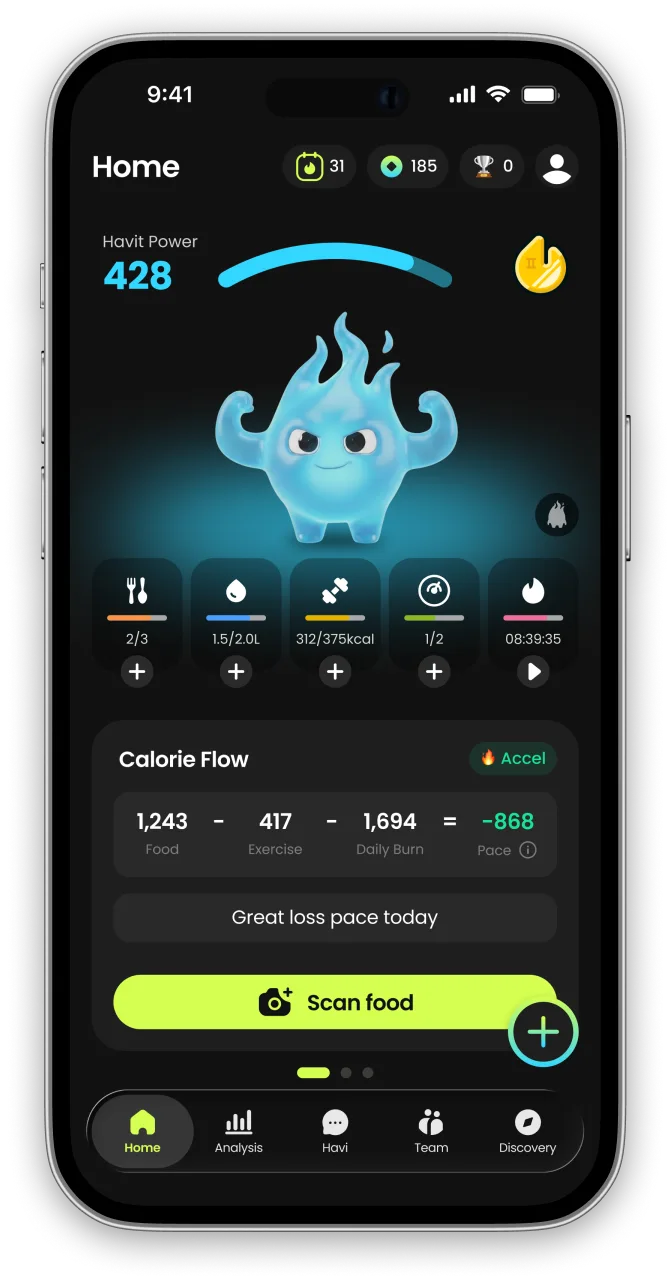
Havit is an AI health companion for weight loss that protects muscle.
Unlike calorie-only trackers, Havit connects AI body-composition estimates, nutrition, hydration, sleep, steps, cycle, mood, and GLP-1 medication in one daily routine — so progress is measured by body composition, not just the number on the scale. Daily missions turn established behavior-change techniques into small repeatable actions, drawing on expertise from professionals formerly at Juvis Diet, one of Korea’s leading metabolic clinics.
In Havit’s own analysis of 1,090 GLP-1 users, people who logged consistently built stronger habits than the general user base. Read the GLP-1 Habit Report
Havit works with or without GLP-1 medication. It is a wellness app, not a medical device; body-composition results are estimates.

Continue in the App
Personalized wellness with your own data


References
- International Society of Sports Nutrition Position Stand: Creatine Supplementation and Exercise — Journal of the International Society of Sports Nutrition, 2024
- Dietary Creatine Sources and Bioavailability in Human Nutrition — Nutrients, 2025
- Creatine Content of Foods and Effects of Cooking Methods — Journal of the International Society of Sports Nutrition, 2024
- Vegetarian and Vegan Diets: Impact on Muscle Creatine Stores — Nutrients, 2025


