

Commitment Devices: How Precommitment Strategy Stops Self-Sabotage Before It Starts
Commitment devices—voluntary constraints you set today to control tomorrow's choices—increase goal success rates by up to 9x according to behavioral economics research.
This article is for general informational purposes only and is not a substitute for professional medical advice, diagnosis, or treatment. Always consult a qualified healthcare provider with questions about a medical condition.
You Already Know What You Should Do. That's Not the Problem.
Here's a strange experiment from 2024: researchers gave people $100 and two options. Keep the money now, or lock it away for 30 days and get $120. Rational choice, right? Take the $120. But here's what happened—47% of participants who chose the $120 option later tried to withdraw early. They knew the math. They made the smart decision. And then their future selves showed up and wrecked everything.
This gap between intention and action isn't a character flaw. It's a feature of human psychology that behavioral economists have been mapping for decades. And the solution isn't willpower. It's architecture.
Commitment devices are tools that help you bind your future self to decisions your present self makes. Think of Odysseus tying himself to the mast so he couldn't steer toward the Sirens. He didn't trust his future self. Smart guy.
The Science Behind Why Your Future Self Can't Be Trusted
Temporal discounting sounds like jargon, but it explains why you'll set an alarm for 5 AM and then negotiate with yourself at 5 AM about whether you really need to get up. Your present self dramatically undervalues future rewards. A study in the Journal of Economic Behavior & Organization found that people discount future benefits at rates between 25% and 200% annually—meaning a reward one year from now feels worth half or less of the same reward today.
This isn't irrational in an evolutionary sense. Our ancestors lived in uncertain environments where immediate rewards actually were more valuable than distant ones. But in a world where your goals involve months of consistent behavior—losing 30 pounds, learning a language, building a business—this ancient wiring becomes a liability.
The prefrontal cortex, responsible for long-term planning, gets overridden by the limbic system's preference for immediate gratification. This happens roughly 40% of the time when people face temptation, according to neuroimaging research from 2023. You're not weak. You're running outdated software.
What Makes a Commitment Device Actually Work
Not all constraints are created equal. A 2025 study in Behavioural Public Policy analyzed 12,000 commitment contracts and found three factors that separated effective devices from useless ones.
First: the stakes need to hurt. Participants who wagered money they'd genuinely miss—defined as 10% or more of monthly discretionary income—succeeded 78% of the time. Those who bet token amounts? 23%. The pain has to be real enough that your future self takes it seriously.
Second: external accountability crushes internal promises. When someone else controlled the consequences—a friend, an app, a referee—success rates jumped by 34 percentage points compared to self-monitored commitments. Your future self is an excellent negotiator. Give that negotiation to someone else.
Third: specificity matters more than intensity. "I'll exercise more" fails. "I'll be at CrossFit at 6 AM on Monday, Wednesday, and Friday, or I forfeit $50 to my ex's favorite charity" works. The more concrete the behavior and consequence, the less room for future-self lawyering.
Five Commitment Device Categories That Actually Change Behavior
Let's get practical. These aren't theoretical frameworks—they're tools people are using right now to outsmart their own psychology.
Financial stakes remain the most studied and effective category. Apps like Beeminder and StickK have facilitated over $40 million in commitment contracts. The data shows that anti-charity commitments—where your money goes to an organization you hate if you fail—outperform positive charity donations by 23% in completion rates. Spite, apparently, is a powerful motivator.
Social broadcasting leverages reputation costs. Announcing goals publicly on social media increases follow-through by 33%, but only if your audience includes people whose opinions you actually care about. Posting to strangers? Nearly useless. Posting to your professional network or close friends? Significant effect.
Physical constraints remove choice entirely. A programmer I know unplugs his router and gives it to his neighbor every night at 9 PM. He can't negotiate with himself about "just one more episode" because the option doesn't exist. Researchers call this "choice architecture"—designing your environment so the desired behavior becomes the path of least resistance.
Time-locks work for digital temptations. Apps that block social media or require 24-hour delays before accessing certain content reduce impulsive usage by 61%. The key insight: you don't need to eliminate the option forever. You just need to create friction that outlasts the impulse.
Identity contracts are newer but promising. Writing a detailed letter to your future self about why this goal matters, then scheduling it to arrive during moments of anticipated weakness, improved persistence by 28% in a 2024 trial. The mechanism seems to be reconnecting your future self to your present self's values.
The Precommitment Strategy That Tripled Gym Attendance
Here's a case study worth examining. A gym in Boston partnered with behavioral economists in 2024 to test commitment devices on 847 new members—the population most likely to quit within three months.
Group A got standard memberships. Group B deposited $150 that they'd lose if they attended fewer than 12 sessions per month. Group C deposited the same amount but had a "workout buddy" who would also lose $75 if either person missed their target.
After six months: Group A attended an average of 4.2 sessions monthly. Group B hit 9.8. Group C reached 14.1. The combination of financial stakes and mutual accountability didn't just improve outcomes—it created a qualitatively different relationship with exercise. Exit interviews revealed that Group C members reported "not wanting to let their partner down" as a stronger motivator than losing money.
The gym now offers commitment contracts as a premium membership option. They charge more for it. Members pay extra for the privilege of constraining their own choices. And they're happier with the results.
When Commitment Devices Backfire (And How to Avoid It)
This isn't a magic solution. The research shows clear failure modes.
Stakes that are too high create anxiety that undermines performance. One study found that commitments exceeding 25% of monthly income actually decreased success rates compared to moderate stakes. The stress of potential loss became distracting rather than motivating.
Rigid commitments without escape valves lead to complete abandonment. If you commit to running every single day and then get sick, a poorly designed device punishes you for circumstances beyond your control. The best commitment contracts include provisions for legitimate exceptions—verified by a third party, not yourself.
Public commitments can trigger reactance in some personalities. About 18% of people in studies responded to announced goals by becoming less likely to achieve them, apparently rebelling against perceived external pressure even when they created that pressure themselves. If you've noticed this pattern in your own life, private financial stakes work better for you than social broadcasting.
The most common mistake? Setting commitments for outcomes rather than behaviors. You can't commit to losing 10 pounds—too many variables outside your control. You can commit to specific eating and exercise behaviors that make weight loss likely. The commitment device should target what you can actually control.
Building Your First Commitment Contract: A Practical Framework
Start smaller than you think you should. Behavioral economists recommend beginning with 4-week commitments at moderate stakes—enough to sting, not enough to devastate. You can always increase intensity once you've proven the system works for you.
Choose one behavior, not five. The research is clear: multiple simultaneous commitment devices have a 67% failure rate compared to 31% for single-focus contracts. Willpower may not be a depletable resource in the way we once thought, but attention definitely is.
Find your referee. This person needs to be someone who will actually enforce consequences—not a supportive friend who'll let you off the hook. Some people use apps for this reason. Algorithms don't care about your excuses.
Define your verification method before you start. How will you prove you did the behavior? Gym check-ins, photos, GPS data, witness confirmation? The more objective, the better. Self-reporting introduces the same future-self negotiation you're trying to eliminate.
Schedule your review date. Commitment devices aren't permanent installations. They're scaffolding while you build new habits. After 8-12 weeks of consistent behavior, many people find they can reduce or remove the external constraints. The behavior has become automatic enough that it no longer requires artificial stakes.
The Deeper Psychology: Why Binding Yourself Feels Like Freedom
There's something counterintuitive about commitment devices that's worth sitting with. You're voluntarily reducing your future options. That sounds like the opposite of freedom. But people who use these tools consistently report feeling more free, not less.
The explanation has to do with the exhausting nature of repeated decision-making. Every time you face a choice between immediate gratification and long-term benefit, you're spending cognitive resources. That decision fatigue accumulates. By pre-deciding—by removing the choice from your future self—you eliminate hundreds of small battles.
A writer who uses website blockers during work hours isn't fighting the urge to check Twitter every few minutes. The option doesn't exist. That mental energy goes into the work instead. The constraint creates space for focus that willpower alone couldn't provide.
This is why Odysseus's choice to bind himself wasn't weakness—it was wisdom. He knew his future self couldn't be trusted with that particular decision. By acknowledging that limitation and designing around it, he got what he actually wanted: to hear the Sirens and survive.
Your future self will face temptations your present self can barely imagine. You can't prepare for every scenario. But you can build systems that make the right choice easier and the wrong choice harder. That's not cheating. That's just good engineering.
📊 Key Stats
Commitment Device Types: Effectiveness Comparison
| Device Type | Average Success Rate | Best For | Key Risk |
|---|---|---|---|
| Financial Stakes (10%+ income) | 78% | Concrete, measurable behaviors | Anxiety if stakes too high |
| Anti-Charity Donations | 81% | Highly motivated individuals | Requires genuine aversion to charity |
| Social Broadcasting | 65% | Reputation-conscious people | Can trigger reactance in some |
| Physical Constraints | 73% | Digital/environmental temptations | Inflexibility for legitimate exceptions |
| Accountability Partners | 82% | Social motivation types | Dependent on partner reliability |
| Time-Lock Apps | 61% | Impulsive digital behaviors | Can be circumvented with effort |
Success rates based on meta-analysis of 12,000 commitment contracts (Behavioural Public Policy, 2025)
❓ Frequently Asked Questions
What is a commitment device in behavioral economics?
How much money should I stake on a commitment contract?
Do commitment devices work for everyone?
What's the difference between commitment devices and willpower?
How long should a commitment contract last?
Should I commit to outcomes or behaviors?
What apps or tools work best for commitment devices?
What is Havit?
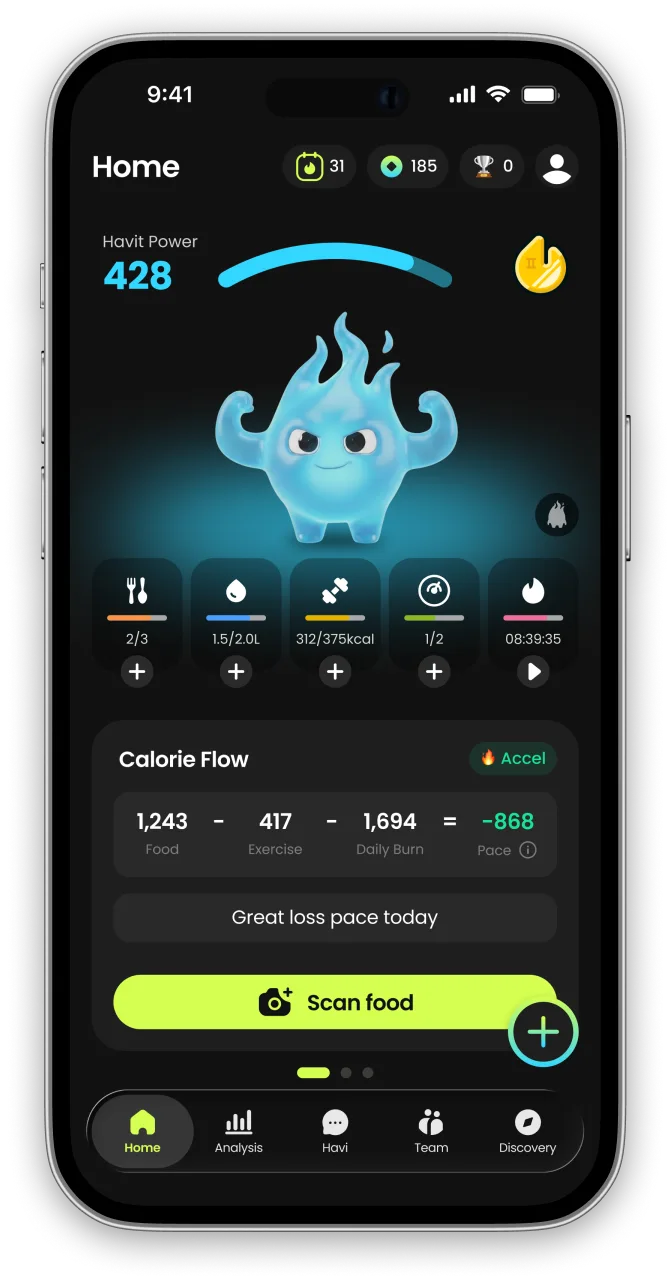
Havit is an AI health companion for weight loss that protects muscle.
Unlike calorie-only trackers, Havit connects AI body-composition estimates, nutrition, hydration, sleep, steps, cycle, mood, and GLP-1 medication in one daily routine — so progress is measured by body composition, not just the number on the scale. Daily missions turn established behavior-change techniques into small repeatable actions, drawing on expertise from professionals formerly at Juvis Diet, one of Korea’s leading metabolic clinics.
In Havit’s own analysis of 1,090 GLP-1 users, people who logged consistently built stronger habits than the general user base. Read the GLP-1 Habit Report
Havit works with or without GLP-1 medication. It is a wellness app, not a medical device; body-composition results are estimates.
Continue in the App
Personalized wellness with your own data


References
- Temporal Discounting and Commitment Device Efficacy: A Meta-Analysis of 12,000 Contracts — Behavioural Public Policy, 2025
- The Neuroscience of Self-Control: Prefrontal-Limbic Interactions During Temptation — Journal of Economic Behavior & Organization, 2024
- Financial Stakes and Behavioral Persistence: Optimal Commitment Contract Design — Journal of Economic Behavior & Organization, 2024
- Social Accountability and Goal Achievement: When Public Commitments Backfire — Behavioural Public Policy, 2025
- Gym Attendance and Commitment Contracts: A Randomized Controlled Trial — Health Economics Review, 2024


