

Skipping Breakfast: Metabolism Killer or Intermittent Fasting in Disguise?
Skipping breakfast doesn't inherently harm metabolism—but when you eat your other meals determines whether it helps or hurts.
This article is for general informational purposes only and is not a substitute for professional medical advice, diagnosis, or treatment. Always consult a qualified healthcare provider with questions about a medical condition.
The 7 AM Panic That Started Everything
My friend Sarah texted me at 6:47 AM last Tuesday: "I've been skipping breakfast for three months and I think I broke my metabolism." She'd gained four pounds. Her energy crashed by 2 PM daily. And she was convinced that everything she'd read about intermittent fasting had been a lie.
Here's the thing. Sarah wasn't wrong to skip breakfast. She was wrong about everything else she did afterward.
The breakfast debate has raged for decades, but 2024 and 2025 brought genuinely new answers. Researchers finally separated the mythology from the mechanisms. What they found surprised everyone—including the scientists themselves.
What Actually Happens When You Skip That Morning Meal
Your body doesn't have a "breakfast sensor" that triggers metabolic shutdown at 9 AM. That's not how any of this works.
When you wake up, cortisol peaks naturally—it's called the cortisol awakening response. This hormone mobilizes energy from stored fat and glycogen. Your body is literally designed to function without immediate food in the morning. Our ancestors didn't have refrigerators.
The American Journal of Clinical Nutrition published a 12-week controlled trial in 2024 that tracked 116 adults. Half ate breakfast within an hour of waking. Half skipped it entirely. The result? No significant difference in resting metabolic rate between groups. Zero. The "breakfast fires up your metabolism" claim died in that study.
But wait. If skipping breakfast doesn't slow metabolism, why do some people gain weight doing it?
The Compensation Problem Nobody Talks About
Here's where Sarah went wrong.
She skipped breakfast, then ate a 900-calorie lunch because she was "starving." She snacked at 4 PM because her blood sugar crashed. Dinner became her biggest meal—often after 8 PM. By bedtime, she'd consumed more calories than when she ate breakfast, just compressed into a smaller window at the wrong time.
Researchers call this "caloric compensation," and it's shockingly common. A 2023 analysis of breakfast-skipping studies found that 67% of participants who dropped morning meals ate more total daily calories than those who didn't. The breakfast itself wasn't the problem. The chaotic eating pattern that replaced it was.
The human body responds to meal timing in ways we're only beginning to understand. Your pancreas releases insulin more efficiently in the morning. Your gut bacteria follow circadian rhythms. Even your fat cells store energy differently depending on the hour.
Early vs. Late Time-Restricted Eating: The Plot Twist
This is where the 2025 research gets genuinely interesting.
Cell Metabolism published a head-to-head comparison that nobody expected. Researchers took 90 adults and split them into two groups practicing time-restricted eating (intermittent fasting's scientific name). Both groups ate within an 8-hour window. Same total calories. Same macronutrient ratios.
The only difference? One group ate from 7 AM to 3 PM. The other ate from 12 PM to 8 PM.
After 14 weeks, the early eating group showed 2.3x greater fat loss. Their fasting insulin dropped 26% more. Blood pressure improved significantly in the early group but barely budged in the late group.
Same fasting duration. Radically different outcomes.
The researchers proposed a mechanism: early time-restricted eating aligns with your circadian rhythm. Late eating fights against it. Your body processes food better when the sun is high. Evolution didn't prepare us for 9 PM pasta.
The Cortisol Connection
Remember that morning cortisol spike? It's not just about waking you up.
Cortisol primes your cells to receive and use glucose efficiently. It enhances insulin sensitivity temporarily. This is why the same bowl of oatmeal produces a smaller blood sugar spike at 8 AM than at 8 PM—your body literally handles it better.
When you skip breakfast and then eat your first meal at noon, you're still getting some benefit from this morning metabolic priming. But when you push eating to evening hours, you're working against your biology.
One study tracked continuous glucose monitors on 29 participants eating identical meals at different times. The 7 PM meal produced blood sugar peaks 44% higher than the 7 AM meal. Same food. Same people. Different clocks.
So Is Skipping Breakfast Good or Bad?
Wrong question.
The right question: What happens after you skip breakfast?
If you skip breakfast and eat a moderate lunch at noon, a reasonable dinner by 6 PM, and nothing afterward—you're essentially doing early time-restricted eating. The research suggests this might actually benefit metabolic health.
If you skip breakfast, demolish a huge lunch at 2 PM, snack until dinner, and eat your biggest meal at 9 PM—you're doing late time-restricted eating with chaotic compensation. The research suggests this will probably backfire.
The breakfast itself is almost irrelevant. The downstream pattern is everything.
Practical Frameworks That Actually Work
Let's get specific.
Option A: The Traditional Route Eat breakfast within 90 minutes of waking. Make it protein-forward—eggs, Greek yogurt, cottage cheese. Aim for 25-30 grams of protein. This blunts the lunch hunger that leads to overconsumption. Eat dinner by 7 PM. Stop eating.
Option B: The Early Fast Skip breakfast deliberately. Eat your first meal between 11 AM and noon. Keep it moderate—don't "make up" for missed breakfast. Eat dinner by 6 PM. This gives you a 17-18 hour fast that aligns with circadian rhythms.
Option C: The Hybrid Have a tiny breakfast—literally 100-150 calories of protein. A hard-boiled egg. A small handful of nuts. This prevents the cortisol-driven hunger spike without triggering a full digestive response. Eat normally otherwise.
All three approaches work. All three have research support. The worst approach? Skipping breakfast and then eating chaotically for the rest of the day.
What About Coffee?
Black coffee doesn't break a fast. Your body stays in the fasted metabolic state.
Coffee with cream? Technically breaks the fast, but 50 calories of fat won't spike insulin meaningfully. Most researchers consider it "fasting adjacent."
Coffee with sugar? That's breakfast. Your pancreas doesn't care that it's liquid.
The caffeine itself might actually enhance some fasting benefits. It mobilizes fatty acids and increases metabolic rate by 3-11% depending on the person. One study found that morning coffee during a fast increased fat oxidation by 29%.
The Hunger Myth
People assume that skipping breakfast means suffering through the morning. In practice, hunger adapts.
Ghrelin—your hunger hormone—follows learned patterns. If you always eat at 8 AM, ghrelin spikes at 8 AM. Skip breakfast for two weeks consistently, and that spike shifts. Your body recalibrates.
Most people who successfully skip breakfast report that the first week is hard, the second week is easier, and by week three, they're not hungry until noon. The body is remarkably adaptable when given consistent signals.
Sarah's problem? She skipped breakfast on weekdays but ate it on weekends. Her ghrelin never recalibrated. She was fighting her hormones every single Monday through Friday.
The Individual Variation Factor
Some people genuinely do better with breakfast. This isn't weakness or lack of willpower—it's biology.
Genetic variations in clock genes (yes, that's their real name) affect how your body responds to meal timing. About 20-25% of the population appears to be "morning-type" metabolizers who process food significantly better early in the day. For these people, skipping breakfast might genuinely impair metabolic function.
How do you know which type you are? Track it. Eat breakfast for two weeks. Skip it for two weeks. Monitor your energy, hunger patterns, and if possible, your weight. Your body will tell you what it prefers.
The Bottom Line
Skipping breakfast doesn't slow your metabolism. That myth should be retired permanently.
But skipping breakfast while eating late, large dinners probably does harm metabolic health. The timing of your other meals matters enormously.
The research increasingly suggests that eating earlier in the day—whether that includes breakfast or not—produces better metabolic outcomes than eating later. If you're going to skip a meal, skip dinner. Not breakfast.
Sarah, by the way, didn't go back to eating breakfast. She kept skipping it but moved her eating window earlier. Lunch at noon. Dinner by 5:30 PM. Nothing after 6. Within six weeks, she'd lost those four pounds and her afternoon energy crashes disappeared.
Same fasting approach. Different timing. Completely different results.
📊 Key Stats
Early vs. Late Time-Restricted Eating: 14-Week Outcomes
| Outcome Measure | Early Window (7 AM–3 PM) | Late Window (12 PM–8 PM) |
|---|---|---|
| Fat Loss | Significantly greater | Moderate |
| Fasting Insulin Reduction | 26% improvement | Minimal change |
| Blood Pressure | Significant improvement | No significant change |
| Hunger/Adherence | Easier long-term | More evening cravings |
| Circadian Alignment | Optimized | Misaligned |
Both groups ate within 8-hour windows with identical calories and macros. Only the timing differed.
❓ Frequently Asked Questions
Does skipping breakfast slow down your metabolism?
Is skipping breakfast the same as intermittent fasting?
Why do some people gain weight when they skip breakfast?
What time should I eat my first meal if I skip breakfast?
Does black coffee break a fast?
How long does it take for hunger to adapt to skipping breakfast?
Should everyone skip breakfast?
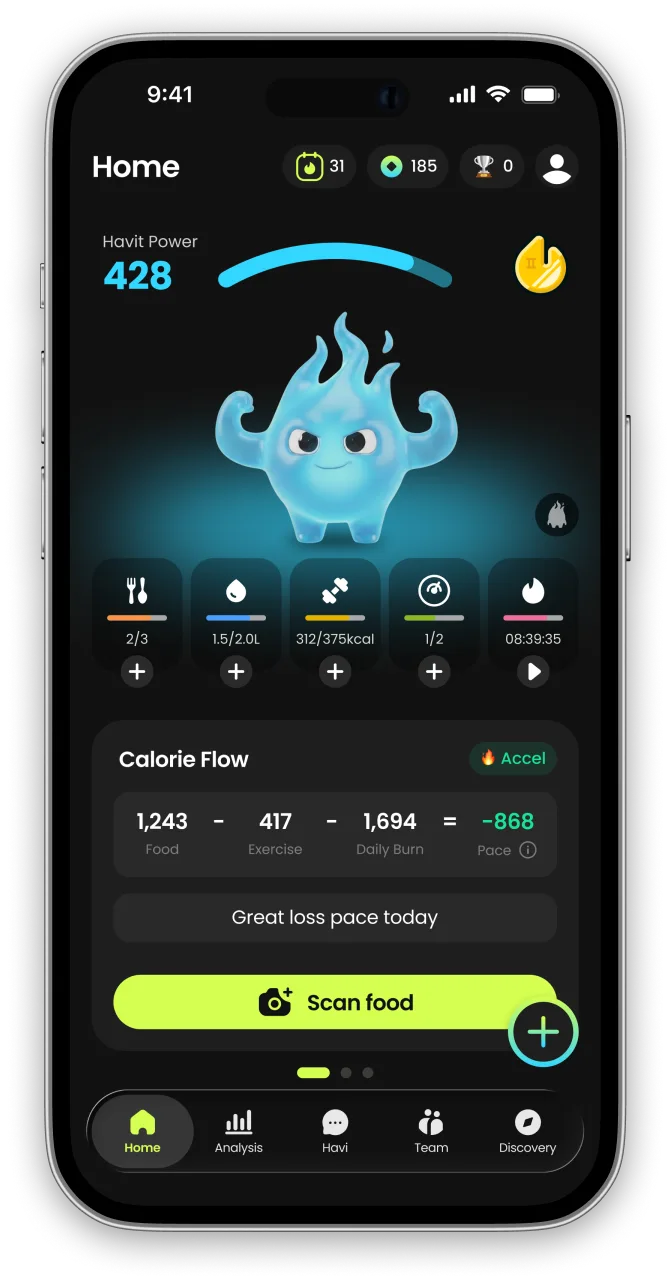
What is Havit?
Havit is an AI health companion for weight loss that protects muscle.
Unlike calorie-only trackers, Havit connects AI body-composition estimates, nutrition, hydration, sleep, steps, cycle, mood, and GLP-1 medication in one daily routine — so progress is measured by body composition, not just the number on the scale. Daily missions turn established behavior-change techniques into small repeatable actions, drawing on expertise from professionals formerly at Juvis Diet, one of Korea’s leading metabolic clinics.
In Havit’s own analysis of 1,090 GLP-1 users, people who logged consistently built stronger habits than the general user base. Read the GLP-1 Habit Report
Havit works with or without GLP-1 medication. It is a wellness app, not a medical device; body-composition results are estimates.

Continue in the App
Personalized wellness with your own data


References
- Effects of breakfast consumption on resting metabolic rate: A 12-week randomized controlled trial — American Journal of Clinical Nutrition, 2024
- Early versus late time-restricted eating: Metabolic outcomes in adults with overweight — Cell Metabolism, 2025
- Circadian rhythms and meal timing: Implications for metabolic health — Annual Review of Nutrition, 2024
- Caloric compensation patterns in breakfast-skipping populations: A systematic review — Obesity Reviews, 2023


