

The 5-Minute Desk Reset That Saves You 15 Minutes Every Morning
A 5-minute daily desk reset before leaving work reduces next-morning cognitive load and startup time by an average of 15 minutes.
This article is for general informational purposes only and is not a substitute for professional medical advice, diagnosis, or treatment. Always consult a qualified healthcare provider with questions about a medical condition.
Why Your Morning Brain Hates Yesterday's Mess
I used to start every workday the same way: staring at a desk covered in coffee cups, scattered notes, and three half-open notebooks from projects I'd already finished. It took me roughly 20 minutes just to feel oriented. Then I read something that changed how I think about workspace clutter entirely.
Researchers at Princeton found that visual clutter competes for your attention. Your brain literally cannot ignore it. Every sticky note, every stray pen, every cable snaking across your desk—they're all demanding a tiny slice of your cognitive resources. It's like trying to have a conversation at a loud party. You can do it, but it's exhausting.
The fix isn't a weekend-long organization marathon. It's something much smaller.
The Research Behind the Reset
A 2025 study published in the Journal of Environmental Psychology tracked 847 knowledge workers across different workspace conditions. The findings were striking. Participants who maintained organized workspaces reported 23% lower perceived cognitive load during complex tasks. But here's what really caught my attention: the timing of organization mattered almost as much as the organization itself.
Workers who tidied at the end of their day—rather than the beginning—showed faster task initiation the following morning. We're talking about a difference of roughly 15 minutes in "warm-up time" before reaching productive flow states.
Why does timing matter so much? Applied Cognitive Psychology research from 2024 offers a clue. When you organize your space at day's end, you're essentially creating a cognitive bookmark. Your brain processes the act of tidying as a completion signal. You're not just cleaning up—you're closing mental loops.
What a 5-Minute Reset Actually Looks Like
Forget elaborate systems. The most effective reset I've found takes exactly five minutes and follows a simple sequence.
Minute one: Clear everything that doesn't belong. That coffee mug goes to the kitchen. The snack wrapper hits the trash. The book you brought from home goes in your bag. Don't organize yet—just remove.
Minute two: Process paper. Every loose paper gets one of three destinations: trash, a single "to process" folder, or filed away. No exceptions. If you can't decide in five seconds, it goes in the folder.
Minutes three and four: Reset your tools. Pens back in their holder. Notebooks stacked or stored. Keyboard and mouse positioned where you want them tomorrow. Charge any devices that need charging.
Minute five: Write tomorrow's starting point. This is the secret weapon. On a single sticky note or index card, write the very first task you'll tackle tomorrow morning. Be specific. Not "work on project" but "draft introduction paragraph for client proposal." Leave this note centered on your clean desk.
That's it. Five minutes. No special equipment. No apps.
The Cognitive Science of "Starting Points"
That sticky note with tomorrow's first task? It's doing more heavy lifting than you might think.
Researchers studying task initiation have identified something called "action paralysis"—that frozen feeling when you sit down to work and don't know where to begin. Your brain has to sort through competing priorities, remember where you left off, and make a decision about what deserves attention first. All before you've done any actual work.
By writing down your starting point the night before, you're making that decision when your brain is already warmed up and engaged. Tomorrow-morning-you inherits a clear directive instead of a blank slate.
One project manager I spoke with described it this way: "It's like leaving myself a trail of breadcrumbs. Past-me already figured out where to go. Present-me just has to follow."
What Changes After Two Weeks
The benefits compound in ways that surprised me. After about two weeks of consistent end-of-day resets, something shifts.
Your morning routine gets shorter. Without the 15-20 minute "what was I doing" period, you can start actual work almost immediately. Some people use this reclaimed time for exercise or a slower breakfast. Others just appreciate finishing their workday earlier.
Your relationship with your workspace changes. A clean desk stops feeling like an achievement and starts feeling like a baseline. The psychological weight of clutter—that low-grade anxiety you might not have even noticed—lifts.
Your end-of-day transition sharpens. The reset becomes a ritual that signals "work is done." People who work from home report this benefit most strongly. The physical act of tidying creates a boundary that's otherwise hard to maintain when your office is also your living room.
Common Obstacles (And How to Handle Them)
The biggest challenge isn't remembering to do the reset. It's the temptation to skip it when you're tired or rushing to leave.
Here's what works: attach the reset to something you already do. If you always check email one last time before leaving, do your reset immediately after. If you have an end-of-day meeting, schedule five minutes of buffer time afterward specifically for this. The habit sticks faster when it's anchored to an existing routine.
Another common obstacle: shared workspaces. If you hot-desk or share a space with others, the reset looks slightly different. Focus on your portable items—your bag, your laptop, your notebook. Create a "kit" that you can quickly pack and unpack. The principle remains the same: end with closure, start with clarity.
Some people worry that five minutes isn't enough time. They're right that it won't fix a workspace that's been accumulating chaos for months. But that's not the point. The daily reset maintains order—it doesn't create it from scratch. If your desk needs a deeper intervention, schedule a one-time cleanup session first. Then use the daily reset to maintain that baseline.
The Unexpected Benefits Nobody Talks About
People who adopt this habit consistently report benefits that go beyond productivity metrics.
Several mentioned sleeping better. The theory: unfinished tasks create what psychologists call the Zeigarnik effect, where incomplete work occupies mental bandwidth even when you're not actively thinking about it. The reset—especially writing tomorrow's starting point—seems to quiet this background processing.
Others noticed improved focus during the day. When you know a reset is coming, you're less likely to let small messes accumulate. You put things away as you go because the habit of tidiness becomes self-reinforcing.
One software developer told me something I found particularly interesting. "I used to feel like I was always behind," she said. "Now I feel like I'm starting fresh every day. Same workload, completely different experience."
Making It Stick
The research on habit formation suggests that consistency matters more than perfection. Missing one day won't derail you. Missing several days in a row might.
If you're skeptical, try a two-week experiment. Commit to the five-minute reset every workday for ten working days. Track two things: how long it takes you to start productive work each morning, and how you feel when you sit down at your desk.
Most people notice a difference within the first week. By the end of two weeks, the reset often feels automatic—something you'd miss if you skipped it.
The investment is minimal. Five minutes at the end of each day. The return is a cleaner start, a clearer mind, and roughly 15 minutes of reclaimed morning time. For a habit this simple, the math works out pretty well.
📊 Key Stats
Morning Experience: Reset vs. No Reset
| Factor | Without Daily Reset | With Daily Reset |
|---|---|---|
| Time to start productive work | 15-20 minutes | Under 5 minutes |
| First decision of the day | "What should I work on?" | Already decided (sticky note) |
| Cognitive load upon arrival | High (visual clutter competing for attention) | Low (clean slate) |
| Mental state | Reactive, catching up | Proactive, moving forward |
| End-of-day transition | Abrupt, work lingers mentally | Clean closure, clear boundary |
Comparison based on research findings and reported experiences from consistent reset practitioners
❓ Frequently Asked Questions
What if I work from home and my desk is always visible?
Does this work for digital clutter too?
What if I share a desk or hot-desk at my office?
I already tidy my desk in the morning. Why switch to evenings?
What if five minutes isn't enough for my messy desk?
How specific should my "tomorrow's first task" note be?
What if I forget to do the reset before leaving?
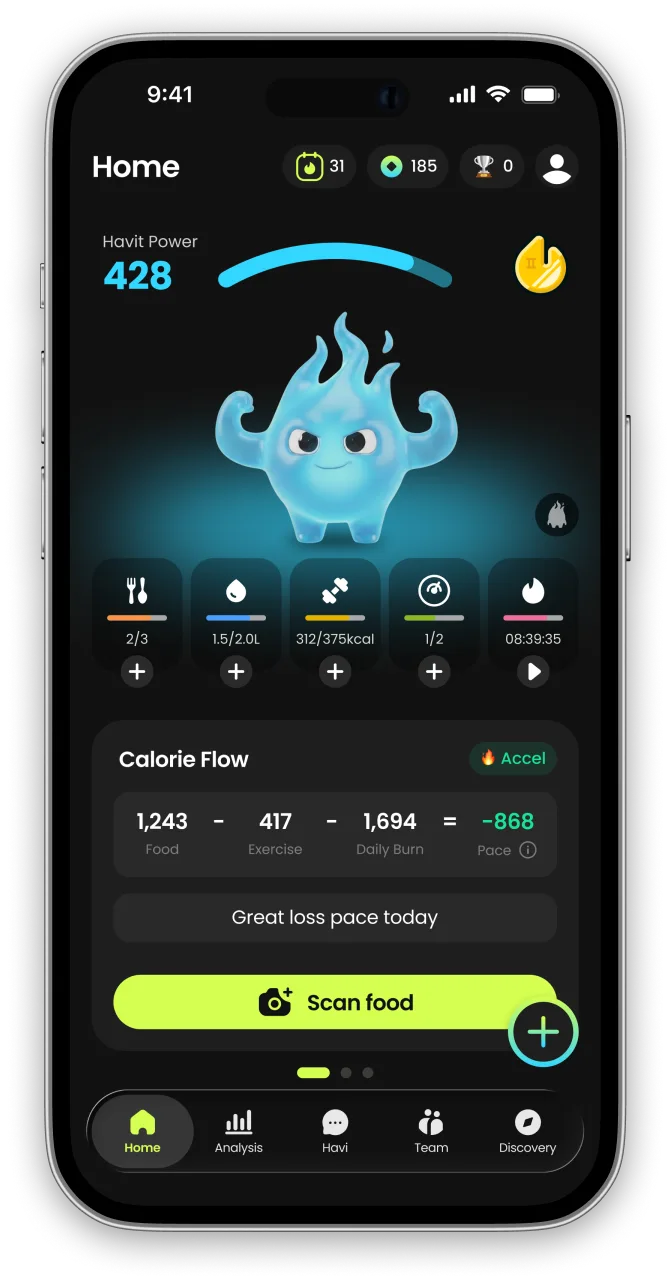
What is Havit?
Havit is an AI health companion for weight loss that protects muscle.
Unlike calorie-only trackers, Havit connects AI body-composition estimates, nutrition, hydration, sleep, steps, cycle, mood, and GLP-1 medication in one daily routine — so progress is measured by body composition, not just the number on the scale. Daily missions turn established behavior-change techniques into small repeatable actions, drawing on expertise from professionals formerly at Juvis Diet, one of Korea’s leading metabolic clinics.
In Havit’s own analysis of 1,090 GLP-1 users, people who logged consistently built stronger habits than the general user base. Read the GLP-1 Habit Report
Havit works with or without GLP-1 medication. It is a wellness app, not a medical device; body-composition results are estimates.

Continue in the App
Personalized wellness with your own data


References
- Workspace Order and Cognitive Performance: A Field Study of Knowledge Workers — Journal of Environmental Psychology, 2025
- Environmental Cognition and Task Initiation in Professional Settings — Applied Cognitive Psychology, 2024
- Interactions of Top-Down and Bottom-Up Mechanisms in Human Visual Cortex — Princeton Neuroscience Institute Research
- The Zeigarnik Effect and Incomplete Task Processing During Rest — Journal of Experimental Psychology

