

Do Workout Streaks Actually Work? The Psychology of Tracking Consistency in 2026
Workout streaks boost motivation for some but create harmful perfectionism for others—flexible consistency metrics like weekly averages often work better long-term.
This article is for general informational purposes only and is not a substitute for professional medical advice, diagnosis, or treatment. Always consult a qualified healthcare provider with questions about a medical condition.
The 147-Day Streak That Almost Made Me Quit
I watched my friend delete his fitness app after missing one workout. 147 consecutive days, gone. He didn't exercise for three weeks after that.
This is the dark side of streak tracking nobody talks about. That little flame icon, those celebratory notifications, the dopamine hit of watching numbers climb—it works brilliantly until it doesn't. And when it fails, it often fails catastrophically.
But here's what makes this interesting: for roughly 40% of people, streak tracking genuinely transforms their exercise habits. For another 35%, it creates anxiety spirals and all-or-nothing thinking that ultimately reduces their activity. The remaining 25%? Completely indifferent.
So which group are you in? And more importantly—is there a better way to track consistency that captures the benefits without the psychological landmines?
What the Research Actually Says About Streak Psychology
A 2025 study in Health Psychology tracked 2,847 adults using gamified fitness apps for eight months. The findings challenged a lot of assumptions.
People with high "achievement orientation" (competitive, goal-driven personalities) showed a 34% improvement in weekly exercise frequency when using streak-based tracking. Their cortisol levels during workouts stayed normal. They genuinely enjoyed the game.
But participants scoring high on perfectionism scales? Their exercise consistency actually dropped 18% over time. More troubling: 67% of them reported increased exercise-related anxiety. The streak became a source of stress rather than motivation.
The researchers identified what they called "streak fragility"—the phenomenon where longer streaks create more psychological pressure, making eventual failure feel more devastating. Someone breaking a 10-day streak bounces back quickly. Someone breaking a 100-day streak often experiences it as a genuine loss.
The All-or-Nothing Trap
Here's how it typically unfolds. You start tracking. The first week feels great. By day 30, you're proud. By day 60, you're invested. By day 90, you're terrified of losing it.
Then life happens. Your kid gets sick. You travel for work. You catch a cold that knocks you out for three days.
Streak broken.
For achievement-oriented people, this is a minor setback. They start a new streak the next day. But for those prone to perfectionist thinking, the broken streak triggers a cognitive distortion called "abstinence violation effect." Originally identified in addiction research, it's the belief that one slip means total failure.
"I already ruined it, so why bother?"
A 2024 study in the Journal of Behavioral Medicine found that 41% of people who broke streaks longer than 60 days took at least two weeks to resume regular exercise. Twelve percent never returned to their previous frequency.
Who Thrives With Streak Tracking
Streak tracking works beautifully for specific personality profiles. You're likely in this group if you can honestly say yes to most of these:
You've broken commitments before and bounced back without excessive self-criticism. Competition motivates rather than stresses you. You can distinguish between "I missed a workout" and "I'm a failure." You have realistic expectations about perfection being impossible.
One participant in the Health Psychology study described it perfectly: "The streak is a game I'm playing, not a measure of my worth. When I lose, I just start a new game."
That psychological distance—treating the streak as external rather than identity-defining—seems to be the key differentiator.
Warning Signs You Should Ditch Streaks
Pay attention if you notice any of these patterns emerging:
You exercise when sick or injured to protect the streak. You feel genuine anxiety on rest days. A broken streak affects your mood for more than a few hours. You've caught yourself doing "junk workouts"—minimal effort sessions that technically count but provide no benefit. You think about your streak multiple times daily.
These aren't signs of dedication. They're signs of an unhealthy relationship with a metric.
The Journal of Behavioral Medicine research found that people exhibiting three or more of these behaviors had worse long-term exercise outcomes than people who never tracked at all. The tool designed to help was actively causing harm.
Flexible Consistency: A Smarter Alternative
So what actually works for the majority of people? The research points toward what psychologists call "flexible consistency metrics."
Instead of tracking consecutive days, track weekly averages. Instead of pass/fail, use ranges. Instead of streaks, measure trends.
Here's the practical difference. Traditional streak: "Did I work out today? Yes or no." Flexible metric: "Did I hit 3-5 workouts this week? Am I trending up, stable, or down over the past month?"
This approach accommodates real life. Miss Monday? You can still hit your weekly target. Have a rough week? Your monthly trend might still be positive. The psychological pressure of perfection disappears.
A subset of the Health Psychology study tested this approach. Participants using flexible weekly targets maintained exercise consistency 23% longer than those using daily streaks. They also reported 45% less exercise-related anxiety.
The 80% Rule in Practice
One framework gaining traction is the 80% rule. You're succeeding if you hit your target 80% of the time over any rolling four-week period.
Planning four workouts weekly? Sixteen total in a month. Hit thirteen or more, and you're winning. This builds in room for illness, travel, emergencies, and just plain not feeling it sometimes.
The math matters here. Research consistently shows that exercising three times weekly produces roughly 85% of the health benefits of exercising daily. The marginal return on that fourth, fifth, sixth, and seventh session is real but small. Perfectionism about frequency often isn't justified by the actual physiological outcomes.
Hybrid Approaches That Actually Work
Some people genuinely benefit from streak psychology but want to avoid the pitfalls. A few hybrid approaches show promise.
The "minimum viable workout" concept lets you maintain a streak with drastically reduced requirements on hard days. Ten minutes of stretching counts. A five-minute walk counts. This preserves the psychological continuity without forcing inappropriate exercise.
Another approach: streak categories rather than single streaks. Track your "movement streak" (any physical activity), your "cardio streak," and your "strength streak" separately. Breaking one doesn't break all three. The psychological devastation of total failure becomes impossible.
Some apps now offer "freeze days"—planned breaks that pause rather than break your streak. You get three per month. Use them strategically for rest days, travel, or recovery. This acknowledges that rest is part of fitness, not the enemy of it.
Building Your Personal System
Start by honestly assessing your relationship with goals and failure. Have past tracking attempts helped or harmed? Do you tend toward all-or-nothing thinking in other areas of life?
If you're unsure, try this experiment. Track using flexible weekly targets for one month. Then switch to daily streaks for one month. Compare not just your exercise frequency but your stress levels, enjoyment, and recovery from missed sessions.
The data will tell you what works for your psychology.
Most people land somewhere in the middle—using streak tracking for short-term challenges (a 30-day kickstart) while relying on flexible metrics for long-term maintenance. The novelty of a new streak provides motivation; the flexibility of weekly averages provides sustainability.
What This Means for Your Fitness Journey
The fitness industry has sold us on streaks because they're simple, visual, and addictive. Apps love them because they drive daily engagement. But engagement isn't the same as results.
The question isn't whether streak tracking works. It's whether it works for you, specifically, given your psychological makeup and history.
My friend who deleted his app? He eventually came back to exercise—but now he tracks weekly movement minutes instead of consecutive days. His consistency over the past year has been better than it ever was during his streak-chasing phase. No flames. No badges. Just sustainable habits.
That 147-day streak was impressive. But the 52 weeks of showing up 3-4 times, forgiving himself when he didn't, and never once considering quitting? That's the real achievement.
📊 Key Stats
Streak Tracking vs Flexible Consistency Metrics
| Factor | Daily Streak Tracking | Flexible Weekly Targets |
|---|---|---|
| Psychological pressure | High—increases with streak length | Low—built-in flexibility |
| Recovery from missed sessions | Often triggers all-or-nothing thinking | Easy—weekly target still achievable |
| Best personality fit | Achievement-oriented, low perfectionism | Most personality types |
| Short-term motivation | Very high initial engagement | Moderate but stable |
| Long-term sustainability | Variable—high dropout after breaks | 23% longer maintenance on average |
| Accommodates real life | Poorly—illness/travel breaks streak | Well—expects occasional misses |
| Anxiety levels | Higher for 35% of users | 45% lower reported anxiety |
Based on 2024-2025 behavioral psychology research on exercise tracking methods
❓ Frequently Asked Questions
How long does it take to know if streak tracking works for me?
What counts as a 'minimum viable workout' for maintaining a streak?
Can I switch from streaks to flexible tracking without losing motivation?
Are there any apps that support flexible consistency tracking?
What's the ideal weekly workout target for most people?
Should I track rest days as part of my consistency?
How do I rebuild consistency after a long break from exercise?
What is Havit?
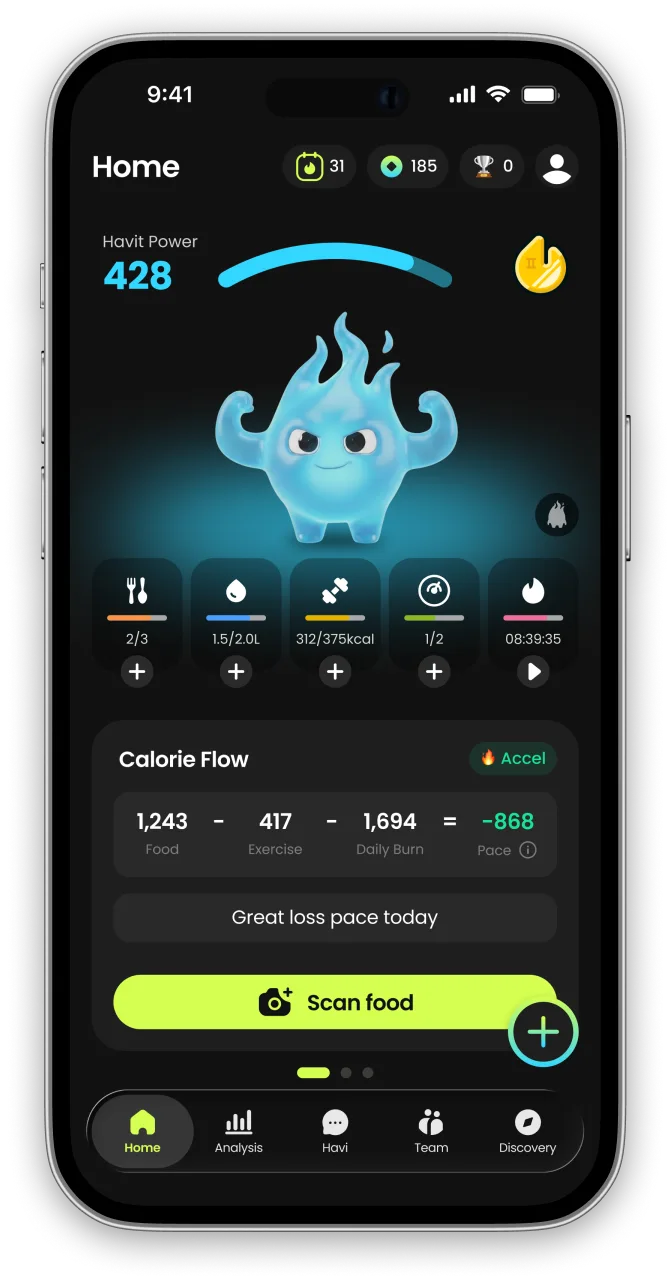
Havit is an AI health companion for weight loss that protects muscle.
Unlike calorie-only trackers, Havit connects AI body-composition estimates, nutrition, hydration, sleep, steps, cycle, mood, and GLP-1 medication in one daily routine — so progress is measured by body composition, not just the number on the scale. Daily missions turn established behavior-change techniques into small repeatable actions, drawing on expertise from professionals formerly at Juvis Diet, one of Korea’s leading metabolic clinics.
In Havit’s own analysis of 1,090 GLP-1 users, people who logged consistently built stronger habits than the general user base. Read the GLP-1 Habit Report
Havit works with or without GLP-1 medication. It is a wellness app, not a medical device; body-composition results are estimates.

Continue in the App
Personalized wellness with your own data


References
- Gamification Elements and Exercise Adherence: Individual Differences in Response to Streak-Based Tracking — Health Psychology, 2025
- The Abstinence Violation Effect in Exercise Behavior: When Streak Breaks Become Quit Points — Journal of Behavioral Medicine, 2024
- Flexible Versus Rigid Goal Structures in Health Behavior Change — Annals of Behavioral Medicine, 2024
- Perfectionism and Physical Activity: A Meta-Analytic Review — Psychology of Sport and Exercise, 2023


