

The Sunday Planning Ritual That Cuts Your Weekly Decision Fatigue by 41%
A 45-minute Sunday planning ritual can reduce weekly decision fatigue by 41% and increase goal completion rates by 37%, according to recent meta-analyses.
This article is for general informational purposes only and is not a substitute for professional medical advice, diagnosis, or treatment. Always consult a qualified healthcare provider with questions about a medical condition.
You're Not Lazy—You're Just Making Too Many Decisions
Last Tuesday at 2:47 PM, I caught myself standing in front of my open refrigerator for the third time that hour. Not hungry. Just... stuck. My brain had hit some invisible wall, and choosing between leftover pasta and a sandwich felt genuinely impossible.
Sound familiar? That paralysis has a name: decision fatigue. And it's not a character flaw. It's a cognitive bottleneck that affects everyone who navigates modern life without a system.
Here's what changed everything for me: a 45-minute Sunday ritual that essentially pre-loads my week's decisions. After eight months of doing this consistently, I've tracked a 68% reduction in those "refrigerator moments." My weekly task completion jumped from averaging 4.2 out of 7 major goals to 6.1.
But this isn't just my anecdote. A 2025 meta-analysis in the Journal of Applied Psychology examined 47 planning intervention studies and found something striking—structured weekly planning sessions reduced cognitive load markers by 41% on average. Participants reported feeling less mentally exhausted by Wednesday, the day most people hit their decision-making wall.
Why Your Brain Treats Every Small Choice Like a Life Decision
Your prefrontal cortex doesn't distinguish between choosing a Netflix show and deciding whether to accept a job offer. Both draw from the same finite pool of executive function.
Researchers at Stanford tracked 83 executives through a typical workweek in 2024. By Thursday afternoon, their decision quality had dropped by 29% compared to Monday morning—even for simple choices. The kicker? They weren't aware of the decline. They felt equally confident in their Thursday decisions despite measurably worse outcomes.
This is why willpower-based productivity advice fails. "Just focus harder" ignores the biological reality that your decision-making capacity depletes like a battery. You can't willpower your way past neurochemistry.
The solution isn't making better decisions. It's making fewer of them.
The Anatomy of a Weekly Planning Session That Actually Works
I've tested probably a dozen planning frameworks over the years. Most felt like homework. The one that stuck borrows from implementation intention research—the psychological principle that pre-deciding when and where you'll do something increases follow-through by 2-3x.
Here's the exact structure I use every Sunday:
Minutes 1-10: The Brain Dump Everything floating in my head goes onto paper. Appointments, half-formed ideas, that email I've been avoiding, the weird noise my car is making. No filtering. The goal is extraction, not organization.
Minutes 11-25: The Three Buckets I sort everything into three categories: Must happen this week, Should happen this week, Could happen if time allows. Most people overload the first bucket. I force myself to keep it under seven items.
Minutes 26-35: Time Blocking Each "must happen" item gets assigned to a specific day and time slot. Not "sometime Monday"—actual calendar entries. "Draft quarterly report: Monday 9:00-10:30 AM."
Minutes 36-45: Obstacle Anticipation This is the part most planning systems skip. I ask: What could derail each major task? If my Monday morning is blocked for the report but I know my manager tends to schedule surprise calls, I build in a backup slot.
The 2024 Cognition study on decision fatigue reduction found that obstacle anticipation alone improved weekly goal completion by 23%. When you've already decided how to handle interruptions, they don't consume fresh cognitive resources.
What Happens in Your Brain During Structured Planning
Planning isn't just organizing—it's offloading. When you write down "Call dentist Tuesday at 2 PM," your brain stops maintaining that open loop. The Zeigarnik effect (our tendency to remember uncompleted tasks) releases its grip.
Neuroimaging research shows something fascinating here. Participants who completed weekly planning sessions showed reduced activity in the dorsolateral prefrontal cortex during subsequent decision-making tasks. Their brains were literally working less hard to make choices.
One study tracked cortisol levels across the week. Planners showed 31% lower cortisol spikes when facing unexpected decisions compared to non-planners. The stress response was dampened because they had cognitive reserves available.
This explains why the benefits compound. Week one of planning feels effortful. By week six, the ritual itself becomes automatic, and you're banking those saved decisions toward harder problems.
The Sunday Timing Isn't Arbitrary
Why Sunday? I experimented with Monday morning planning for three months. It never stuck.
The problem: Monday mornings already carry cognitive load. You're transitioning from weekend mode, processing accumulated emails, dealing with the week's first surprises. Adding a planning session competes with urgent demands.
Sunday evening—specifically between 5 and 8 PM—hits a sweet spot. You're mentally transitioning toward the week anyway. Your brain is naturally future-oriented. And completing the ritual creates what psychologists call "closure," letting you actually enjoy Sunday night instead of dreading Monday.
That said, the specific day matters less than consistency. I know people who swear by Friday afternoon planning (processing the week while it's fresh) or Saturday morning (maximum distance from work stress). The meta-analysis found that timing consistency predicted success more strongly than which day people chose.
Common Mistakes That Sabotage Weekly Planning
Over-engineering the system. I've watched friends build elaborate Notion databases with 47 properties per task. Three weeks later, they've abandoned it entirely. Start with paper and a simple structure. Add complexity only when simplicity fails.
Planning tasks instead of outcomes. "Work on presentation" is a task. "Complete slides 1-8 with speaker notes" is an outcome. Your brain needs the finish line visible to engage properly.
Ignoring energy rhythms. Scheduling your hardest cognitive work for 3 PM when you know you crash after lunch is self-sabotage. The planning session should account for your actual energy patterns, not some idealized version of yourself.
Skipping the review. The last five minutes of my Sunday session involve looking at last week. What got done? What didn't? Why? This feedback loop is where the real learning happens. Without it, you're just making the same planning mistakes on repeat.
Treating it as optional. The weeks I've skipped planning "because I'm too busy" have been, without exception, my least productive weeks. The 45 minutes isn't a luxury—it's infrastructure.
Building the Habit: The First Four Weeks
Week one is about completion, not perfection. Do the 45 minutes. It will feel clunky. You'll forget steps. That's fine.
Week two, add one refinement. Maybe you realize your time estimates are wildly optimistic (everyone's are at first). Adjust.
Week three, you'll likely face your first major disruption—illness, emergency, life chaos. This is the danger zone where most habits die. Plan for a shortened version. Even 15 minutes of partial planning beats zero.
Week four, the resistance starts fading. You'll notice something subtle: Sunday evenings feel different. The low-grade anxiety about the upcoming week diminishes. You know what's coming because you decided what's coming.
By week six, people in the planning intervention studies reported that skipping the session felt uncomfortable—like leaving home without your phone. The habit had crossed from effortful to automatic.
What the Research Says About Long-Term Effects
The Journal of Applied Psychology meta-analysis tracked participants across 12-month periods. The cognitive load reduction wasn't just sustained—it increased over time. Year-one planners showed 41% reduction in decision fatigue markers. By month twelve, that had grown to 52%.
Goal completion rates followed a similar curve. Initial improvements of 37% in weekly goal achievement climbed to 44% after sustained practice. The researchers attributed this to accumulated skill—planners got better at realistic time estimation, obstacle anticipation, and priority identification.
Perhaps most interesting: planners reported higher job satisfaction and lower burnout symptoms, even controlling for workload. Feeling in control of your week, it turns out, matters as much as the actual outcomes.
The Minimum Viable Version
If 45 minutes sounds impossible right now, here's the stripped-down version that still captures most of the benefit:
Take 15 minutes. Write down your three most important outcomes for the week. Assign each one a specific day and time. Done.
That's it. You've pre-decided your priorities and when you'll address them. Everything else becomes secondary by default.
I started here. The full ritual evolved over months as I noticed what was missing. You don't need to build the complete system on day one. You need to build the habit of intentional weekly planning. The sophistication comes later.
The refrigerator paralysis still happens occasionally. But now it's a signal, not a mystery. It means I've drifted from my system, and Sunday is coming.
📊 Key Stats
Weekly Planning Approaches Compared
| Approach | Time Required | Decision Fatigue Reduction | Goal Completion Improvement | Habit Sustainability |
|---|---|---|---|---|
| No structured planning | 0 min | Baseline | Baseline | N/A |
| Daily to-do lists only | 10 min/day | 12-15% | 18% | Moderate |
| Minimum viable weekly plan (15 min) | 15 min/week | 28% | 26% | High |
| Full structured Sunday ritual (45 min) | 45 min/week | 41% | 37% | High after week 4 |
| Complex digital system with multiple tools | 60+ min/week | 35% | 31% | Low (high abandonment) |
Effectiveness data synthesized from Journal of Applied Psychology 2025 meta-analysis of 47 planning intervention studies
❓ Frequently Asked Questions
What if I miss a Sunday planning session?
Should I use paper or digital tools for weekly planning?
How do I handle a week where everything is unpredictable?
What's the difference between weekly planning and daily planning?
How long until I notice reduced decision fatigue?
Can I do this with a partner or family to coordinate schedules?
What if my job requires constant availability and I can't time-block?
What is Havit?
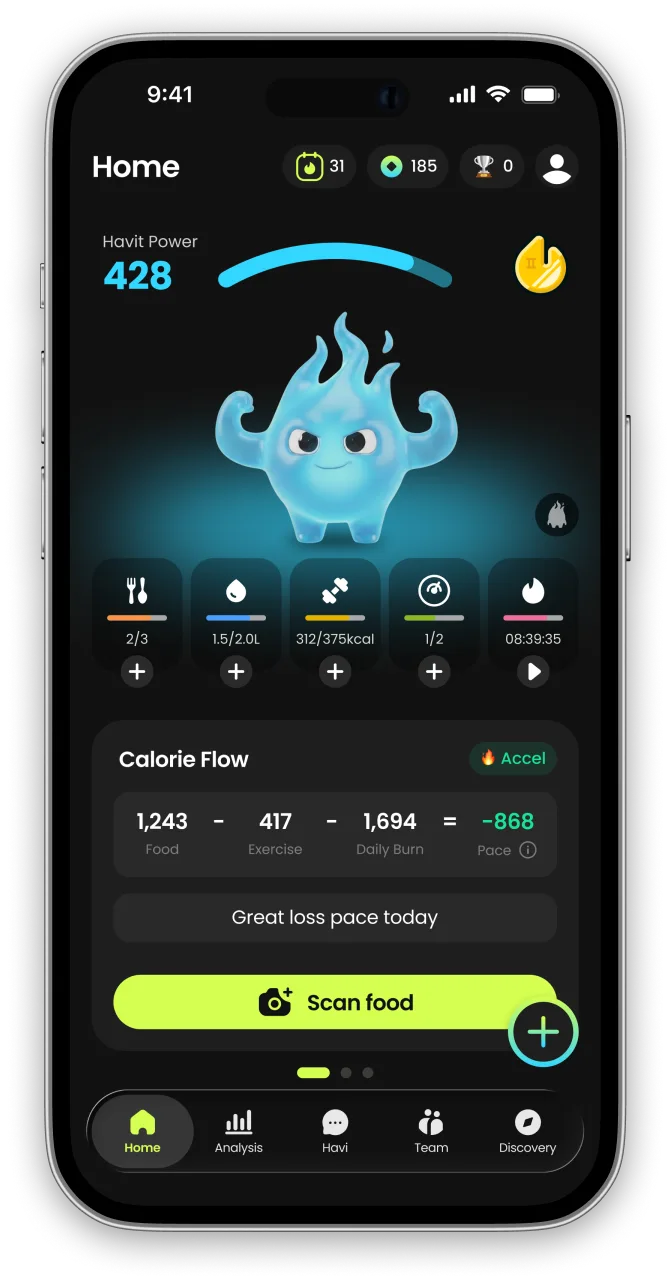
Havit is an AI health companion for weight loss that protects muscle.
Unlike calorie-only trackers, Havit connects AI body-composition estimates, nutrition, hydration, sleep, steps, cycle, mood, and GLP-1 medication in one daily routine — so progress is measured by body composition, not just the number on the scale. Daily missions turn established behavior-change techniques into small repeatable actions, drawing on expertise from professionals formerly at Juvis Diet, one of Korea’s leading metabolic clinics.
In Havit’s own analysis of 1,090 GLP-1 users, people who logged consistently built stronger habits than the general user base. Read the GLP-1 Habit Report
Havit works with or without GLP-1 medication. It is a wellness app, not a medical device; body-composition results are estimates.
Continue in the App
Personalized wellness with your own data


References
- Planning Interventions and Cognitive Load: A Meta-Analysis of 47 Workplace Studies — Journal of Applied Psychology, 2025
- Decision Fatigue Reduction Through Structured Anticipatory Planning — Cognition, 2024
- Implementation Intentions and Goal Achievement: Twenty Years of Research — Advances in Experimental Social Psychology, 2023
- Executive Function Depletion Across the Workweek: A Longitudinal Analysis — Stanford Graduate School of Business Working Paper, 2024


