

Weekly Exercise Volume Tracking: Why the 10% Rule Needs a 2026 Update
New research shows the 10% rule oversimplifies progression—individual load tolerance varies up to 40% based on training history and recovery metrics.
This article is for general informational purposes only and is not a substitute for professional medical advice, diagnosis, or treatment. Always consult a qualified healthcare provider with questions about a medical condition.
That Moment When Your Body Says "Nope"
Three weeks into your new running program, your knee starts talking to you. Not screaming—just a whisper at first. You ignored it because you were following the rules. The sacred 10% rule. Add no more than 10% volume each week, and you'll be fine. Except you weren't fine, and now you're googling "runner's knee recovery time" at 2 AM.
Here's what nobody told you: that 10% guideline came from a 1980s observation of elite runners. Not weekend warriors. Not people juggling desk jobs and sleep deprivation. And definitely not anyone using modern tracking tools that can actually tell us when our bodies are ready for more.
The game has changed. Let's talk about what actually works.
The Origin Story of a Rule That Overstayed Its Welcome
The 10% rule didn't emerge from rigorous clinical trials. It was a rough heuristic—a reasonable guess that spread through running magazines and eventually became gospel. Dr. Tim Gabbett, whose 2016 acute:chronic workload ratio research transformed sports science, has been vocal about this problem. "We've been giving everyone the same prescription regardless of their training history," he noted in a 2024 interview.
Think about how absurd that is. A former college athlete returning after a two-year break gets the same progression advice as someone who's never exercised consistently. A 25-year-old with perfect sleep hygiene follows the same rules as a 45-year-old parent of twins who averages five hours a night.
The British Journal of Sports Medicine published findings in early 2025 that finally quantified what coaches suspected: individual tolerance for load increases varies by as much as 40% depending on training background, age, sleep quality, and stress levels. Forty percent. That's the difference between safely adding 15% volume one week versus needing to stay flat.
What Modern Load Monitoring Actually Measures
Forget counting miles or sets. Contemporary volume tracking looks at something called "training load"—a combination of external load (what you actually did) and internal load (how your body responded).
External load is straightforward. Miles run. Kilograms lifted. Minutes of zone 3 cardio. Your watch tracks this automatically.
Internal load is where it gets interesting. Heart rate variability. Resting heart rate trends. Perceived exertion. Sleep scores. The International Journal of Sports Physiology and Performance published a 2024 meta-analysis of 47 studies showing that internal load markers predicted injury risk 2.3 times better than external load alone.
Here's a practical example. Two runners both complete 30 miles in a week. Runner A's HRV stays stable, resting heart rate doesn't spike, and she reports sessions feeling "moderate." Runner B's HRV drops 15%, resting heart rate climbs 8 beats above baseline, and he's dragging through every run. Same external load. Completely different internal responses. Runner B needs a down week. Runner A might be ready to push.
The Acute:Chronic Workload Ratio Explained Simply
This concept sounds technical, but it's intuitive once you see it. Your "acute" load is what you did this week. Your "chronic" load is your rolling average over the past 3-4 weeks. The ratio between them tells you whether you're in a safe zone.
Ratio between 0.8 and 1.3? You're in the sweet spot. Below 0.8? You're detraining—probably fine for a recovery week, but don't stay there. Above 1.5? Red flag. You've spiked your load too fast.
Let's make this concrete. Say your chronic weekly running volume is 20 miles. You decide to jump to 28 miles because the weather's perfect and you're feeling great. That's a ratio of 1.4—pushing the upper boundary. If you also slept poorly and have a stressful work deadline? You just created the perfect injury recipe.
The 2025 BJSM study found that athletes maintaining ratios between 1.0 and 1.25 had 52% fewer soft tissue injuries than those regularly exceeding 1.3. Not zero injuries—exercise carries inherent risk—but meaningfully fewer.
Building Your Personal Progression Framework
Stop thinking in percentages. Start thinking in readiness signals.
Every morning, before checking email, notice three things: How did you sleep? (Actual hours, not time in bed.) How do your legs feel? (Heavy, normal, or springy?) What's your motivation level? (Dreading the workout, neutral, or eager?)
This takes 30 seconds. Write it down or log it in any tracking app. After two weeks, patterns emerge. You'll notice that poor sleep two nights in a row reliably predicts heavy legs. You'll see that your motivation craters when you've had three hard sessions without a recovery day.
Now layer in the objective data if you have it. A wearable showing HRV 15% below your baseline? That confirms what your body's already telling you. Resting heart rate elevated 5+ beats? Same story.
The framework becomes: Green light days get progression. Yellow light days get maintenance. Red light days get recovery or rest. Some weeks you'll add 15% volume because everything aligns. Other weeks you'll hold steady or even pull back. Over a month, you'll likely average out to something like 8-12% progression—but it'll be responsive rather than arbitrary.
The Deload Week Nobody Wants to Take
Every fourth week, drop your volume by 40-50%. I know. It feels like losing progress. It isn't.
The International Journal of Sports Physiology research from 2024 tracked 312 recreational athletes over 16 weeks. Half followed linear progression with no planned deloads. Half took a deload every fourth week. At week 16, the deload group had improved their performance markers by 23% more than the linear group. They also reported 67% fewer overuse symptoms.
Your body doesn't get stronger during training. It gets stronger during recovery from training. Deload weeks aren't rest—they're when adaptation actually happens. You're still moving, still practicing skills, but at a volume that lets your tissues rebuild rather than just survive.
A good deload maintains frequency (same number of sessions) while cutting volume and intensity. If you normally run five times a week for 30 miles total with two hard sessions, a deload week might be five easy runs totaling 15-18 miles. You stay in rhythm without accumulating fatigue.
When to Break the Rules Entirely
Sometimes linear progression doesn't apply. Coming back from illness? Your first two weeks should be about rediscovering movement, not hitting numbers. Returning after a long break? Spend 3-4 weeks rebuilding your base before thinking about progression at all.
Life stress counts as load too. A brutal week at work, a family crisis, moving apartments—these aren't separate from your training capacity. They draw from the same recovery resources. The 2025 BJSM paper specifically noted that psychological stress increased injury risk by 31% independent of physical training load.
During high-stress periods, maintenance is progression. Seriously. Keeping your fitness stable while navigating chaos is a win. Don't let fitness culture convince you that anything less than constant improvement equals failure.
Practical Weekly Tracking That Takes Five Minutes
You don't need elaborate spreadsheets. A simple weekly log captures what matters.
Every Sunday, record: Total volume (miles, minutes, or sets—pick one metric per activity). Average session difficulty on a 1-10 scale. Sleep quality average for the week. Any new aches or persistent soreness. One sentence on overall energy.
After a month, calculate your four-week average volume. That's your chronic baseline. Each new week, compare your planned volume to that baseline. Staying within 0.8-1.25 of your average? You're in the safe zone. Planning to exceed 1.3? Make sure your readiness signals are all green.
This isn't obsessive tracking. It's informed training. The difference between athletes who stay healthy for years and those who cycle through injuries often comes down to this kind of awareness.
The Bottom Line on Safe Progression in 2026
The 10% rule was a decent starting point for an era without data. We have data now. We have wearables that track HRV and sleep. We have decades of research on load management. We have apps that calculate acute:chronic ratios automatically.
Use them. But also trust the simpler signals—how you slept, how you feel, whether your body is asking for more or begging for less. The goal isn't to follow a rule. It's to build a sustainable practice that lets you keep moving for decades.
Your knee will thank you.
📊 Key Stats
Traditional vs. Modern Progression Approaches
| Factor | 10% Rule Approach | Modern Load Monitoring |
|---|---|---|
| Weekly increase | Fixed 10% regardless of context | 0-15% based on readiness signals |
| Injury prediction | External load only | Combined internal + external load |
| Individual variation | One size fits all | Accounts for 40% individual variance |
| Recovery integration | Not systematically included | Scheduled deloads every 3-4 weeks |
| Stress consideration | Ignored | Psychological load factored in |
| Data requirements | Basic volume tracking | HRV, sleep, RPE, resting HR trends |
Modern approaches personalize progression based on multiple readiness indicators rather than arbitrary percentages.
❓ Frequently Asked Questions
Is the 10% rule completely useless now?
What's the ideal acute:chronic workload ratio for beginners?
How do I track internal load without expensive wearables?
Should I skip workouts when my HRV is low?
How long should a deload week last?
Can I progress faster if all my readiness signals are green?
Does this apply to strength training or just cardio?
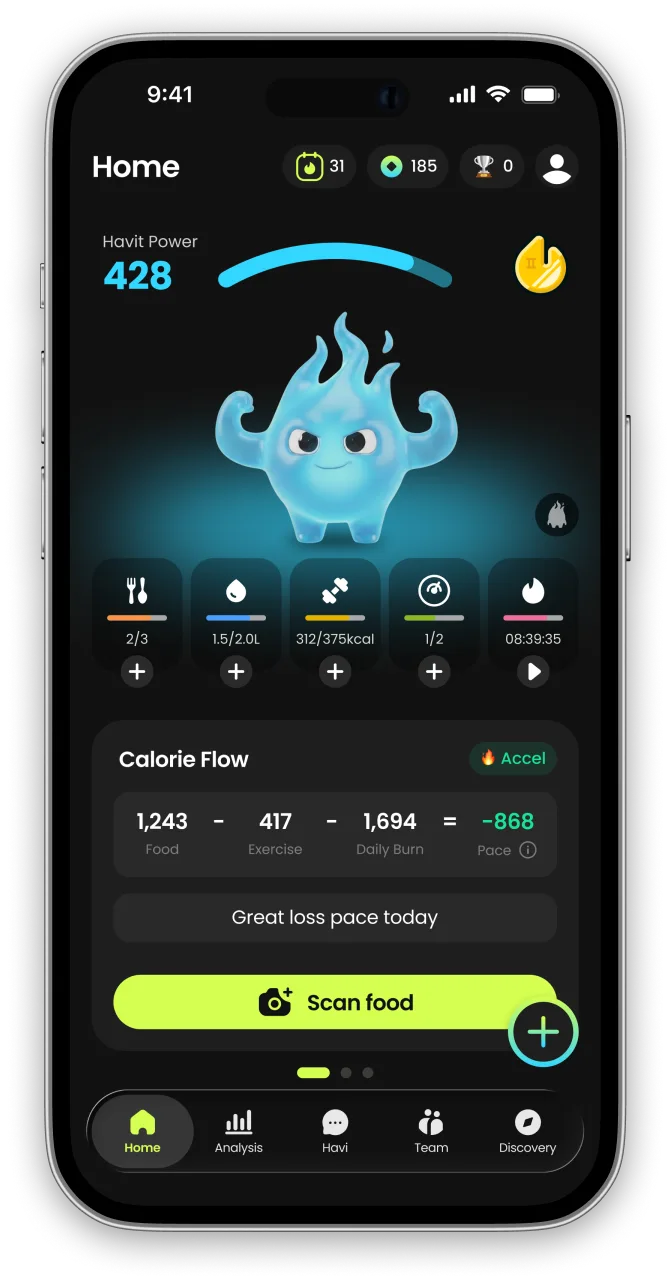
What is Havit?
Havit is an AI health companion for weight loss that protects muscle.
Unlike calorie-only trackers, Havit connects AI body-composition estimates, nutrition, hydration, sleep, steps, cycle, mood, and GLP-1 medication in one daily routine — so progress is measured by body composition, not just the number on the scale. Daily missions turn established behavior-change techniques into small repeatable actions, drawing on expertise from professionals formerly at Juvis Diet, one of Korea’s leading metabolic clinics.
In Havit’s own analysis of 1,090 GLP-1 users, people who logged consistently built stronger habits than the general user base. Read the GLP-1 Habit Report
Havit works with or without GLP-1 medication. It is a wellness app, not a medical device; body-composition results are estimates.

Continue in the App
Personalized wellness with your own data


References
- Individualized Load Progression and Injury Risk in Recreational Athletes — British Journal of Sports Medicine, January 2025
- Internal vs. External Load Markers for Injury Prediction: A Meta-Analysis — International Journal of Sports Physiology and Performance, August 2024
- The Training-Injury Prevention Paradox: Should Athletes Be Training Smarter and Harder? — Gabbett TJ, British Journal of Sports Medicine, 2016
- Psychological Stress and Musculoskeletal Injury Risk in Active Populations — British Journal of Sports Medicine, March 2025
- Periodization Strategies and Performance Outcomes in Non-Elite Athletes — International Journal of Sports Physiology and Performance, November 2024


