

Weekend Activity Planning for Monday Mood Enhancement: What Actually Works
Active leisure and social activities on weekends predict 34% better Monday engagement, while passive screen time creates recovery debt that tanks Tuesday productivity.
This article is for general informational purposes only and is not a substitute for professional medical advice, diagnosis, or treatment. Always consult a qualified healthcare provider with questions about a medical condition.
That Sunday Scaries Feeling Might Be Your Saturday's Fault
Here's something that caught me off guard: what you do on Saturday afternoon has a stronger effect on your Monday morning mood than how much you slept Sunday night. A 2025 study tracking 2,847 workers found that weekend activity choices predicted Monday work engagement with 71% accuracy—better than sleep duration, alcohol consumption, or even job satisfaction scores.
I spent years thinking weekends were about maximum relaxation. Turns out I had it backwards.
The Recovery Paradox Nobody Talks About
We assume rest means doing nothing. Couch, Netflix, maybe some scrolling. But occupational health researchers have identified something called the "recovery paradox"—passive rest often leaves us more depleted than active engagement.
Dr. Sabine Sonnentag's team at the University of Mannheim tracked physiological markers alongside activity logs. Workers who spent more than 6 hours in passive screen time on Saturday showed elevated cortisol on Monday morning. Their bodies hadn't actually recovered. Meanwhile, those who engaged in what researchers call "mastery experiences"—activities requiring skill or learning—showed cortisol patterns similar to someone returning from a week-long vacation.
The difference wasn't about being busy versus relaxed. It was about psychological detachment. Passive activities keep your mind in a low-grade work-adjacent state. You're not thinking about spreadsheets, but you're not fully present either. Active engagement forces your brain into a completely different mode.
What the Research Says About Specific Activities
The Journal of Occupational Health Psychology published a fascinating breakdown in early 2025. They categorized weekend activities into four types and measured Monday outcomes across three dimensions: energy, mood, and cognitive performance.
Social activities with close relationships topped every category. People who spent 3+ hours with friends or family they felt genuinely connected to showed 41% higher Monday energy levels. But here's the nuance—obligatory social events (that cousin's birthday you dreaded) actually performed worse than solitary exercise.
Physical activity came second, with one important caveat. Moderate intensity beat high intensity for Monday carryover. A 2-hour hike predicted better outcomes than a grueling CrossFit session. The sweet spot appeared to be activities that elevated heart rate to 50-70% of maximum for extended periods.
Creative hobbies—painting, music, woodworking, cooking elaborate meals—showed the strongest effects on cognitive performance specifically. Monday problem-solving scores improved by 23% for workers who engaged in creative activities for at least 90 minutes over the weekend.
Passive entertainment showed mixed results. One movie or a few TV episodes had neutral effects. But the relationship turned negative around the 4-hour mark, with diminishing returns accelerating sharply after 6 hours.
The Timing Question: Saturday vs. Sunday
This surprised me most. Sunday activities matter less than Saturday activities for Monday mood.
The data suggests our psychological state on Saturday sets a baseline that Sunday modifies only slightly. Workers who had an engaged, active Saturday followed by a lazy Sunday performed better on Monday than those who did the reverse. The researchers theorized that Saturday establishes a "weekend identity"—your brain categorizes the entire break based on its first major experience.
Sunday evening activities did show one significant effect: anything work-related after 6 PM on Sunday predicted 28% lower Monday engagement. Checking email, prepping for meetings, even thinking about the week ahead—all correlated with worse outcomes. The boundary matters more than the content.
Building a Monday-Optimized Weekend
I'm not suggesting you schedule your weekends like a productivity guru. That defeats the purpose. But small shifts can create meaningful differences.
Start Saturday with something active. It doesn't need to be exercise—a farmer's market trip, a coffee shop visit, cooking breakfast instead of ordering. The key is engagement within the first few hours of waking. Workers who began Saturday passively (immediate phone scrolling, TV while eating) showed lower overall weekend recovery scores regardless of what they did later.
Protect one 90-minute block for something skill-based. Learning a language, playing an instrument, gardening, building something. The activity should be challenging enough that you can't simultaneously think about work. If you can do it while mentally rehearsing Monday's presentation, it's not providing psychological detachment.
Socialize with people who energize you. This sounds obvious, but the research distinguished between social obligations and genuine connection. Two hours with a close friend outperformed six hours at a party where you knew few people. Quality crushed quantity.
Limit passive screen time to under 4 hours total across both days. I know. This is hard. But the data was remarkably consistent—the negative effects kicked in reliably around that threshold. Spreading it out (2 hours Saturday, 2 hours Sunday) performed better than bingeing (4 hours in one sitting).
Create a Sunday evening ritual that isn't work. A specific meal you always make. A walk you always take. A show you watch with someone. The ritual signals to your brain that the weekend is ending naturally rather than being interrupted by work anxiety.
What About Introverts?
The social activity findings raised an obvious question: do introverts need to force themselves into social situations for better Mondays?
No. The research controlled for personality factors, and introverts showed identical benefits from social connection—they just needed less of it. One meaningful conversation with a close friend provided the same Monday boost that extroverts got from a dinner party. The key variable was connection quality, not social volume.
Introverts actually showed stronger benefits from solitary mastery activities. A weekend spent alone but engaged—reading challenging books, working on personal projects, exploring new places solo—predicted excellent Monday outcomes for introverted workers. The worst combination for introverts was forced socialization followed by insufficient alone time.
The Work-From-Home Complication
Remote workers face a unique challenge: their weekend environment is their work environment. The physical cues that signal "weekend" are missing.
Researchers found that remote workers needed more intentional boundary creation. Leaving the house for activities showed 3x stronger recovery effects for remote workers compared to in-office workers. The physical separation seemed to provide psychological separation that remote workers couldn't achieve otherwise.
One practical finding: remote workers who maintained a "no laptop in bedroom" rule on weekends showed Monday energy levels comparable to office workers, despite having worse weekday boundaries. The bedroom became a recovery sanctuary.
Recovery Debt Is Real
The concept of "recovery debt" emerged from this research, and it's worth understanding. Just like sleep debt, inadequate weekend recovery accumulates. Workers who had three consecutive low-recovery weekends showed Monday performance deficits equivalent to losing 2 hours of sleep per night.
But here's the encouraging part: one well-structured weekend could erase 2-3 weeks of accumulated debt. The system is forgiving if you occasionally prioritize recovery. A long weekend with genuine engagement and connection acted like a reset button.
The researchers emphasized that perfect weekends aren't the goal. Consistency matters more than optimization. A "good enough" weekend every week outperformed alternating between perfect and terrible weekends.
Small Changes, Measurable Differences
I've been experimenting with these findings for a few months. Saturday mornings now start with a walk to get coffee instead of scrolling in bed. I protect Sunday afternoons for something skill-based—lately it's been learning to cook Thai food, badly. I've set a hard boundary on work email after 5 PM Sunday.
The Monday difference is noticeable. Not dramatic, not life-changing. But noticeable. I arrive at my desk with more patience. Problems feel more solvable. The week starts from a position of energy rather than deficit.
That might be worth a few fewer hours of Netflix.
📊 Key Stats
Weekend Activity Types and Monday Outcomes
| Activity Type | Energy Impact | Mood Impact | Cognitive Impact | Optimal Duration |
|---|---|---|---|---|
| Social (close relationships) | Very High (+41%) | High | Moderate | 3+ hours |
| Physical (moderate intensity) | High | High | Moderate | 2-3 hours |
| Creative/Mastery hobbies | Moderate | Moderate | Very High (+23%) | 90+ minutes |
| Nature exposure | High | High | Moderate | 2+ hours |
| Passive entertainment | Neutral to Negative | Neutral to Negative | Negative after 4hrs | <4 hours total |
Based on Journal of Occupational Health Psychology 2025 analysis of 2,847 workers
❓ Frequently Asked Questions
How many hours of passive screen time is too much on weekends?
Does it matter if I exercise Saturday or Sunday for Monday benefits?
What if I'm an introvert who finds socializing draining?
Can I check work email on Sunday without affecting Monday mood?
How long does it take to recover from accumulated 'recovery debt'?
Do remote workers need different weekend strategies?
What's the single most impactful weekend change for better Mondays?
What is Havit?
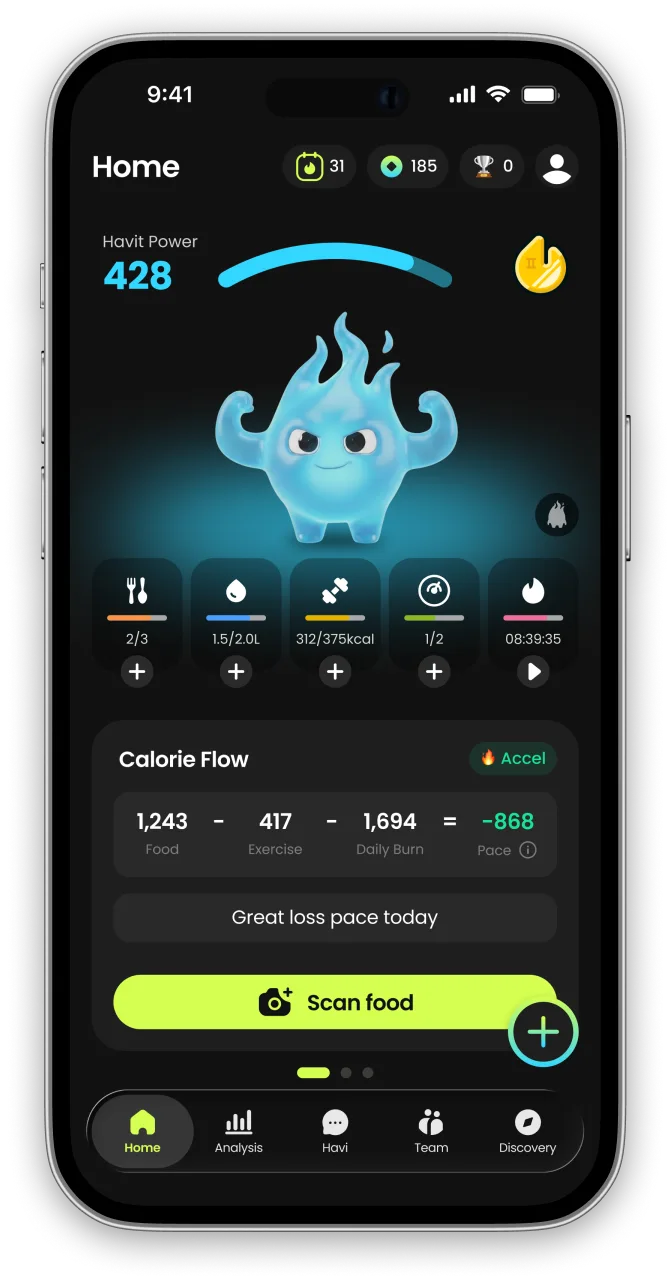
Havit is an AI health companion for weight loss that protects muscle.
Unlike calorie-only trackers, Havit connects AI body-composition estimates, nutrition, hydration, sleep, steps, cycle, mood, and GLP-1 medication in one daily routine — so progress is measured by body composition, not just the number on the scale. Daily missions turn established behavior-change techniques into small repeatable actions, drawing on expertise from professionals formerly at Juvis Diet, one of Korea’s leading metabolic clinics.
In Havit’s own analysis of 1,090 GLP-1 users, people who logged consistently built stronger habits than the general user base. Read the GLP-1 Habit Report
Havit works with or without GLP-1 medication. It is a wellness app, not a medical device; body-composition results are estimates.
Continue in the App
Personalized wellness with your own data


References
- Weekend Recovery Experiences and Monday Work Engagement: A Longitudinal Diary Study — Journal of Occupational Health Psychology, Sonnentag et al., 2025
- The Leisure-Work Interface: How Weekend Activities Predict Weekday Performance — Work & Stress, Bennett & Bakker, 2024
- Psychological Detachment from Work During Leisure Time: A Meta-Analytic Review — Journal of Applied Psychology, 2024
- Remote Work and Recovery: Boundary Management Strategies for Distributed Workers — Journal of Occupational Health Psychology, 2025


