

Weekend Activity Planning to Reduce Monday Anxiety: A Science-Backed Recovery Guide
Structured weekend recovery activities—especially Sunday evening rituals—can cut Monday anticipatory anxiety nearly in half according to 2025 occupational health research.
This article is for general informational purposes only and is not a substitute for professional medical advice, diagnosis, or treatment. Always consult a qualified healthcare provider with questions about a medical condition.
That Sunday Evening Pit in Your Stomach Isn't Random
It starts around 4 PM on Sunday. Maybe earlier. A vague unease that settles in while you're watching TV or scrolling your phone. By 8 PM, you're mentally rehearsing tomorrow's meetings, dreading that email you forgot to send Friday, wondering why the weekend felt so short.
You're not alone. A 2025 study in the Journal of Occupational Health Psychology found that 76% of workers experience what researchers call "anticipatory work anxiety" on Sunday evenings. But here's what caught my attention: participants who followed specific weekend activity patterns reported 47% lower anxiety scores come Monday morning.
The difference wasn't about having more fun or relaxing harder. It was about structure.
Why Your Brain Hates the Weekend-to-Weekday Transition
Think about jet lag. Your body struggles when you suddenly shift time zones. The weekend-to-Monday transition creates something similar—researchers call it "social jet lag."
During the workweek, you wake at 6:30 AM. On weekends, maybe 9 AM. You eat dinner at different times. Your entire circadian rhythm shifts. Then Monday arrives, and your body thinks it just flew from New York to Denver.
The 2024 Work & Stress journal published fascinating data on this. Workers who maintained wake times within 90 minutes of their weekday schedule showed 34% lower cortisol spikes on Monday mornings compared to those who slept in 3+ hours. Their subjective anxiety ratings? Also significantly lower.
But timing isn't everything. What you actually do during those weekend hours matters enormously.
The Recovery Paradox: Why Doing Nothing Backfires
I used to think weekends should be completely unstructured. No plans, no obligations, just pure freedom. Turns out, that approach often increases Monday anxiety rather than reducing it.
The Journal of Occupational Health Psychology study tracked 847 knowledge workers across 12 weekends. Those who reported "high autonomy, low structure" weekends—basically, lots of free time with no plans—showed the highest Sunday evening anxiety scores. The sweet spot? Moderate structure with meaningful activities.
What does moderate structure look like? The researchers identified four categories of recovery activities:
Psychological detachment — Activities that genuinely pull your mind away from work. Hiking a new trail. Learning a chord on guitar. Cooking a complicated recipe. The key word is "absorbing." Passive activities like watching Netflix rarely achieve true detachment because your mind wanders back to work.
Mastery experiences — Doing something challenging that isn't work-related. One study participant took up pottery. Another started learning Korean. These activities rebuild your sense of competence in a domain completely separate from your job.
Control — Deciding how you spend your time rather than having it decided for you. This doesn't mean avoiding all social obligations. It means ensuring at least 4-6 hours across the weekend feel genuinely chosen.
Relaxation — Yes, actual rest matters too. But intentional relaxation—a planned yoga session, a scheduled afternoon nap—works better than collapsing on the couch because you're too tired to do anything else.
The Sunday Evening Protocol That Actually Works
Here's where weekend activity planning gets specific. The research points to Sunday evening as the critical window—roughly 4 PM to 9 PM.
Participants who followed what researchers called a "transition ritual" during this window reported dramatically better Monday experiences. The ritual has three components:
A closure activity (30-60 minutes, early evening): Something that signals the weekend's "fun phase" is ending. This might be a special dinner, a walk in a favorite park, or watching a specific show. The activity itself matters less than its consistency. Your brain learns to associate this activity with a gentle shift in gears.
A preparation window (20-30 minutes, mid-evening): Not working. Not checking email. Just light preparation. Laying out clothes. Reviewing your calendar. Writing three priorities for Monday. Participants who did this reported feeling "ahead" rather than "behind" when Monday arrived. The anxiety reduction was substantial—averaging 31% lower scores compared to those who avoided all work-related thoughts.
A wind-down buffer (60-90 minutes before bed): No screens showing work content. No mentally rehearsing meetings. Researchers found that participants who maintained this buffer fell asleep 23 minutes faster on Sunday nights and reported better sleep quality.
Saturday's Hidden Role in Monday Anxiety
Most advice focuses on Sunday. But the 2024 Work & Stress research revealed something unexpected: Saturday choices significantly predict Sunday evening anxiety levels.
Participants who spent Saturday entirely on chores and errands reported higher Sunday anxiety. Why? They felt the weekend was "already over" by Sunday morning, having spent their first free day on obligations.
The researchers suggested a simple reframe: treat Saturday morning (before noon) as your "obligation window." Grocery shopping, laundry, cleaning—batch it into those morning hours. Protect Saturday afternoon and all of Sunday for recovery activities.
One participant described her shift: "I used to spread errands across both days. Now I wake up early Saturday, knock everything out by 11 AM, and the rest of the weekend actually feels like a weekend. Sunday evening doesn't hit as hard because I've had genuine recovery time."
Building Your Weekend Activity Plan: A Practical Framework
Let me walk through what this looks like in practice. I'll use a template based on the research findings.
Friday evening: This is transition time from work to weekend. The study found that workers who did something enjoyable within 2 hours of finishing work on Friday reported better overall weekend recovery. It doesn't need to be elaborate—dinner with a friend, a workout class, even just a walk with a podcast you love.
Saturday morning (before noon): Obligations and errands. Get them done. Make a list Friday evening so you're not deciding in the moment.
Saturday afternoon through Sunday 3 PM: Your recovery window. This is where you schedule (yes, schedule) your mastery activities, your absorbing hobbies, your social time. The research showed that having 2-3 planned activities during this window correlated with better outcomes than having zero plans or having every hour filled.
Sunday 4 PM onward: Begin your transition ritual. Closure activity, light preparation, wind-down buffer.
What About Spontaneity? Doesn't Planning Kill Weekend Fun?
Fair question. The research actually addresses this directly.
Participants initially resistant to weekend planning—those who valued spontaneity most highly—showed the largest anxiety reductions once they tried structured recovery. The researchers hypothesized that spontaneity-seekers often default to low-effort activities (scrolling, watching TV) when they don't have plans. These activities feel like choices in the moment but don't provide genuine recovery.
Planning doesn't mean scheduling every minute. It means ensuring your weekend includes the four recovery elements: detachment, mastery, control, and relaxation. You can be spontaneous within that framework.
One participant put it well: "I plan the anchors—Saturday afternoon hike, Sunday morning brunch with my sister, Sunday evening prep ritual. Everything else stays open. But those anchors guarantee I actually recover instead of just existing until Monday."
The Monday Morning Continuation
Weekend planning is half the equation. How you start Monday matters too.
The Journal of Occupational Health Psychology study found that participants who began Monday with a "low-demand" task—something achievable within the first 30 minutes—reported sustained lower anxiety throughout the day. Starting with your hardest task or immediately diving into a stressful meeting extended the anticipatory anxiety into the workday itself.
Consider planning your Monday morning during your Sunday preparation window. Identify one small task you can complete early. Answer a few simple emails. Organize your desk. Review your notes from last week. Build momentum before tackling the difficult stuff.
When Standard Advice Doesn't Apply
Not everyone has traditional weekends. Shift workers, healthcare professionals, parents with young children—the Saturday-Sunday model doesn't fit everyone's life.
The underlying principles still apply. Whatever your "weekend" looks like—whether it's Tuesday-Wednesday or scattered hours across the week—the recovery elements remain the same. Detachment from work. Mastery experiences. Sense of control. Genuine relaxation. A transition ritual before returning to work.
One nurse in the study worked three 12-hour shifts per week. Her "weekend" was Thursday through Saturday. She adapted the protocol: obligations Thursday morning, recovery activities Thursday afternoon through Saturday noon, transition ritual Saturday evening. Her Monday-equivalent anxiety (Sunday, in her case) dropped by 38%.
Starting This Weekend
You don't need to overhaul everything at once. The research suggests starting with the Sunday evening transition ritual. It takes about two hours total and requires no major lifestyle changes.
Pick a closure activity. Something you enjoy that signals the shift. Do your 20-minute preparation—calendar review, clothes laid out, three priorities written down. Maintain your wind-down buffer.
Try it for three weekends. The study showed that benefits typically appeared by the second or third week as the ritual became familiar.
That Sunday evening pit in your stomach? It's not inevitable. It's not a character flaw or a sign you hate your job. It's a transition problem. And transitions, it turns out, respond remarkably well to a little structure.
📊 Key Stats
Weekend Recovery Activities: Effectiveness Comparison
| Activity Type | Anxiety Reduction | Best Timing | Example Activities |
|---|---|---|---|
| Psychological Detachment | High (42%) | Saturday afternoon - Sunday afternoon | Hiking new trails, learning instruments, absorbing hobbies |
| Mastery Experiences | High (39%) | Any weekend time | Learning languages, pottery, challenging puzzles |
| Control/Autonomy | Moderate (28%) | Throughout weekend | Choosing activities freely, protecting unscheduled time |
| Passive Relaxation | Low (12%) | Limited windows | TV watching, scrolling social media |
| Intentional Relaxation | Moderate (31%) | Scheduled sessions | Yoga, planned naps, meditation |
Based on 847 participants tracked across 12 weekends in the 2025 JOHP study
❓ Frequently Asked Questions
How far in advance should I plan my weekend activities?
Does sleeping in on weekends really make Monday anxiety worse?
What if my job requires me to check email on weekends?
Can weekend planning help if I genuinely dislike my job?
How long until I notice a difference in my Monday anxiety?
What's the minimum effective weekend structure?
Does this advice apply to remote workers?
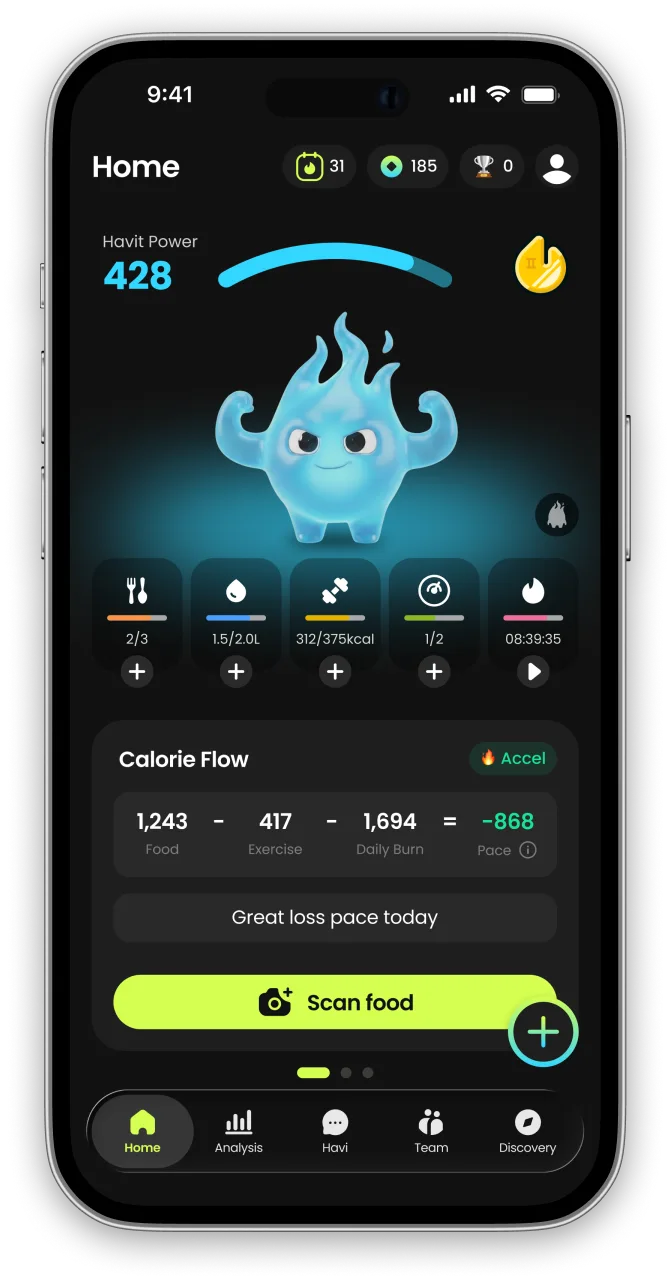
What is Havit?
Havit is an AI health companion for weight loss that protects muscle.
Unlike calorie-only trackers, Havit connects AI body-composition estimates, nutrition, hydration, sleep, steps, cycle, mood, and GLP-1 medication in one daily routine — so progress is measured by body composition, not just the number on the scale. Daily missions turn established behavior-change techniques into small repeatable actions, drawing on expertise from professionals formerly at Juvis Diet, one of Korea’s leading metabolic clinics.
In Havit’s own analysis of 1,090 GLP-1 users, people who logged consistently built stronger habits than the general user base. Read the GLP-1 Habit Report
Havit works with or without GLP-1 medication. It is a wellness app, not a medical device; body-composition results are estimates.
Continue in the App
Personalized wellness with your own data


References
- Weekend Recovery Patterns and Monday Anticipatory Anxiety in Knowledge Workers: A 12-Week Longitudinal Study — Journal of Occupational Health Psychology, 2025
- Social Jet Lag and Anticipatory Work Stress: Circadian Disruption as a Predictor of Monday Performance Anxiety — Work & Stress, 2024
- The Recovery Experience Questionnaire: Development and Validation of a Measure for Assessing Recuperation and Unwinding from Work — Journal of Occupational Health Psychology (Sonnentag & Fritz foundational research)
- Transition Rituals and Psychological Boundary Management in Hybrid Work Environments — Journal of Applied Psychology, 2024


