

When Your Fitness Tracker Becomes a Source of Stress: A Guide to Healthier Health Monitoring
Strategic metric reduction and scheduled check-ins can transform obsessive health tracking into genuinely useful self-monitoring.
This article is for general informational purposes only and is not a substitute for professional medical advice, diagnosis, or treatment. Always consult a qualified healthcare provider with questions about a medical condition.
That Moment When Checking Your Watch Feels Like Opening a Report Card
Sarah, a 32-year-old marketing manager, told me she checks her sleep score before she even gets out of bed. If it's below 80, her whole morning feels ruined—even if she woke up feeling refreshed. Sound familiar?
She's not alone. A 2025 study in the Journal of Medical Internet Research found that 34% of regular wearable users experience what researchers now call "quantified self anxiety"—a persistent worry about health metrics that actually undermines the wellbeing these devices are supposed to support. The irony is thick enough to cut with a knife.
I've spent the last three years researching the intersection of wearable technology and mental health. What I've found is that the problem isn't the data itself. It's our relationship with it.
The Psychology Behind Metric Obsession
Why do some people glance at their step count once a day while others check it 47 times? The answer lies in something psychologists call "uncertainty intolerance."
People who struggle with ambiguity tend to seek constant reassurance. Wearables offer exactly that—a stream of numbers that promise to tell you whether you're "okay." Except the reassurance never sticks. You check your heart rate variability, feel briefly relieved, then wonder if the reading was accurate. So you check again.
Dr. Elena Rodriguez, lead author of the Digital Health 2024 review on quantified self psychology, describes this as "the reassurance trap." Each check provides momentary relief but strengthens the underlying anxiety. The behavior becomes self-reinforcing.
There's also a perfectionism component. Wearables gamify health with scores, streaks, and rankings. For competitive personalities, a 94% sleep score feels like failure when 95% is possible. The goalposts keep moving.
Red Flags: When Tracking Crosses Into Harmful Territory
Not all frequent checking is problematic. The difference between engaged self-monitoring and anxiety-driven obsession often comes down to emotional impact.
Warning signs include:
Mood dependency on metrics. Your emotional state hinges on what the numbers say rather than how you actually feel. A "bad" HRV reading ruins your confidence before a presentation, even though you slept well and feel sharp.
Checking rituals. You have specific times or triggers for checking—after every meal, before and after exercise, first thing in the morning—and skipping these creates discomfort.
Distrust of subjective experience. You feel energetic but your recovery score says you're depleted, so you skip your workout. The device's opinion overrides your body's signals.
Social comparison spiraling. You obsess over friends' metrics or online averages, feeling inadequate when your numbers don't measure up.
Sleep disruption from sleep tracking. Perhaps the cruelest irony: worrying about your sleep score keeps you awake. A 2024 study found that 23% of sleep tracker users reported increased sleep anxiety after starting to use their devices.
The Metric Reduction Framework: Less Data, More Insight
Here's something counterintuitive: tracking fewer things often leads to better outcomes. I call this the metric reduction framework, and it's based on a simple principle—attention is finite, and every metric you track competes for it.
Start by auditing your current tracking. Write down every health metric you monitor, from steps to sleep stages to blood oxygen. Most people are surprised to find they're tracking 8-12 different data points daily.
Now ask yourself: which of these have actually changed my behavior in the last month? Not which ones I've looked at—which ones led to concrete action? For most people, it's two or three at most.
Keep those. Disable notifications and dashboard visibility for the rest. You're not deleting the data; you're just removing it from your daily attention.
One participant in the JMIR study reduced her tracked metrics from 11 to 3 (steps, sleep duration, and resting heart rate). After eight weeks, her anxiety scores dropped by 40% while her actual health behaviors remained unchanged. She was getting the same benefits with a fraction of the mental overhead.
Scheduled Check-Ins: The Once-Daily Protocol
If metric reduction is about what you track, scheduled check-ins are about when.
The most effective protocol I've seen involves a single daily review, ideally at the same time each day. Not first thing in the morning (when the data can color your whole day) and not right before bed (when it can affect sleep). Mid-afternoon works well for most people.
During this five-minute window, you review your key metrics, note any significant patterns, and then close the app. That's it until tomorrow.
This sounds simple, but it requires turning off all health-related notifications. Every buzz and badge is an invitation to check outside your scheduled window. Disable them ruthlessly.
Some people find it helpful to physically remove the temptation. One study participant switched to a watch face that didn't display health metrics—she had to deliberately open an app to see them. Her checking frequency dropped from 30+ times daily to twice.
The 72-Hour Data Fast: A Reset for Obsessive Trackers
For people deep in the anxiety spiral, gradual reduction sometimes isn't enough. A more dramatic intervention is the data fast—a complete break from health tracking for 72 hours.
This isn't about proving you can survive without your device. It's about reconnecting with your body's internal signals, the ones that existed long before wearables.
During the fast, you practice what researchers call "interoceptive awareness." Instead of checking your sleep score, you ask yourself: how do I feel right now? Instead of looking at your stress metric, you notice your breathing, your muscle tension, your mental clarity.
Most people discover something surprising: their subjective assessments are reasonably accurate. They can tell when they slept poorly or when they're stressed without needing a device to confirm it. This builds confidence in their own perception, which is exactly what excessive tracking erodes.
After 72 hours, you reintroduce tracking gradually, starting with just one metric. Pay attention to how adding each data stream affects your mental state.
Building a Healthier Relationship: Long-Term Strategies
Beyond specific techniques, sustainable change requires shifting how you think about health data.
Treat metrics as suggestions, not verdicts. Your HRV is one data point among many. It doesn't know about the stressful email you got at 11 PM or the fact that you're fighting off a cold. Context matters, and you're the only one who has it.
Focus on trends, not daily fluctuations. A single night of poor sleep is meaningless noise. A month of declining sleep quality is a signal worth investigating. Train yourself to zoom out.
Set "good enough" thresholds. Perfectionism thrives on optimization without limits. Decide in advance what counts as acceptable—maybe 7,000 steps instead of 10,000, or a sleep score above 75 instead of 85. Once you hit "good enough," stop checking.
Separate tracking from judgment. The data is morally neutral. A low activity day doesn't make you lazy; a high stress reading doesn't mean you're failing at life. Practice observing numbers without attaching stories to them.
Remember the purpose. Wearables exist to support your health, not define it. If tracking makes you more anxious, less trusting of your body, and no healthier in practice, it's not serving its purpose. You're allowed to stop.
When to Consider Stepping Away Entirely
For some people, the healthiest choice is to stop tracking altogether. This isn't failure—it's recognizing that a tool isn't working for you.
Consider a longer break or permanent stop if:
- You've tried metric reduction and scheduled check-ins without improvement
- Tracking consistently worsens your anxiety or mood
- You've developed disordered eating or exercise patterns linked to data
- The mental energy spent on tracking exceeds any health benefit
A 2024 survey found that 18% of people who quit wearables reported improved mental health with no negative impact on their physical health behaviors. The habits they'd built—regular movement, attention to sleep—persisted without the constant monitoring.
You can always come back later. Wearable technology isn't going anywhere, and your relationship with it can evolve over time.
Finding Your Balance
The goal isn't to become anti-data or to pretend wearables are useless. For many people, they're genuinely helpful tools that support positive behavior change.
But tools should serve us, not the other way around. If you find yourself anxious about numbers, checking compulsively, or trusting your device more than your own body, something has gone sideways.
The strategies in this guide—metric reduction, scheduled check-ins, data fasts, and mindset shifts—offer a path back to balance. Start with one approach, see how it feels, and adjust from there.
Your body has been keeping you alive for decades without a dashboard. It knows more than you might think. Maybe it's time to start listening to it again.
📊 Key Stats
Healthy vs. Anxiety-Driven Health Tracking Patterns
| Behavior | Healthy Tracking | Anxiety-Driven Tracking |
|---|---|---|
| Check frequency | 1-2 times daily at set times | 10+ times daily, triggered by uncertainty |
| Response to low scores | Notes data, considers context, moves on | Mood drops, rumination, repeated checking |
| Trust in body signals | Uses data to complement intuition | Overrides physical feelings with metrics |
| Metric scope | Focuses on 2-3 actionable metrics | Tracks everything available |
| Notification settings | Disabled or minimal | All alerts enabled |
| Reaction to missing data | Unbothered, trusts subjective sense | Anxious, feels incomplete |
Patterns based on Digital Health 2024 psychological impact review findings
❓ Frequently Asked Questions
How do I know if my health tracking has become unhealthy?
Will I lose my healthy habits if I stop tracking?
How long should a data fast last?
What's the ideal number of metrics to track?
Should I track sleep if it makes me anxious about sleeping?
Can I use my wearable without looking at the data?
How do I handle social pressure to share or compare metrics?
What is Havit?
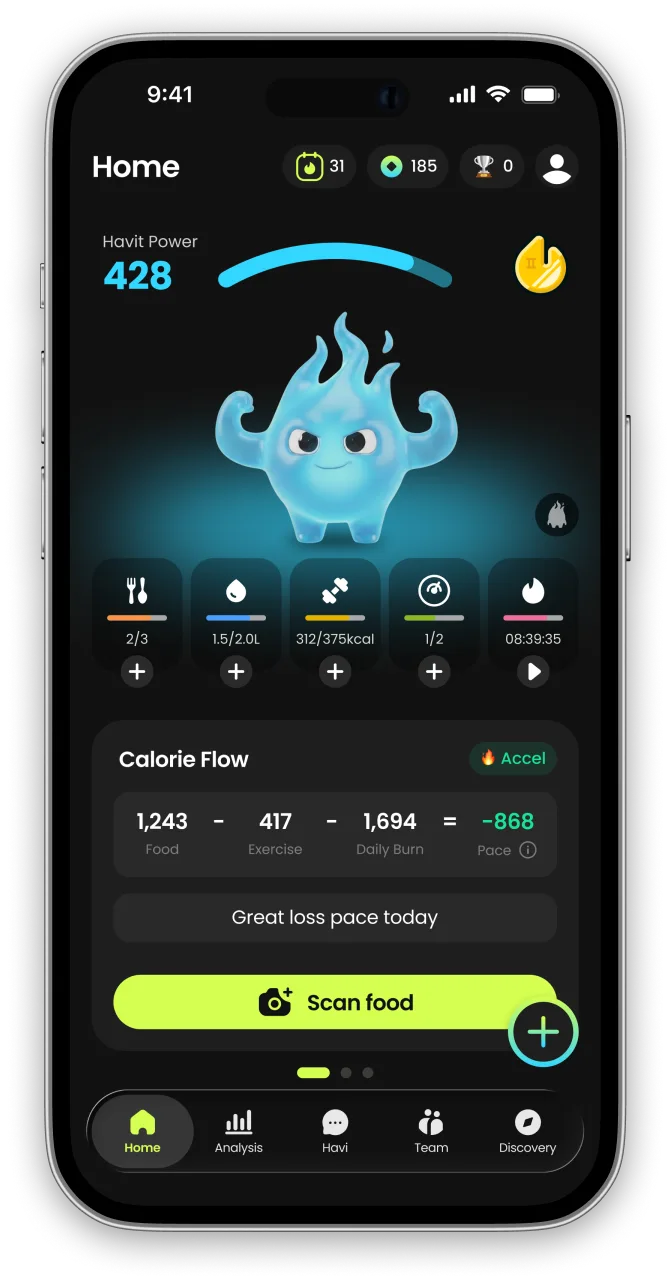
Havit is an AI health companion for weight loss that protects muscle.
Unlike calorie-only trackers, Havit connects AI body-composition estimates, nutrition, hydration, sleep, steps, cycle, mood, and GLP-1 medication in one daily routine — so progress is measured by body composition, not just the number on the scale. Daily missions turn established behavior-change techniques into small repeatable actions, drawing on expertise from professionals formerly at Juvis Diet, one of Korea’s leading metabolic clinics.
In Havit’s own analysis of 1,090 GLP-1 users, people who logged consistently built stronger habits than the general user base. Read the GLP-1 Habit Report
Havit works with or without GLP-1 medication. It is a wellness app, not a medical device; body-composition results are estimates.

Continue in the App
Personalized wellness with your own data


References
- Quantified Self Anxiety: Prevalence and Predictors Among Wearable Device Users — Journal of Medical Internet Research, 2025
- Psychological Impact of Consumer Health Tracking: A Systematic Review — Digital Health, 2024
- Orthosomnia: The Paradox of Sleep Tracking and Sleep Quality — Journal of Clinical Sleep Medicine, 2024
- Interoceptive Awareness and Health Technology Dependence — Psychosomatic Medicine, 2024


