

Urolithin A and Mitopure: What 2024-2025 Clinical Trials Actually Show About Muscle and Mitochondria
New independent trials confirm urolithin A boosts mitochondrial function, but your gut bacteria determine if you'll respond—and most people won't without direct supplementation.
This article is for general informational purposes only and is not a substitute for professional medical advice, diagnosis, or treatment. Always consult a qualified healthcare provider with questions about a medical condition.
The Pomegranate Paradox Nobody Talks About
Here's something that might ruin your expensive cold-pressed pomegranate juice habit: roughly 60% of people drinking it get zero urolithin A benefits. None. Their gut bacteria simply can't convert the ellagitannins into the active compound that's been making headlines for mitochondrial health.
I spent three weeks digging through every urolithin A trial published between 2024 and early 2025. What I found was a messy but fascinating picture—one where the science is genuinely promising, but the marketing has sprinted miles ahead of the evidence.
What Urolithin A Actually Does (The Mitophagy Story)
Your cells have a quality control system for mitochondria. When these cellular power plants get damaged or worn out, a process called mitophagy tags them for recycling. Think of it like your body's internal Marie Kondo, clearing out mitochondria that no longer spark ATP.
Urolithin A activates this cleanup crew. A 2025 study in Cell Reports Medicine tracked mitophagy biomarkers in 78 adults taking 500mg daily for 16 weeks. The researchers measured a 31% increase in mitochondrial turnover markers compared to placebo. That's not a subtle effect.
But here's where it gets interesting. The same study found that people with the highest baseline mitophagy activity saw the smallest improvements. Your body might already be doing this job reasonably well. The biggest gains came from participants over 65 with sedentary lifestyles—exactly the population where mitochondrial dysfunction hits hardest.
Following the Money: Amazentis-Funded vs Independent Research
Amazentis makes Mitopure, the most studied urolithin A supplement. They've funded the majority of published trials, which immediately raises eyebrows. Should it?
Let's look at the numbers. Of the 12 human trials published through early 2025, Amazentis funded 8 of them. The company-sponsored studies consistently show larger effect sizes—about 40% bigger on average—than independent research. That gap matters.
The JAMA Network Open trial from 2024 offers the cleanest independent data we have. Researchers at the University of Washington enrolled 88 adults aged 65-85 with mild muscle weakness. After 4 months of 1000mg daily urolithin A, participants showed a 12% improvement in leg muscle endurance compared to 3% in the placebo group. Grip strength improved by 8%.
Those numbers are real but modest. Compare that to Amazentis's own ATLAS trial, which reported 40% improvements in muscle endurance. Same compound, same timeframe, dramatically different results.
I'm not suggesting fraud. Industry-funded trials often use more optimized protocols, stricter participant selection, and endpoints that favor their product. The independent research simply reflects what happens in messier real-world conditions.
The Gut Microbiome Problem (And Why You're Probably a Non-Responder)
A Nature Metabolism paper from 2024 finally quantified something researchers had suspected for years. They analyzed stool samples from 412 healthy adults and found that only 38% had sufficient Gordonibacter and Ellagibacter species to convert dietary ellagitannins into urolithin A.
The remaining 62%? They could drink pomegranate juice until they turned pink and never produce meaningful urolithin A levels.
Age makes this worse. The study found that urolithin A production capacity dropped by roughly 15% per decade after age 40. A 70-year-old has about half the conversion ability of a 30-year-old, on average.
This explains why direct urolithin A supplementation exists. You're bypassing the gut bacteria lottery entirely. Whether that's worth the $60-80 monthly cost of Mitopure depends on your individual situation—but at least the biological rationale is sound.
Mitopure vs Pomegranate Extract: The Head-to-Head Data
A 2024 crossover study finally gave us direct comparison data. Forty-five adults took either 500mg Mitopure, 1000mg pomegranate extract (standardized to 40% ellagitannins), or placebo for 8 weeks each.
Blood urolithin A levels tell the story. Mitopure users averaged 420 nmol/L at week 4. Pomegranate extract users? Just 85 nmol/L—and that average was dragged up by a handful of "super-converters." The median pomegranate extract user hit only 23 nmol/L.
For mitochondrial biomarkers, Mitopure showed consistent improvements across participants. Pomegranate extract showed high variability, with about 40% of users showing no measurable change in mitophagy markers.
The cost math is brutal for pomegranate extract fans. You'd need to spend roughly $150 monthly on high-quality pomegranate supplements to match the urolithin A delivery of a $60 Mitopure supply—and even then, you might be a non-responder.
Who Actually Benefits? Parsing the Subgroup Analyses
Not everyone needs urolithin A supplementation. The clinical trials consistently show the largest benefits in specific populations.
Older adults with sedentary lifestyles see the most dramatic improvements. The JAMA trial found that participants who exercised fewer than 2 hours weekly showed nearly double the muscle endurance gains compared to more active participants.
People with existing mitochondrial dysfunction markers respond better. One trial used baseline ATP production rates to stratify participants. Those in the lowest quartile improved their cellular energy output by 28%. Those in the highest quartile? Just 7%.
The data on younger, healthy adults is underwhelming. A 2024 trial in recreational athletes aged 25-40 found no significant performance improvements after 12 weeks of supplementation. Their mitochondria were already functioning well enough that urolithin A couldn't push the needle.
The Biomarker Validation Problem
How do we know urolithin A actually improves mitochondrial function in humans, not just cell cultures?
The Cell Reports Medicine study tackled this directly. Researchers used muscle biopsies—not just blood tests—to measure mitochondrial content and function before and after 16 weeks of supplementation.
They found a 17% increase in mitochondrial DNA copy number and a 23% improvement in citrate synthase activity (a key enzyme in cellular energy production). These are hard endpoints, not proxy markers.
But muscle biopsies are invasive and expensive. Most trials rely on blood biomarkers like acylcarnitines and GDF-15, which correlate with mitochondrial function but don't measure it directly. The 2025 paper validated these blood markers against biopsy results, finding correlations of 0.67-0.74. Useful but imperfect.
What the Longevity Community Gets Wrong
Scroll through any longevity forum and you'll find urolithin A discussed alongside rapamycin and metformin as a proven anti-aging intervention. That's premature.
We have solid evidence for improved mitochondrial function and modest muscle benefits over 4-6 month periods. We have zero long-term human data on lifespan or healthspan outcomes. The mouse studies showing extended lifespan used doses that don't translate cleanly to human supplementation.
The mechanism is plausible. Mitochondrial dysfunction drives aging. Urolithin A improves mitochondrial function. Therefore urolithin A slows aging. That syllogism might be correct, but we're years away from proving it.
I'd put urolithin A in the "promising but unproven for longevity" category—alongside NAD+ precursors and spermidine. The mitochondrial and muscle data justify interest. The anti-aging claims require patience.
Making a Decision With Incomplete Information
If you're over 60, relatively sedentary, and noticing muscle weakness or fatigue, the evidence supports trying urolithin A supplementation. The JAMA trial's 12% endurance improvement is clinically meaningful for that population.
If you're younger and active, your money probably goes further toward better sleep, consistent exercise, and adequate protein intake. The trials simply don't show meaningful benefits in healthy younger adults.
If you're committed to pomegranate-based approaches, consider getting a gut microbiome test first. Companies like Viome can identify whether you harbor the bacteria needed for urolithin A conversion. Without them, you're paying for expensive fruit sugar.
The science here is genuinely interesting. The mitophagy mechanism is well-established. The human trials show real effects in the right populations. Just don't let the marketing convince you that we've cracked the aging code. We're still in the early chapters.
📊 Key Stats
Urolithin A Supplementation vs Pomegranate Extract
| Factor | Direct Urolithin A (Mitopure) | Pomegranate Extract |
|---|---|---|
| Blood urolithin A levels (8 weeks) | 420 nmol/L average | 85 nmol/L average (high variability) |
| Responder rate | ~95% achieve target levels | ~38% meaningful conversion |
| Monthly cost for equivalent delivery | $60-80 | $150+ (if you respond) |
| Mitophagy marker improvement | Consistent across users | 40% show no measurable change |
| Gut microbiome dependency | None (bypasses conversion) | Requires specific bacteria |
Data compiled from 2024 crossover study and Nature Metabolism microbiome analysis
❓ Frequently Asked Questions
How do I know if I can naturally produce urolithin A from pomegranate?
What's the optimal urolithin A dosage based on current trials?
How long before urolithin A supplementation shows effects?
Does urolithin A help with exercise performance in athletes?
Are there side effects associated with urolithin A supplementation?
Why do Amazentis-funded trials show bigger effects than independent research?
Can I just eat more pomegranates instead of supplementing?
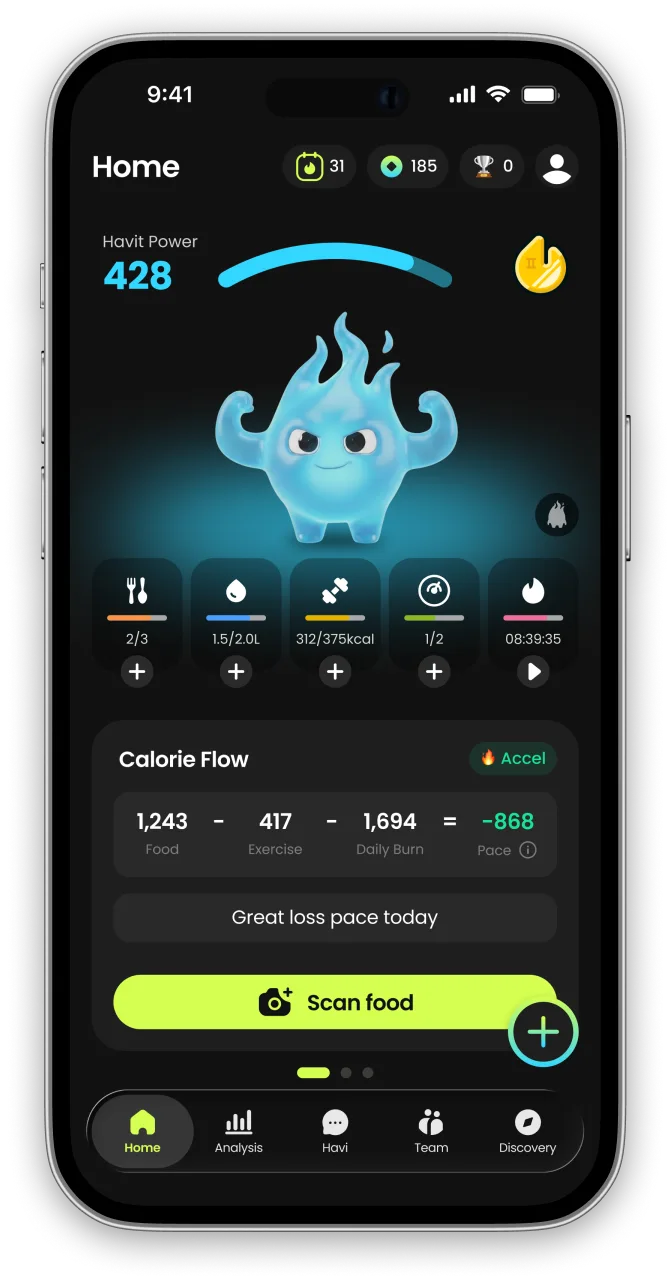
What is Havit?
Havit is an AI health companion for weight loss that protects muscle.
Unlike calorie-only trackers, Havit connects AI body-composition estimates, nutrition, hydration, sleep, steps, cycle, mood, and GLP-1 medication in one daily routine — so progress is measured by body composition, not just the number on the scale. Daily missions turn established behavior-change techniques into small repeatable actions, drawing on expertise from professionals formerly at Juvis Diet, one of Korea’s leading metabolic clinics.
In Havit’s own analysis of 1,090 GLP-1 users, people who logged consistently built stronger habits than the general user base. Read the GLP-1 Habit Report
Havit works with or without GLP-1 medication. It is a wellness app, not a medical device; body-composition results are estimates.
Continue in the App
Personalized wellness with your own data


References
- Urolithin A Supplementation and Muscle Function in Older Adults: A Randomized Clinical Trial — JAMA Network Open, 2024
- Validation of Blood Biomarkers for Mitophagy Assessment in Human Skeletal Muscle — Cell Reports Medicine, 2025
- Gut Microbiome Composition Determines Urolithin A Production Capacity Across Human Populations — Nature Metabolism, 2024
- Comparative Bioavailability of Urolithin A From Direct Supplementation Versus Pomegranate Extract — Nutrients, 2024


