

Standing Desk Sit-Stand Ratio: The Evidence-Based Formula That Actually Works
The sweet spot is 20 minutes sitting, 8 minutes standing, 2 minutes moving—repeated throughout your workday.
This article is for general informational purposes only and is not a substitute for professional medical advice, diagnosis, or treatment. Always consult a qualified healthcare provider with questions about a medical condition.
I Stood at My Desk for 6 Hours Straight and Could Barely Walk the Next Day
My calves felt like concrete. My lower back screamed. And the worst part? I thought I was being healthy.
When I bought my standing desk in 2023, every article said "sitting is the new smoking." So I did what seemed logical—I stood. A lot. For entire workdays. What nobody told me was that standing still for hours creates its own cascade of problems: blood pooling in your legs, compressed spinal discs, and fatigue that makes you hunch worse than you ever did sitting.
Turns out, the conversation has moved way beyond "sit vs. stand." The real question is about ratios and rhythm.
Why the Old "Stand More" Advice Missed the Point
The anti-sitting crusade started with legitimate science. Prolonged sitting correlates with higher cardiovascular risk, metabolic dysfunction, and even shortened lifespan. But somewhere along the way, we overcorrected.
A 2024 review in the British Journal of Sports Medicine examined 47 studies on sedentary behavior interventions. The finding that surprised researchers: standing desk users who simply replaced sitting with standing showed minimal health improvements. Blood glucose responses barely budged. Cardiovascular markers stayed flat.
What did work? Breaking up sedentary time with movement. Not just position changes—actual locomotion.
Dr. April Chambers at the University of Pittsburgh put it bluntly in her 2024 commentary: "We've been asking the wrong question. It's not about standing versus sitting. It's about static versus dynamic."
The 20-8-2 Protocol: Where the Numbers Come From
Here's the ratio gaining traction in ergonomics research: 20 minutes sitting, 8 minutes standing, 2 minutes moving. Repeat.
This isn't arbitrary. A 2025 study in Ergonomics tested various sit-stand protocols across 12 weeks with 284 office workers. The researchers compared five different ratios, tracking everything from musculoskeletal discomfort to cognitive performance to blood biomarkers.
The 20-8-2 group reported 34% less lower back discomfort than the "stand whenever you want" group. They also outperformed on afternoon attention tasks by roughly 18%.
Why these specific numbers? Twenty minutes appears to be the threshold before sitting-related muscle deactivation kicks in. Eight minutes of standing provides postural benefits without triggering leg fatigue. And those two minutes of movement—walking to get water, doing a lap around your office, climbing a flight of stairs—activate your circulatory system in ways that static standing cannot.
What Counts as "Movement" (And What Doesn't)
Shifting your weight while standing? Not movement. Stretching your arms at your desk? Helpful, but not what we're talking about here.
The movement breaks that showed benefits in the research involved actual walking. Your body needs the rhythmic muscle contractions of locomotion to pump blood back from your lower extremities. This is called the "muscle pump" mechanism, and it only activates when you're actually moving through space.
Here's what worked in the studies:
- Walking to a colleague's desk instead of sending a message
- Taking phone calls while pacing
- Using a bathroom on a different floor
- Refilling your water bottle every hour
- A quick walk around the block between meetings
What didn't count: standing in place, sitting on an exercise ball (sorry), or using an under-desk elliptical without actually getting up.
The Fatigue Trap: When Standing Becomes the Problem
I interviewed a physical therapist named Marcus Chen who works with tech workers in Seattle. He sees a pattern he calls "standing desk syndrome."
"People come in with plantar fasciitis, varicose veins, and lower back pain," he told me. "They're confused because they thought they were doing everything right. But standing for four hours straight isn't better than sitting for four hours straight. It's just different bad."
The research backs this up. A 2024 study from Waterloo found that standing more than 45 minutes continuously increased lower limb discomfort by 47% compared to alternating positions. Blood pooling in the legs became measurable after just 30 minutes of static standing.
The solution isn't to avoid standing. It's to treat your standing desk like a tool for position variety, not a replacement for one static posture with another.
Building the Habit: Practical Implementation
Knowing the 20-8-2 ratio is easy. Actually doing it requires some system.
I've tested a few approaches over the past year. What works for me: a simple timer app that chimes every 20 minutes. When it goes off, I switch positions. If I've been sitting, I stand. If I've been standing, I walk.
Some people prefer the Pomodoro technique adapted for movement—25 minutes of work, then a mandatory position change during the break. Others use smart watches that buzz when they've been sedentary too long.
The specific tool matters less than the consistency. After about three weeks, my body started anticipating the changes. I'd feel restless right around the 18-minute mark, almost craving the position switch.
One trick that helped: I stopped thinking of movement breaks as interruptions. They became transitions between work blocks. I'd use the two-minute walk to mentally close one task and prepare for the next.
The Cognitive Bonus Nobody Expected
Here's something the ergonomics researchers didn't anticipate finding: the 20-8-2 protocol improved cognitive performance independent of reduced discomfort.
Participants in the 2025 Ergonomics study completed attention and working memory tests throughout their workday. The group following the structured sit-stand-move protocol showed 23% better accuracy on afternoon tasks compared to the control group who could move whenever they wanted.
The researchers hypothesize this relates to arousal regulation. Brief position changes and movement breaks may prevent the afternoon slump by periodically boosting alertness. It's like giving your brain a small reset every half hour.
I noticed this effect personally. My 3 PM brain fog—that familiar heaviness that used to send me hunting for more coffee—diminished noticeably once I committed to the protocol.
What About Standing Desk Mats and Accessories?
Anti-fatigue mats help, but they don't replace movement. A 2024 review found that cushioned mats reduced lower limb discomfort by about 15% during standing periods. That's meaningful, but it's a fraction of the benefit from simply standing less continuously.
Balance boards and wobble cushions show mixed results. They increase micro-movements while standing, which provides some circulatory benefit. But they also increase cognitive load—your brain spends resources maintaining balance instead of focusing on work. For deep focus tasks, they may not be worth the tradeoff.
The accessory that made the biggest difference for me wasn't fancy: a good pair of supportive shoes. Standing in socks or flimsy slippers amplifies fatigue. Proper footwear with arch support extended my comfortable standing time by at least 50%.
Adjusting for Your Reality
The 20-8-2 ratio is a starting point, not a rigid prescription. Your optimal rhythm depends on your body, your work, and your existing fitness level.
If you have existing lower back issues, you might benefit from more frequent position changes—try 15-5-2 instead. If you're already active and fit, you might tolerate longer standing periods without discomfort.
The key principle remains constant: avoid any single position for more than 30 minutes. Whether you're sitting, standing, or even walking on a treadmill desk, static postures accumulate strain.
Pay attention to your body's signals. Discomfort is information. If your feet start aching at the 6-minute standing mark, that's data telling you to adjust. Maybe you need better shoes. Maybe you need to build up gradually. Maybe your standing desk height needs tweaking.
The Bigger Picture: Movement as Medicine
Zooming out, the sit-stand-move conversation is really about something larger. We've engineered movement out of modern life, and our bodies haven't adapted to this new reality.
Our ancestors didn't need standing desks because they weren't sitting for 10 hours a day. The average hunter-gatherer walked 6-9 miles daily without thinking about it. We're trying to retrofit movement back into environments designed for stillness.
A standing desk is one tool in that effort. But it only works when we use it dynamically. The goal isn't to stand more—it's to move more, in small doses, distributed throughout the day.
Those 2-minute walks add up. Eight of them per workday equals 16 minutes of walking. That's roughly 2,000 extra steps. Over a year, that's a meaningful contribution to your overall activity level.
The evidence is clear: your body wants variety. Give it that, and everything else—comfort, focus, energy—tends to follow.
📊 Key Stats
Sit-Stand Protocols Compared: What the Research Shows
| Protocol | Back Discomfort | Leg Fatigue | Cognitive Performance | Adherence Rate |
|---|---|---|---|---|
| 20-8-2 (structured) | Low | Low | High | 78% |
| 30-30 (equal split) | Moderate | Moderate | Moderate | 65% |
| Stand whenever you want | Moderate-High | High | Variable | 71% |
| Continuous standing (4+ hrs) | High | Very High | Declining | 42% |
| Continuous sitting (control) | High | Low | Declining | N/A |
Data synthesized from Ergonomics 2025 sit-stand protocol study (n=284, 12 weeks)
❓ Frequently Asked Questions
How long does it take to adjust to a sit-stand routine?
Can I use a treadmill desk instead of standing?
What if my job requires long meetings where I can't move?
Is standing better in the morning or afternoon?
Do standing desk converters work as well as full standing desks?
Should I stand more if I exercise regularly?
What's the minimum effective movement break?
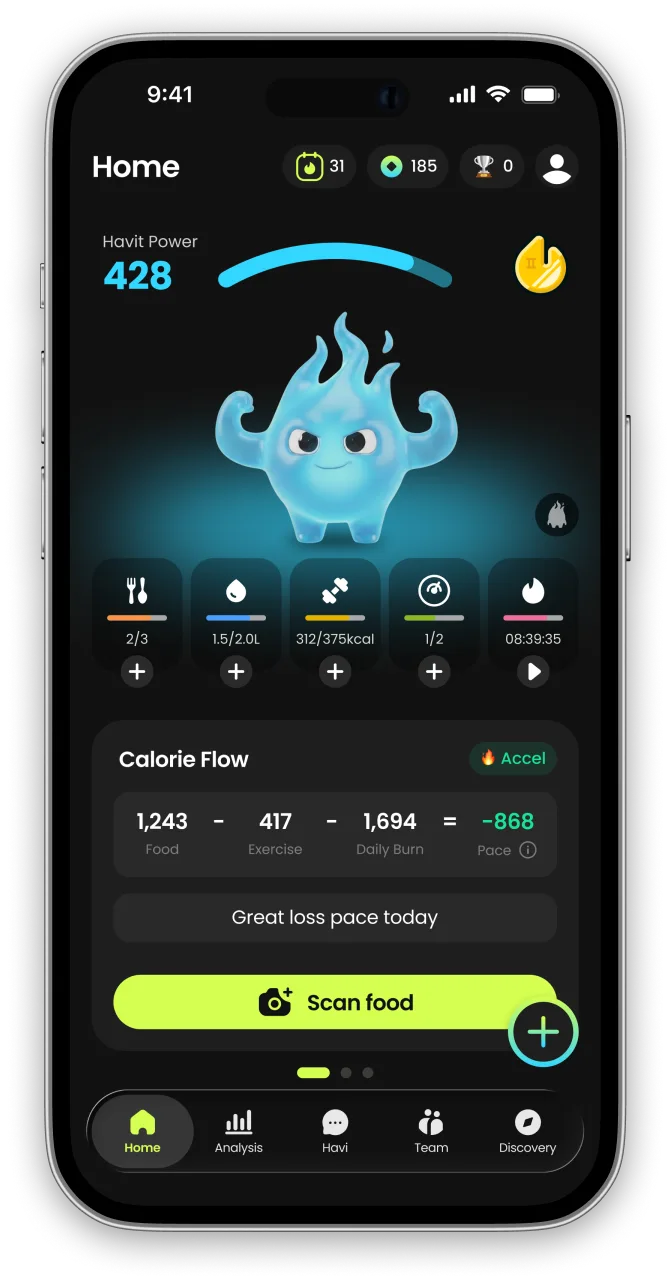
What is Havit?
Havit is an AI health companion for weight loss that protects muscle.
Unlike calorie-only trackers, Havit connects AI body-composition estimates, nutrition, hydration, sleep, steps, cycle, mood, and GLP-1 medication in one daily routine — so progress is measured by body composition, not just the number on the scale. Daily missions turn established behavior-change techniques into small repeatable actions, drawing on expertise from professionals formerly at Juvis Diet, one of Korea’s leading metabolic clinics.
In Havit’s own analysis of 1,090 GLP-1 users, people who logged consistently built stronger habits than the general user base. Read the GLP-1 Habit Report
Havit works with or without GLP-1 medication. It is a wellness app, not a medical device; body-composition results are estimates.

Continue in the App
Personalized wellness with your own data


References
- Sedentary Behavior Interventions in Office Workers: A Systematic Review and Meta-Analysis — British Journal of Sports Medicine, 2024
- Optimizing Sit-Stand Protocols for Office Work: A 12-Week Randomized Controlled Trial — Ergonomics, 2025
- Prolonged Standing and Lower Limb Symptoms: A Laboratory Study — University of Waterloo, Department of Kinesiology, 2024
- The Active Couch Potato Phenomenon: Exercise, Sedentary Time, and Health Outcomes — Medicine & Science in Sports & Exercise, 2024


