

The 7-Day Social Media Time Audit That Actually Changes Your Scrolling Habits
A structured 7-day tracking challenge reveals your true social media patterns and uses behavioral science to help you scroll with intention, not compulsion.
This article is for general informational purposes only and is not a substitute for professional medical advice, diagnosis, or treatment. Always consult a qualified healthcare provider with questions about a medical condition.
You Probably Scrolled for 47 Minutes Before Opening This Article
I'm not judging. I did the same thing yesterday morning. Woke up at 6:42 AM, grabbed my phone to check the time, and somehow emerged from an Instagram rabbit hole at 7:29 AM wondering where my morning went.
Here's what's wild: when researchers asked people to estimate their daily social media use, most guessed around 2 hours. The actual number? Closer to 4 hours and 37 minutes on average. We're not lying—we genuinely have no idea how much time we're spending. A 2024 study in Computers in Human Behavior found that participants underestimated their usage by an average of 2.3 hours daily. That's not a rounding error. That's an entire movie's worth of time vanishing into the void every single day without us noticing.
This challenge isn't about quitting social media or declaring some dramatic digital detox. It's about something simpler and, honestly, more useful: actually knowing where your time goes.
Why Your Brain Has No Clue What's Happening
Social media platforms are engineered by some of the smartest people on the planet to feel like five minutes when it's actually forty-five. The infinite scroll, the variable reward schedule, the autoplay—these aren't accidents. They're features designed to dissolve your sense of time.
Your brain processes social media differently than other activities. When you're cooking dinner or reading a book, you have natural stopping points. The chapter ends. The pasta finishes boiling. But scrolling has no built-in friction. Each post loads seamlessly into the next, and your brain never gets the signal that says "okay, this activity is complete."
Research from Cyberpsychology in 2025 showed something fascinating about awareness interventions. When people simply tracked their usage without any pressure to reduce it, their daily social media time dropped by 38% within two weeks. No willpower required. No dramatic lifestyle overhaul. Just the act of seeing the numbers changed behavior automatically.
That's the principle behind this challenge. Awareness first. Decisions later.
The Pre-Challenge Setup (Do This Tonight)
Before Day 1, you need baseline data. Most smartphones already track this—you just haven't looked.
On iPhone, go to Settings > Screen Time > See All Activity. On Android, check Settings > Digital Wellbeing. Screenshot your current weekly report. Don't judge it. Don't try to fix it. Just document it.
Next, identify your top three social media apps by usage time. For most people, this is some combination of Instagram, TikTok, YouTube, Twitter/X, or Facebook. Write these down somewhere you'll see them daily—a sticky note on your bathroom mirror works surprisingly well.
Finally, set up a simple tracking method. You can use a notes app, a paper notebook, or a spreadsheet. The format doesn't matter. What matters is that you'll actually use it.
Days 1-2: The Pure Observation Phase
For the first two days, change nothing about your behavior. Seriously. Scroll as much as you normally would. The goal here is gathering accurate data, and if you're trying to be "good," you'll skew your baseline.
Every time you open a social media app, note three things: the time, what triggered you to open it (boredom, notification, habit, specific purpose), and how you felt before opening. That last one matters more than you'd think.
A participant in the 2024 Computers in Human Behavior study described her Day 1 log: "I opened Instagram 34 times. Thirty-four. I thought it was maybe eight or nine. Twenty-one of those times, I had no idea why I was opening it—my thumb just did it automatically."
By the end of Day 2, you'll have a clear picture of your patterns. Most people discover they have 2-3 "danger zones"—specific times or emotional states that trigger mindless scrolling. Common ones include: first thing in the morning, during work breaks, while eating alone, and the hour before bed.
Days 3-4: Introducing Friction Points
Now we start making small adjustments. Not restrictions—friction.
The difference matters. Restrictions feel like punishment and trigger rebellion. Friction just adds a tiny pause between impulse and action. That pause is often enough to let your conscious brain catch up with your autopilot.
Here are proven friction techniques from digital wellness research:
The App Relocation Method: Move your top social media apps off your home screen and into a folder on your second or third page. One study found this reduced opens by 23% because the extra 2-3 seconds of searching was enough to break the automatic pattern.
The Grayscale Trick: Switch your phone to grayscale mode (usually in accessibility settings). Social media feeds look significantly less appealing without color. Instagram's engagement dropped 37% in grayscale during one experiment.
The Lock Screen Question: Set your lock screen wallpaper to a simple question: "What am I looking for?" Sounds cheesy. Works anyway.
During Days 3-4, implement at least two friction techniques. Keep logging your usage and noting which barriers actually made you pause.
Days 5-6: The Intentional Use Protocol
Here's where the challenge gets interesting. You're not cutting social media out—you're learning to use it on purpose instead of by accident.
Introduce the 5-5-5 Rule: Before opening any social media app, answer three questions. What specifically am I looking for? How long will that take (be honest)? What will I do immediately after closing the app?
This sounds tedious. It is, initially. That's the point. The tedium forces intentionality.
A 28-year-old marketing manager who tested this protocol reported: "By Day 5, I realized that 80% of the time, I couldn't answer the first question. I wasn't looking for anything. I was just... opening. Once I saw that pattern, I couldn't unsee it."
During these two days, also experiment with time-boxed sessions. If you want to scroll TikTok, great—set a 15-minute timer first. When it goes off, you can choose to set another timer or close the app. The key word is choose.
Day 7: The Audit Review and Forward Planning
Your final day is about synthesis. Compare your Day 1-2 baseline with your Day 5-6 data. Most people see a 25-40% reduction in total usage time without feeling deprived.
Ask yourself these questions:
- Which platform gave me the most value relative to time spent?
- Which platform felt most like a time sink with little return?
- What were my biggest trigger moments, and did the friction techniques help?
- How did my mood differ on high-scroll days versus low-scroll days?
The Cyberpsychology research found that participants who completed a structured review were 67% more likely to maintain reduced usage at the 3-month follow-up compared to those who just tracked without reflecting.
Create a simple "social media policy" for yourself. Not rigid rules—just guidelines. Maybe it's "no phones in the bedroom" or "social media only after 10 AM" or "TikTok limited to 30 minutes daily." Make it specific enough to follow but flexible enough to live with.
What Happens After the Seven Days
Some people finish this challenge and dramatically cut their social media use. Others return to roughly their previous levels but with much more awareness about what they're doing and why. Both outcomes are valid.
The goal was never to make you quit anything. It was to close the gap between your perceived usage and your actual usage. Once you see the real numbers, you get to make informed decisions about how you spend your time.
One thing most participants report: the awareness doesn't fade. Even months later, you'll notice yourself reaching for your phone and think "wait, why?" That pause—that tiny moment of consciousness—is the whole point.
Your time is genuinely finite. Knowing where it goes is the first step toward spending it the way you actually want to.
📊 Key Stats
7-Day Social Media Time Audit Challenge Overview
| Day | Focus | Key Action | Expected Outcome |
|---|---|---|---|
| Pre-Challenge | Baseline Setup | Screenshot current usage stats, identify top 3 apps | Clear starting point for comparison |
| Days 1-2 | Pure Observation | Log every open: time, trigger, pre-open mood | Identify patterns and danger zones |
| Days 3-4 | Friction Introduction | Implement 2+ friction techniques (app relocation, grayscale) | 20-25% reduction in automatic opens |
| Days 5-6 | Intentional Use | Apply 5-5-5 Rule before each session, use timers | Shift from reactive to purposeful usage |
| Day 7 | Audit Review | Compare data, create personal social media policy | Sustainable guidelines for ongoing use |
Each phase builds on the previous one, moving from awareness to action to lasting behavior change.
❓ Frequently Asked Questions
Do I need to delete social media apps to do this challenge?
What if I need social media for work?
Will the friction techniques make my phone annoying to use?
What if my usage doesn't decrease during the challenge?
Can I do this challenge with a partner or friend?
How is this different from just using Screen Time limits?
What should I do with the time I reclaim?
What is Havit?
Havit is an AI health companion for weight loss that protects muscle.
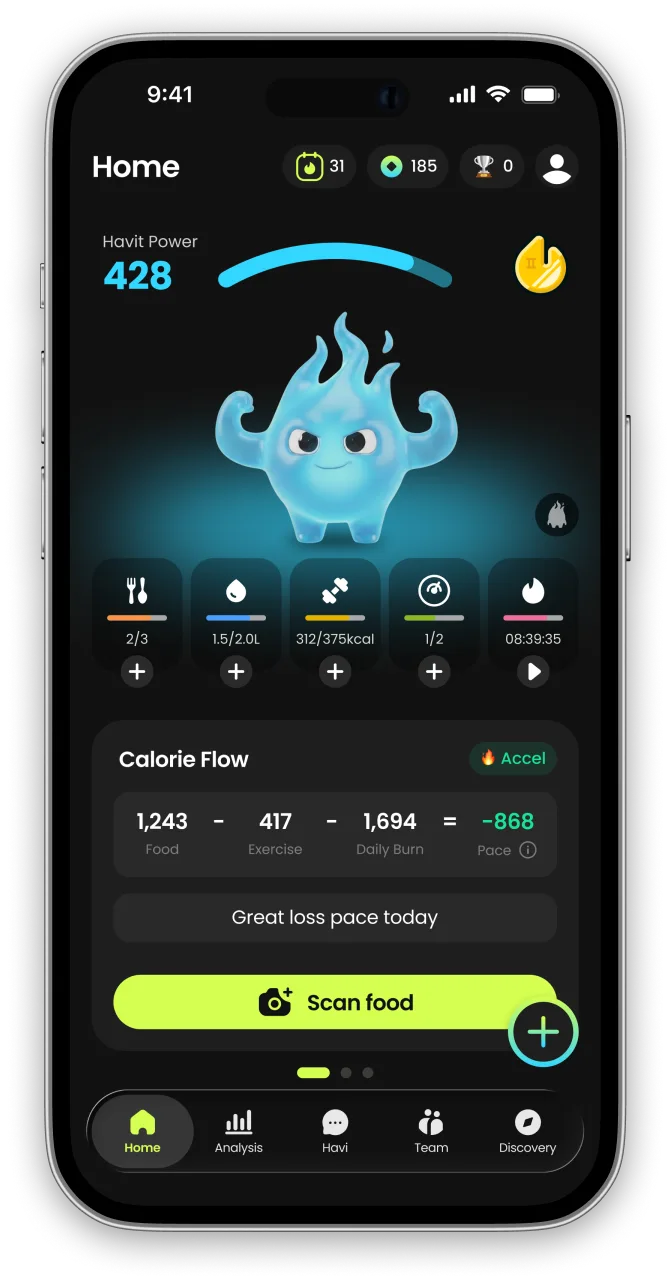
Unlike calorie-only trackers, Havit connects AI body-composition estimates, nutrition, hydration, sleep, steps, cycle, mood, and GLP-1 medication in one daily routine — so progress is measured by body composition, not just the number on the scale. Daily missions turn established behavior-change techniques into small repeatable actions, drawing on expertise from professionals formerly at Juvis Diet, one of Korea’s leading metabolic clinics.
In Havit’s own analysis of 1,090 GLP-1 users, people who logged consistently built stronger habits than the general user base. Read the GLP-1 Habit Report
Havit works with or without GLP-1 medication. It is a wellness app, not a medical device; body-composition results are estimates.
Continue in the App
Personalized wellness with your own data


References
- Self-Monitoring Digital Media Use: Accuracy of Perceived Versus Actual Social Media Time — Computers in Human Behavior, 2024
- Digital Usage Awareness Interventions: A Randomized Controlled Trial of Tracking-Based Behavior Change — Cyberpsychology, Behavior, and Social Networking, 2025
- Friction-Based Interventions for Smartphone Overuse: Efficacy of Design Modifications — Computers in Human Behavior, 2024
- The Psychology of Infinite Scroll: Time Perception Distortion in Social Media Environments — Journal of Behavioral Addictions, 2024


