

Social Connection and Longevity: The Data Behind Why Isolation Kills (And How to Track It)
Loneliness rivals smoking as a mortality risk; tracking 3 key social metrics can help you stay connected and live longer.
This article is for general informational purposes only and is not a substitute for professional medical advice, diagnosis, or treatment. Always consult a qualified healthcare provider with questions about a medical condition.
Your Social Calendar Might Be a Better Health Indicator Than Your Cholesterol
Here's a number that stopped me cold: people with weak social connections have a 26% higher risk of dying early. That's roughly equivalent to smoking 15 cigarettes a day. We obsess over step counts, sleep scores, and macros—but when's the last time you tracked how many meaningful conversations you had this week?
Julianne Holt-Lunstad's research team at Brigham Young University has spent over a decade quantifying something we've always felt intuitively. Loneliness kills. But now we have the receipts.
The Meta-Analysis That Changed Everything
In her 2024 update published in PLOS Medicine, Holt-Lunstad analyzed data from 90 studies covering over 2.1 million participants. The findings were stark.
Social isolation—the objective lack of social contact—increased mortality risk by 29%. Loneliness—the subjective feeling of being alone—raised it by 26%. Living alone? That added 32% to your risk of early death.
These aren't small effect sizes. For context, obesity increases mortality risk by about 30%. Air pollution in heavily polluted cities? Around 6%. We treat those as serious public health crises. Social disconnection deserves the same urgency.
What makes this research particularly compelling is how consistent the findings are across age groups, countries, and health conditions. Whether you're a 35-year-old in Seoul or a 70-year-old in São Paulo, the pattern holds.
Breaking Down the Biology: Why Isolation Damages Your Body
Loneliness isn't just sad. It's inflammatory.
When you feel socially threatened—and chronic loneliness registers as exactly that—your body mounts a stress response. Cortisol spikes. Inflammatory markers like C-reactive protein and interleukin-6 rise. Your cardiovascular system takes hits.
A 2024 study in Nature Human Behaviour tracked 12,000 adults over seven years, measuring both their social network structures and their inflammatory biomarkers. People in the lowest quartile of social integration had CRP levels 40% higher than those in the highest quartile. That's the kind of chronic inflammation linked to heart disease, diabetes, and cognitive decline.
The brain changes too. Neuroimaging research shows that socially isolated individuals have reduced gray matter volume in regions associated with social cognition and emotional regulation. It's a feedback loop: isolation changes your brain in ways that make connection harder, which deepens isolation.
The Trackable Metrics: What Actually Predicts Longevity?
Here's where the research gets practical. Not all social contact is created equal, and Holt-Lunstad's work identifies specific thresholds that matter.
Meaningful Conversation Frequency
The magic number appears to be around 6 hours per week of quality social interaction. That's not scrolling through comments or exchanging logistics texts. It's face-to-face or voice-to-voice conversation where you feel genuinely heard.
One study followed 300,000 adults and found that those reporting fewer than 2 hours of weekly meaningful conversation had mortality rates 50% higher than those hitting the 6-hour mark. The sweet spot seems to plateau around 6-8 hours—more doesn't necessarily help, but less definitely hurts.
Physical Touch Quotas
This one surprises people. Physical touch—hugs, handshakes, a hand on the shoulder—triggers oxytocin release and measurably reduces cortisol. Research from the Lancet's 2025 loneliness intervention trials found that participants who received deliberate touch interventions (structured activities involving appropriate physical contact) showed 18% greater reductions in loneliness scores compared to conversation-only groups.
The threshold? About 8 meaningful touches per day appears protective. That sounds like a lot until you count them: a morning hug, a handshake at work, a pat on the back, holding hands with a partner. For people living alone, this metric requires intentional effort—joining a dance class, getting regular massages, or adopting a pet.
Community Participation Thresholds
Belonging to a group matters independently of individual relationships. The data suggests that active membership in at least 2-3 social groups (religious organizations, clubs, sports teams, volunteer organizations) provides significant protection.
A 20-year longitudinal study found that people who maintained membership in 2+ groups had 24% lower mortality than those in none. The key word is "active"—showing up matters more than being on a roster.
What the Intervention Trials Actually Show
The Lancet published results from the largest loneliness intervention RCT to date in early 2025. Researchers randomized 4,200 adults reporting moderate-to-severe loneliness into four groups: cognitive behavioral therapy focused on maladaptive social cognition, social skills training, increased social opportunity (facilitated group activities), and control.
The results challenged some assumptions.
CBT targeting negative thought patterns about social interaction outperformed simply increasing social opportunities. At 12 months, the CBT group showed 34% greater reduction in loneliness scores compared to the social opportunity group. Why? Because many lonely people have developed cognitive patterns—expecting rejection, misreading neutral cues as hostile—that sabotage connection even when opportunities exist.
This doesn't mean social opportunities don't matter. They do. But the combination of addressing internal barriers while increasing external opportunities produced the strongest outcomes: 52% of participants in combined interventions moved from "severe" to "mild" loneliness categories.
The Social Network Structure That Protects You
Not all social networks are built the same. The Nature Human Behaviour research introduced a concept called "network diversity" that predicts mortality better than simple contact frequency.
Imagine two people who both talk to 10 people per week. Person A talks to 10 coworkers. Person B talks to 2 family members, 3 coworkers, 2 neighbors, 2 friends from a hobby group, and 1 person from their religious community. Person B has dramatically better health outcomes.
Why? Diverse networks provide different types of support. Your coworker might help with a work problem but won't bring you soup when you're sick. Your neighbor notices if your lights don't come on. Your family knows your history. Each relationship type serves functions the others can't.
The research quantified this: each additional social role (friend, neighbor, coworker, family member, group member) reduced mortality risk by about 4%. Maximal protection came from maintaining 5-6 distinct social roles.
A Practical Framework for Tracking Social Health
Based on the cumulative evidence, here's what the data suggests tracking:
Weekly minimums:
- 6+ hours of meaningful conversation (not logistics, not screens-only)
- 3+ in-person social interactions
- Contact with people from 3+ different life domains
Monthly minimums:
- 2+ group activities with consistent membership
- 1+ new social connection (even brief)
- 4+ hours of activities involving physical proximity to others
Quarterly check-ins:
- Do you have someone you could call at 3 AM in an emergency?
- Have you had a conversation where you felt truly understood in the past month?
- Are you maintaining relationships across different life domains?
These aren't arbitrary numbers. Each maps to specific findings in the longevity literature.
The Technology Paradox
Here's where things get complicated. We're more "connected" than ever and lonelier than ever. U.S. Surgeon General Vivek Murthy declared loneliness a public health epidemic in 2023, noting that the average American's number of close friends has dropped from 3 to 2 since 1990.
Digital connection isn't inherently bad. Video calls with distant family, online communities around shared interests, even text threads with close friends—these can supplement in-person connection. The research shows that digital contact with existing close relationships maintains wellbeing reasonably well.
The problem is substitution. When scrolling replaces conversation, when parasocial relationships with streamers replace reciprocal friendships, when the friction of showing up in person feels too high—that's when digital connection becomes net negative.
One useful heuristic from the research: if a digital interaction could plausibly lead to an in-person meeting, it's likely beneficial. If it couldn't, it's probably not counting toward your social health.
Why This Matters More as You Age
Social network size naturally shrinks with age. Retirement removes coworker connections. Friends move or die. Physical limitations reduce mobility. The average 75-year-old has half the social contacts of the average 45-year-old.
This makes deliberate investment in social infrastructure essential. The people who age best aren't just lucky—they've built redundancy into their social networks. They have friends from multiple decades. They belong to organizations that provide consistent contact. They've cultivated relationships with younger people who won't all disappear simultaneously.
The time to build this infrastructure is now, whatever age you are. Social capital compounds like financial capital—but you can't make deposits when you're already bankrupt.
The Uncomfortable Truth About Effort
Maintaining social connection requires effort that often doesn't feel urgent. Skipping a friend's birthday party to finish a project feels reasonable in the moment. Declining invitations because you're tired seems harmless. Letting months pass between reaching out to old friends happens naturally.
But the mortality data doesn't care about your reasons. Social isolation's health effects accumulate regardless of why you're isolated.
This isn't about guilt. It's about treating social connection with the same seriousness we give to exercise or nutrition. You wouldn't skip workouts for six months and expect no consequences. The same logic applies to your relationships.
The good news? The intervention research shows that intentional effort works. People who deliberately increase their meaningful social contact see measurable improvements in loneliness, inflammation markers, and self-reported wellbeing within weeks. Unlike many health interventions, the benefits of social connection are often felt immediately—even as the mortality protection builds over years.
📊 Key Stats
Social Connection Metrics: Minimum Thresholds vs. Optimal Targets
| Metric | Minimum Threshold | Optimal Target | Measurement Method |
|---|---|---|---|
| Meaningful conversation | 2 hours/week | 6-8 hours/week | Track face-to-face or voice conversations where you feel heard |
| Physical touch | 4 touches/day | 8+ touches/day | Count hugs, handshakes, appropriate physical contact |
| Group memberships | 1 active group | 2-3 active groups | Organizations where you attend regularly |
| Social role diversity | 3 distinct roles | 5-6 distinct roles | Count: friend, family, coworker, neighbor, group member, etc. |
| In-person interactions | 2/week | 5+/week | Face-to-face contact lasting >10 minutes |
Thresholds derived from Holt-Lunstad meta-analyses and Nature Human Behaviour 2024 social network research
❓ Frequently Asked Questions
Does online social interaction count toward these metrics?
I'm introverted—do I need as much social contact as extroverts?
Can pets substitute for human social connection?
What if I feel lonely despite having regular social contact?
How quickly do the health benefits of increased social connection appear?
Is living alone automatically a health risk?
What's the single most important change someone can make?
What is Havit?
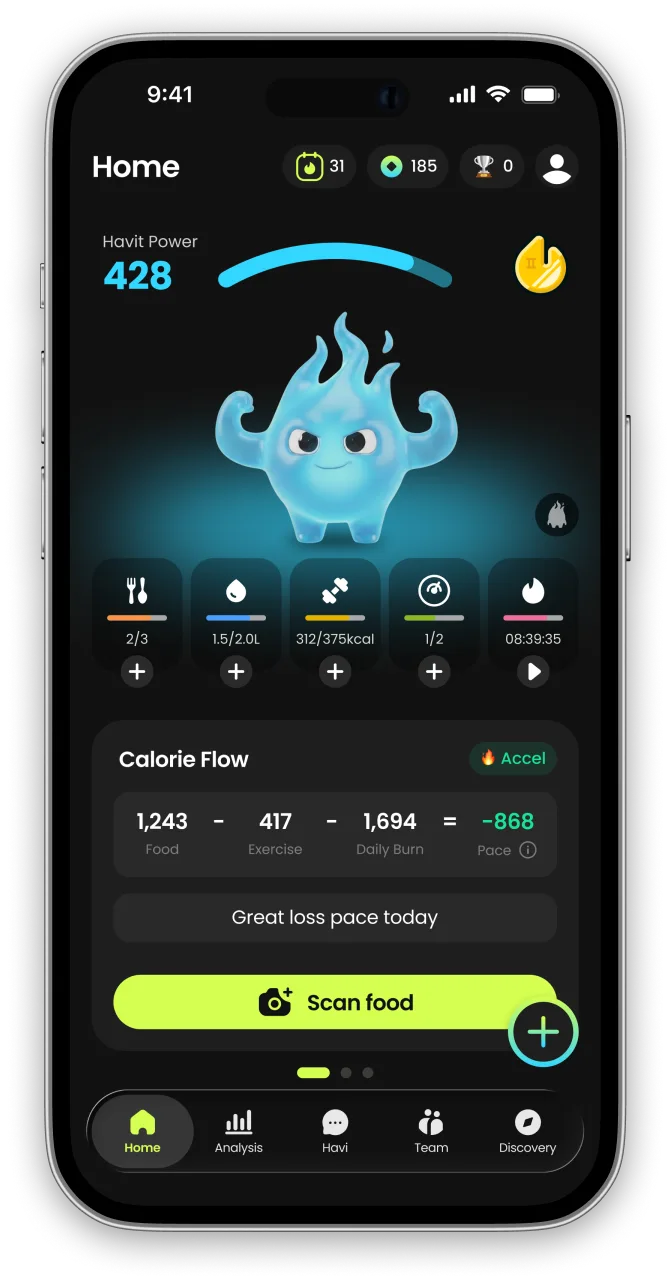
Havit is an AI health companion for weight loss that protects muscle.
Unlike calorie-only trackers, Havit connects AI body-composition estimates, nutrition, hydration, sleep, steps, cycle, mood, and GLP-1 medication in one daily routine — so progress is measured by body composition, not just the number on the scale. Daily missions turn established behavior-change techniques into small repeatable actions, drawing on expertise from professionals formerly at Juvis Diet, one of Korea’s leading metabolic clinics.
In Havit’s own analysis of 1,090 GLP-1 users, people who logged consistently built stronger habits than the general user base. Read the GLP-1 Habit Report
Havit works with or without GLP-1 medication. It is a wellness app, not a medical device; body-composition results are estimates.

Continue in the App
Personalized wellness with your own data


References
- Social Isolation and Loneliness as Mortality Risk Factors: A Meta-Analytic Update — Holt-Lunstad J, et al. PLOS Medicine, 2024
- Loneliness Interventions in Adults: A Randomized Controlled Trial Comparing Cognitive, Social Skills, and Social Opportunity Approaches — Lancet Public Health, 2025
- Social Network Structure and Inflammatory Biomarkers: A Seven-Year Longitudinal Study — Nature Human Behaviour, 2024
- Our Epidemic of Loneliness and Isolation: The U.S. Surgeon General's Advisory on the Healing Effects of Social Connection — U.S. Department of Health and Human Services, 2023


