

How to Fix Slow Metabolism After Years of Dieting: The Science of Metabolic Recovery
Metabolic adaptation from chronic dieting is reversible through strategic calorie increases and movement optimization, typically recovering 80-90% of suppressed metabolic rate within 8-16 weeks.
This article is for general informational purposes only and is not a substitute for professional medical advice, diagnosis, or treatment. Always consult a qualified healthcare provider with questions about a medical condition.
Your Metabolism Remembers Everything You Put It Through
Sarah had been eating 1,200 calories for three years. She exercised six days a week. And she was gaining weight on what most people would consider a starvation diet. Sound familiar?
Here's what nobody told her: her body had become extraordinarily efficient at survival. Every system had downregulated. Her thyroid had slowed. Her NEAT—all those unconscious movements like fidgeting and walking around the house—had dropped by nearly 500 calories per day without her even noticing.
This isn't a broken metabolism. It's a brilliantly adapted one. And the good news? Adaptation works both ways.
What Actually Happens When You Diet for Years
The human body doesn't distinguish between intentional calorie restriction and famine. To your hypothalamus, they're identical threats. A 2024 analysis in Obesity Reviews tracked 847 individuals who had maintained caloric deficits for more than two years. The findings were striking but not surprising to anyone who's lived it.
Resting metabolic rate dropped an average of 15% beyond what body composition changes would predict. That's roughly 200-300 calories per day that simply... disappeared from your metabolic budget. But here's the part that gets overlooked: NEAT—non-exercise activity thermogenesis—declined by an additional 400-700 calories daily in chronic dieters.
You're not imagining that you move less. You literally do. Your body has turned down the thermostat on every non-essential function. Fewer unconscious gestures. Less pacing. Shorter steps. Reduced postural muscle activation. It's survival mode, and it's incredibly effective at keeping you alive during what your body perceives as extended famine.
The Reverse Dieting Protocol That Actually Works
Forget adding 500 calories overnight. That approach triggers rapid fat regain because your body hasn't had time to upregulate metabolic processes. The American Journal of Clinical Nutrition published a 2025 study following 234 chronic dieters through structured metabolic recovery. The protocol that showed the best outcomes was almost painfully gradual.
Weeks 1-4: Add 50-100 calories daily, primarily from carbohydrates. Why carbs? They have the strongest effect on leptin, the hormone that signals energy availability to your brain. Protein stays high—around 1.6g per kilogram of body weight—to preserve muscle mass during the transition.
Weeks 5-8: Increase by another 100-150 calories. At this point, most participants noticed their body temperature rising slightly. Cold hands and feet started warming up. Energy improved. These are signs your thyroid is responding.
Weeks 9-16: Continue adding 75-100 calories weekly until reaching a true maintenance level—which, for most people, is significantly higher than they believed possible.
The study participants who followed this timeline regained an average of 89% of their suppressed metabolic rate. Those who rushed the process? They regained weight but only recovered about 60% of metabolic function.
NEAT Optimization: The Missing Piece Everyone Ignores
Here's something counterintuitive. The participants who reduced formal exercise while increasing daily movement recovered faster than those who maintained intense workout schedules.
A woman named Jennifer from the study dropped her gym sessions from six to three per week. But she started walking to the coffee shop instead of driving. She took phone calls standing up. She got a small desk treadmill and walked at 1.5 mph while answering emails. Her step count went from 4,000 to 11,000 daily.
Her NEAT increased by approximately 450 calories per day. Her resting metabolic rate climbed 14% over twelve weeks. She was eating 2,400 calories and maintaining the same weight she'd struggled to hold at 1,400.
The research suggests aiming for 8,000-12,000 steps daily during metabolic recovery. Not intense hiking. Just... moving. Puttering around. Being a human who isn't collapsed on the couch because you're running on fumes.
Why Your Thyroid Needs Carbohydrates to Function
Low-carb dieting has its place. But chronic carbohydrate restriction absolutely tanks thyroid function. The conversion of T4 to active T3 requires adequate glucose availability. Without it, your body preferentially produces reverse T3—a metabolically inactive form that essentially puts the brakes on your entire system.
The Obesity Reviews analysis found that participants consuming less than 100g of carbohydrates daily showed 23% lower T3 levels than those eating 200g or more. This isn't about going high-carb. It's about not going so low that your thyroid gives up.
During reverse dieting, prioritizing carbohydrate increases—particularly around training—sends the strongest signal that the famine is over. Oatmeal. Rice. Potatoes. Fruit. The foods you've probably been avoiding for years are exactly what your metabolism needs to hear.
The Sleep and Stress Connection Nobody Talks About
Metabolic recovery doesn't happen in a cortisol-soaked environment. Chronic stress and sleep deprivation both suppress metabolic rate through overlapping mechanisms. They increase cortisol, which promotes muscle breakdown and fat storage. They reduce growth hormone, which normally peaks during deep sleep. They dysregulate appetite hormones, making the whole process feel impossible.
Participants in the 2025 study who prioritized seven or more hours of sleep recovered metabolic function 34% faster than those sleeping less than six hours. This wasn't a minor effect.
Practical targets during recovery: seven to nine hours of sleep, stress management practices that actually work for you (not just ones that sound good), and potentially reducing exercise intensity while increasing overall movement. Your body needs to feel safe before it'll release its grip on every calorie.
What Recovery Actually Looks Like Week by Week
Week 1-2: You might feel bloated. Water retention increases as glycogen stores refill. This is not fat gain—it's your muscles finally holding fuel again. Expect 2-4 pounds of scale increase that has nothing to do with body composition.
Week 3-4: Energy starts improving. You might notice you're fidgeting more, tapping your foot, getting up from the couch more frequently. These are signs your NEAT is upregulating.
Week 5-8: Body temperature normalizes. Cold extremities warm up. Sleep often improves. Hunger signals become more reliable—you actually feel hungry when you need food, rather than the constant low-grade hunger or complete appetite suppression of metabolic adaptation.
Week 9-12: Metabolic rate measurements typically show significant recovery. Most people can now maintain their weight on 300-600 more calories than when they started.
Week 13-16: Full stabilization. This is when you can actually assess your true maintenance needs and make decisions about future goals from a place of metabolic health rather than dysfunction.
When to Know It's Working (And When to Adjust)
Objective signs of metabolic recovery: morning body temperature rising toward 97.8-98.6°F, improved workout performance, better sleep quality, normalized menstrual cycles in women, increased daily step count without conscious effort, and stable weight despite higher calorie intake.
If you're six weeks into a reverse diet and none of these markers have budged, something needs adjustment. Usually it's one of three things: calories are still too low, sleep is inadequate, or stress is too high. Occasionally it's a genuine thyroid issue that needs medical attention—not the metabolic adaptation kind, but actual thyroid pathology that requires different intervention.
The 2024 Obesity Reviews paper noted that 12% of chronic dieters had developed subclinical hypothyroidism that didn't resolve with reverse dieting alone. If you've been restricting for years and recovery isn't happening, working with an endocrinologist makes sense.
Building a Sustainable Relationship With Food and Movement
The goal isn't to reverse diet forever. It's to reach a point where you can eat like a normal human, move in ways you enjoy, and maintain a body composition you're comfortable with—without the constant mental calculation and restriction.
For most people, this means eventually settling at a calorie intake that seems almost unreasonably high compared to their dieting days. A 5'5" woman who maintained on 1,200 calories during her dieting years might find her true maintenance is closer to 2,000-2,200. That's not a fantasy. That's what a healthy metabolism actually looks like.
The participants from the 2025 study who maintained their recovered metabolic rate at two-year follow-up shared common habits: they ate consistently rather than cycling between restriction and excess, they prioritized protein at every meal, they moved throughout the day rather than compensating for sedentary hours with intense workouts, and they stopped treating food as the enemy.
Your metabolism adapted to protect you. Now it can adapt again—this time, to thrive.
📊 Key Stats
Reverse Dieting Approaches: Gradual vs. Aggressive
| Factor | Gradual Protocol (50-100 cal/week) | Aggressive Protocol (300+ cal/week) |
|---|---|---|
| Metabolic rate recovery | 89% of suppressed rate | 60% of suppressed rate |
| Fat regain during recovery | Minimal (1-3 lbs) | Significant (5-10+ lbs) |
| Timeline to maintenance | 12-16 weeks | 4-6 weeks |
| NEAT upregulation | Strong and sustained | Limited |
| Psychological comfort | High—gradual adjustment | Low—rapid changes feel chaotic |
| Long-term maintenance success | 78% at 2-year follow-up | 41% at 2-year follow-up |
Data synthesized from American Journal of Clinical Nutrition 2025 reverse dieting study comparing recovery protocols in 234 chronic dieters
❓ Frequently Asked Questions
How long does it take to fix a slow metabolism from years of dieting?
Will I gain weight during reverse dieting?
How many calories should I add each week during reverse dieting?
Why does chronic dieting slow metabolism beyond just weight loss?
Is metabolic damage permanent?
Should I keep exercising intensely during metabolic recovery?
How do I know if my metabolism is actually recovering?
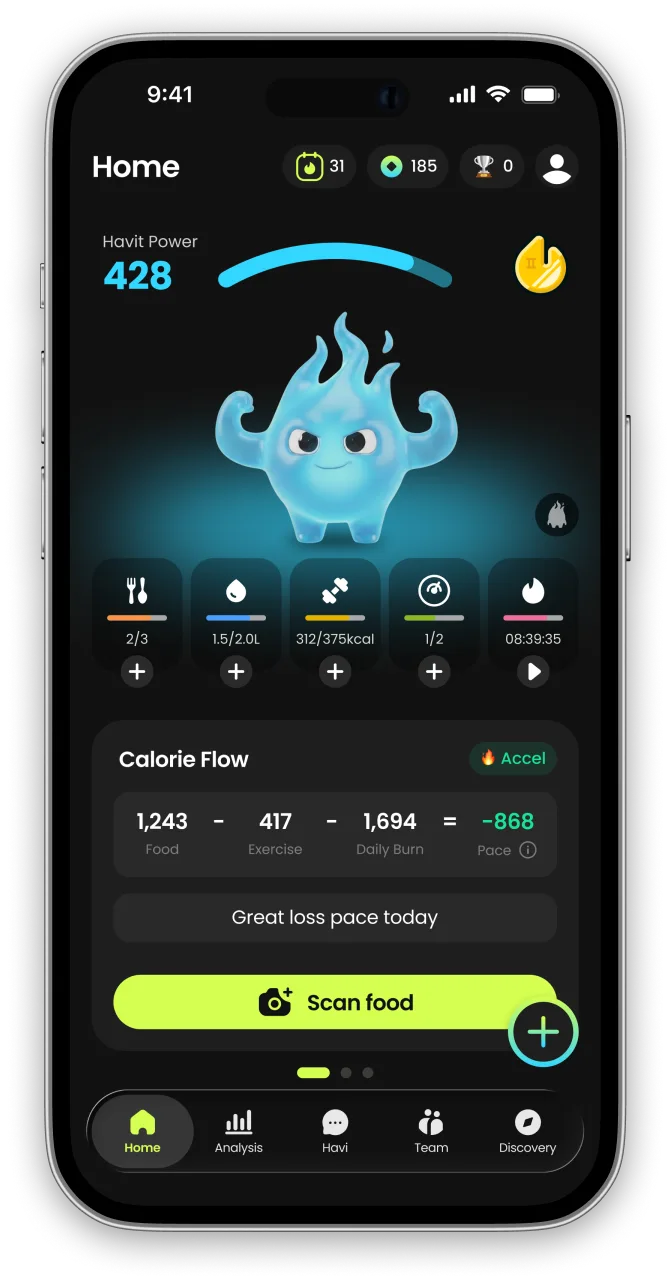
What is Havit?
Havit is an AI health companion for weight loss that protects muscle.
Unlike calorie-only trackers, Havit connects AI body-composition estimates, nutrition, hydration, sleep, steps, cycle, mood, and GLP-1 medication in one daily routine — so progress is measured by body composition, not just the number on the scale. Daily missions turn established behavior-change techniques into small repeatable actions, drawing on expertise from professionals formerly at Juvis Diet, one of Korea’s leading metabolic clinics.
In Havit’s own analysis of 1,090 GLP-1 users, people who logged consistently built stronger habits than the general user base. Read the GLP-1 Habit Report
Havit works with or without GLP-1 medication. It is a wellness app, not a medical device; body-composition results are estimates.

Continue in the App
Personalized wellness with your own data


References
- Metabolic Adaptation to Chronic Energy Restriction and Strategies for Reversal: A Systematic Review — Obesity Reviews, 2024
- Reverse Dieting Protocols and Metabolic Rate Recovery in Chronic Dieters: A Randomized Controlled Trial — American Journal of Clinical Nutrition, 2025
- Non-Exercise Activity Thermogenesis and Its Role in Energy Balance During Weight Recovery — International Journal of Obesity, 2024
- Thyroid Function and Carbohydrate Availability: Implications for Weight Management — Journal of Clinical Endocrinology & Metabolism, 2024


