

Age-Specific Workout Recovery Protocol: Why Your 40s Body Needs a Different Playbook Than Your 20s
After 30, recovery capacity declines roughly 1% per year—40-somethings need 48-72 hours between intense sessions versus 24-48 hours for those in their 20s.
This article is for general informational purposes only and is not a substitute for professional medical advice, diagnosis, or treatment. Always consult a qualified healthcare provider with questions about a medical condition.
The Moment I Realized My Body Had Changed
I used to bounce back from leg day in 36 hours. Now at 43, my quads are still screaming three days later. Sound familiar?
Here's what nobody told me: recovery capacity doesn't just gradually slow down with age. It follows a predictable decline of approximately 1% per year after you hit 30. That means by 45, you've lost roughly 15% of the recovery horsepower you had at your peak.
This isn't about being "out of shape." It's biology. And fighting it instead of working with it is why so many people in their 40s either burn out, get injured, or quit exercising altogether.
The Science Behind Age-Related Recovery Decline
Your body repairs muscle through satellite cells—basically stem cells that live in your muscle tissue. A 2025 study in the Journal of Aging and Physical Activity tracked satellite cell activation across age groups and found something striking. Participants in their 40s showed 23% slower satellite cell response compared to those in their 20s.
But that's just one piece.
Hormonal shifts compound the problem. Growth hormone production drops about 14% per decade after 30. Testosterone (yes, in women too) declines steadily. These hormones don't just affect muscle building—they directly influence how quickly damaged tissue repairs itself.
Then there's inflammation. Younger bodies clear inflammatory markers faster. A 28-year-old's C-reactive protein levels typically return to baseline within 24 hours post-exercise. For a 45-year-old doing the same workout? Often 48-72 hours.
Recovery Windows: The Numbers That Actually Matter
Let's get specific about timing.
For high-intensity resistance training (think heavy squats, deadlifts, or HIIT):
20-somethings: 24-48 hours before hitting the same muscle group again 40-somethings: 48-72 hours minimum, sometimes longer for compound movements
Medicine & Science in Sports & Exercise published data in 2024 showing that adults over 40 who ignored these extended windows had 34% higher injury rates over a 12-month period. Not minor tweaks—we're talking strains, tendinitis, and stress fractures that sidelined people for weeks.
The good news? Adaptation still happens. Your 40-year-old body absolutely builds muscle and improves fitness. It just needs more runway between stimulus and response.
Nutrition Timing Shifts Dramatically With Age
Here's where it gets interesting.
A 25-year-old can eat a decent meal within a few hours of training and recover fine. Their protein synthesis window stays elevated for roughly 24 hours post-workout.
At 45? That window shrinks to about 4-6 hours. Miss it consistently, and you're leaving gains on the table.
Protein requirements change too. The standard "0.8 grams per kilogram" recommendation was based on studies of young adults. Research now suggests adults over 40 need 1.2-1.6 grams per kilogram just to maintain muscle mass. Building new tissue? Push that to 1.6-2.0 grams.
A 170-pound person in their 40s should aim for 120-150 grams of protein daily. That's roughly a chicken breast at every meal plus strategic snacks. Most people I talk to are hitting maybe 80 grams and wondering why progress stalls.
Sleep: The Recovery Multiplier Nobody Takes Seriously
Sleep quality matters more than quantity, but quantity still matters.
Deep sleep—stages 3 and 4—is when growth hormone pulses peak. It's also when your brain clears metabolic waste that accumulates during waking hours. Young adults typically spend 15-20% of their night in deep sleep. By 45, that often drops to 5-10%.
The practical impact: a 40-year-old getting 7 hours of fragmented sleep might be recovering slower than a 25-year-old getting 6 hours of solid sleep.
What actually helps? Temperature manipulation works surprisingly well. Dropping your bedroom to 65-67°F increases deep sleep duration by up to 25% in studies. Consistent sleep timing matters more than total hours—your body's repair processes sync to circadian rhythms.
Alcohol deserves special mention. Even two drinks within 4 hours of bed suppresses deep sleep by up to 40%. At 25, you might not notice. At 45, that's the difference between waking up ready to train and waking up still sore.
Programming Adjustments That Actually Work
Forget the "no pain, no gain" mentality. Smart programming for the 40+ crowd looks different.
Frequency over intensity: Three moderate sessions beat two crushing ones. Your weekly volume can stay the same—just spread it out.
Strategic deload weeks: Every 4-6 weeks, cut volume by 40-50%. Younger lifters can push 8-12 weeks between deloads. Your tendons and joints will thank you.
Movement prep matters more: That 5-minute warmup you skipped at 25? Now it's 10-15 minutes of targeted mobility work. Tissue quality changes with age—cold muscles and tendons are injury magnets.
One client of mine, a 47-year-old former college athlete, kept trying to train like he did at 22. Constant nagging injuries. We shifted to 4 days per week with 72-hour gaps between lower body sessions. Within three months, he was actually lifting heavier because he wasn't training through accumulated fatigue.
Active Recovery: What Works and What's Hype
Not all recovery methods deserve your time.
What the evidence supports:
- Light movement on rest days (walking, easy cycling) increases blood flow without adding stress
- Contrast showers (alternating hot/cold) show modest benefits for reducing muscle soreness
- Foam rolling before bed improves sleep quality in some studies, possibly through parasympathetic activation
What's probably oversold:
- Cryotherapy chambers have minimal evidence for recovery beyond placebo
- Most supplements marketed for recovery lack rigorous human trials
- Compression gear helps during activity but post-workout benefits are questionable
The boring stuff works best. Sleep, protein, hydration, time. Everything else is marginal at best.
Building Your Personal Recovery Protocol
Start by tracking what actually happens, not what you think should happen.
Rate your readiness each morning on a simple 1-10 scale. Note your sleep quality, any lingering soreness, and energy levels. After a month, patterns emerge. Maybe you recover faster from upper body work. Maybe Friday sessions wreck your weekend more than Monday sessions do.
Here's a framework that works for most people over 40:
Monday: Moderate intensity, compound movements Tuesday: Light cardio or mobility work Wednesday: Upper body focus if Monday was lower, or vice versa Thursday: Complete rest or gentle walking Friday: Moderate intensity, different movement patterns than Monday Weekend: One active day, one full rest day
Adjust based on your data. Some people thrive on this schedule. Others need an extra rest day. There's no universal answer—just principles you adapt to your reality.
The Mindset Shift That Makes Everything Easier
Here's what took me years to accept: training smarter isn't a consolation prize for getting older. It's actually better.
When you can't rely on brute recovery capacity, you're forced to be strategic. You learn your body's signals. You prioritize what matters. You stop wasting energy on junk volume that never helped anyway.
Most 25-year-olds train with terrible efficiency—they just recover fast enough that it doesn't matter. By 45, efficiency isn't optional. And that efficiency often produces better results than the chaotic approach of youth.
The goal isn't to train like you're 25 again. It's to train in a way that lets you still be active, strong, and injury-free at 55, 65, and beyond. That requires respecting the biology while refusing to use it as an excuse.
Your body changed. Your approach should too.
📊 Key Stats
Recovery Protocol Comparison: 20s vs 40s
| Factor | 20-Somethings | 40-Somethings |
|---|---|---|
| Recovery time between intense sessions | 24-48 hours | 48-72 hours |
| Protein synthesis window | ~24 hours | 4-6 hours |
| Daily protein needs (per kg bodyweight) | 0.8-1.2g | 1.2-2.0g |
| Deep sleep percentage | 15-20% | 5-10% |
| Recommended deload frequency | Every 8-12 weeks | Every 4-6 weeks |
| Warmup duration | 5-10 minutes | 10-15 minutes |
| Inflammatory marker clearance | ~24 hours | 48-72 hours |
Key physiological and programming differences between age groups based on current research
❓ Frequently Asked Questions
Can I still build muscle effectively in my 40s?
How do I know if I'm recovering enough between workouts?
Should I take supplements to improve recovery as I age?
Is soreness a good indicator of whether I've recovered?
How does alcohol affect recovery differently as I age?
What's the minimum effective training frequency for someone over 40?
Do I need to change my training style completely after 40?
What is Havit?
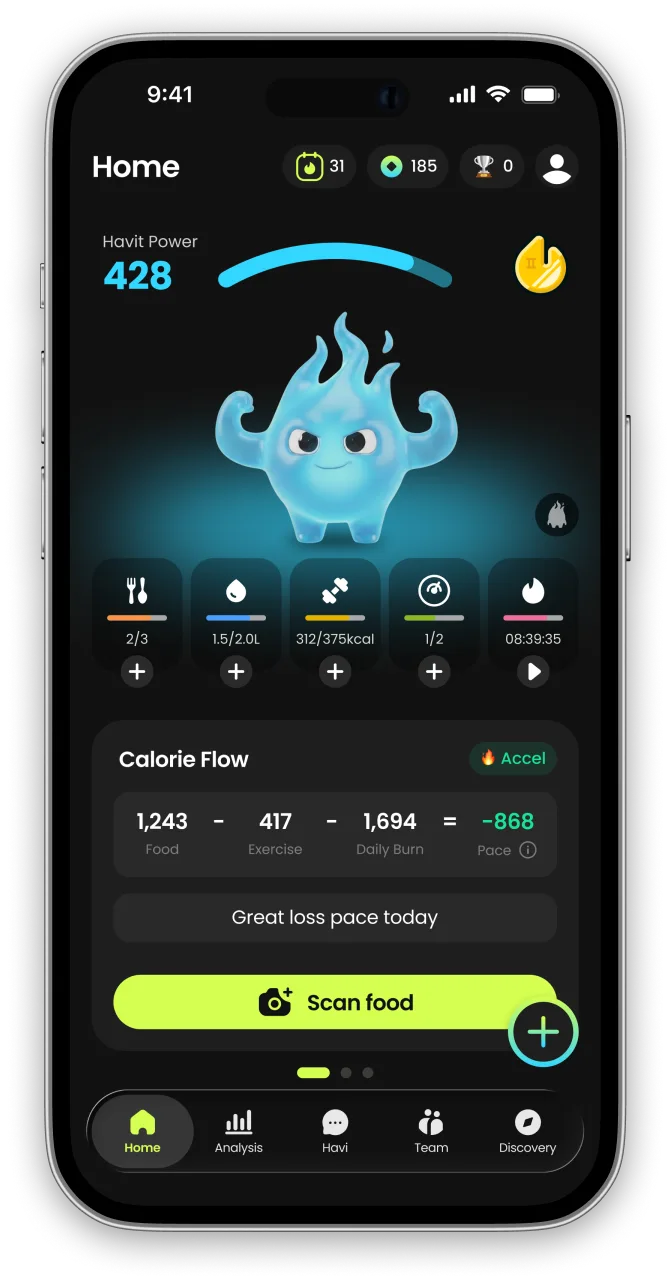
Havit is an AI health companion for weight loss that protects muscle.
Unlike calorie-only trackers, Havit connects AI body-composition estimates, nutrition, hydration, sleep, steps, cycle, mood, and GLP-1 medication in one daily routine — so progress is measured by body composition, not just the number on the scale. Daily missions turn established behavior-change techniques into small repeatable actions, drawing on expertise from professionals formerly at Juvis Diet, one of Korea’s leading metabolic clinics.
In Havit’s own analysis of 1,090 GLP-1 users, people who logged consistently built stronger habits than the general user base. Read the GLP-1 Habit Report
Havit works with or without GLP-1 medication. It is a wellness app, not a medical device; body-composition results are estimates.

Continue in the App
Personalized wellness with your own data


References
- Age-Related Decline in Satellite Cell Function and Recovery Capacity — Journal of Aging and Physical Activity, 2025
- Recovery Timing and Injury Risk Across Age Groups in Recreational Athletes — Medicine & Science in Sports & Exercise, 2024
- Protein Requirements for Muscle Maintenance in Middle-Aged Adults — Journal of Aging and Physical Activity, 2025
- Sleep Architecture Changes and Exercise Recovery in Adults Over 40 — Medicine & Science in Sports & Exercise, 2024


