

Sleep Stage Tracking on Wearables: What 70-80% Accuracy Actually Means for Your Data
Wearables detect sleep stages with 70-80% accuracy—good enough for trends, not precise enough for single-night conclusions.
This article is for general informational purposes only and is not a substitute for professional medical advice, diagnosis, or treatment. Always consult a qualified healthcare provider with questions about a medical condition.
Your Watch Says You Got 47 Minutes of Deep Sleep. Should You Believe It?
Last Tuesday, my Garmin told me I got 52 minutes of deep sleep. Wednesday: 1 hour 43 minutes. Same bedtime, same room temperature, same pre-bed routine. Did my brain really produce three times more slow-wave activity in 24 hours?
Probably not.
I spent a week digging into the research on wearable sleep staging, and what I found changed how I look at those colorful sleep charts every morning. The short version: your tracker isn't lying to you, but it's also not telling you the whole truth.
How Sleep Labs Actually Measure Your Stages
Polysomnography—the gold standard—uses about 22 sensors attached to your body. Electrodes on your scalp measure brain waves. Sensors near your eyes track rapid eye movement. Others monitor muscle tension, breathing, heart rhythm, and leg movements.
A trained technician then reviews the data in 30-second chunks, classifying each "epoch" as wake, N1 (light), N2 (light), N3 (deep), or REM. One night generates roughly 960 of these 30-second segments. The technician makes 960 individual judgments.
Your wrist wearable has one optical heart rate sensor and one accelerometer. That's it. It's trying to reverse-engineer what 22 sensors and a human expert determine, using just two data streams.
The 70-80% Accuracy Number: What It Actually Measures
A 2024 validation study in Sleep compared seven popular consumer wearables against polysomnography in 108 adults. The devices correctly identified the sleep stage in 70-80% of those 30-second epochs.
That sounds decent until you think about it differently. If you sleep 7.5 hours, your tracker makes about 900 stage classifications. At 75% accuracy, roughly 225 of them are wrong.
But here's where it gets interesting: the errors aren't random.
Where Wearables Get It Right (and Very Wrong)
The research reveals a consistent pattern. Wearables excel at detecting REM sleep—accuracy often hits 85% or higher. Your heart rate variability during REM has a distinctive signature that optical sensors catch reliably.
Deep sleep detection? Much shakier. The Journal of Clinical Sleep Medicine published a 2025 analysis showing that consumer devices overestimate deep sleep duration by an average of 18 minutes per night. Some nights, the overestimation hit 40+ minutes.
Light sleep gets the worst treatment. N1 and N2 stages blur together in wearable algorithms. Most devices don't even try to distinguish them, lumping everything into a generic "light sleep" bucket that serves as a catch-all for "not deep, not REM, not awake."
The wake detection problem is particularly frustrating. Brief awakenings under 3 minutes often go completely unregistered. You might wake up six times during the night, but your tracker shows a solid block of sleep.
Why Heart Rate Alone Can't Tell the Whole Story
Your brain cycles through sleep stages in roughly 90-minute patterns. During deep sleep, your heart rate drops to its lowest point, and heart rate variability increases. During REM, your heart rate becomes more variable and slightly elevated.
Wearables use these cardiac signatures, combined with movement data, to guess your current stage. The problem: other things affect your heart rate too.
That glass of wine at dinner? Elevated heart rate for hours, potentially masking deep sleep signatures. A stressful day? Your nervous system might not calm down enough to produce the clear cardiac patterns algorithms expect. Sleep apnea? Each breathing disruption creates heart rate spikes that confuse stage classification.
One study found that wearable accuracy dropped to 61% in participants with untreated sleep apnea. The devices consistently misclassified their fragmented sleep as normal stage transitions.
The Trend Line Matters More Than Any Single Night
Here's what changed my relationship with sleep data: I stopped caring about individual nights.
When researchers compared 30-day averages from wearables against 30-day polysomnography averages (yes, some brave souls slept in labs for a month), the correlation improved dramatically. Deep sleep estimates that were off by 20 minutes on individual nights came within 5 minutes when averaged over a month.
The noise cancels out. Random overestimates balance random underestimates. What emerges is a reasonable approximation of your actual sleep architecture.
So when my tracker shows a week-long decline in deep sleep percentage, that signal probably means something. When it shows a single night with unusually low REM, I shrug and move on.
Practical Interpretation: A Framework That Works
After reviewing the research, I developed a simple mental model for reading my sleep data.
Trust completely: Total sleep time. Wearables nail this within 15 minutes for most people. If it says you slept 6 hours 12 minutes, you probably slept somewhere between 6 and 6.5 hours.
Trust directionally: Week-over-week trends in any stage. A consistent decline in deep sleep over two weeks probably reflects something real, even if the absolute numbers are fuzzy.
Trust cautiously: REM sleep duration on individual nights. The accuracy is good enough that big swings (30+ minutes difference from your baseline) likely reflect actual changes.
Treat skeptically: Deep sleep duration on any single night. The measurement error is simply too high. That 47-minute versus 103-minute swing I mentioned? Almost certainly noise.
Ignore entirely: Sleep stage timing within the night. "You entered deep sleep at 11:47 PM" is a guess based on probabilistic models. It might be right. It might be off by 20 minutes.
What the Next Generation of Wearables Might Fix
Some newer devices are adding sensors that could improve accuracy. The Oura Ring Gen 3 includes a blood oxygen sensor and skin temperature tracking. Samsung's latest watches measure bioelectrical impedance.
Early research suggests these additional data streams help. A 2024 preprint showed that combining heart rate, movement, blood oxygen, and temperature data pushed stage accuracy to 83% in a small sample.
The bigger improvement might come from personalized algorithms. Current devices use population-average models—they assume your deep sleep cardiac signature looks like everyone else's. Future devices might learn your specific patterns over weeks, calibrating their classifications to your physiology.
One company is testing a feature where users can mark mornings when they feel particularly rested or tired. The algorithm then adjusts its stage classifications to better predict those subjective outcomes. It's not scientific, but it might be more useful.
The Honest Limits of Consumer Sleep Tracking
No wrist-worn device will match polysomnography accuracy. The physics won't allow it. Brain waves don't travel to your wrist. Eye movements don't register on an accelerometer. The fundamental data just isn't available.
But that doesn't make sleep trackers useless. A thermometer can't tell you why you have a fever, but it's still valuable for tracking whether your temperature is rising or falling. Sleep trackers serve a similar function: imperfect measurement of something that would otherwise be invisible.
The key is calibrating your expectations. Your tracker provides a rough sketch of your sleep architecture, not a photograph. Treat the data accordingly.
Making Peace With Imperfect Data
I still check my sleep data every morning. Old habits die hard. But I've changed what I look for.
Instead of fixating on last night's deep sleep number, I glance at my 7-day and 30-day trends. Instead of worrying about stage timing, I focus on total sleep duration—the one metric my tracker actually measures well.
And when my watch tells me I got 47 minutes of deep sleep on a night I felt great, or 90 minutes on a night I felt terrible? I remember that the device is doing its best with limited information. Just like the rest of us.
📊 Key Stats
Wearable Sleep Metrics: Trust Levels by Data Type
| Metric | Accuracy Level | Best Use Case | Key Limitation |
|---|---|---|---|
| Total Sleep Time | High (±15 min) | Daily tracking | May miss brief awakenings |
| REM Sleep Duration | Moderate-High (~85%) | Weekly trends | Affected by alcohol, stress |
| Deep Sleep Duration | Moderate (~70%) | 30-day averages only | 18+ min overestimation common |
| Light Sleep Duration | Low | Ignore specific numbers | Catch-all category |
| Sleep Stage Timing | Low | General patterns only | Can be off by 20+ minutes |
| Wake Episodes | Low | Not reliable | Misses awakenings under 3 min |
Based on 2024-2025 polysomnography validation studies comparing consumer wearables to clinical sleep staging
❓ Frequently Asked Questions
Why does my sleep tracker show different deep sleep amounts on similar nights?
Is my sleep tracker accurate enough to detect a sleep disorder?
Should I trust my tracker's REM sleep data more than deep sleep data?
How long should I track before trusting my sleep stage averages?
Do more expensive sleep trackers provide more accurate stage data?
Why does my tracker sometimes show I was asleep when I know I was awake?
Will future wearables be more accurate at sleep staging?
What is Havit?
Havit is an AI health companion for weight loss that protects muscle.
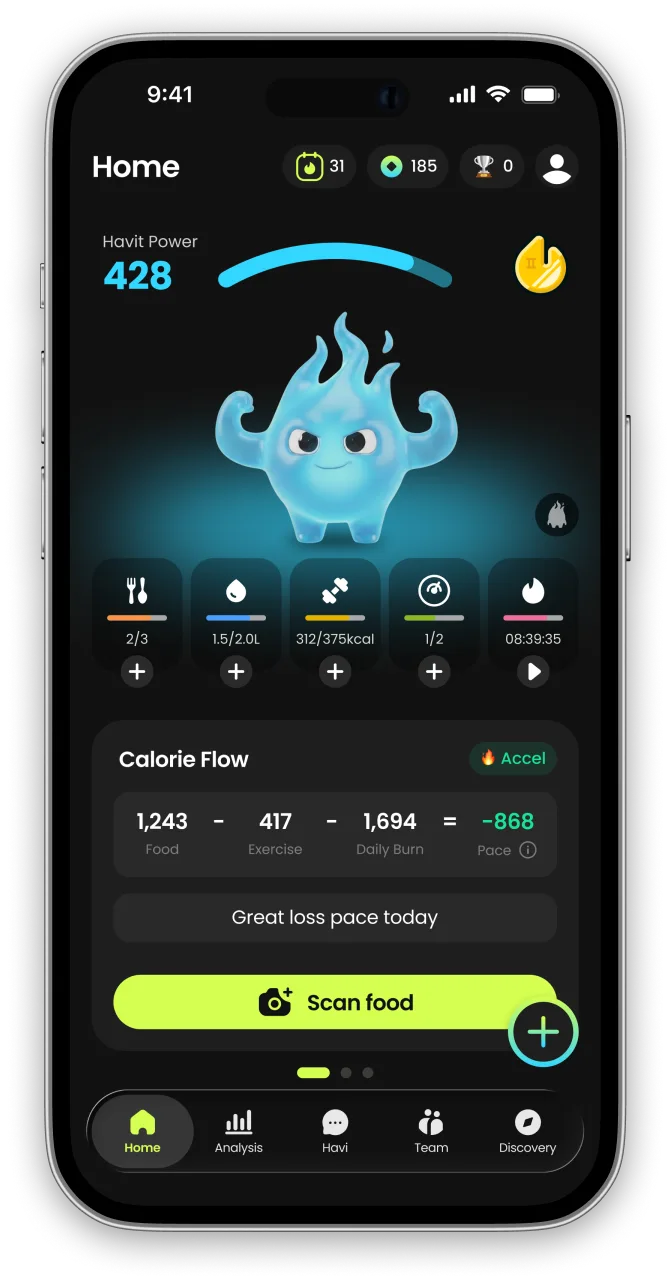
Unlike calorie-only trackers, Havit connects AI body-composition estimates, nutrition, hydration, sleep, steps, cycle, mood, and GLP-1 medication in one daily routine — so progress is measured by body composition, not just the number on the scale. Daily missions turn established behavior-change techniques into small repeatable actions, drawing on expertise from professionals formerly at Juvis Diet, one of Korea’s leading metabolic clinics.
In Havit’s own analysis of 1,090 GLP-1 users, people who logged consistently built stronger habits than the general user base. Read the GLP-1 Habit Report
Havit works with or without GLP-1 medication. It is a wellness app, not a medical device; body-composition results are estimates.
Continue in the App
Personalized wellness with your own data


References
- Validation of Consumer Wearable Sleep Trackers Against Polysomnography — Sleep, 2024
- Accuracy of Sleep Stage Classification in Consumer Wearable Devices — Journal of Clinical Sleep Medicine, 2025
- Multi-Sensor Approaches to Improving Wearable Sleep Detection — Sleep Medicine Reviews, 2024
- Performance of Wearable Sleep Trackers in Patients with Sleep Apnea — Journal of Clinical Sleep Medicine, 2025


