

Can't Fall Asleep Without Your Phone? The Adult's Guide to Breaking Screen Sleep Dependency
Adults dependent on screens for sleep can retrain their brains using gradual extinction—reducing dependency by 15-minute increments over 3-4 weeks.
This article is for general informational purposes only and is not a substitute for professional medical advice, diagnosis, or treatment. Always consult a qualified healthcare provider with questions about a medical condition.
The Confession Nobody Wants to Make
Here's something I hear constantly but people rarely admit publicly: "I literally cannot fall asleep unless the TV is on." Or its cousin: "I need to scroll TikTok until my eyes physically won't stay open." You're not lazy. You're not broken. You've accidentally trained your brain to need external stimulation to transition into sleep—and about 34% of adults have done the exact same thing, according to a 2025 study in Behavioral Sleep Medicine.
The clinical term is sleep onset association disorder, and while it sounds like something only babies get (think: needing to be rocked to sleep), adults develop it too. We just swap pacifiers for podcasts and lullabies for late-night YouTube binges.
Why Your Brain Got Hooked in the First Place
Your brain is annoyingly good at forming associations. Pair two things together enough times—pillow + phone glow, bed + Netflix autoplay—and your nervous system starts treating them as a package deal. Miss one component? Your brain throws a tantrum.
A 2024 Sleep Medicine trial found that adults who used screens within 30 minutes of sleep for more than 6 months showed measurably different sleep architecture. Their brains literally waited for the "signal" (screen light, audio stimulation) before initiating the sleep cascade. Participants in this study took an average of 47 minutes to fall asleep when their devices were removed cold-turkey. That's not willpower failure. That's neurological conditioning.
The blue light argument is real but overblown. Yes, screens suppress melatonin by about 22%. But the bigger issue is psychological: your brain has outsourced the job of "winding down" to an external device. It forgot how to do it alone.
The Cold-Turkey Trap (And Why It Backfires)
Maybe you've tried the obvious solution. Phone goes in another room. TV gets unplugged. You lie there for two hours staring at the ceiling, anxiety mounting, until you finally cave at 2 AM. Sound familiar?
This approach fails for a specific reason: extinction bursts. When you remove a conditioned stimulus abruptly, the brain doesn't just accept it. It panics. It screams louder for the thing it expects. Sleep researchers call this "paradoxical arousal"—your attempt to force sleep actually activates your stress response.
The 2025 Behavioral Sleep Medicine study tracked 127 adults through different intervention approaches. Cold-turkey removal worked for only 23% of participants at the 8-week mark. The rest either relapsed or developed new problematic associations (like needing alcohol to sleep instead).
Gradual Extinction: The Protocol That Actually Works
Here's what did work: gradual extinction with systematic fading. Sounds clinical, but the execution is surprisingly simple.
Week 1-2: Time Reduction If you currently scroll for 45 minutes before sleep, cut to 30. Not negotiable, but not dramatic either. Set a timer. When it goes off, screen goes dark. You're allowed to lie there awake—that's part of the retraining.
Week 3-4: Distance Introduction Keep the reduced time, but move the device. Phone goes on the dresser instead of the pillow. TV volume drops by 30%. You're weakening the association without eliminating it.
Week 5-6: Substitution Phase Replace the screen with a "bridge" stimulus—something that still provides input but is less activating. Audiobooks at 15-minute sleep timers. A white noise machine. One study participant used a specific playlist that she gradually shortened from 20 minutes to 5 over three weeks.
Week 7-8: Independence The bridge stimulus gets its own fade-out. By now, your brain has practiced the skill of transitioning to sleep without high-stimulation input. The 2024 trial found 71% of participants following this protocol could fall asleep without any device within 20 minutes by week 8.
The Replacement Ritual Nobody Talks About
Here's the part most advice skips: you need to give your brain something to do. The reason screens work so well is they occupy the anxious, ruminating part of your mind. Remove them without a replacement, and that mental chatter fills the void.
Effective replacements share three qualities: they're mildly engaging, predictable, and have a natural endpoint.
One approach that showed surprising effectiveness in the Sleep Medicine trial was "cognitive shuffling"—mentally listing random, unconnected words (apple, stapler, cloud, bicycle) until the brain essentially gets bored and gives up. Participants using this technique fell asleep 12 minutes faster than those using traditional relaxation breathing.
Another option: body scanning with a twist. Instead of the standard "relax your toes, relax your feet" progression, try temperature scanning. Notice which parts of your body feel warmest, then coolest. It's specific enough to occupy attention but boring enough to induce drowsiness.
What About Podcast and Audiobook Dependency?
Audio-only sleep aids sit in a gray zone. They're less disruptive than screens—no light suppression, no infinite scroll temptation—but they can still create dependency.
The key distinction: passive versus active audio. Falling asleep to a familiar podcast you've heard dozens of times? Relatively benign. Your brain isn't processing new information; it's using the familiar voices as background comfort. Needing to listen to new content every night? That's active engagement, and it can fragment your early sleep stages.
If you're audio-dependent, the gradual extinction protocol still applies, but you can move faster. Most people can transition from nightly podcasts to silence within 2-3 weeks using sleep timers that progressively shorten.
The Partner Problem
Nobody mentions this, but sleep onset associations often involve another person's habits. Your partner watches TV in bed. Your roommate's light bleeds under the door. You've adapted to their patterns, and now you can't sleep without them.
The 2025 study found that 41% of participants with screen-dependent sleep onset had a partner with the same habit. Treating one person without addressing the shared environment led to relapse rates above 60%.
Practical solutions exist. Separate wind-down periods (you start your protocol 30 minutes before your partner comes to bed). Sleep headphones that block their audio while playing your transitional sounds. Gradual room darkening that benefits both of you. The key is treating it as a shared project rather than one person's problem.
Tracking Progress Without Obsessing
You need some way to know if this is working, but sleep tracking can become its own anxiety trigger. A simple approach: rate your sleep onset on a 1-5 scale each morning. 1 means you struggled significantly. 5 means you barely remember lying down before you were out.
Don't expect linear improvement. The 2024 trial showed a common pattern: initial improvement in weeks 1-2, a dip in weeks 3-4 (the brain's last protest), then steady gains through week 8. Participants who quit during the week 3-4 dip had the highest relapse rates.
A reasonable goal: moving from an average of 2.1 to 3.5 over eight weeks. That's what the successful intervention group achieved. Perfect sleep every night isn't the target—consistent, unassisted sleep onset is.
When This Isn't Enough
Gradual extinction works for conditioned sleep onset associations. It doesn't work for underlying conditions that drove you to screens in the first place.
If you started using screens to escape racing thoughts, the thoughts will still be there when the screens are gone. If you developed the habit during a period of insomnia, the insomnia may need separate treatment. If anxiety spikes significantly when you attempt the protocol, that's information worth exploring with a professional.
The distinction matters: sleep onset association disorder is a learned behavior pattern. It responds to behavioral retraining. But it can coexist with anxiety disorders, chronic insomnia, or circadian rhythm issues that need their own interventions.
The Eight-Week Reality Check
Most people reading this will try the protocol for about four days before deciding it's not working. That's the honest truth about behavior change—it's boring, it's gradual, and it doesn't feel like progress until suddenly it does.
The adults in these studies who succeeded had one thing in common: they committed to the full eight weeks regardless of how individual nights went. They treated bad nights as data, not failure. They expected the week 3-4 dip and pushed through it.
Your brain learned to need screens over months or years of nightly repetition. It can unlearn that dependency in weeks—but only if you give it the consistent counter-conditioning it needs. No hack, no supplement, no sleep gadget replaces that fundamental retraining.
The goal isn't to become someone who hates screens or judges others for their sleep habits. It's simply to restore your brain's ability to fall asleep on its own terms, without requiring external permission from a glowing rectangle. That independence is worth eight weeks of effort.
📊 Key Stats
Sleep Onset Intervention Approaches Compared
| Approach | Success Rate (8 weeks) | Relapse Rate | Best For |
|---|---|---|---|
| Cold-Turkey Removal | 23% | High (60%+) | Mild dependency, high motivation |
| Gradual Extinction Protocol | 71% | Low (18%) | Moderate to severe dependency |
| Device Substitution Only | 45% | Moderate (35%) | Audio-only dependencies |
| Sleep Restriction Therapy | 58% | Low (22%) | Combined with insomnia symptoms |
| Cognitive Behavioral Techniques | 64% | Low (20% | Anxiety-driven screen use |
Data synthesized from Behavioral Sleep Medicine 2025 and Sleep Medicine 2024 intervention trials
❓ Frequently Asked Questions
Is it really that bad to fall asleep with the TV on?
How long does it take to break screen sleep dependency?
Can I use blue light glasses instead of reducing screen time?
What if my partner needs the TV on to sleep?
Are podcasts and audiobooks as problematic as screens?
Why do I feel more anxious when I try to sleep without my phone?
Should I track my sleep with an app during this process?
What is Havit?
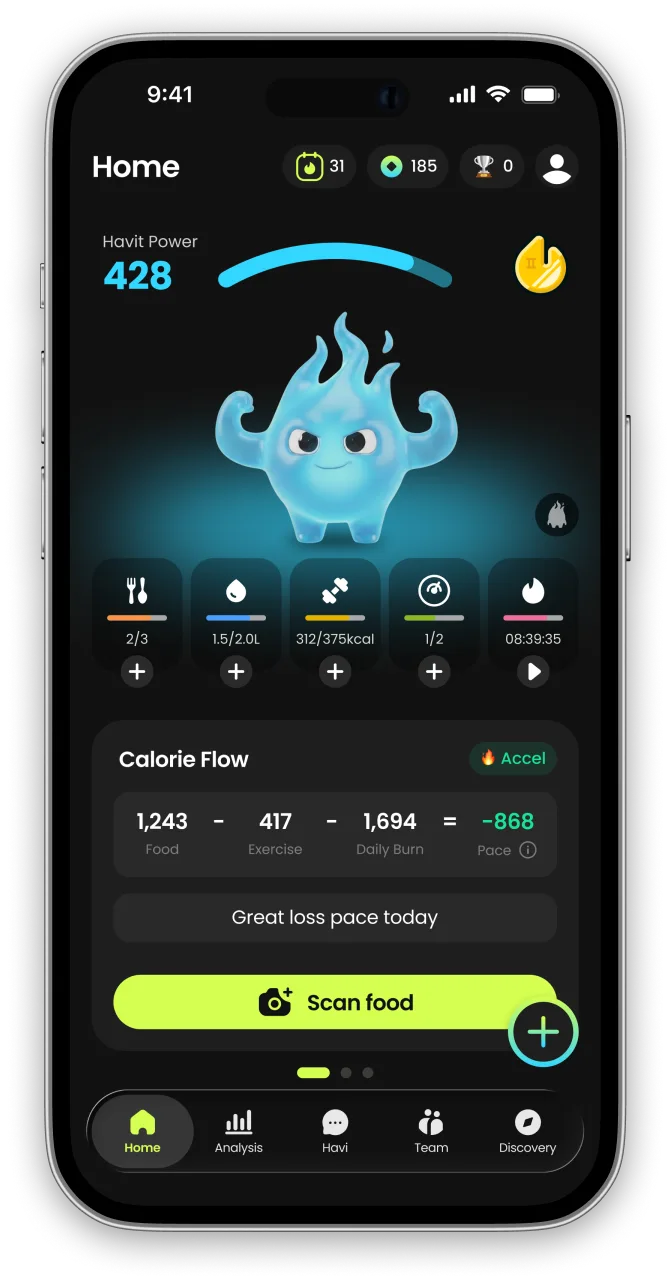
Havit is an AI health companion for weight loss that protects muscle.
Unlike calorie-only trackers, Havit connects AI body-composition estimates, nutrition, hydration, sleep, steps, cycle, mood, and GLP-1 medication in one daily routine — so progress is measured by body composition, not just the number on the scale. Daily missions turn established behavior-change techniques into small repeatable actions, drawing on expertise from professionals formerly at Juvis Diet, one of Korea’s leading metabolic clinics.
In Havit’s own analysis of 1,090 GLP-1 users, people who logged consistently built stronger habits than the general user base. Read the GLP-1 Habit Report
Havit works with or without GLP-1 medication. It is a wellness app, not a medical device; body-composition results are estimates.
Continue in the App
Personalized wellness with your own data


References
- Sleep Onset Association Patterns in Adults: Prevalence and Behavioral Interventions — Behavioral Sleep Medicine, 2025
- Media Dependency and Sleep Initiation: A Randomized Controlled Trial of Graduated Extinction — Sleep Medicine, 2024
- Cognitive Shuffling as a Sleep Onset Intervention: Mechanisms and Efficacy — Journal of Clinical Sleep Medicine, 2024
- Partner Concordance in Sleep-Related Media Use: Implications for Intervention Design — Behavioral Sleep Medicine, 2025


