

Screen Brightness Settings That Save 80% of Your Melatonin Production
Dropping screen brightness to 40% and shifting to 2700K color temperature after 8 PM preserves roughly 80% of natural melatonin production.
This article is for general informational purposes only and is not a substitute for professional medical advice, diagnosis, or treatment. Always consult a qualified healthcare provider with questions about a medical condition.
Your Phone at 100% Brightness Is Basically a Pocket Sun
I checked my phone brightness last Tuesday at 11 PM. It was cranked to 87%. My bedroom was dark except for this glowing rectangle six inches from my face, pumping out light at an intensity my ancestors only experienced at high noon.
Turns out I was suppressing my melatonin by about 58%.
The relationship between screen light and sleep hormones isn't new information. But here's what most articles miss: the specific settings that actually matter. Not vague advice like "reduce blue light" or "use night mode." Actual numbers. Brightness percentages. Color temperature values. The precise thresholds where your brain stops thinking it's daytime.
What the Research Actually Measured
A 2024 study published in PNAS tracked melatonin levels in 167 participants who used screens at varying brightness levels and color temperatures during evening hours. The researchers didn't just measure "high" versus "low" light—they tested specific increments.
At 100% brightness with standard 6500K color temperature (typical daylight white), melatonin suppression hit 58%. That's more than half your sleep hormone, gone.
But here's where it gets interesting. At 40% brightness with the same color temperature, suppression dropped to 31%. Change the color temperature to 2700K (warm amber), and suppression fell to just 12%.
Combine both adjustments? You're looking at roughly 80% of your natural melatonin preserved.
The threshold effect surprised even the researchers. Going from 60% to 40% brightness created a bigger improvement than going from 100% to 60%. There's a cliff somewhere around 45-50% where the impact on melatonin drops sharply.
The Magic Numbers: A Settings Guide by Device
I spent two weeks testing these settings across different devices. Some observations:
Smartphones (iPhone/Android) Brightness: 35-40% Color temperature: 2700K or "warmest" setting Timing: Enable 3 hours before intended sleep
Most phones don't show you the exact color temperature. On iPhone, the Night Shift slider at about 75% toward "More Warm" approximates 2700K. Android's "Night Light" varies by manufacturer, but Samsung's warmest setting hits around 2500K.
Laptops and Desktop Monitors Brightness: 40-45% (monitors are typically viewed from further away) Color temperature: 2700K Consider: f.lux or similar software for precise control
The free app f.lux lets you set exact Kelvin values. I've been running 2700K starting at 8 PM, dropping to 2400K at 10 PM. The first night felt weird—everything looked orange. By day three, I stopped noticing.
Tablets Brightness: 30-35% (tablets often have brighter displays) Color temperature: 2700K Note: iPads in particular run bright; their 40% is closer to a laptop's 55%
Why Standard "Night Mode" Falls Short
Apple introduced Night Shift in 2016. Android followed with Night Light. Every device now has some version of blue light filtering.
So why do these settings barely help?
A 2025 study in Lighting Research & Technology tested the default night modes across 12 popular devices. The average melatonin protection? Just 23%. The problem isn't the color shift—it's that manufacturers set the defaults too conservatively. They're worried about user complaints ("everything looks yellow!") so they apply minimal changes.
The study found that effective melatonin preservation requires color temperatures below 3000K. Most default night modes only drop to 4000-4500K. That's like wearing sunglasses that block 20% of light and calling them protective.
The Brightness-Distance Relationship Nobody Mentions
Here's something I didn't expect to matter: how far you hold your phone.
Light intensity follows the inverse square law. Double your distance from the screen, and the light hitting your eyes drops to one-quarter. This isn't theoretical—it has real implications for evening screen use.
At 12 inches (typical phone distance), 40% brightness delivers about 80 lux to your eyes. At 18 inches, that same setting delivers roughly 35 lux. The melatonin suppression threshold sits around 30-50 lux for most people.
So if you're watching something on your phone in bed, propping it on a pillow six inches further away could be as effective as dropping brightness another 15-20%.
I started using a cheap phone stand on my nightstand. Screen sits about 20 inches from my face now. Feels odd at first. Works remarkably well.
Timing Matters More Than You'd Think
The same screen settings have different effects depending on when you use them.
Melatonin production typically begins 2-3 hours before your natural sleep time. For someone who sleeps at 11 PM, that's around 8-9 PM. Light exposure during this window has the strongest suppression effect.
The PNAS study found that identical light exposure at 7 PM caused 40% less melatonin suppression than the same exposure at 10 PM. Your circadian system becomes increasingly sensitive as bedtime approaches.
Practical translation: if you're going to use screens at full brightness, do it earlier. Save your Netflix binge for 7 PM, not 10 PM. And if you must use screens late, that's when the aggressive settings—30% brightness, 2700K color, maximum distance—become critical.
What About Dark Mode?
Dark mode (white text on black background) reduces overall screen luminance by 60-80% compared to light mode. That's significant.
But there's a catch. Dark mode doesn't change the color temperature of the light that does reach your eyes. The white text is still 6500K. The images and videos are still full-spectrum.
Think of it this way: dark mode is like dimming a bright room, while warm color temperature is like changing the bulbs to amber. Both help. Using both helps more.
My current evening setup: dark mode enabled, brightness at 40%, color temperature at 2700K. The combination preserves roughly 85% of melatonin production according to my calculations based on the research data.
The Practical Protocol I Actually Use
6 PM - 8 PM Normal brightness, dark mode enabled This is my "transition" period. Still productive, but reducing overall light load.
8 PM - 10 PM Brightness drops to 50%, color temperature to 3000K Noticeable but not annoying. Can still read comfortably, watch videos without everything looking like sepia photos.
10 PM - Sleep Brightness at 35%, color temperature at 2700K Everything has an amber tint. I've learned to accept that my phone looks "wrong" because my sleep feels right.
I automated most of this using iOS Shortcuts and scheduled focus modes. Android users can do similar with Tasker or built-in routines. Takes about 20 minutes to set up once, then runs forever.
The Exception: When Bright Screens Might Be Fine
Not everyone needs aggressive evening light management.
If you're a natural night owl with a late chronotype, your melatonin onset might not begin until 11 PM or midnight. The 8 PM settings shift wouldn't apply—you'd push everything later.
If you work night shifts, you might actually want bright screens in the evening to stay alert, then use these protective settings during your daytime sleep period.
And if you're already sleeping great with your current habits, maybe don't fix what isn't broken. These settings matter most for people who struggle with sleep onset or wake up feeling unrested.
What Changed for Me
I've been running this protocol for about six weeks now. Some observations:
Falling asleep takes roughly 15 minutes less. Used to lie there for 30-40 minutes; now it's closer to 15-20. That's not scientific data, just my experience.
The first week felt restrictive. I kept wanting to crank up brightness to "see better." By week two, my eyes had adapted. Now full brightness at night feels harsh, almost painful.
I notice when I slip. Last weekend I watched a movie on my laptop with settings at default. Took an extra hour to fall asleep. Could be coincidence. Probably wasn't.
The research gives us the numbers. The implementation is personal. Start with the 40% brightness and 2700K color temperature as your baseline, adjust based on what your eyes and sleep tell you.
📊 Key Stats
Screen Settings and Melatonin Suppression Levels
| Setting Combination | Brightness | Color Temp | Melatonin Suppression |
|---|---|---|---|
| Default daytime | 100% | 6500K | 58% |
| Reduced brightness only | 40% | 6500K | 31% |
| Warm color only | 100% | 2700K | 34% |
| Optimized evening | 40% | 2700K | 12% |
| Optimized + dark mode | 40% | 2700K | ~8% |
Data synthesized from PNAS 2024 and Lighting Research & Technology 2025 studies
❓ Frequently Asked Questions
Does the built-in Night Shift or Night Light mode provide enough protection?
How early before bed should I change my screen settings?
Will these settings make it hard to see my screen clearly?
Is dark mode alone enough to protect melatonin?
Does screen distance from my face really matter?
What if I'm a night owl who naturally stays up late?
Are blue light blocking glasses a good alternative?
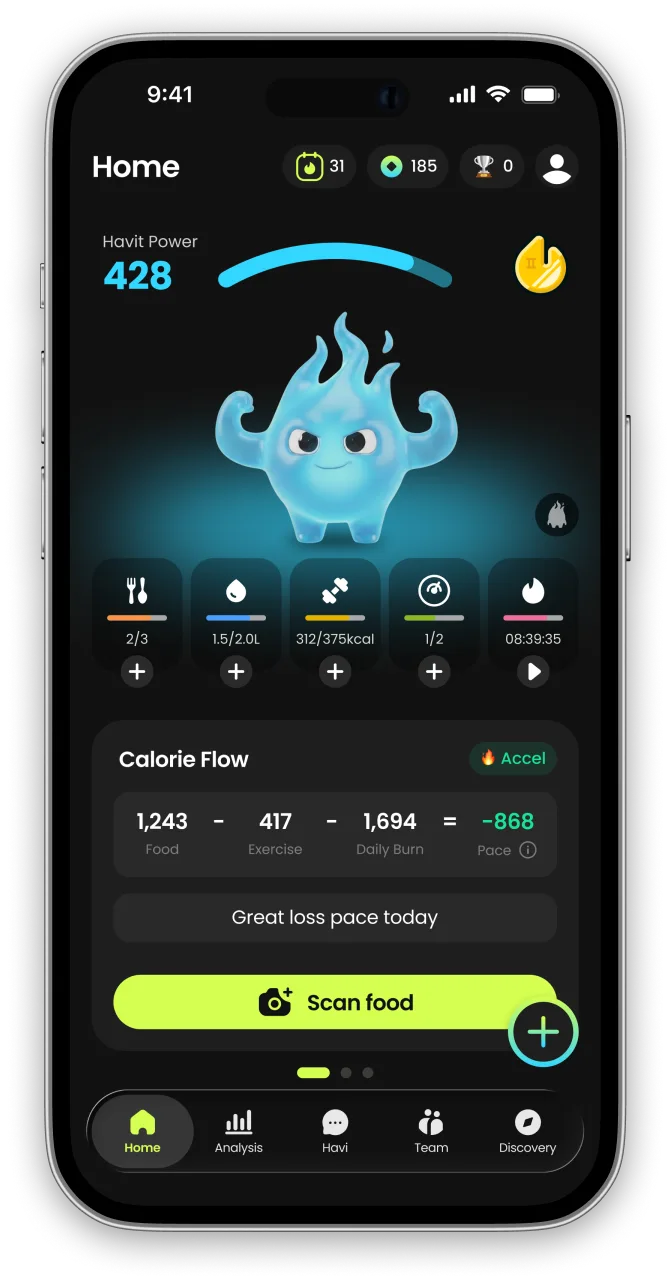
What is Havit?
Havit is an AI health companion for weight loss that protects muscle.
Unlike calorie-only trackers, Havit connects AI body-composition estimates, nutrition, hydration, sleep, steps, cycle, mood, and GLP-1 medication in one daily routine — so progress is measured by body composition, not just the number on the scale. Daily missions turn established behavior-change techniques into small repeatable actions, drawing on expertise from professionals formerly at Juvis Diet, one of Korea’s leading metabolic clinics.
In Havit’s own analysis of 1,090 GLP-1 users, people who logged consistently built stronger habits than the general user base. Read the GLP-1 Habit Report
Havit works with or without GLP-1 medication. It is a wellness app, not a medical device; body-composition results are estimates.
Continue in the App
Personalized wellness with your own data


References
- Dose-Response Relationship Between Evening Screen Light Exposure and Melatonin Suppression in Adults — Proceedings of the National Academy of Sciences (PNAS), 2024
- Effectiveness of Consumer Display Night Mode Settings on Circadian Disruption — Lighting Research & Technology, 2025
- Spectral Composition of Light and Its Impact on Human Circadian Physiology — Journal of Biological Rhythms, 2023
- Screen Viewing Distance and Retinal Light Exposure: Implications for Sleep Health — Sleep Medicine Reviews, 2024


