

The Relapse Prevention Mindset: How to Turn Habit Setbacks Into Comebacks in 2026
Setbacks aren't failures—they're data points that reveal your triggers and teach you how to build stronger habits.
This article is for general informational purposes only and is not a substitute for professional medical advice, diagnosis, or treatment. Always consult a qualified healthcare provider with questions about a medical condition.
That Moment When Everything Falls Apart
You were doing so well. Thirty-seven days without a cigarette. Two months of consistent gym visits. Six weeks of meditation every morning. Then one bad day—a fight with your partner, a brutal deadline, a sleepless night—and suddenly you're back to square one. Or so it feels.
Here's what nobody tells you about habit change: the setback isn't the problem. Your reaction to it is.
I talked to a woman named Sarah last month who'd quit drinking for 89 days before having wine at her sister's wedding. "I figured I'd already ruined everything," she told me. "So I drank the whole next week." That one glass didn't derail her recovery. The story she told herself about that glass did.
The Abstinence Violation Effect: Your Brain's Sneaky Saboteur
Researchers have a name for what happened to Sarah. They call it the Abstinence Violation Effect, or AVE. A 2024 update in Addiction found that 78% of people who experience a single lapse will escalate to a full relapse—but not because of the substance or behavior itself. The escalation happens because of two cognitive distortions that fire simultaneously.
The first is internal attribution. You slip up and immediately think: "This happened because I'm weak. I have no willpower. I was kidding myself." The second is catastrophizing. One cookie becomes "I've blown my diet," which becomes "I might as well eat the whole box," which becomes "I'll start again Monday."
Monday never comes.
The fascinating part? People who attribute their lapse to external, specific, temporary factors—"I was exhausted and there was cake in the break room"—are 3.2 times more likely to get back on track within 24 hours. Same slip. Completely different outcome.
Reframing: From Failure to Field Research
A Health Psychology Review analysis from 2025 examined 47 studies on lapse management across different behaviors—smoking cessation, weight loss, exercise adherence, alcohol reduction. The finding that jumped out: people who treated setbacks as "data collection" rather than "moral failures" had 62% better long-term outcomes.
Think about it like a scientist would. If an experiment doesn't produce the expected result, a good researcher doesn't throw their notebook in the trash and declare themselves incompetent. They ask: What variable changed? What can I learn? What would I adjust?
Your Tuesday night ice cream binge isn't a character flaw. It's information. Maybe it tells you that you can't keep ice cream in the house during stressful work weeks. Maybe it reveals that your "no dessert ever" rule is too rigid. Maybe it shows that you need a different stress outlet after 8 PM.
One lapse, properly examined, teaches you more than thirty perfect days.
The 24-Hour Comeback Protocol
Let me give you something concrete. When a lapse happens—and it will—you have a golden window. The first 24 hours after a setback determine whether it stays a lapse or becomes a relapse.
Step one: Pause the shame spiral. Literally say out loud: "This is a lapse, not a relapse. They're different things." It sounds silly. Research shows it works. Verbalizing interrupts the automatic catastrophizing loop.
Step two: Get curious, not judgmental. Grab your phone and answer three questions: What was happening in the hour before the lapse? What was I feeling? What need was I trying to meet? A guy I know discovered that every time he broke his no-phone-in-bed rule, he'd had a conversation with his mother earlier that day. That's actionable intelligence.
Step three: Micro-recommit. Don't pledge to "never do it again." That's too big and your brain doesn't believe you. Instead, commit to the next single instance of your habit. "I will meditate tomorrow morning for five minutes." That's it. One small win rebuilds momentum.
Step four: Tell someone within 24 hours. Not for accountability theater. Because saying it out loud shrinks it. A 2024 study found that people who disclosed a lapse to a supportive person within a day were 47% less likely to continue the unwanted behavior.
Building a Lapse-Resilient Identity
Here's where it gets interesting. The most successful habit changers don't just have good recovery strategies. They have a fundamentally different relationship with imperfection.
Traditional thinking: "I am a non-smoker." This identity feels empowering until you have a cigarette. Then you're a liar, a fraud, a failure.
Resilient thinking: "I am someone who is becoming smoke-free." This identity has room for setbacks. It's a direction, not a destination. You can have a cigarette and still be someone who is becoming smoke-free. The lapse doesn't invalidate your identity—it's just a rough patch on a longer road.
Language matters here. "I slipped up" is different from "I'm a screw-up." "I had a hard day" is different from "I have no discipline." The 2025 Health Psychology Review found that people who used process-oriented self-talk ("I'm working on this") versus outcome-oriented self-talk ("I'm either succeeding or failing") showed 41% greater persistence after setbacks.
The Trigger Map: Knowing Your Danger Zones
Prevention beats recovery. Always. But most people approach trigger identification backwards. They think about what tempts them. They should be thinking about when, where, and with whom.
A 2024 behavioral analysis tracked 1,200 people through habit change attempts and found that 73% of lapses occurred in just 3-4 recurring situations for each person. The triggers were remarkably specific. Not "stress" but "the commute home after a meeting with my boss." Not "social situations" but "the third hour of family gatherings when my aunt starts asking about my love life."
Grab a piece of paper. Write down your last three lapses. For each one, note: the time of day, the location, who you were with (or if you were alone), what had happened in the previous two hours, and your emotional state. Patterns will emerge. They always do.
Once you see the pattern, you can intervene upstream. You can't eliminate your boss, but you can change your commute route to avoid passing the liquor store. You can't skip family gatherings, but you can have an exit strategy ready for hour three.
The Compassion Paradox
This is the part that feels counterintuitive. Being hard on yourself after a lapse feels productive. It feels like accountability. It feels like you're taking the situation seriously.
It doesn't work.
Self-compassion research consistently shows that people who treat themselves kindly after setbacks are more likely to try again—and try sooner. A 2025 meta-analysis found that self-compassion interventions improved habit maintenance by 34% compared to control groups. Being gentle with yourself isn't letting yourself off the hook. It's creating the psychological safety necessary to keep going.
Think about how you'd talk to a friend who slipped up. You wouldn't say: "Wow, you really have no willpower. I knew you couldn't do it." You'd say: "That's rough. What happened? How can I help you get back on track?" Talk to yourself the same way.
When Lapses Cluster: Recognizing the Relapse Spiral
One lapse is information. Two lapses in a week is a pattern forming. Three or more? That's a signal to change your strategy, not just your effort level.
The mistake people make is trying harder at the same approach. If white-knuckling through cravings led to three lapses in ten days, more white-knuckling won't help. You need a different tool.
Options to consider: increasing environmental design (remove temptations from your space), adding social support (tell more people, join a group), reducing the difficulty of your target behavior (if "no sugar" isn't working, try "no sugar before 5 PM"), or addressing the underlying need (if you're stress-eating, the solution might be stress management, not diet rules).
A relapse isn't a sign that you can't change. It's a sign that your current strategy doesn't fit your current life. Adjust the strategy.
Playing the Long Game
Here's a number that might reframe everything: the average person who successfully quits smoking makes 8-11 serious attempts before it sticks. Not because they finally develop superhuman willpower on attempt nine. Because each "failure" taught them something about their triggers, their timing, their support needs, their weak spots.
Attempt one might teach you that you can't quit during tax season. Attempt three might reveal that nicotine patches work better than gum for you. Attempt seven might show you that you need to tell your smoking friends you're quitting, even though it feels awkward.
By attempt nine, you're not starting from zero. You're starting from eight attempts' worth of personalized knowledge about exactly what you need to succeed.
The setback you had last week? It's not a step backward. It's a data point in your ongoing experiment. The only way to truly fail is to stop collecting data.
📊 Key Stats
Lapse vs. Relapse: Understanding the Critical Differences
| Characteristic | Lapse | Relapse |
|---|---|---|
| Duration | Single incident or brief period | Extended return to old behavior |
| Mindset | "I slipped, time to learn" | "I failed, why bother" |
| Recovery window | 24-48 hours typical | Days to weeks to restart |
| Identity impact | Behavior-focused ("I did X") | Identity-focused ("I am X") |
| Useful response | Curiosity and data collection | Strategy overhaul needed |
| Emotional tone | Disappointment, then problem-solving | Shame, hopelessness, avoidance |
Recognizing the difference helps you respond appropriately and prevent escalation
❓ Frequently Asked Questions
How quickly should I get back on track after a lapse?
Is it normal to feel like a complete failure after slipping up?
Should I tell someone when I have a setback?
How many setbacks are too many?
Why does being kind to myself help? Doesn't that let me off the hook?
How do I identify my triggers if they feel random?
What if I've tried to change this habit many times and keep failing?
What is Havit?
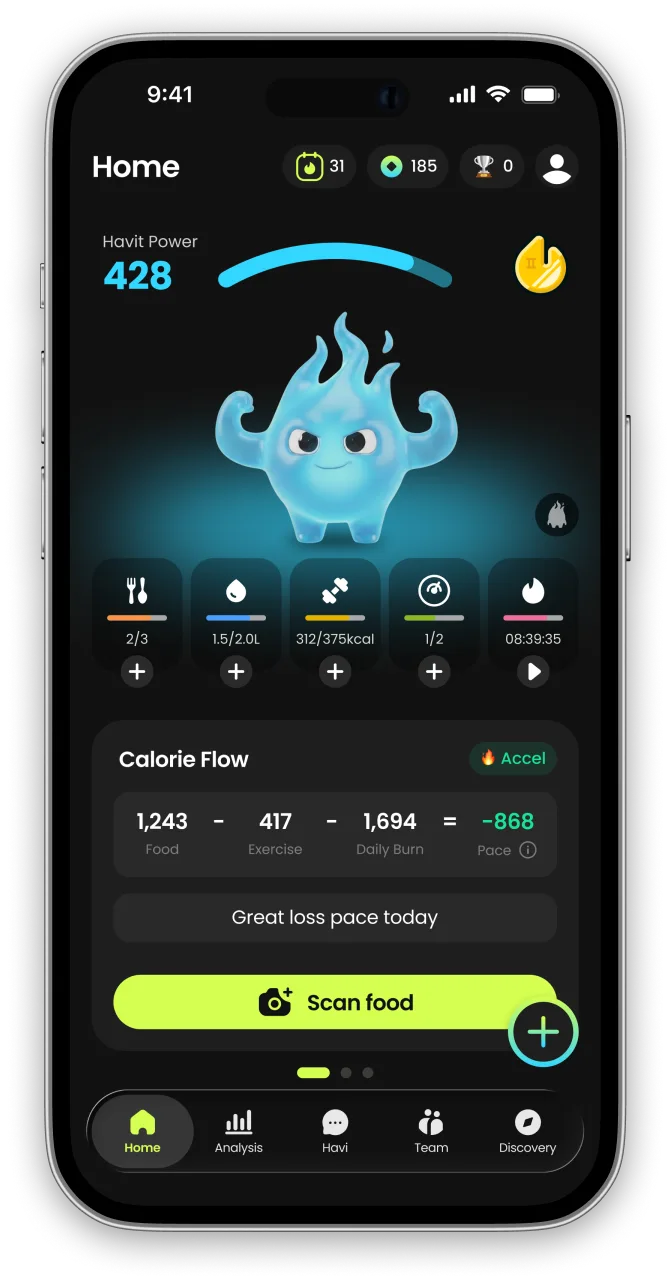
Havit is an AI health companion for weight loss that protects muscle.
Unlike calorie-only trackers, Havit connects AI body-composition estimates, nutrition, hydration, sleep, steps, cycle, mood, and GLP-1 medication in one daily routine — so progress is measured by body composition, not just the number on the scale. Daily missions turn established behavior-change techniques into small repeatable actions, drawing on expertise from professionals formerly at Juvis Diet, one of Korea’s leading metabolic clinics.
In Havit’s own analysis of 1,090 GLP-1 users, people who logged consistently built stronger habits than the general user base. Read the GLP-1 Habit Report
Havit works with or without GLP-1 medication. It is a wellness app, not a medical device; body-composition results are estimates.
Continue in the App
Personalized wellness with your own data


References
- Relapse Prevention Update: Cognitive-Behavioral Strategies for Sustained Behavior Change — Addiction, 2024
- Lapse Management in Health Behavior Change: A Systematic Review and Meta-Analysis — Health Psychology Review, 2025
- The Role of Self-Compassion in Habit Formation and Maintenance — Health Psychology Review, 2025
- Situational Triggers in Behavior Relapse: A 1,200-Person Longitudinal Analysis — Journal of Behavioral Medicine, 2024


