

What Your Recovery Score Actually Means (And When to Ignore It)
Recovery scores blend HRV, sleep, and strain data, but context matters more than the number—learn when to trust the algorithm and when to override it.
This article is for general informational purposes only and is not a substitute for professional medical advice, diagnosis, or treatment. Always consult a qualified healthcare provider with questions about a medical condition.
That Red Number Ruined My Morning
I woke up feeling genuinely good. Eight hours of sleep, no alarm, ready to crush my interval session. Then I glanced at my wrist: 34% recovered. Suddenly I felt tired. My legs seemed heavier. Maybe I was overtraining?
This happens to millions of people every day. A 2024 survey found that 67% of wearable users have skipped planned workouts based solely on a low recovery score. But here's what most people don't realize: that number isn't measuring some objective truth about your body. It's a prediction. And predictions can be wrong.
The Ingredients Inside Your Recovery Number
Every major wearable calculates recovery differently, but they're all cooking with similar ingredients. The base layer is almost always heart rate variability—specifically, the millisecond variations between heartbeats while you sleep. Higher variability generally signals a parasympathetic-dominant state, meaning your nervous system isn't in fight-or-flight mode.
But HRV alone tells an incomplete story. So algorithms layer in resting heart rate trends, sleep architecture (how much deep and REM sleep you logged), respiratory rate changes, and your recent training load. Some newer devices now incorporate skin temperature deviations and blood oxygen patterns.
The math gets interesting. Most systems don't just look at last night—they're comparing your current metrics against your personal 14 to 60-day baseline. A resting heart rate of 52 might be perfectly normal for one person and a red flag for another. Your score is relative to your normal, not some universal standard.
Why the Same HRV Can Mean Opposite Things
Here's where things get tricky. An HRV of 45ms after a brutal training week might indicate genuine fatigue—your body screaming for rest. That same 45ms reading after a recovery week could mean you're primed and ready, your nervous system coiled like a spring.
Context changes everything. A 2025 study in the International Journal of Sports Physiology and Performance tracked 127 collegiate athletes over a competitive season. The researchers found that HRV-based recovery scores predicted next-day performance accurately only 61% of the time when used in isolation. But when coaches combined the scores with athlete-reported readiness and training phase context, prediction accuracy jumped to 84%.
The algorithm doesn't know you had three espressos yesterday. It doesn't know you're anxious about a work presentation. It can't tell that your "poor sleep" was actually you staying up late celebrating something wonderful. Numbers without narrative are just numbers.
The Five Scenarios Where Your Body Knows Better
After interviewing sports scientists and digging through the research, I've identified five situations where overriding your recovery score makes sense.
Scenario one: The caffeine hangover. You had coffee later than usual, your HRV tanked overnight, and your score looks terrible. But you feel fine. Caffeine's half-life is 5-6 hours, meaning that 3pm latte was still 50% active at 9pm. Your nervous system was stimulated, not stressed. Train normally.
Scenario two: The alcohol illusion. Conversely, a drink or two can temporarily increase HRV in some people by suppressing sympathetic activity. Your score might look green while your body is actually processing toxins. If you drank last night and feel rough, trust the feeling over the number.
Scenario three: Adaptation in progress. During a planned overreaching phase—intentionally training hard to trigger adaptation—your scores will look chronically low. That's the point. Elite coaches often ignore recovery metrics for 2-3 week blocks, then use them to confirm supercompensation during the taper.
Scenario four: The baseline shift. Started a new medication? Changed time zones? Going through menstruation? Your baseline is temporarily meaningless. Most algorithms need 14+ days to recalibrate. During transitions, rely more on subjective feel.
Scenario five: Mental readiness mismatch. You're psychologically fired up for a race or important session, but your score is mediocre. Sports Medicine research from 2024 showed that psychological readiness can override moderate physiological fatigue for single performances. The adrenaline and focus of competition create their own recovery.
When the Algorithm Actually Knows Better Than You
I'd be doing you a disservice if I only talked about overriding scores. Sometimes the number sees what you can't.
Chronic sleep debt is the classic example. You feel "fine" because you've adapted to feeling terrible. Your new normal is exhausted. But your HRV trend tells the real story—a slow, steady decline over weeks that you've normalized. When scores stay suppressed for 5+ consecutive days despite feeling okay, that's a signal worth heeding.
Same goes for early illness detection. Several studies have documented HRV and respiratory rate changes appearing 24-48 hours before people notice cold or flu symptoms. If your score craters for no obvious reason and you genuinely can't explain it, consider it an early warning system.
The pattern matters more than any single day. One bad score is noise. Five bad scores are data.
Building Your Personal Override Framework
Here's the system I've developed after testing this with my own training and reviewing what works for coached athletes.
Step one: Log a daily 1-10 subjective readiness score before checking your wearable. This takes ten seconds and prevents the number from anchoring your perception. Over time, you'll learn how well your gut correlates with the algorithm.
Step two: When scores and feelings diverge, ask three questions. Did I consume anything unusual in the last 24 hours? Am I in a planned hard training phase? Is there an obvious life stressor the device can't detect? If you answer yes to any, lean toward your subjective sense.
Step three: Use the 20% rule. If your recovery score is within 20% of your baseline average, treat it as essentially "normal" and train as planned. The meaningful signals live in the extremes—the 30% days and the 95% days.
Step four: Track outcomes. When you override a low score and train anyway, note how the session actually went. After 20-30 data points, you'll know how reliable your intuition really is.
The Uncomfortable Truth About Recovery Tech
Wearable companies have a vested interest in making you check the app every morning. Engagement drives subscriptions. But the most sophisticated users I've encountered check their recovery scores maybe 2-3 times per week, primarily looking for trends rather than daily verdicts.
A 2025 analysis of Whoop user data found that people who checked scores daily were actually more likely to report training anxiety than those who checked weekly. The constant feedback loop can create a dependency that undermines the body awareness these tools are supposed to enhance.
The goal isn't to outsource your intuition to an algorithm. It's to use the algorithm as one input among many—a second opinion from a reasonably smart friend who only knows part of your story.
Making Peace With Uncertainty
Your recovery score is a probability estimate, not a prescription. It's saying something like: "Based on the signals I can measure, there's a higher-than-usual chance you're fatigued." That's useful information. It's not a command.
The athletes who get the most from these tools hold them loosely. They appreciate the trend data, they investigate surprising readings, and they maintain final veto power over their own bodies. The technology serves them, not the other way around.
So the next time you wake up to a red number, pause before panicking. Ask yourself how you actually feel. Consider what the algorithm can't see. Then make your own call.
You might be wrong sometimes. So is the algorithm. The difference is that you can learn from the mismatch in ways no wearable ever will.
📊 Key Stats
When to Trust vs. Override Your Recovery Score
| Situation | Trust the Score | Override the Score |
|---|---|---|
| Late caffeine consumption | No | Yes—HRV suppression is chemical, not fatigue |
| Alcohol the night before | Yes—even if score looks fine | No |
| Planned overreaching phase | No | Yes—low scores are expected and intentional |
| 5+ consecutive low scores | Yes—pattern indicates real fatigue | No |
| High psychological readiness for competition | No | Yes—mental state can override moderate fatigue |
| Recent medication or timezone change | No | Yes—baseline is temporarily invalid |
| Score within 20% of your average | Treat as normal | Train as planned |
Context determines whether algorithmic recommendations apply to your specific situation
❓ Frequently Asked Questions
How accurate are wearable recovery scores?
Should I skip my workout if my recovery score is low?
Why does my recovery score vary so much day to day?
Can alcohol improve my recovery score?
How long does it take for a wearable to learn my baseline?
Do elite athletes use recovery scores?
What's the 20% rule for recovery scores?
What is Havit?
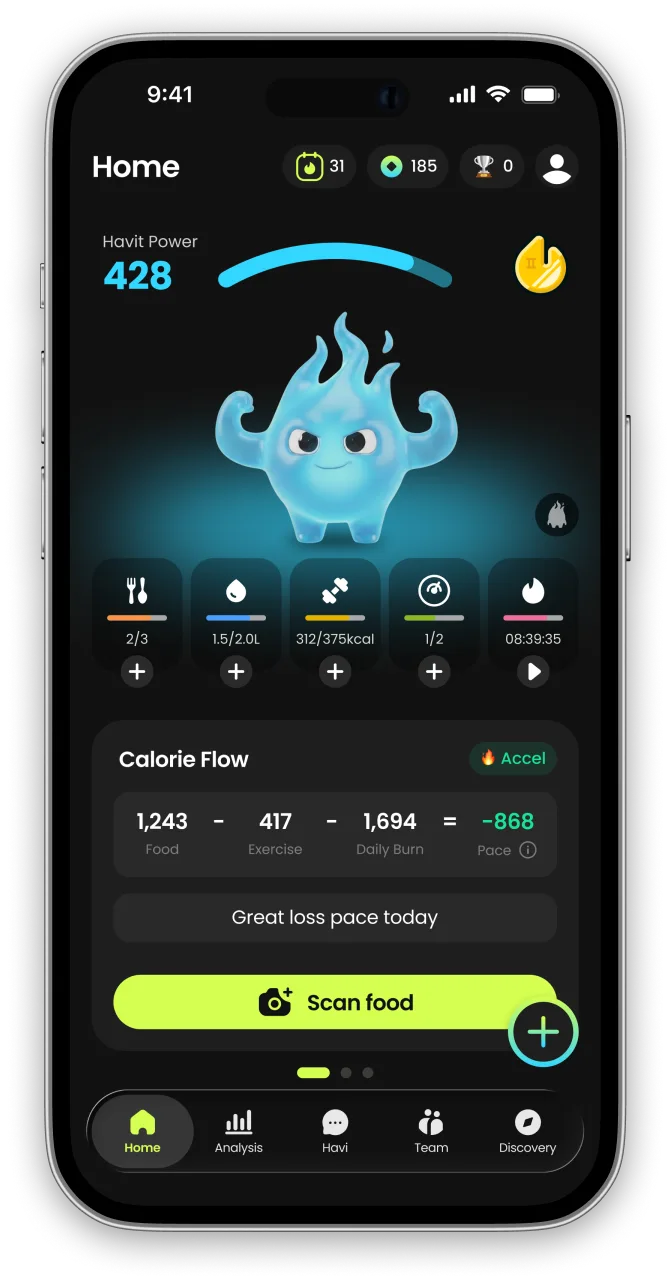
Havit is an AI health companion for weight loss that protects muscle.
Unlike calorie-only trackers, Havit connects AI body-composition estimates, nutrition, hydration, sleep, steps, cycle, mood, and GLP-1 medication in one daily routine — so progress is measured by body composition, not just the number on the scale. Daily missions turn established behavior-change techniques into small repeatable actions, drawing on expertise from professionals formerly at Juvis Diet, one of Korea’s leading metabolic clinics.
In Havit’s own analysis of 1,090 GLP-1 users, people who logged consistently built stronger habits than the general user base. Read the GLP-1 Habit Report
Havit works with or without GLP-1 medication. It is a wellness app, not a medical device; body-composition results are estimates.
Continue in the App
Personalized wellness with your own data


References
- Heart Rate Variability and Training Readiness: A Contextual Framework for Interpretation — International Journal of Sports Physiology and Performance, 2025
- Wearable Recovery Metrics in Collegiate Athletes: Predictive Validity and Practical Applications — Sports Medicine, 2024
- Subjective vs Objective Recovery Assessment: When Do They Diverge? — Journal of Strength and Conditioning Research, 2024
- The Psychology of Self-Tracking: Behavioral Outcomes in Wearable Device Users — Digital Health, 2025


