

Protein Leverage Hypothesis: Why Your Body Forces You to Overeat Until Protein Needs Are Met
Your body will keep driving hunger until you hit your protein target—eating more protein-dense foods first can slash total calorie intake by 12-15%.
This article is for general informational purposes only and is not a substitute for professional medical advice, diagnosis, or treatment. Always consult a qualified healthcare provider with questions about a medical condition.
You're Not Weak-Willed. Your Biology Is Hunting for Protein.
Here's something that might change how you think about your last late-night fridge raid: your body wasn't craving chips. It was hunting for protein. And it was willing to make you eat 500 extra calories of carbs and fat to find it.
This isn't pop psychology. It's called the protein leverage hypothesis, and it's reshaping how researchers understand appetite, obesity, and why willpower-based dieting fails so spectacularly. The basic idea is almost embarrassingly simple: humans have a protein-specific appetite that takes priority over total energy intake. When protein is diluted in your diet, you'll unconsciously eat more of everything else until you hit your protein target.
Think of it like this. Imagine you need 80 grams of protein daily. If your breakfast is a 400-calorie muffin with 4 grams of protein, your body registers that as "protein mission: 5% complete." So it keeps the hunger signals firing. You eat more. Maybe a lot more.
The Science Behind Protein Prioritization
The protein leverage hypothesis was first proposed by researchers David Raubenheimer and Stephen Simpson in 2005, but it's gained serious traction in the past two years as larger studies confirmed its predictions.
A 2024 meta-analysis in Obesity Reviews examined 31 studies involving over 9,000 participants. The findings were striking. When dietary protein dropped below 15% of total calories, people consistently increased their food intake. On average, every 1% decrease in protein proportion led to a 2.2% increase in total energy consumed. The body wasn't being greedy. It was being precise—about protein.
Cell Metabolism published a controlled feeding study in early 2025 that took this further. Researchers gave participants access to unlimited food but varied the protein content of available options. When only low-protein foods were accessible (10% protein), subjects ate 35% more total calories compared to when high-protein options (25% protein) were available. Their protein intake? Nearly identical in both conditions—around 75-80 grams.
The implications hit hard. Your body has a protein thermostat. It will make you eat and eat until that thermostat is satisfied.
Why Modern Diets Set the Protein Trap
Walk through any grocery store and you'll notice something. Ultra-processed foods—the ones engineered for maximum cravability—tend to be protein-diluted. A frosted pastry might deliver 400 calories but only 3 grams of protein. A bag of chips? 150 calories, 2 grams of protein.
This isn't accidental. Food manufacturers discovered decades ago that the combination of refined carbs, fats, and salt creates a "bliss point" that drives consumption. What they may not have realized is that they were also exploiting protein leverage. By diluting protein, they created foods that satisfy immediate cravings but leave the deeper protein appetite unsatisfied.
The numbers tell the story. In 1970, the average American diet was about 16% protein. By 2020, that had dropped to roughly 12-13%. During that same period, average daily calorie intake increased by approximately 425 calories. The protein leverage hypothesis suggests these trends are connected.
A person eating a 12% protein diet needs to consume about 2,500 calories to get 75 grams of protein. Someone eating a 20% protein diet hits that same 75 grams at just 1,500 calories. That's a 1,000-calorie difference for the same protein intake.
The Breakfast Experiment You Can Try Tomorrow
Let's make this practical. Track what you eat for breakfast tomorrow and calculate the protein percentage. If you're having toast with jam and orange juice—maybe 350 calories, 6 grams of protein—that's about 7% protein. Your body will likely push you toward a bigger lunch.
Now imagine swapping that for Greek yogurt with nuts and berries. Similar calories, but 25-30 grams of protein. That's closer to 30% protein. The protein leverage hypothesis predicts you'll naturally eat less at lunch without trying.
Researchers at the University of Sydney tested exactly this. Participants who ate a 30% protein breakfast consumed 12% fewer calories over the entire day compared to those who ate a 10% protein breakfast. They weren't told to restrict. They weren't counting calories. They just felt satisfied sooner.
Not All Protein Sources Work Equally
Here's where it gets interesting. The protein leverage effect isn't just about grams—it's about how your body detects and uses that protein.
Animal proteins trigger stronger satiety signals per gram than most plant proteins. A 2024 study found that 30 grams of protein from eggs reduced subsequent meal intake by 18%, while 30 grams from wheat bread reduced it by only 7%. The difference likely comes down to amino acid profiles and digestion speed.
This doesn't mean plant proteins are useless for appetite control. Legumes, which combine protein with fiber, showed satiety effects nearly matching animal sources. The key seems to be amino acid completeness and the food matrix—how the protein is packaged with other nutrients.
Practically speaking: a lentil soup will leverage your appetite better than a protein bar made with wheat gluten, even if the protein grams look similar on the label.
The Timing Factor Most People Miss
When you eat protein matters almost as much as how much you eat.
Research from the 2025 Cell Metabolism study included a timing component. Participants who front-loaded protein—eating 40% of their daily protein at breakfast—showed better appetite control throughout the day than those who saved most protein for dinner. Total daily protein was identical. Only the distribution changed.
The breakfast group reported 23% lower hunger ratings at 4 PM, the classic danger zone for snacking. They also made fewer visits to the study's freely available snack station.
The mechanism appears related to how protein influences hormones like PYY and GLP-1, which regulate satiety. These hormones spike after protein consumption and take hours to return to baseline. Eating protein early means these satiety signals are active during the day when food decisions happen most frequently.
What This Means for Weight Management
The protein leverage hypothesis doesn't promise effortless weight loss. But it does suggest that the traditional advice—"just eat less"—ignores biological reality.
If you're eating a 12% protein diet and trying to cut calories, you're fighting your body's protein-seeking drive. You might succeed for days or weeks through sheer willpower. Eventually, the protein thermostat wins. You overeat. You blame yourself. The cycle repeats.
A smarter approach: raise the protein percentage of your diet first, then let appetite self-regulate. The Obesity Reviews meta-analysis found that people who increased dietary protein to 25-30% of calories spontaneously reduced their intake by 12-15% without being told to diet. They weren't hungry. Their protein thermostat was satisfied.
This isn't about protein shakes and chicken breasts at every meal. It's about strategic choices. Choosing eggs over cereal. Adding chickpeas to a salad. Snacking on cheese instead of crackers. Small shifts that move the protein percentage needle.
The Limits of Protein Leverage
Before you start mainlining protein powder, some caveats.
The appetite-suppressing effect of protein has a ceiling. Studies show diminishing returns above about 1.6 grams per kilogram of body weight daily. For a 70-kilogram person, that's around 112 grams. Going to 150 or 200 grams doesn't proportionally increase satiety—it just increases protein intake.
Individual variation exists. Some people show strong protein leverage effects; others are less sensitive. Age matters too. Older adults often have blunted protein appetite signals, which may partly explain age-related changes in body composition.
And protein leverage doesn't override hedonic eating. If you're eating for emotional reasons or out of habit, hitting your protein target won't necessarily stop you from reaching for comfort food. The hypothesis explains physiological hunger, not the full complexity of human eating behavior.
Putting It Into Practice
Start by calculating your current protein percentage. Track a typical day of eating and divide protein calories by total calories. If you're below 20%, you've found low-hanging fruit.
Aim to hit 25-30 grams of protein at breakfast. This single change often cascades into better choices throughout the day. Greek yogurt, eggs, cottage cheese, or leftover dinner protein all work.
When snacking, reach for protein-containing options first. A handful of almonds. String cheese. Deli turkey. The goal isn't to eliminate carbs or fat—it's to ensure protein comes along for the ride.
Pay attention to satiety, not just fullness. Fullness is mechanical—your stomach is stretched. Satiety is the absence of hunger over time. High-protein meals create satiety. High-volume, low-protein meals create temporary fullness that fades quickly.
The protein leverage hypothesis won't solve every eating challenge. But understanding it gives you a new lens. That relentless afternoon hunger might not be a character flaw. It might be your body doing exactly what evolution designed it to do—hunt for protein in a world that keeps hiding it.
📊 Key Stats
Protein Leverage Effect: Low vs. High Protein Meals
| Factor | Low Protein Diet (10-12%) | High Protein Diet (25-30%) |
|---|---|---|
| Calories needed for 75g protein | ~2,500 kcal | ~1,500 kcal |
| Afternoon hunger levels | High | Moderate to low |
| Spontaneous snacking | Frequent | Reduced by 30-40% |
| Satiety hormone response | Weak, short-lived | Strong, sustained |
| Next-meal calorie intake | Often compensatory overeating | Naturally moderated |
Based on aggregate findings from Obesity Reviews 2024 and Cell Metabolism 2025 studies
❓ Frequently Asked Questions
How much protein do I need to trigger the leverage effect?
Does protein source matter for appetite control?
Can I just drink protein shakes to control appetite?
Why do I still overeat even when I eat enough protein?
Is there such a thing as too much protein for appetite control?
How quickly will I notice appetite changes after increasing protein?
Does the protein leverage hypothesis apply to children?
What is Havit?
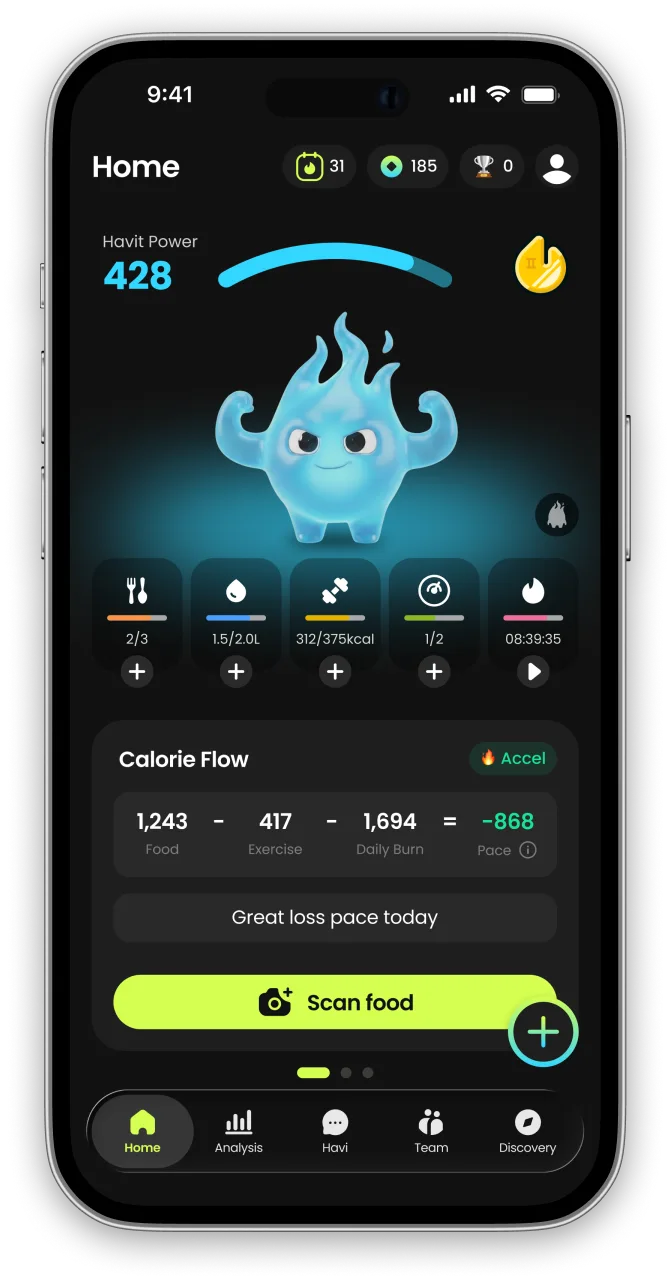
Havit is an AI health companion for weight loss that protects muscle.
Unlike calorie-only trackers, Havit connects AI body-composition estimates, nutrition, hydration, sleep, steps, cycle, mood, and GLP-1 medication in one daily routine — so progress is measured by body composition, not just the number on the scale. Daily missions turn established behavior-change techniques into small repeatable actions, drawing on expertise from professionals formerly at Juvis Diet, one of Korea’s leading metabolic clinics.
In Havit’s own analysis of 1,090 GLP-1 users, people who logged consistently built stronger habits than the general user base. Read the GLP-1 Habit Report
Havit works with or without GLP-1 medication. It is a wellness app, not a medical device; body-composition results are estimates.
Continue in the App
Personalized wellness with your own data


References
- Protein leverage and energy intake: a meta-analysis of human studies — Obesity Reviews, 2024
- Protein-specific appetite and macronutrient selection in humans — Cell Metabolism, 2025
- The protein leverage hypothesis: origins and evidence — Raubenheimer & Simpson, Obesity Reviews, 2005 (foundational paper)
- Dietary protein and satiety: a systematic review of mechanisms — Nutrition Reviews, 2024
- Trends in macronutrient intake in the United States, 1970-2020 — USDA Economic Research Service


