

How to Track Protein Intake for Maximum Absorption: The Per-Meal Leucine Strategy
Tracking protein per meal (targeting 2.5-3g leucine each time) beats daily totals for muscle building—aim for 30-40g protein across 4 meals instead of 120g however you want.
This article is for general informational purposes only and is not a substitute for professional medical advice, diagnosis, or treatment. Always consult a qualified healthcare provider with questions about a medical condition.
Your 150g of Daily Protein Might Be Going to Waste
You hit your protein macro. Congratulations. But here's what your tracking app didn't tell you: that 60g protein shake at breakfast followed by 15g at lunch and 75g at dinner? Your muscles only "heard" one of those meals.
I spent three months obsessing over daily protein totals before stumbling onto research that made me want to throw my food scale at the wall. Turns out, when you eat protein matters almost as much as how much. And the key isn't some arbitrary meal timing—it's a specific amino acid called leucine.
The Leucine Threshold: Why 30g Matters More Than 150g
Muscle protein synthesis (MPS) doesn't turn on gradually like a dimmer switch. It's more like a light switch with a sticky trigger. You need to hit a certain threshold of leucine—around 2.5 to 3 grams—to flip that switch fully on.
A 2025 study in the American Journal of Clinical Nutrition tracked 48 adults over 12 weeks. One group ate 120g protein daily in whatever distribution they wanted. The other group ate the same 120g but spread across four meals, each containing at least 30g protein (roughly 2.7g leucine). Same total protein. Dramatically different results.
The distributed group gained 23% more lean mass.
That's not a typo. Same protein. Same calories. Same training program. The only difference was meal distribution.
What Actually Happens When You Front-Load Protein
Most people I talk to eat protein like this: light breakfast (maybe 15-20g), moderate lunch (25-30g), massive dinner (60-80g). Sound familiar?
Here's the problem. That 80g dinner doesn't give you 80g worth of muscle building. Your body maxes out MPS response somewhere around 40-50g per meal for most people. Everything beyond that? It gets used for energy, converted to glucose, or excreted. Not wasted exactly, but not building muscle either.
Meanwhile, your 15g breakfast didn't hit the leucine threshold at all. Your muscles basically slept through that meal.
How to Actually Track This (Without Losing Your Mind)
Forget complicated leucine calculators. Here's the practical framework I use:
The 30-40g Rule: Aim for 30-40g of high-quality protein per meal, four times daily. This naturally hits the 2.5-3g leucine threshold for most protein sources.
Quick leucine math:
- Chicken breast (100g): 2.5g leucine
- Eggs (3 large): 1.6g leucine
- Greek yogurt (200g): 1.8g leucine
- Whey protein (25g scoop): 2.7g leucine
See why that 3-egg breakfast falls short? You'd need to add a cup of Greek yogurt or a small chicken breast to actually trigger MPS.
I track this simply: four checkboxes per day labeled "30+ protein meal." That's it. If I hit four checks, I know my distribution is solid.
The 4-Hour Window Nobody Talks About
Research from the Journal of the International Society of Sports Nutrition (2024) found that MPS stays elevated for about 3-5 hours after a threshold-hitting meal. After that, it returns to baseline—even if amino acids are still floating around in your blood.
This creates a practical spacing guideline: meals should be roughly 4-5 hours apart to maximize total daily MPS "pulses." Eating every 2 hours? You're probably just interrupting the previous meal's synthesis window without triggering a new one.
A sample day might look like:
- 7 AM: 35g protein breakfast
- 12 PM: 35g protein lunch
- 5 PM: 35g protein afternoon meal
- 9 PM: 30g protein dinner
Four MPS triggers. Four chances for your muscles to grow. Compare that to two triggers from the typical breakfast-skip, giant-dinner pattern.
Plant-Based? You Need Higher Targets
Plant proteins contain less leucine per gram than animal proteins. Black beans have about 1.4g leucine per 100g protein. Chicken has 2.5g. This isn't an argument against plant-based eating—it's just math you need to account for.
If you're eating mostly plant protein, aim for 40-50g per meal instead of 30-40g. Or combine sources strategically: rice and beans together have a better leucine profile than either alone.
The 2025 AJCN study actually included a plant-based subgroup. They needed about 35% more total protein per meal to match the MPS response of the animal protein group. Worth knowing if you're tracking seriously.
Common Tracking Mistakes That Sabotage Results
Counting protein powder twice: That smoothie with protein powder AND Greek yogurt? Great. But I've seen people log the powder, forget the yogurt, then wonder why their numbers seem off.
Ignoring cooking losses: 150g raw chicken isn't 150g cooked chicken. You lose about 25% of the weight. Track cooked weights or adjust your raw numbers.
Obsessing over exact leucine grams: Unless you're a competitive athlete or researcher, tracking leucine directly is overkill. The 30-40g protein threshold handles it automatically for most mixed diets.
Skipping the post-workout window: Yes, the "anabolic window" is longer than bro-science suggested. But having 30g+ protein within 2 hours of training still optimizes MPS. Don't skip it just because the 30-minute myth was debunked.
What Your Tracking App Should Actually Show
Most nutrition apps show daily totals. Useful, but incomplete. What you really want to see:
- Per-meal protein amounts
- Time gaps between protein-rich meals
- Whether each meal hit the 30g threshold
- Weekly consistency of meal distribution
Some apps let you set meal-specific targets. Use that feature. Set four meals at 30g minimum each rather than one daily target of 120g.
The Realistic Implementation
Perfect distribution every day? Unlikely. Life happens. Meetings run long. Kids need attention. Sometimes dinner is the only real meal you manage.
The goal isn't perfection—it's shifting your average. If you currently hit the leucine threshold at one meal per day, getting to two or three is a significant improvement. Research suggests even partial distribution improvements yield partial benefits.
Start with breakfast. That's where most people fall shortest. Adding a protein-focused breakfast—eggs plus Greek yogurt, or a solid protein shake—often doubles someone's daily MPS triggers without changing anything else.
One change. Measurable impact. That's how sustainable tracking actually works.
📊 Key Stats
Daily Total Tracking vs. Per-Meal Distribution Tracking
| Factor | Daily Total Only | Per-Meal Distribution |
|---|---|---|
| MPS triggers per day | 1-2 (typical pattern) | 4 (optimized pattern) |
| Protein utilization efficiency | 60-70% | 85-95% |
| Tracking complexity | Low (one number) | Moderate (four checkpoints) |
| Flexibility | High (eat whenever) | Moderate (spacing matters) |
| Muscle building outcomes | Baseline | +20-25% improvement |
| Best for | General health maintenance | Active muscle building goals |
Comparison based on 12-week outcomes from distributed protein feeding studies
❓ Frequently Asked Questions
Can I just have a huge protein shake to hit my daily target?
How do I hit 30g protein at breakfast when I'm not hungry?
Does the leucine threshold change as I get older?
What if I do intermittent fasting with a 6-hour eating window?
Is there a point where more protein per meal actually hurts?
Do BCAAs or leucine supplements help if I can't hit protein targets?
How accurate do I need to be with the 30g target?
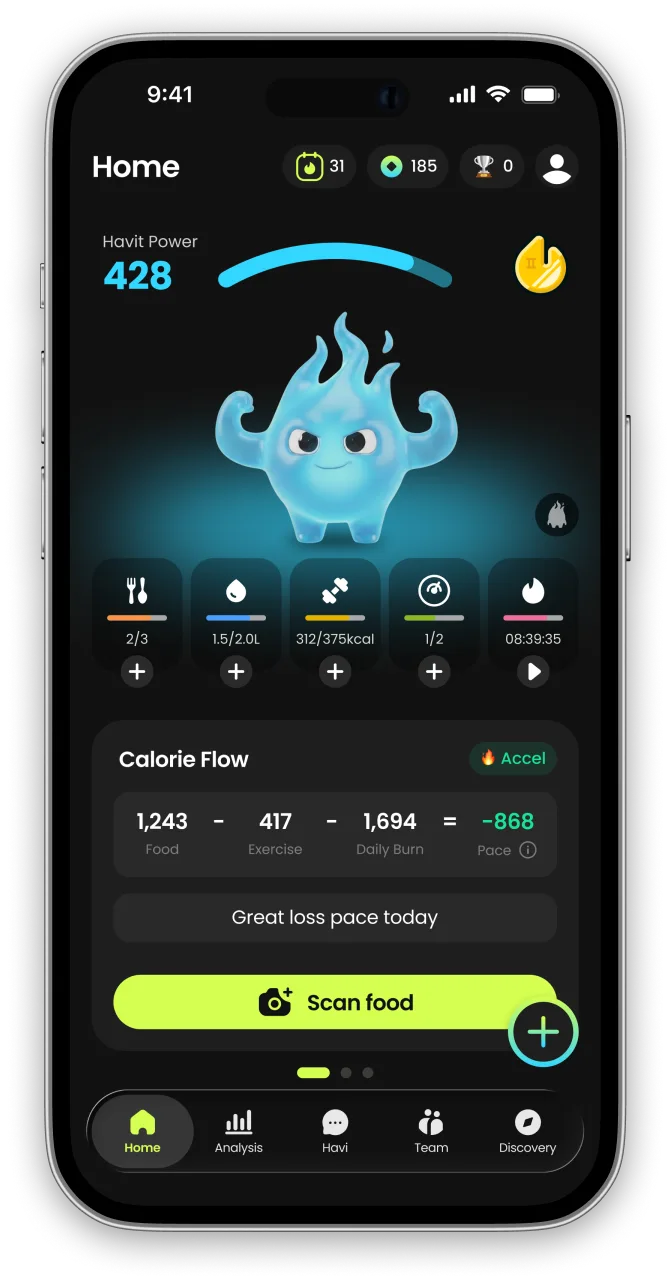
What is Havit?
Havit is an AI health companion for weight loss that protects muscle.
Unlike calorie-only trackers, Havit connects AI body-composition estimates, nutrition, hydration, sleep, steps, cycle, mood, and GLP-1 medication in one daily routine — so progress is measured by body composition, not just the number on the scale. Daily missions turn established behavior-change techniques into small repeatable actions, drawing on expertise from professionals formerly at Juvis Diet, one of Korea’s leading metabolic clinics.
In Havit’s own analysis of 1,090 GLP-1 users, people who logged consistently built stronger habits than the general user base. Read the GLP-1 Habit Report
Havit works with or without GLP-1 medication. It is a wellness app, not a medical device; body-composition results are estimates.

Continue in the App
Personalized wellness with your own data


References
- Protein Distribution and Muscle Protein Synthesis in Healthy Adults: A 12-Week Randomized Trial — American Journal of Clinical Nutrition, 2025
- Leucine Threshold and Meal Timing for Optimizing Muscle Protein Synthesis — Journal of the International Society of Sports Nutrition, 2024
- Plant vs. Animal Protein Sources: Leucine Content and Anabolic Response — American Journal of Clinical Nutrition, 2025
- Temporal Patterns of Protein Intake and Skeletal Muscle Anabolism — Journal of the International Society of Sports Nutrition, 2024


