

How Often Should You Track Your Goals? Science Found the Sweet Spot
Weekly tracking hits the sweet spot—daily obsession kills motivation, while monthly check-ins let goals drift into oblivion.
This article is for general informational purposes only and is not a substitute for professional medical advice, diagnosis, or treatment. Always consult a qualified healthcare provider with questions about a medical condition.
The Bathroom Scale Paradox
Sarah weighed herself every morning for three months. She lost exactly zero pounds. Her friend Mike stepped on the scale once a week and dropped 15. Same diet app. Same gym membership. The difference? How often they checked.
This isn't just an anecdote. A 2024 meta-analysis in Psychological Bulletin examined 138 studies with over 19,000 participants and found something counterintuitive: more tracking doesn't equal more progress. There's a frequency sweet spot, and most of us are nowhere near it.
What 138 Studies Actually Show
Harkin and colleagues crunched data spanning four decades of goal-tracking research. The headline finding: people who monitored their progress were significantly more likely to achieve their goals than those who didn't. The effect size was d = 0.40—in psychology terms, that's meaningful.
But here's where it gets interesting. The relationship between monitoring frequency and success isn't linear. It curves.
Daily trackers showed initial gains that plateaued around week six. Weekly trackers maintained steady improvement through week twenty-four. Monthly trackers? They barely moved the needle after the first month.
The researchers identified what they called the "monitoring fatigue threshold." Track too often, and the behavior becomes a source of anxiety rather than information. Track too rarely, and you lose the feedback loop that makes goals achievable.
Why Daily Tracking Often Backfires
Your weight fluctuates 2-4 pounds daily based on water retention, sodium intake, and whether you've used the bathroom. Your savings account balance changes with every coffee purchase. Your step count varies wildly depending on whether you parked close to the entrance.
Daily tracking captures noise, not signal.
A 2025 study in Health Psychology followed 847 people trying to build exercise habits. The daily-tracking group reported 34% higher anxiety about their goals and were 23% more likely to quit by month three. They weren't failing more—they were perceiving failure more because they saw every dip and fluctuation.
One participant described it perfectly: "I'd have a great workout Monday, check Tuesday morning, see no change, and feel like it was pointless."
The weekly tracking group had a different experience. They saw trends instead of turbulence. A bad day got averaged into a good week. Progress became visible.
The Weekly Sweet Spot
Why does weekly work? Three reasons emerge from the research.
First, it matches human memory and planning cycles. We naturally think in weeks. "I'll start Monday" is practically a universal phrase. Weekly tracking aligns with how our brains already organize time.
Second, seven days provides enough data points to show real change while filtering out daily randomness. Weight loss becomes visible. Savings accumulate. Habits solidify.
Third—and this is crucial—weekly tracking leaves room for recovery. Miss a workout on Tuesday? You have five more days to course-correct before your check-in. Daily tracking turns every slip into a recorded failure.
The Psychological Bulletin analysis found that weekly monitoring produced 39% better goal attainment compared to daily monitoring for health-related goals. For financial goals, the advantage was 27%.
When Daily Actually Makes Sense
Not all goals are created equal. Some genuinely benefit from daily attention.
Medication adherence is one. If you need to take a pill every morning, daily tracking prevents dangerous gaps. The Health Psychology research found daily monitoring improved medication compliance by 52% compared to weekly check-ins.
Sobriety tracking is another. For people in recovery, each day sober is a meaningful milestone. The daily count serves a psychological function beyond mere measurement.
Language learning apps like Duolingo have cracked this code. They track daily streaks but measure progress weekly. You get the dopamine hit of daily engagement without the crushing weight of daily assessment.
The pattern: track daily when the behavior itself is daily and binary. Track weekly when you're measuring cumulative progress toward a larger goal.
The Monthly Monitoring Trap
Monthly check-ins feel reasonable. They're not demanding. They don't create anxiety. They also don't work.
The meta-analysis found that monthly monitoring performed only marginally better than no monitoring at all. The effect size dropped to d = 0.12—barely detectable.
Why? Thirty days is too long for the feedback loop to influence behavior. By the time you realize you've drifted off course, you've been drifting for weeks. The connection between action and outcome becomes too abstract.
There's also a recency effect problem. When you check monthly, you remember the last few days clearly and the first three weeks vaguely. Your assessment becomes skewed toward recent performance.
One financial study tracked 312 people trying to build emergency funds. Monthly trackers saved an average of $89 per month. Weekly trackers saved $156. Same income levels. Same savings goals. Different feedback frequency.
Building a Sustainable Tracking System
The research points toward a specific framework. Weekly primary check-ins for your main metrics. Daily habit tracking only for binary behaviors. Monthly reviews for big-picture assessment.
Here's what that looks like in practice:
For fitness goals, weigh yourself every Sunday morning, same conditions. Track whether you exercised each day with a simple yes/no. Once a month, take progress photos or measurements.
For financial goals, check your spending every Sunday. Track daily whether you stuck to your budget (yes/no). Monthly, review your net worth and savings rate.
For learning goals, assess your progress every Sunday. Track daily whether you practiced. Monthly, test yourself on what you've retained.
The key is separating behavior tracking (daily, binary) from outcome tracking (weekly, quantitative). You want to know if you're doing the work every day. You want to know if the work is working every week.
What the Research Doesn't Tell You
Meta-analyses reveal averages. They don't reveal you.
Some people genuinely thrive with daily data. They find it motivating rather than anxiety-inducing. If that's you, the research suggests adding a weekly trend analysis to prevent getting lost in daily fluctuations.
Others find even weekly tracking oppressive. For them, the research suggests starting with biweekly check-ins and increasing frequency only if progress stalls.
The 2025 Health Psychology study identified a useful self-test: track daily for two weeks, then ask yourself whether you feel informed or anxious. If informed, continue. If anxious, pull back.
The Unexpected Variable
One finding from the meta-analysis surprised the researchers. Public monitoring—sharing your progress with others—amplified the effects of any tracking frequency by 28%.
Weekly trackers who shared their numbers with a friend or group showed results comparable to daily trackers who kept their data private. The social element added accountability without adding anxiety.
This explains why weight loss groups, running clubs, and accountability partnerships work. It's not just motivation. It's that sharing transforms tracking from self-judgment into conversation.
Finding Your Frequency
The research is clear on the population level: weekly tracking outperforms daily for most goals. But the research also acknowledges individual variation.
Start with weekly. Give it eight weeks—enough time for the feedback loop to establish itself. If you're not seeing progress, consider whether you need more frequent behavioral tracking (daily yes/no) rather than more frequent outcome tracking.
If weekly feels obsessive, try biweekly. Some progress monitoring beats no progress monitoring, even at lower frequencies.
The goal isn't to optimize your tracking. The goal is to achieve your goal. Tracking is just the tool that helps you see whether your actions are working. Use it enough to stay informed. Not so much that it becomes the point.
📊 Key Stats
Goal Tracking Frequency: What the Research Shows
| Frequency | Best For | Effect Size | Risk |
|---|---|---|---|
| Daily | Medication, sobriety, binary habits | Variable | Anxiety, burnout, noise perception |
| Weekly | Weight, savings, fitness, learning | d = 0.40 | Minimal when consistent |
| Biweekly | Long-term projects, anxiety-prone individuals | d = 0.28 | Slower feedback loop |
| Monthly | Big-picture reviews only | d = 0.12 | Drift, weak behavior connection |
Data synthesized from Psychological Bulletin 2024 meta-analysis (138 studies, n=19,000+)
❓ Frequently Asked Questions
Should I track my weight daily or weekly?
Why does tracking too often reduce motivation?
What goals benefit from daily tracking?
How long should I try a tracking frequency before changing it?
Does sharing my progress with others help?
What if weekly tracking still feels obsessive?
Should I track multiple goals at different frequencies?
What is Havit?
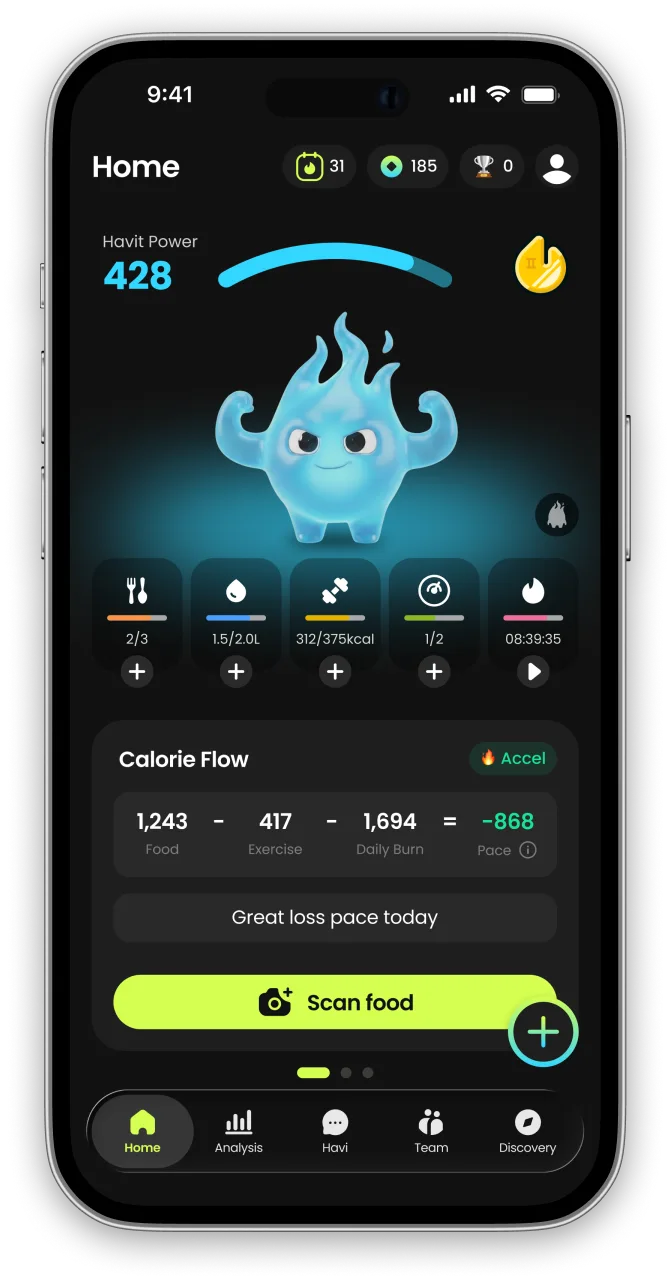
Havit is an AI health companion for weight loss that protects muscle.
Unlike calorie-only trackers, Havit connects AI body-composition estimates, nutrition, hydration, sleep, steps, cycle, mood, and GLP-1 medication in one daily routine — so progress is measured by body composition, not just the number on the scale. Daily missions turn established behavior-change techniques into small repeatable actions, drawing on expertise from professionals formerly at Juvis Diet, one of Korea’s leading metabolic clinics.
In Havit’s own analysis of 1,090 GLP-1 users, people who logged consistently built stronger habits than the general user base. Read the GLP-1 Habit Report
Havit works with or without GLP-1 medication. It is a wellness app, not a medical device; body-composition results are estimates.

Continue in the App
Personalized wellness with your own data


References
- Does Monitoring Goal Progress Promote Goal Attainment? A Meta-Analysis of the Experimental Evidence — Harkin, B., et al., Psychological Bulletin, 2024
- Tracking Frequency and Psychological Outcomes in Health Behavior Change — Health Psychology, 2025
- Self-Monitoring in Weight Loss: A Systematic Review of the Literature — Journal of the American Dietetic Association, 2023
- The Role of Feedback Frequency in Financial Goal Achievement — Journal of Consumer Psychology, 2024


