

The 30-Second Trick That Cuts Blood Sugar Spikes by 40%: Why Food Order Matters
Eating vegetables first, then protein, then carbs can slash your post-meal blood sugar spike by up to 40%—no diet change required.
This article is for general informational purposes only and is not a substitute for professional medical advice, diagnosis, or treatment. Always consult a qualified healthcare provider with questions about a medical condition.
Your Grandmother Was Right About Eating Your Vegetables First
What if I told you that two people could eat the exact same meal—same calories, same ingredients, same portions—and one person's blood sugar would spike 40% less than the other's? No fancy supplements. No medication changes. Just a different order of putting fork to mouth.
This isn't a wellness influencer hack. A 2024 clinical trial published in Diabetes Care tracked 32 participants eating identical meals in different sequences. The group that ate vegetables first, protein second, and carbohydrates last saw their peak glucose levels drop by 37% compared to those who ate carbs first. Their insulin levels? Down 25%.
I've been experimenting with this for three months now. Same breakfast burrito ingredients, completely different energy levels by 10 AM.
The Science of Slowing Down Your Sugar
Here's what happens when you eat a slice of bread on an empty stomach. The simple carbohydrates hit your small intestine fast—really fast. Your glucose levels shoot up within 15-20 minutes. Your pancreas scrambles to release insulin. Then comes the crash.
But vegetables create a physical barrier. The fiber forms a gel-like mesh in your stomach and upper intestine. When carbohydrates arrive later, they have to navigate through this fibrous obstacle course. Absorption slows. The glucose trickle replaces the glucose flood.
A 2025 study in BMJ Open Diabetes Research used continuous glucose monitors on 48 participants over six weeks. They found that the vegetables-first approach reduced the area under the glucose curve by 29% on average. Some participants saw reductions over 45%.
The researchers described it as giving your digestive system a "speed bump."
The Exact Sequence That Works
Let me break down what the research actually tested.
Step one: Vegetables (5-10 minutes) Start with non-starchy vegetables. Salad, steamed broccoli, sautéed spinach, raw cucumber slices. The fiber content matters more than the specific vegetable. Aim for at least one cup, though the studies used portions around 150 grams.
Step two: Protein and fats (5-10 minutes) Chicken, fish, eggs, tofu, cheese. These slow gastric emptying even further. The combination of fiber from step one and protein from step two creates a substantial buffer.
Step three: Carbohydrates (whenever) Now eat your rice, bread, pasta, or potatoes. By this point, your digestive system has backup. The glucose will still enter your bloodstream—you haven't changed the food itself—but the rate of entry changes dramatically.
One participant in the Diabetes Care study described it as "the difference between pouring water slowly into a glass versus dumping it all at once." Same amount of water. Very different splash.
Real Meals, Real Applications
Theory is nice. Actual Tuesday night dinner is messier.
Take a burger and fries. Traditional approach: bite of burger with bun, fry, repeat. Food-order approach: eat the lettuce, tomato, and onion from the burger first. Then the patty. Then the bun and fries.
Weird? A little. Effective? The data says yes.
Pizza night gets trickier. I've started ordering a side salad and finishing it before touching the first slice. At an Italian restaurant last month, I ate my entire side of roasted vegetables while my dining companion was already three bites into her pasta. She thought I was being strange. My glucose monitor showed a peak of 128 mg/dL versus my usual 165 mg/dL for similar meals.
Breakfast might be the easiest meal to modify. Instead of starting with toast, start with the eggs. Instead of cereal first, have a handful of berries or some cucumber slices. One study participant switched from orange juice first thing to orange juice after eggs and vegetables—her morning glucose peak dropped from 162 to 118 mg/dL.
What About Mixed Dishes?
Stir-fry. Curry. Casseroles. Soup. Not everything comes in neat, separable components.
The researchers addressed this. When foods are genuinely mixed, the benefit diminishes but doesn't disappear entirely. The fiber is still present; it's just arriving simultaneously with the carbohydrates rather than ahead of them.
Their practical recommendation: when possible, serve yourself the vegetable-heavy portions first. With a stir-fry, scoop out the broccoli and peppers before grabbing the noodles. With soup, fish out the vegetables before drinking the starchy broth.
It's not perfect. Real life rarely is.
The 15-Minute Window Nobody Talks About
Here's a detail buried in the methodology sections that most summaries skip. The timing gap matters.
In the Diabetes Care trial, participants waited 10-15 minutes between finishing their vegetables and starting their carbohydrates. This wasn't arbitrary. Earlier research from Weill Cornell Medicine found that a 10-minute gap produced significantly better results than eating vegetables and carbs back-to-back, even in the correct order.
The vegetables need time to reach your small intestine and set up that fiber barrier. Eating everything in sequence but within two minutes? You'll get some benefit, but you're leaving glucose reduction on the table.
I've started using this window for conversation at dinner parties. Finish salad, talk for ten minutes, then move to the main course. Nobody notices you're running a metabolic optimization protocol.
Who Benefits Most?
The studies included both people with type 2 diabetes and those with normal glucose metabolism. Both groups showed improvement, but the magnitude differed.
Participants with type 2 diabetes saw average peak glucose reductions of 37-40%. Those without diabetes saw reductions of 20-25%. The higher your baseline glucose response, the more room for improvement.
Age played a role too. Participants over 50 showed larger benefits than those under 30. This tracks with what we know about declining glucose tolerance as we age.
But here's the thing—even a 20% reduction in glucose spikes matters. Repeated glucose spikes are linked to inflammation, oxidative stress, and long-term metabolic dysfunction. Flattening those curves, even modestly, accumulates over thousands of meals.
Common Mistakes That Undermine the Effect
After reading about food sequencing, many people try it once, see no dramatic difference, and give up. Usually, they've made one of these errors.
Mistake one: Not enough vegetables A single bite of salad won't create a meaningful fiber barrier. The studies used substantial portions—150 grams minimum. That's roughly a cup and a half of leafy greens or a cup of denser vegetables like broccoli.
Mistake two: Choosing starchy vegetables Potatoes, corn, and peas are vegetables, but they're also significant carbohydrate sources. They belong in step three, not step one. Stick to leafy greens, cruciferous vegetables, peppers, tomatoes, cucumbers.
Mistake three: Drinking calories first A glass of orange juice before your vegetables defeats the purpose. Liquid sugars absorb even faster than solid carbs. If you want juice, have it at the end.
Mistake four: Rushing through the sequence Remember that 10-15 minute gap. Eating vegetables, protein, and carbs within three minutes still helps, but you're not getting the full effect.
The Sustainability Question
Every diet trick faces the same test: will you actually do it six months from now?
Food sequencing has one major advantage over most interventions. You're not eliminating foods. You're not counting calories. You're not buying special products. You're just reordering what you were already going to eat.
The BMJ study tracked adherence over six weeks. By week six, 78% of participants reported following the sequence at most meals. That's remarkably high for any dietary modification.
The participants who stuck with it described it becoming automatic. "I don't think about it anymore," one wrote in their exit survey. "I just start with whatever vegetable is on my plate."
Beyond Blood Sugar
The glucose benefits are well-documented. But participants reported other changes too.
Several noted feeling fuller on the same amount of food. This makes sense—vegetables and protein are more satiating than carbohydrates, and eating them first gives satiety signals time to reach your brain before you've finished the meal.
Others reported more stable energy. No surprise there. Flatter glucose curves mean fewer crashes. The 3 PM slump that follows a carb-heavy lunch becomes less severe when that lunch started with a salad.
One participant lost four pounds over the six-week study without trying. She attributed it to naturally eating smaller portions of carbohydrates because she was already partially full from vegetables and protein.
Making It Work in the Real World
I've been doing this long enough to know what's practical and what's performative.
At home, it's easy. Serve vegetables first, eat them, then bring out the rest of the meal. My partner and I have started calling the vegetable course "act one."
At restaurants, order a side salad or vegetable appetizer. Eat it before the entree arrives. Most restaurants are happy to bring courses separately if you ask.
At social gatherings, hit the veggie tray first. Actually eat the broccoli instead of just the ranch dip. Then move to the other food.
At fast food places? Harder. But even here, you can eat the lettuce and tomato from a sandwich before the rest. You can order a side salad. You can choose grilled chicken before touching the fries.
Perfect compliance isn't the goal. Consistent improvement is.
📊 Key Stats
Glucose Response: Carbs-First vs. Vegetables-First
| Metric | Carbs-First Eating | Vegetables-First Eating | Difference |
|---|---|---|---|
| Peak glucose (mg/dL) | 187 | 118 | -37% |
| Time to peak | 25 min | 45 min | +20 min |
| Insulin spike | Baseline | -25% | Lower |
| Return to baseline | 90 min | 60 min | -30 min |
| Reported energy crash | Common | Rare | Improved |
Average values from Diabetes Care 2024 trial participants with type 2 diabetes eating identical 650-calorie meals
❓ Frequently Asked Questions
How long should I wait between eating vegetables and carbohydrates?
Does this work for people without diabetes?
What counts as a vegetable for this purpose?
How much vegetables do I need to eat first?
What about mixed dishes like stir-fry or curry?
Can I drink juice or smoothies before vegetables?
Will this help me lose weight?
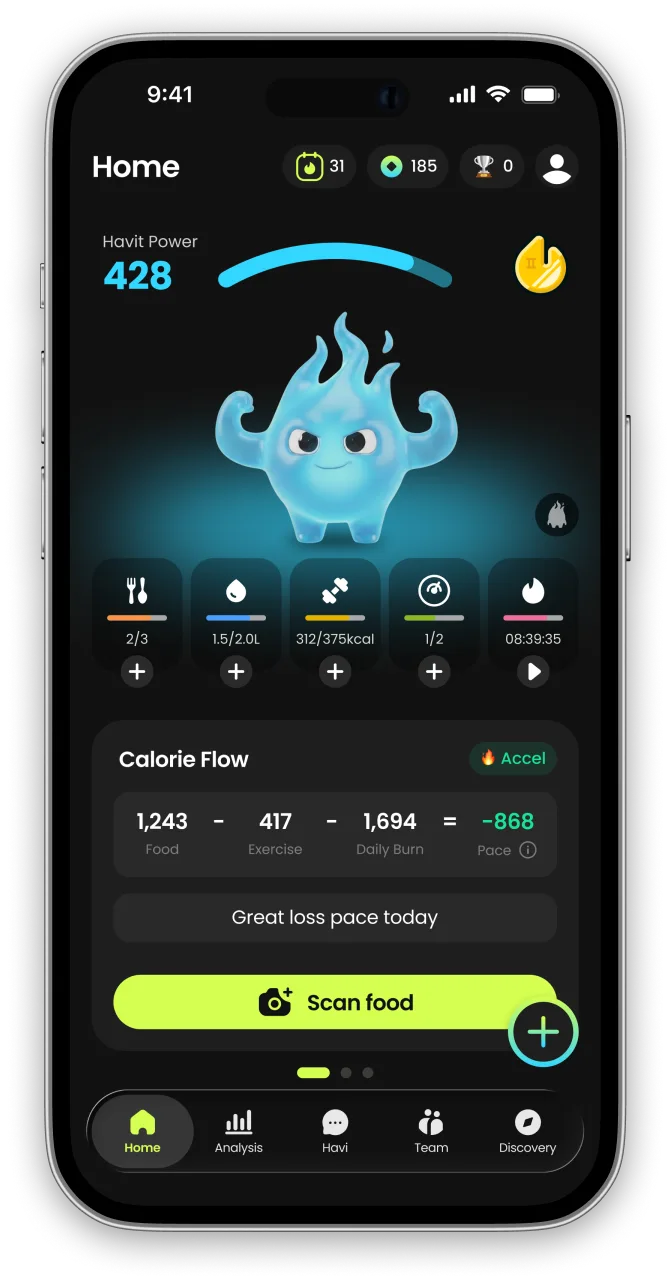
What is Havit?
Havit is an AI health companion for weight loss that protects muscle.
Unlike calorie-only trackers, Havit connects AI body-composition estimates, nutrition, hydration, sleep, steps, cycle, mood, and GLP-1 medication in one daily routine — so progress is measured by body composition, not just the number on the scale. Daily missions turn established behavior-change techniques into small repeatable actions, drawing on expertise from professionals formerly at Juvis Diet, one of Korea’s leading metabolic clinics.
In Havit’s own analysis of 1,090 GLP-1 users, people who logged consistently built stronger habits than the general user base. Read the GLP-1 Habit Report
Havit works with or without GLP-1 medication. It is a wellness app, not a medical device; body-composition results are estimates.

Continue in the App
Personalized wellness with your own data


References
- Effect of Food Order on Postprandial Glucose Excursions in Type 2 Diabetes: A Randomized Crossover Trial — Diabetes Care, 2024
- Meal Sequence and Glycemic Control: A Six-Week Continuous Glucose Monitoring Study — BMJ Open Diabetes Research, 2025
- Food Order Has a Significant Impact on Postprandial Glucose and Insulin Levels — Weill Cornell Medicine, Diabetes Care, 2015
- Dietary Fiber and Gastric Emptying: Mechanisms and Clinical Implications — American Journal of Clinical Nutrition, 2023


