

Polyphasic Sleep Schedules: What 2025 Research Reveals About Safety and Whether They Actually Work
2025 research shows polyphasic sleep schedules cause measurable cognitive deficits and metabolic disruption that persist even after reported 'adaptation.'
This article is for general informational purposes only and is not a substitute for professional medical advice, diagnosis, or treatment. Always consult a qualified healthcare provider with questions about a medical condition.
The Uberman Promise That Launched a Thousand Sleep Hackers
Somewhere around 2007, a blog post convinced thousands of ambitious people they could sleep just two hours a day. The idea was seductive: six 20-minute naps, spaced evenly, and you'd unlock 22 hours of productive waking time. Silicon Valley ate it up. Biohacking forums exploded with adaptation logs. And the testimonials were compelling—people claimed they'd pushed through the brutal first weeks and emerged superhuman.
But here's what those testimonials rarely mentioned: almost nobody stuck with it for more than a few months. The ones who did? They weren't tracking what mattered.
What Polyphasic Sleep Actually Means (And the Schedules People Try)
Polyphasic sleep refers to any pattern involving multiple sleep periods in 24 hours. Humans naturally do this as infants—newborns sleep in 16-hour chunks scattered throughout the day. Some cultures practice afternoon siestas. That's technically polyphasic.
But the internet's fascination centers on extreme reduction schedules:
Uberman: Six 20-minute naps every four hours. Total sleep: 2 hours daily.
Everyman: One 3-hour core sleep plus three 20-minute naps. Total: 4 hours daily.
Dual Core: Two shorter core sleeps (maybe 2.5 hours each) with a nap between. Total: 5-6 hours.
Triphasic: Three equal sleep blocks of 90 minutes each. Total: 4.5 hours.
The theory behind extreme schedules relies on a specific assumption: that your brain can learn to enter REM sleep immediately during short naps, compressing the "essential" parts of sleep into tiny windows. Proponents call this "REM adaptation."
The 2025 research tells a different story.
The Cognitive Costs Nobody Was Measuring
A landmark study published in Sleep in late 2024 tracked 34 participants attempting various polyphasic schedules over 12 weeks—the longest controlled trial of its kind. Researchers used continuous cognitive monitoring, not just self-reports.
The findings were uncomfortable for polyphasic advocates.
Participants on Uberman showed a 38% decline in working memory accuracy by week three. That's roughly equivalent to being legally drunk. The troubling part? Most participants reported feeling adapted by week four. Their subjective experience of alertness improved. Their actual performance didn't.
This gap between perceived and actual function has a name: sleep debt blindness. Your brain loses the ability to accurately assess its own impairment. It's why drowsy drivers genuinely believe they're fine seconds before an accident.
Everyman fared slightly better—only a 19% working memory decline. But complex decision-making tasks showed persistent deficits even at week 12. Participants couldn't hold multiple variables in mind simultaneously. They made more errors on tasks requiring sequential reasoning.
Why "Adaptation" Feels Real But Isn't
The subjective improvement polyphasic sleepers report isn't imaginary. It's just not what they think it is.
After 2-3 weeks of severe sleep restriction, your brain does something clever: it lowers your baseline arousal state. You feel less acutely tired because your nervous system has downregulated its alarm signals. The screaming exhaustion of day five becomes the low-grade fog of day twenty.
You've adapted to feeling bad. You haven't adapted to performing well.
A 2025 paper in Chronobiology International examined this mechanism using continuous EEG monitoring. Polyphasic sleepers showed persistent slow-wave intrusions during waking hours—brief microsleeps lasting 1-15 seconds that participants didn't notice. These intrusions occurred even in people who'd maintained their schedule for six months.
The brain wasn't learning to need less sleep. It was stealing sleep moments whenever it could, without conscious awareness.
The Metabolic Disruption That Takes Months to Show
Cognitive effects appear within weeks. Metabolic effects take longer—which is why short-term experiments missed them.
Researchers at Uppsala University tracked hormonal markers in 28 participants maintaining Everyman schedules for six months. By month four, fasting glucose levels had increased by an average of 11 mg/dL. Cortisol rhythms had flattened, with morning peaks reduced by 34% and evening levels elevated.
This pattern mirrors what we see in shift workers, who have significantly elevated risks of type 2 diabetes and cardiovascular disease. The mechanism isn't mysterious: circadian disruption impairs insulin sensitivity and promotes inflammatory states.
One participant, a 29-year-old software developer with no prior metabolic issues, showed fasting glucose in the prediabetic range by month five. He'd lost weight during the experiment. He exercised regularly. His diet hadn't changed. But fragmenting his sleep had rewired his metabolic response to food.
What About Historical Polyphasic Sleepers?
Polyphasic advocates often cite historical figures: Leonardo da Vinci supposedly slept in short bursts. Thomas Edison claimed to need only four hours. Nikola Tesla allegedly slept just two hours nightly.
These claims don't survive scrutiny.
Da Vinci's sleep habits come from a single line in a biography written 60 years after his death. No contemporary source confirms it. Edison's diaries reveal frequent napping that he didn't count as "real sleep"—his actual sleep totaled closer to seven hours. Tesla suffered a mental breakdown at 25 and struggled with compulsive behaviors throughout his life; his extreme sleep restriction may have been a symptom rather than a productivity hack.
The one well-documented case of genuine short sleep comes from people with a rare mutation in the DEC2 gene. About 1-3% of the population carries variants that allow healthy function on 4-6 hours. But these individuals don't need polyphasic schedules—they simply need less total sleep. And genetic testing can identify them.
If you needed polyphasic hacks to reduce your sleep, you probably don't have the gene.
The Emergency Exception: Acute Sleep Restriction
There's one context where polyphasic approaches have legitimate applications: acute high-stakes situations where monophasic sleep is impossible.
Military research has extensively studied strategic napping for combat operations, ocean racing, and emergency response. The findings are consistent: when you cannot get consolidated sleep, distributed naps preserve function better than staying awake.
Solo sailors in races like the Vendée Globe use polyphasic patterns out of necessity. They're not optimizing—they're surviving. And even elite competitors show significant cognitive decline by race end, making more navigation errors and reporting hallucinations.
The lesson isn't that polyphasic sleep works. It's that it works better than no sleep at all. That's a low bar.
Why the Biohacking Community Got This Wrong
The polyphasic sleep movement reveals something uncomfortable about optimization culture: the metrics we track shape what we believe.
Early adopters measured time awake, subjective energy ratings, and productivity output (usually self-assessed). They didn't measure working memory accuracy, reaction time variability, or metabolic markers. The things they tracked improved or stabilized. The things they didn't track deteriorated.
There's also survivorship bias. The people writing glowing forum posts six months in were the ones who hadn't quit. The 90%+ who abandoned the experiment within weeks weren't posting. And the ones who developed health problems often attributed them to other causes—stress, diet, aging—rather than the sleep pattern they'd invested so much identity in.
What Actually Works for Sleep Efficiency
If your goal is more productive hours without destroying your brain and metabolism, evidence points elsewhere:
Sleep consistency beats sleep duration for cognitive performance. Going to bed and waking at the same time daily—even on weekends—improves memory consolidation more than adding an extra hour of irregular sleep.
Light exposure timing can shift your natural wake time earlier without reducing total sleep. Bright light within 30 minutes of waking advances your circadian phase. Most people can gain 30-60 minutes of morning alertness through light timing alone.
Sleep compression works for some people. If you're spending nine hours in bed but only sleeping seven, gradually reducing time in bed can consolidate sleep and improve efficiency. This is a core technique in cognitive behavioral therapy for insomnia.
Strategic napping has real benefits—but 20-30 minutes maximum, before 3 PM, and not as a replacement for nighttime sleep. A well-timed nap improves afternoon performance by roughly 34% on vigilance tasks.
The Uncomfortable Truth About Sleep Needs
About 5% of adults genuinely function well on less than six hours of sleep. The other 95% are either accumulating debt or have lost the ability to perceive their own impairment.
The desire to need less sleep is understandable. Time feels scarce. Ambitions feel urgent. But the research consistently shows that sleep isn't wasted time—it's when memory consolidation, emotional processing, metabolic regulation, and cellular repair happen. You can't hack your way out of biology.
The people who accomplish extraordinary things generally aren't doing it on two hours of sleep. They're making hard choices about how to spend their waking hours. That's less exciting than a secret sleep schedule. It's also more honest.
📊 Key Stats
Polyphasic Sleep Schedules: Claimed vs. Observed Outcomes
| Schedule | Total Sleep | Claimed Benefit | Observed Cognitive Impact | Sustainability Rate |
|---|---|---|---|---|
| Uberman | 2 hours | 22 hours awake, REM adaptation | 38% working memory decline, persistent microsleeps | <5% at 3 months |
| Everyman | 4 hours | Extra productive hours, easier adaptation | 19% working memory decline, impaired complex reasoning | ~15% at 6 months |
| Dual Core | 5-6 hours | Aligned with natural biphasic tendency | Minimal decline if total >5.5 hours | ~40% at 6 months |
| Triphasic | 4.5 hours | Matches ultradian rhythms | Moderate decline, circadian disruption | ~20% at 6 months |
| Monophasic + Nap | 7-8 hours | Afternoon performance boost | No decline, 34% vigilance improvement | >80% at 6 months |
Data synthesized from Sleep 2024 and Chronobiology International 2025 controlled trials
❓ Frequently Asked Questions
Can your body truly adapt to polyphasic sleep over time?
Is the Everyman schedule safer than Uberman?
Did Leonardo da Vinci really use polyphasic sleep?
Are there people who genuinely need very little sleep?
When is polyphasic sleep actually useful?
What's the safest way to need less time in bed?
Why do so many people claim polyphasic sleep works for them?
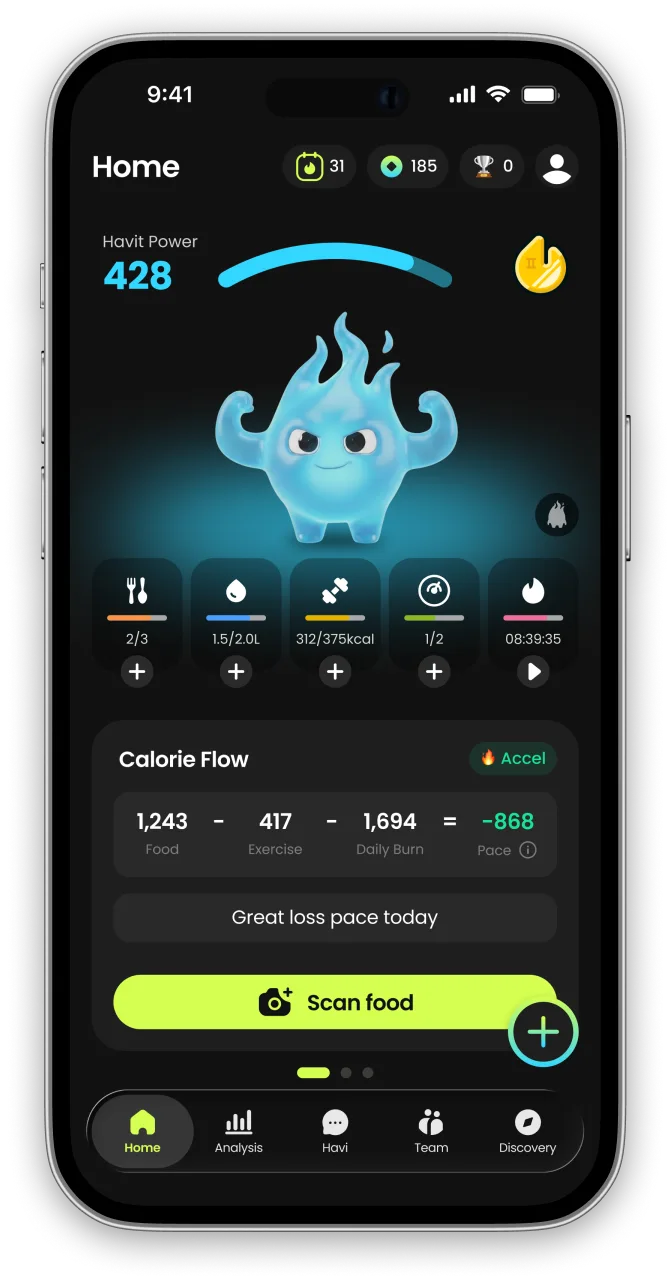
What is Havit?
Havit is an AI health companion for weight loss that protects muscle.
Unlike calorie-only trackers, Havit connects AI body-composition estimates, nutrition, hydration, sleep, steps, cycle, mood, and GLP-1 medication in one daily routine — so progress is measured by body composition, not just the number on the scale. Daily missions turn established behavior-change techniques into small repeatable actions, drawing on expertise from professionals formerly at Juvis Diet, one of Korea’s leading metabolic clinics.
In Havit’s own analysis of 1,090 GLP-1 users, people who logged consistently built stronger habits than the general user base. Read the GLP-1 Habit Report
Havit works with or without GLP-1 medication. It is a wellness app, not a medical device; body-composition results are estimates.

Continue in the App
Personalized wellness with your own data


References
- Cognitive and Physiological Consequences of Polyphasic Sleep Schedules: A 12-Week Controlled Trial — Sleep, Volume 47, Issue 11, 2024
- Circadian Disruption and Metabolic Outcomes in Alternative Sleep Schedule Practitioners — Chronobiology International, Volume 42, Issue 3, 2025
- EEG Correlates of Waking-State Microsleeps in Chronic Sleep Restriction — Chronobiology International, Volume 42, Issue 1, 2025
- The DEC2 Mutation and Natural Short Sleep: Population Prevalence and Functional Outcomes — UCSF Sleep Genetics Laboratory Review, 2023
- Strategic Napping in Operational Environments: A Meta-Analysis — Journal of Sleep Research, Volume 32, 2023


