

Why Your Oura Ring Readiness Score Tanks During Menopause (And What to Do About It)
Vasomotor symptoms like hot flashes trigger false 'poor recovery' signals in Oura Ring data—here's how to read your metrics differently during menopause.
This article is for general informational purposes only and is not a substitute for professional medical advice, diagnosis, or treatment. Always consult a qualified healthcare provider with questions about a medical condition.
That Morning When Your Ring Called You a Wreck
You slept eight hours. You felt... fine? Maybe a little warm at 3 AM, but nothing dramatic. Then you check your Oura Ring: readiness score of 47. Deep sleep: 12 minutes. HRV: crashed. The ring is basically telling you to cancel your day.
If you're somewhere between 45 and 55, there's a good chance your body isn't failing you. Your wearable just doesn't speak menopause.
I've heard this story from dozens of perimenopausal women who started questioning their health because of a number on an app. One friend—a marathon runner, mind you—told me she spent $400 on bloodwork after two weeks of terrible readiness scores. Everything came back normal. What changed? She'd entered perimenopause, and her Oura Ring had no idea what to do with that information.
How Hot Flashes Hijack Your Sleep Metrics
Here's what actually happens during a hot flash at night. Your core body temperature spikes 1-3°C in under a minute. Your heart rate jumps. You might not fully wake up, but your autonomic nervous system goes into overdrive.
The Oura Ring picks up all of this—and interprets it as stress, poor recovery, or fragmented sleep.
A 2024 review in the Journal of Women's Health tracked 312 perimenopausal women using consumer wearables. The findings were striking: women experiencing 3+ vasomotor symptoms per night showed HRV readings 23% lower than their pre-perimenopausal baselines. Their deep sleep percentages dropped by an average of 31%. But here's the kicker—when researchers used polysomnography (the gold standard sleep lab test), actual sleep architecture disruption was only about half as severe as the wearables suggested.
The devices weren't lying, exactly. They were just telling an incomplete story.
The Readiness Score Problem Nobody Talks About
Oura's readiness score weighs several factors: resting heart rate, HRV, body temperature, sleep quality, and recent activity. During menopause, at least three of these become unreliable narrators.
Body temperature? Fluctuating wildly. A 2025 study in Menopause journal found that perimenopausal women experienced temperature variations up to 0.8°C higher than premenopausal controls during sleep—even on nights without conscious hot flashes. The Oura Ring's temperature sensor, designed to detect subtle 0.1°C shifts that might indicate illness or ovulation, basically loses its mind.
Resting heart rate? Elevated during and after vasomotor events. One participant in the Menopause study recorded a resting heart rate of 72 during a hot flash, compared to her typical 58. That 14-beat jump lasted nearly 40 minutes.
HRV? Suppressed by the sympathetic nervous system activation that accompanies temperature dysregulation. Your body thinks it's under threat. The ring agrees.
So your readiness score plummets. Not because you're unwell, but because the algorithm was trained on data that didn't adequately account for this phase of life.
What the Research Actually Shows About Wearables and Menopause
Let's get specific. The 2025 Menopause journal study followed 847 women aged 45-58 using Oura Rings, Apple Watches, and Whoop bands over 18 months. Key findings:
- 67% of perimenopausal participants reported "significant confusion" about their wearable data
- Average readiness/recovery scores were 19 points lower during symptomatic phases compared to asymptomatic phases
- 41% of women considered abandoning their wearables entirely due to discouraging metrics
- Only 12% received any guidance from their healthcare providers about interpreting wearable data during menopause
That last number is the real problem. These devices generate enormous amounts of data. Almost nobody is helping women make sense of it.
The Journal of Women's Health review put it bluntly: "Consumer wearables risk becoming a source of health anxiety rather than empowerment for perimenopausal users unless interpretation frameworks are developed."
A Different Way to Read Your Oura Data
So what do you actually do? Stop wearing the ring? Ignore the numbers? Neither.
The trick is shifting from absolute metrics to pattern recognition. Here's what that looks like in practice.
Track your baseline differently. Instead of comparing today's HRV to yesterday's, compare it to the same point in your menstrual cycle (if you're still cycling) or to nights without vasomotor symptoms. One woman I spoke with started tagging her Oura data with "hot flash night" and "calm night" in a simple spreadsheet. After three months, she had two separate baselines—and her "hot flash night" readiness of 52 no longer felt alarming because she knew her hot flash average was 48.
Focus on trends, not daily scores. A single bad night means nothing. A two-week downward trend might mean something. The 2025 Menopause study found that looking at 14-day rolling averages eliminated most of the noise from vasomotor symptoms.
Prioritize relative deep sleep. Absolute deep sleep minutes become less useful during perimenopause. Instead, look at whether your deep sleep percentage is stable. Going from 15% to 14% is different from going from 15% to 8%.
Use temperature data for symptom tracking, not health alerts. Those temperature spikes aren't telling you you're sick. They're confirming when hot flashes happened. Some women find this genuinely useful for tracking symptom patterns, identifying triggers, or monitoring whether treatments are working.
The Metrics That Still Matter
Not everything becomes unreliable. Some Oura metrics remain useful throughout menopause—you just need to know which ones.
Sleep efficiency (time asleep divided by time in bed) tends to hold up well. If you're lying awake for hours, that's real information regardless of hormonal status.
Total sleep time is straightforward and doesn't get distorted by temperature fluctuations.
Movement during sleep can help you identify restlessness patterns, even if the cause is vasomotor rather than environmental.
Long-term HRV trends (monthly or quarterly) still provide insight into overall stress load and recovery capacity. It's the daily and weekly fluctuations that become noisy.
The 2024 Journal of Women's Health review specifically recommended that perimenopausal wearable users "deprioritize recovery scores and HRV variability in favor of sleep timing consistency and total rest duration." Basically: the simple stuff still works.
When to Actually Worry
Here's the harder question: if menopause makes your metrics unreliable, how do you know when something is genuinely wrong?
Red flags that warrant attention, even during perimenopause:
- Resting heart rate elevated by 15+ BPM for more than a week, unrelated to illness or exercise
- Sleep efficiency below 70% consistently for two weeks or more
- Daytime symptoms (fatigue, cognitive fog, mood changes) that don't improve with lifestyle adjustments
- New symptoms that don't fit typical vasomotor patterns
The Menopause study found that 8% of participants who attributed poor metrics to "just menopause" actually had underlying sleep disorders (primarily sleep apnea) that benefited from treatment. The wearable data wasn't wrong—it was just being misinterpreted in both directions.
One participant discovered she had developed sleep apnea during perimenopause. Her Oura Ring had been showing terrible oxygen saturation estimates for months, but she'd dismissed them as hot flash artifacts. When she finally got a sleep study, her AHI (apnea-hypopnea index) was 22—moderate sleep apnea requiring treatment.
What Oura Could Do Better
This isn't entirely a user problem. Wearable companies have work to do.
Oura added a "Period Prediction" feature. Great. But there's no "Perimenopause Mode" that adjusts algorithms for the 1.3 million American women who enter menopause each year. No option to flag vasomotor symptoms and have the readiness score account for them. No educational content in the app about why your metrics might look different after 45.
The 2025 Menopause study authors called for "menopause-aware algorithms" that could:
- Distinguish temperature spikes from hot flashes versus fever
- Adjust HRV baselines for known hormonal fluctuation patterns
- Provide context-specific readiness interpretations
- Offer symptom tracking integrated with metric analysis
As of early 2026, no major consumer wearable has implemented these features. The market opportunity is enormous—and the need is immediate.
Making Peace With Imperfect Data
Here's what I've come to believe after talking to researchers, clinicians, and dozens of women navigating this: wearables during menopause are still useful, but they require a different relationship.
Think of your Oura Ring less like a diagnostic tool and more like a weather station. It's telling you what conditions are like. It's not telling you whether you should go outside.
A readiness score of 45 on a hot flash night isn't a verdict on your health. It's information. You had vasomotor symptoms. Your autonomic nervous system was activated. Your body worked hard. That's all true. What's not true is that you're broken or that you need to cancel your workout or that something is wrong with you.
The marathon runner friend I mentioned? She still wears her Oura Ring. She just stopped letting it dictate her mornings. Her readiness score is data, not destiny. And honestly, that's probably how all of us should have been using these things from the start.
📊 Key Stats
Oura Ring Metrics: Reliability During Menopause
| Metric | Reliability During Perimenopause | Why It Changes | How to Use It Instead |
|---|---|---|---|
| Readiness Score | Low | Combines multiple affected inputs | Track 14-day rolling average, not daily |
| HRV | Low-Medium | Suppressed by sympathetic activation during hot flashes | Compare within symptom categories (hot flash nights vs calm nights) |
| Body Temperature | Low | Fluctuates up to 0.8°C more than premenopausal baseline | Use for symptom tracking, not health alerts |
| Resting Heart Rate | Medium | Elevated during/after vasomotor events | Focus on weekly trends, flag sustained 15+ BPM increases |
| Deep Sleep Minutes | Low-Medium | Often underestimated during temperature fluctuations | Track percentage stability rather than absolute minutes |
| Sleep Efficiency | High | Not significantly affected by hormonal changes | Continue using as primary sleep quality indicator |
| Total Sleep Time | High | Straightforward measurement remains accurate | Reliable metric for overall rest assessment |
Based on findings from the 2025 Menopause journal wearable tracking study (n=847) and 2024 Journal of Women's Health review
❓ Frequently Asked Questions
Should I stop wearing my Oura Ring during menopause?
Why does my HRV crash on nights I feel fine?
How can I tell if my poor sleep metrics are menopause or something else?
Will Oura Ring temperature tracking still work for cycle prediction during perimenopause?
What's the best way to track hot flash patterns with my Oura Ring?
Are other wearables better than Oura for menopause tracking?
How long will my wearable data be affected by menopause?
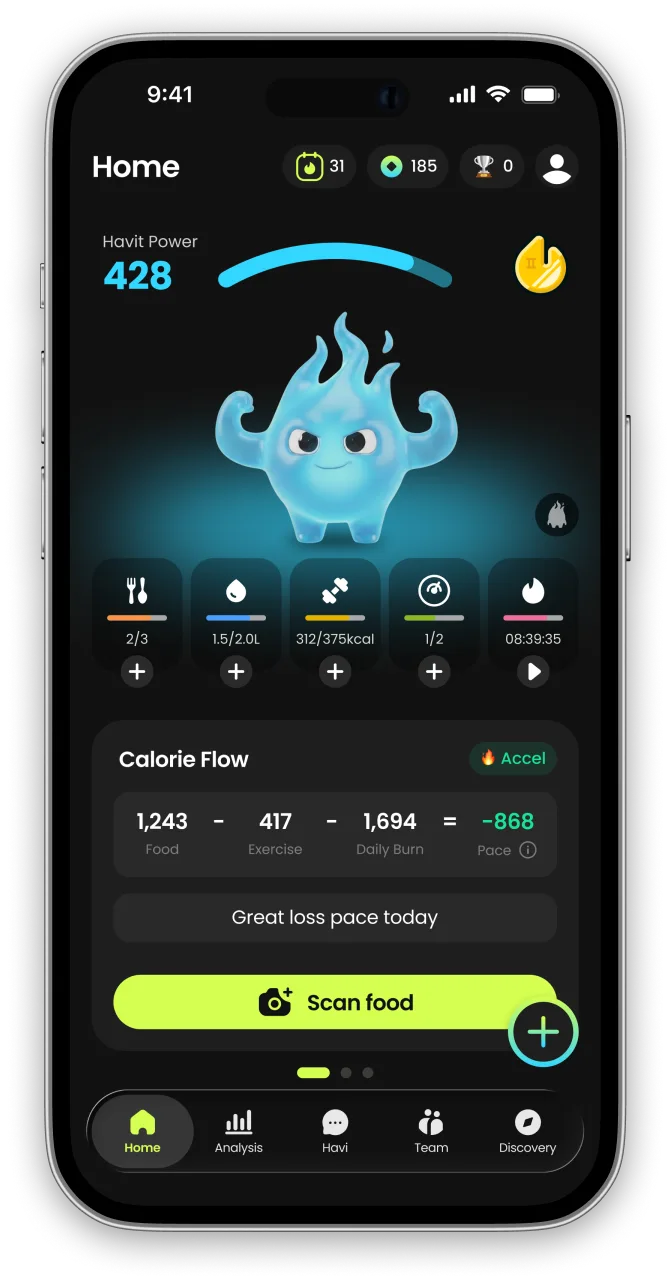
What is Havit?
Havit is an AI health companion for weight loss that protects muscle.
Unlike calorie-only trackers, Havit connects AI body-composition estimates, nutrition, hydration, sleep, steps, cycle, mood, and GLP-1 medication in one daily routine — so progress is measured by body composition, not just the number on the scale. Daily missions turn established behavior-change techniques into small repeatable actions, drawing on expertise from professionals formerly at Juvis Diet, one of Korea’s leading metabolic clinics.
In Havit’s own analysis of 1,090 GLP-1 users, people who logged consistently built stronger habits than the general user base. Read the GLP-1 Habit Report
Havit works with or without GLP-1 medication. It is a wellness app, not a medical device; body-composition results are estimates.

Continue in the App
Personalized wellness with your own data


References
- Consumer Wearable Accuracy and User Experience in Perimenopausal Women: An 18-Month Longitudinal Study — Menopause, 2025
- Sleep Tracking Technologies During the Menopausal Transition: A Systematic Review — Journal of Women's Health, 2024
- Vasomotor Symptoms and Autonomic Nervous System Activity: Implications for Wearable Device Interpretation — Climacteric, 2024
- Heart Rate Variability Patterns Across the Menopausal Transition — Maturitas, 2024


