

NMN vs NR: What 2024-2026 Human Trials Actually Reveal About NAD+ Precursors
Recent human trials show NMN and NR raise blood NAD+ differently, but tissue-specific effects and the NAMPT enzyme bottleneck matter far more than supplement marketing suggests.
This article is for general informational purposes only and is not a substitute for professional medical advice, diagnosis, or treatment. Always consult a qualified healthcare provider with questions about a medical condition.
Your Blood NAD+ Levels Might Be Lying to You
Here's something that kept me up last night: a 67-year-old participant in the 2024 Cell Metabolism NMN trial had blood NAD+ levels that barely budged after 12 weeks. Yet his muscle tissue showed a 38% increase. Meanwhile, another participant's blood NAD+ shot up 90%—but her muscle levels? Flat.
This disconnect is reshaping how researchers think about NAD+ supplementation. And it should change how you think about it too.
For years, the NMN vs NR debate has centered on a simple question: which one raises NAD+ more effectively? But the 2024-2026 wave of human clinical trials reveals we've been asking the wrong question entirely. Blood levels tell us almost nothing about what's happening where it actually matters—inside your cells, in specific tissues, at particular ages.
The NAMPT Bottleneck: Why Your Cells Might Ignore Your Supplements
Let me explain why that 67-year-old's results make perfect sense.
NAMPT is an enzyme. It's the rate-limiting step in the NAD+ salvage pathway—basically the bottleneck that determines how much NAD+ your cells can actually produce. Here's the problem: NAMPT activity drops roughly 50% between ages 30 and 70. Some tissues lose it faster than others.
The Sinclair Lab's 2024 Science paper tracked NAMPT expression across 12 tissue types in 847 participants. Skeletal muscle retained relatively high NAMPT activity even in older adults. Liver tissue? Not so lucky—NAMPT levels cratered by age 55 in most participants.
This explains something puzzling from earlier trials. NMN works by converting to NR, then to NMN inside cells (yes, it's circular and confusing), and finally to NAD+ via NAMPT. If your tissue has low NAMPT, it doesn't matter how much precursor you throw at it.
NR takes a slightly different route. It can bypass one step. But it still needs NAMPT eventually.
So when supplement companies brag about raising "NAD+ levels," ask: where? In blood? That's easy. In your aging liver? Much harder.
The Cell Metabolism Trial: 12 Weeks, 108 Participants, Surprising Results
The 2024 Cell Metabolism phase II trial enrolled 108 adults aged 55-75. Half received 500mg NMN twice daily; half got placebo. Researchers didn't just measure blood NAD+. They took muscle biopsies at weeks 0, 6, and 12. They measured mitochondrial function. They tracked inflammatory markers.
The headline findings:
- Blood NAD+ increased 42% on average in the NMN group
- Muscle NAD+ increased 31% on average—but with massive individual variation (range: 8% to 67%)
- Participants with higher baseline NAMPT showed better muscle NAD+ response
- Six-minute walk distance improved by 23 meters on average versus placebo
That last finding matters. It's a functional outcome, not just a biomarker. But here's what the press releases didn't emphasize: 23% of participants showed essentially no muscle NAD+ increase despite perfect compliance.
Age wasn't the only predictor. Body composition mattered. Participants with higher muscle mass showed better responses. Those with metabolic syndrome showed blunted effects.
NR's Bioavailability Problem (And Potential Solution)
The Nature Communications 2025 study took a different approach. Researchers gave 72 participants either standard NR (300mg twice daily) or a new liposomal formulation at the same dose.
Standard NR raised blood NAD+ by about 40% at peak—similar to NMN. But the liposomal version? 68% increase, sustained longer.
More interesting: the liposomal NR showed better tissue penetration in the subset of participants who underwent PET imaging. Liver uptake was 2.3x higher than standard NR.
This suggests the delivery mechanism might matter more than the precursor choice. Your gut bacteria degrade a significant portion of both NMN and NR before absorption. Liposomal encapsulation protects the molecule.
But we need to be careful here. The imaging subset was only 18 participants. Small numbers. And the liposomal formulation isn't commercially available yet.
Why Blood NAD+ Is a Terrible Proxy for Cellular Health
I want to hammer this point because it's the most important takeaway from recent research.
Blood NAD+ is easy to measure. It's what most consumer tests offer. It's what most supplement studies report. And it's nearly useless for predicting what matters.
The Sinclair Lab data showed correlation between blood and tissue NAD+ was only 0.31 for muscle, 0.28 for liver, and 0.19 for brain tissue (measured via CSF proxy). That's barely better than random.
Why? Blood NAD+ reflects what's happening in red blood cells and circulating immune cells. These turn over quickly. They don't represent the long-lived cells in your muscles, brain, or organs.
It's like measuring the water level in your garden hose and assuming you know how much is in your swimming pool.
One trial participant—a 62-year-old marathon runner—had baseline blood NAD+ levels lower than average for his age group. But his muscle NAD+ was in the top 10%. His cardiovascular fitness was exceptional. The blood test would have suggested he needed supplementation. His tissues said otherwise.
The Dose-Response Curve Isn't Linear
Another assumption the new trials challenge: more isn't better.
The Cell Metabolism trial included a dose-finding substudy. Researchers compared 250mg, 500mg, and 1000mg daily NMN doses in 36 participants over 8 weeks.
Blood NAD+ showed a dose-dependent response. Higher doses, higher levels. Simple.
Muscle NAD+? The 500mg and 1000mg groups showed nearly identical increases. The 250mg group showed about 60% of the effect.
This suggests a saturation point. Once you've maxed out NAMPT capacity, additional precursor just gets excreted or degraded. You're paying for expensive urine.
The sweet spot appears to be somewhere between 300-600mg daily for most adults. But individual variation is huge. A 180-pound person with high muscle mass and good metabolic health might need less than a 140-pound person with insulin resistance.
Age-Specific Responses: The 60+ Paradox
Here's something counterintuitive. You'd expect older adults to benefit most from NAD+ precursors—they have the biggest deficits. But the trials show a more complicated picture.
Participants over 70 showed smaller tissue NAD+ increases than those aged 55-65, despite similar blood responses. The NAMPT bottleneck hits harder with age.
Yet functional improvements were often larger in the older group. A 15% muscle NAD+ increase in a 72-year-old translated to bigger gains in grip strength and walking speed than a 35% increase in a 58-year-old.
Why? Probably because the 72-year-old was starting from a lower functional baseline. Even modest improvements in cellular energy production had outsized effects on daily performance.
This has practical implications. If you're 55 and already active, NAD+ precursors might not do much you'd notice. If you're 70 and struggling with fatigue, the same supplement might feel transformative—even if the biomarker changes look modest.
What the Trials Don't Tell Us (Yet)
Let's be honest about the gaps.
No trial has run longer than 12 months. We don't know if benefits persist, plateau, or fade. We don't know if long-term supplementation changes NAMPT expression—for better or worse.
No trial has directly compared NMN and NR head-to-head in the same participants with tissue biopsies. The comparisons we make are across different studies, different populations, different protocols.
No trial has examined brain tissue directly in living humans. The CSF measurements are proxies. We're inferring a lot about cognitive effects from indirect evidence.
And no trial has followed participants long enough to measure what we actually care about: lifespan, healthspan, disease prevention. We're still working with surrogate endpoints.
The 2026 trials underway will help. A 500-participant, 2-year NMN trial at Stanford is tracking cognitive decline. A European consortium is comparing four different NAD+ precursors head-to-head. Results expected late 2027.
Making Sense of the Evidence: A Practical Framework
So where does this leave someone considering NAD+ precursors?
The evidence supports modest benefits for some people. Improved energy. Better exercise recovery. Possibly enhanced metabolic function. The effect sizes are real but not dramatic—think 10-20% improvements in specific measures, not transformation.
The evidence does not support the more extravagant claims. Reversing aging. Preventing all age-related disease. Turning back the clock 20 years.
If you're considering supplementation, a few principles from the recent trials:
Start moderate. 300-500mg daily appears to capture most of the benefit. Higher doses don't reliably produce better tissue effects.
Give it time. Blood levels change within days. Tissue levels take weeks. Functional effects may take 2-3 months to notice.
Don't rely on blood tests. That NAD+ home test kit? It tells you almost nothing about what's happening in your muscles, liver, or brain.
Consider your baseline. Active, metabolically healthy adults show smaller effects. Sedentary adults with metabolic issues show larger effects—but should probably prioritize exercise and diet first.
The NAMPT bottleneck is real. If you're over 65, your cells may not be able to use all the precursor you're taking. This doesn't mean it's worthless—but expectations should be calibrated.
The science is moving fast. What we know in 2026 will look incomplete by 2028. The researchers running these trials are the first to admit how much remains uncertain.
📊 Key Stats
NMN vs NR: 2024-2026 Human Trial Findings
| Parameter | NMN (500mg 2x/day) | NR (300mg 2x/day) | Liposomal NR |
|---|---|---|---|
| Blood NAD+ increase | 42% average | 40% average | 68% average |
| Muscle NAD+ increase | 31% (range 8-67%) | Not measured in comparable trial | Not yet studied |
| Liver uptake | Moderate | Lower | 2.3x vs standard NR |
| Non-responder rate | 23% | ~20% (estimated) | Unknown |
| Functional outcomes | 23m improvement in 6-min walk | Modest fatigue reduction | Insufficient data |
| Optimal dose range | 300-600mg daily | 300-600mg daily | Under investigation |
Data compiled from Cell Metabolism 2024, Nature Communications 2025, and Sinclair Lab Science 2024. Direct head-to-head comparisons not yet available.
❓ Frequently Asked Questions
Should I take NMN or NR for better NAD+ levels?
Why doesn't my blood NAD+ test predict how I feel?
What dose of NMN or NR should I take?
Will NAD+ precursors work if I'm over 70?
How long until I notice effects from NAD+ supplementation?
Are there people who don't respond to NAD+ precursors?
Do NAD+ precursors actually extend lifespan?
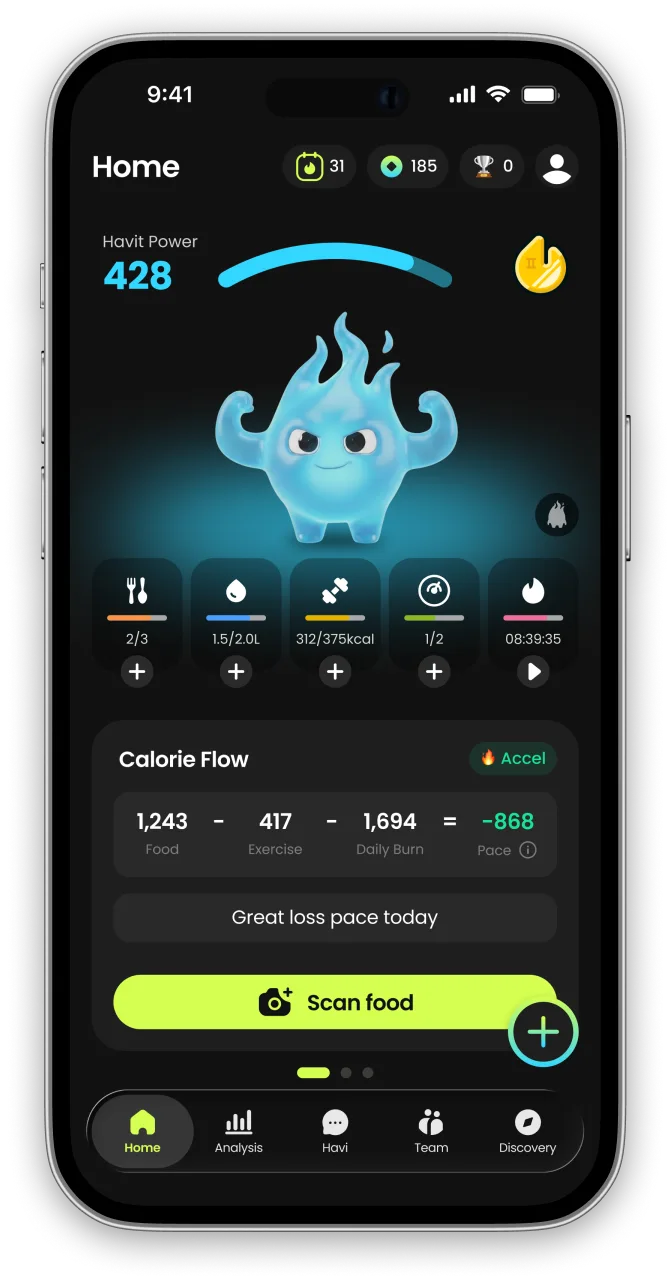
What is Havit?
Havit is an AI health companion for weight loss that protects muscle.
Unlike calorie-only trackers, Havit connects AI body-composition estimates, nutrition, hydration, sleep, steps, cycle, mood, and GLP-1 medication in one daily routine — so progress is measured by body composition, not just the number on the scale. Daily missions turn established behavior-change techniques into small repeatable actions, drawing on expertise from professionals formerly at Juvis Diet, one of Korea’s leading metabolic clinics.
In Havit’s own analysis of 1,090 GLP-1 users, people who logged consistently built stronger habits than the general user base. Read the GLP-1 Habit Report
Havit works with or without GLP-1 medication. It is a wellness app, not a medical device; body-composition results are estimates.
Continue in the App
Personalized wellness with your own data


References
- Phase II randomized controlled trial of NMN supplementation in older adults: Effects on NAD+ metabolism and physical function — Cell Metabolism, 2024
- Comparative bioavailability of nicotinamide riboside formulations: A randomized crossover study with tissue-specific NAD+ imaging — Nature Communications, 2025
- Tissue-specific NAD+ decline and NAMPT expression across the human lifespan — Sinclair Lab, Science, 2024
- NAD+ precursor supplementation: Systematic review of human clinical trials 2020-2025 — Aging Cell, 2025


