

Muscle Mass Loss After 40: The Prevention Protocol That Actually Works in 2026
Combat age-related muscle loss with 3x weekly resistance training at 70-85% max effort plus 40g protein within 2 hours post-workout.
This article is for general informational purposes only and is not a substitute for professional medical advice, diagnosis, or treatment. Always consult a qualified healthcare provider with questions about a medical condition.
Your Muscles Are Quietly Disappearing (And Most People Don't Notice Until It's Too Late)
Somewhere between your 35th birthday and now, your body started a silent rebellion. Not dramatic. Not painful. Just a slow, steady erosion of the muscle tissue you spent decades building. By the time most people notice—struggling with a heavy grocery bag, feeling winded on stairs—they've already lost 8-10% of their peak muscle mass.
I watched my father realize this at 58. He'd been a weekend warrior his whole life, played tennis, stayed "active." Then one summer he couldn't open a stubborn jar lid. That moment hit him harder than any birthday.
The clinical term is sarcopenia. The practical reality? Your body becomes progressively less capable of doing what you want it to do. But here's what most articles won't tell you: the loss isn't inevitable, and the window for intervention is wider than you think.
Why Your Body Stops Building Muscle (The Anabolic Resistance Problem)
At 25, your muscles respond to protein like a sponge absorbs water. Eat some chicken, lift some weights, wake up slightly stronger. Simple cause and effect.
At 45? That same chicken, those same weights—your muscles shrug. "We're good," they seem to say, even when they're clearly not.
This phenomenon has a name: anabolic resistance. Your muscle protein synthesis machinery becomes less responsive to the signals that used to trigger growth. A 2024 study in the American Journal of Clinical Nutrition found that adults over 40 need approximately 40% more protein per meal to achieve the same muscle-building response as someone in their twenties.
Think of it like a campfire that's harder to light as the wood gets older. You need more kindling, better technique, and more patience. The fire can still burn bright—it just requires a different approach.
The mechanisms are complex but worth understanding. Your muscle cells develop reduced sensitivity to leucine, the amino acid that triggers protein synthesis. Chronic low-grade inflammation interferes with muscle repair. Satellite cells—the stem cells responsible for muscle regeneration—become less active. None of these changes happen overnight. They accumulate like compound interest in reverse.
The Protein Math Most People Get Wrong
Here's where conventional wisdom fails spectacularly. The standard recommendation of 0.8 grams of protein per kilogram of body weight? That's a minimum to prevent deficiency, not an optimal target for maintaining muscle.
For adults over 40 actively trying to preserve muscle mass, the research points to a different number: 1.2 to 1.6 grams per kilogram of body weight daily. For a 70kg person, that's 84-112 grams of protein spread across the day.
But total daily protein is only half the equation. Distribution matters enormously.
A 2024 analysis published in the Journal of Cachexia, Sarcopenia and Muscle examined protein timing patterns in 847 adults aged 45-70. Those who consumed at least 30-40 grams of protein at each of three meals showed 23% better muscle mass retention over two years compared to those who ate the same total protein but concentrated it at dinner.
The practical translation: that yogurt-and-granola breakfast isn't cutting it. Neither is the coffee-only morning followed by a massive steak dinner. Your muscles can only process so much protein at once—roughly 40 grams in a single sitting for most people over 40. Anything beyond that gets oxidized for energy rather than used for muscle repair.
Breakfast becomes the critical meal most people botch. Eggs, Greek yogurt, cottage cheese, or a protein smoothie—pick your weapon, but make sure it delivers at least 30 grams before noon.
The Resistance Training Protocol: What Actually Moves the Needle
Cardio won't save your muscles. Walking is wonderful for your heart and mood, but it does almost nothing to prevent sarcopenia. Your muscles need to be challenged with loads heavy enough to trigger adaptation.
The 2025 guidelines from the Journal of Cachexia, Sarcopenia and Muscle are specific: adults over 40 should perform resistance training at least three times weekly, targeting all major muscle groups, at intensities between 70-85% of their one-repetition maximum.
What does 70-85% feel like in practice? If you could theoretically lift 100 pounds once with maximum effort, you'd train with 70-85 pounds for multiple repetitions. In subjective terms, it's a weight that feels genuinely challenging by the 8th repetition and nearly impossible by the 12th.
The compound movements matter most: squats, deadlifts, rows, presses, and their variations. These exercises recruit multiple muscle groups simultaneously and produce the strongest hormonal response. Isolation exercises—bicep curls, leg extensions—have their place, but they shouldn't dominate your routine.
A practical weekly structure might look like this:
Monday: Lower body emphasis (squats, Romanian deadlifts, lunges) Wednesday: Upper body push (bench press, overhead press, dips) Friday: Upper body pull plus lower body (rows, pull-ups, hip hinges)
Each session: 45-60 minutes. Each major movement: 3-4 sets of 8-12 repetitions. Rest between sets: 90 seconds to 3 minutes, depending on intensity.
The temptation to do more is real but counterproductive. Recovery capacity decreases with age, and overtraining accelerates muscle breakdown rather than preventing it.
Timing Your Protein Around Training (The 2-Hour Window)
Post-workout protein timing has been debated for decades. The "anabolic window" was once described as a narrow 30-minute opportunity that slammed shut if you didn't chug a protein shake immediately after your last rep.
Current research suggests a more forgiving timeline—but one that still matters, especially for older adults.
A 2024 meta-analysis found that consuming 40 grams of high-quality protein within two hours of resistance training enhanced muscle protein synthesis by 31% compared to the same protein consumed four or more hours later. The effect was more pronounced in adults over 45 than in younger subjects.
The type of protein matters too. Fast-digesting proteins—whey, for instance—appear to have an advantage in the immediate post-workout period because they deliver amino acids to muscles more quickly. Whole food proteins work well but take longer to digest.
A practical post-workout approach: whey protein shake immediately after training, followed by a balanced meal containing whole food protein within 90 minutes. This creates two waves of amino acid delivery to muscles that are primed for repair.
For those who train in the morning before breakfast, pre-workout protein becomes more important. Training completely fasted may actually impair muscle protein synthesis in older adults—the body starts breaking down muscle for fuel when it doesn't have readily available amino acids.
The Sleep and Recovery Variables Nobody Wants to Hear About
You can nail your protein intake and training program perfectly and still lose muscle if your sleep is garbage.
Growth hormone—essential for muscle repair—is released primarily during deep sleep. Cortisol—a hormone that promotes muscle breakdown—rises when sleep is chronically restricted. A 2024 study found that adults who slept less than six hours nightly lost muscle mass at twice the rate of those sleeping seven to eight hours, even when protein intake and exercise were equivalent.
The cruel irony: sleep quality naturally declines with age, precisely when you need it most for muscle preservation.
Practical interventions that help: consistent sleep and wake times (even on weekends), cool bedroom temperatures around 65-68°F, no screens for an hour before bed, and limiting alcohol—which fragments sleep architecture even when total sleep duration seems adequate.
Stress management deserves mention too. Chronic psychological stress elevates cortisol persistently, creating a catabolic environment where muscle breakdown exceeds muscle building. Meditation, time in nature, social connection—whatever genuinely reduces your stress levels contributes to muscle preservation in ways that protein powder cannot.
Supplements That Help (And the Ones That Don't)
The supplement industry loves sarcopenia. It's a perfect target market: motivated adults with disposable income and a problem they desperately want to solve.
Most supplements marketed for muscle preservation are expensive placebos. But a few have legitimate research support.
Creatine monohydrate sits at the top of the evidence hierarchy. A 2025 systematic review found that creatine supplementation combined with resistance training improved lean mass gains by 1.4 kg more than resistance training alone in adults over 50. The dose that works: 3-5 grams daily, taken consistently. No loading phase necessary.
Vitamin D matters if you're deficient—and roughly 40% of adults over 50 are. Low vitamin D correlates with accelerated muscle loss and reduced strength. Testing your levels makes sense; supplementing blindly does not.
Omega-3 fatty acids show promise for reducing anabolic resistance, possibly by decreasing the chronic inflammation that impairs muscle protein synthesis. The evidence isn't as strong as for creatine, but 2-3 grams of EPA and DHA daily appears safe and potentially beneficial.
Branched-chain amino acids (BCAAs)? Skip them if you're already eating adequate protein. They're just expensive incomplete protein.
Testosterone boosters? The herbal ones don't work. Actual testosterone replacement therapy is a medical decision with real trade-offs—not something to pursue based on supplement marketing.
The Long Game: What Consistency Looks Like Over Years
Muscle preservation isn't a six-week challenge. It's a decades-long commitment that compounds over time.
The adults who maintain the most muscle mass into their 70s and 80s aren't the ones who trained hardest for brief periods. They're the ones who trained consistently at moderate intensity for 20, 30, 40 years. They adapted their programs when injuries arose. They kept showing up when motivation waned.
A 2025 longitudinal study tracked 1,200 adults from age 45 to 65. Those who maintained resistance training throughout the two decades retained 87% of their baseline muscle mass. Those who trained sporadically retained 71%. Those who did no resistance training retained just 58%.
The difference between 87% and 58% is the difference between climbing stairs effortlessly and needing a handrail. Between carrying your own luggage and asking for help. Between living independently and needing assistance.
Start where you are. If you haven't touched a weight in years, begin with bodyweight exercises and light dumbbells. Build the habit before building the intensity. Three sessions weekly of 30 minutes beats one heroic two-hour session followed by three weeks of nothing.
The best protocol is the one you'll actually follow. Consistently. For the rest of your life.
📊 Key Stats
Protein Requirements: Young Adults vs. Adults Over 40
| Factor | Adults Under 30 | Adults Over 40 |
|---|---|---|
| Daily protein target | 0.8-1.0 g/kg body weight | 1.2-1.6 g/kg body weight |
| Protein per meal for optimal synthesis | 20-25 grams | 30-40 grams |
| Post-workout protein timing | Flexible (up to 4+ hours) | Within 2 hours preferred |
| Leucine threshold per meal | 2-2.5 grams | 3-4 grams |
| Muscle protein synthesis response | High sensitivity | Reduced (anabolic resistance) |
Older adults require higher protein doses and more strategic timing to achieve equivalent muscle-building responses.
❓ Frequently Asked Questions
Can I reverse muscle loss that's already happened after 40?
Is plant protein as effective as animal protein for preventing muscle loss?
How do I know if I'm lifting heavy enough to prevent sarcopenia?
Does walking or other cardio help prevent muscle loss?
Should I take creatine if I'm over 50?
How quickly does muscle loss accelerate with age?
Is it too late to start strength training at 60 or 70?
What is Havit?
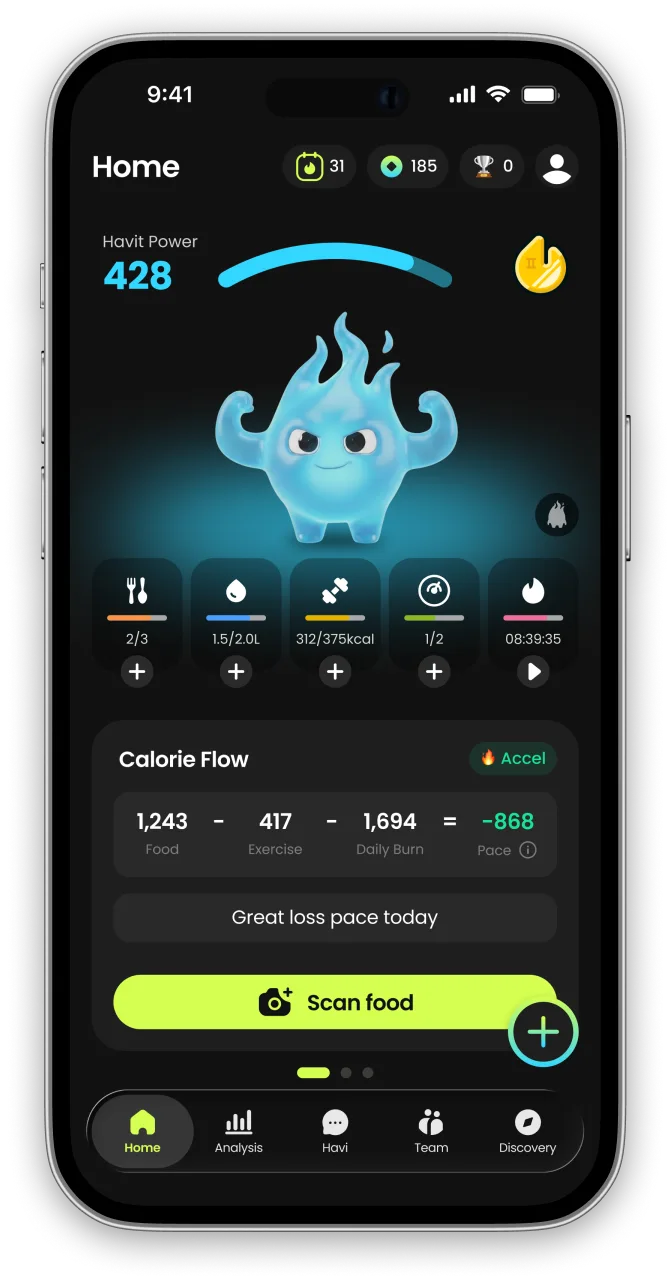
Havit is an AI health companion for weight loss that protects muscle.
Unlike calorie-only trackers, Havit connects AI body-composition estimates, nutrition, hydration, sleep, steps, cycle, mood, and GLP-1 medication in one daily routine — so progress is measured by body composition, not just the number on the scale. Daily missions turn established behavior-change techniques into small repeatable actions, drawing on expertise from professionals formerly at Juvis Diet, one of Korea’s leading metabolic clinics.
In Havit’s own analysis of 1,090 GLP-1 users, people who logged consistently built stronger habits than the general user base. Read the GLP-1 Habit Report
Havit works with or without GLP-1 medication. It is a wellness app, not a medical device; body-composition results are estimates.

Continue in the App
Personalized wellness with your own data


References
- Updated Guidelines for Sarcopenia Prevention Through Resistance Training in Middle-Aged and Older Adults — Journal of Cachexia, Sarcopenia and Muscle, 2025
- Protein Requirements for Optimal Muscle Protein Synthesis in Aging Adults: A Systematic Review and Meta-Analysis — American Journal of Clinical Nutrition, 2024
- Protein Distribution Patterns and Muscle Mass Retention: A Two-Year Longitudinal Study in Adults 45-70 — Journal of Cachexia, Sarcopenia and Muscle, 2024
- Creatine Supplementation and Resistance Training in Older Adults: A Systematic Review — Journal of Cachexia, Sarcopenia and Muscle, 2025
- Sleep Duration and Muscle Mass Preservation: Associations in a Cohort of Middle-Aged Adults — American Journal of Clinical Nutrition, 2024


