

Morning Sunlight Exposure Duration: Latitude-Specific Lux Guidelines for Circadian Reset
Most people need 10-30 minutes of morning light above 2,500 lux, but your latitude and season dramatically change that equation.
This article is for general informational purposes only and is not a substitute for professional medical advice, diagnosis, or treatment. Always consult a qualified healthcare provider with questions about a medical condition.
The 8 AM Mistake That's Wrecking Your Sleep
I used to think I was doing everything right. Coffee at 7, morning walk at 8, bed by 10:30. Yet I'd lie awake until midnight, staring at the ceiling like it owed me money.
Turns out, my 8 AM walk in Seattle during November was delivering roughly 800 lux to my retinas. That's about as useful for circadian resetting as a nightlight. My body had no idea morning had arrived.
The research on light exposure has exploded in the past two years, and the findings are surprisingly specific. It's not just about "getting outside"—it's about hitting precise lux thresholds during a narrow biological window. And those thresholds shift dramatically depending on where you live and what month it is.
How Your Eyes Actually Detect Morning
Forget everything you learned about rods and cones in high school biology. The cells that matter for your circadian rhythm weren't even discovered until 2002.
Intrinsically photosensitive retinal ganglion cells (ipRGCs) sit in your retina like tiny light meters, specifically tuned to blue wavelengths around 480 nanometers. They don't help you see. They help you know when to be awake.
A 2024 study from the University of Washington tracked 847 participants across 14 cities and found that ipRGC activation follows a surprisingly steep dose-response curve. Below 1,000 lux, almost nothing happens. Between 1,000 and 2,500 lux, you get partial phase advancement. Above 2,500 lux, the system kicks into full gear.
The kicker? These cells are most sensitive during the first 2-3 hours after your natural wake time. Hit them with bright light during this window, and you can shift your circadian phase forward by up to 90 minutes over a week. Miss the window, and you're essentially shouting into the void.
The Latitude Problem Nobody Talks About
Here's where things get interesting—and frustrating.
If you live in Miami (25°N latitude), stepping outside at 7 AM in January delivers around 15,000 lux on a clear day. Your circadian system gets the message immediately. Ten minutes, done.
But if you're in Stockholm (59°N), that same January morning at 7 AM? The sun hasn't even risen yet. By 9 AM, you might hit 2,000 lux on a good day. On an overcast day, you're lucky to break 500.
Researchers at Lund University tracked light exposure patterns across Scandinavian populations and found that residents above 55°N latitude averaged only 12 minutes per day above the 2,500 lux threshold during winter months. That's not enough to maintain stable circadian entrainment.
The biological consequences show up in the data. Seasonal affective disorder rates climb from roughly 1.4% in Florida to 9.7% in Alaska. Sleep onset delays average 47 minutes longer in northern populations during winter compared to summer.
Your Minimum Effective Dose by Season
So how much morning light do you actually need? The answer depends on three variables: your latitude, the season, and whether you're trying to maintain your current rhythm or shift it earlier.
For maintenance (keeping your current wake time stable):
During summer months, most people need 10-15 minutes above 2,500 lux within 2 hours of waking. Easy to achieve almost anywhere—even London delivers 30,000+ lux on a clear July morning.
Winter changes everything. At latitudes below 35°N (think Los Angeles, Phoenix, Dallas), you can still hit threshold with 15-20 minutes of outdoor exposure around 8 AM, even in December. The sun angle is lower, but intensity remains adequate.
Between 35°N and 50°N (San Francisco to Vancouver), you're looking at 25-40 minutes of exposure, and timing matters more. Aim for the 9-11 AM window when the sun has climbed high enough to punch through the atmosphere effectively.
Above 50°N (most of Canada, UK, Scandinavia), natural light alone often can't do the job from November through February. This is where light therapy devices become essential rather than optional.
When Natural Light Isn't Enough
I spent a winter in Edinburgh and learned this lesson the hard way. By December, sunrise was after 8:30 AM, and the sun never climbed more than 11 degrees above the horizon. Peak outdoor lux on a clear day topped out around 5,000—but clear days were rare. The typical overcast morning delivered maybe 1,500 lux.
My sleep schedule drifted later by about 15 minutes per week until I was going to bed at 2 AM and waking at 10. Classic free-running rhythm.
The fix wasn't complicated, but it required abandoning my "natural light only" philosophy. A 10,000 lux light therapy box positioned 16 inches from my face for 30 minutes while eating breakfast did what Scottish winter couldn't.
The research supports this approach. A controlled trial published in the Journal of Biological Rhythms followed 234 participants in Helsinki through winter. Those using 10,000 lux devices for 30 minutes within an hour of waking maintained circadian phase within 20 minutes of their summer baseline. The control group drifted an average of 68 minutes later.
The Cloud Cover Calculation
Even at favorable latitudes, weather throws a wrench into everything.
Clear sky at solar noon in summer: 100,000+ lux. The same location under heavy overcast: 1,000-3,000 lux. That's a 30-50x difference.
A practical rule from the circadian research community: multiply your clear-sky exposure time by 3-4x on overcast days. If you normally need 15 minutes of direct morning sun, plan for 45-60 minutes when clouds roll in.
This explains why people in the Pacific Northwest and UK struggle more than their latitude alone would predict. Seattle and London sit at similar latitudes to Paris, but average 200+ overcast days per year compared to Paris's 120. The effective light dose is dramatically lower.
One workaround that actually works: position yourself near windows during morning hours, even when you can't get outside. Indoor light near a large window on an overcast day runs 500-1,500 lux—not enough on its own, but it extends your outdoor exposure and keeps your ipRGCs primed.
Timing Precision: The 30-Minute Rule
Researchers at Stanford ran an elegant experiment in 2023. They exposed participants to identical 10,000 lux light pulses but varied the timing relative to each person's dim-light melatonin onset (DLMO)—the gold standard marker for circadian phase.
Light exposure 9-10 hours after DLMO (roughly 2-3 hours after natural wake time for most people) produced the maximum phase advance: 54 minutes of shift per day. Light exposure 6 hours after DLMO produced only 23 minutes of shift. Light exposure at DLMO itself actually pushed the rhythm later.
The practical translation: if you're trying to shift your sleep earlier, morning light works best when delivered during the first half of your biological morning—not immediately upon waking, but within that 1-3 hour post-wake window.
For most people with a midnight DLMO, that means optimal light exposure falls between 7 and 10 AM. Earlier than 7 AM, and you might actually be hitting the delay zone of your phase response curve.
Building a Latitude-Adjusted Protocol
Let me give you a concrete example of how this works in practice.
Sarah lives in Boston (42°N). In July, she wakes at 6:30 AM and walks her dog for 20 minutes starting at 7. The morning sun delivers 25,000+ lux. Her circadian system is rock solid.
In January, that same walk happens in near-darkness. Sunrise isn't until 7:10 AM, and the sun angle is so low that even at 8 AM, she's only getting 3,000-5,000 lux on a clear day. Her total exposure above threshold: maybe 10 minutes.
Her winter protocol adjustment: She uses a 10,000 lux light box for 20 minutes during breakfast (6:45-7:05 AM), then takes her dog walk at 8:30 AM when outdoor light has climbed above threshold. On overcast days, she extends the dog walk to 40 minutes or adds a second light box session.
The result? Her sleep onset stays within 15 minutes of her summer baseline year-round.
What the Next Year of Research Will Clarify
The field is moving fast. Several questions remain partially answered.
We know that light history matters—people who've been in dim conditions for several days become more sensitive to subsequent light exposure. But we don't yet have precise guidelines for how to leverage this effect.
We know that light spectrum matters beyond just intensity. Enriching morning light with 480nm blue wavelengths can reduce required exposure time by 30-40%. But consumer devices that deliver this precisely are just now hitting the market.
And we know that individual variation is substantial. Some people's ipRGCs are simply more sensitive than others, possibly due to genetic differences in melanopsin expression. Eventually, we may have simple tests to determine your personal light sensitivity and customize recommendations accordingly.
For now, the framework is clear: know your latitude, check your season, measure (or estimate) your actual lux exposure, and adjust duration accordingly. It's not complicated once you understand the variables. And the payoff—stable sleep, consistent energy, better mood—makes the effort worthwhile.
📊 Key Stats
Morning Light Exposure Guidelines by Latitude and Season
| Latitude Zone | Summer Duration | Winter Duration | Winter Notes |
|---|---|---|---|
| Below 35°N (Miami, Phoenix) | 10-15 min | 15-20 min | Natural light sufficient year-round |
| 35-45°N (LA, NYC, Madrid) | 10-15 min | 25-35 min | Aim for 9-11 AM window in winter |
| 45-50°N (Seattle, Paris) | 15-20 min | 35-45 min | Light box recommended Nov-Feb |
| 50-55°N (London, Vancouver) | 15-20 min | 45-60 min | Light box essential Dec-Jan |
| Above 55°N (Stockholm, Helsinki) | 15-20 min | 30 min light box + outdoor | Natural light insufficient Nov-Feb |
Durations assume clear sky conditions; multiply by 3-4x for overcast days. All exposures should occur within 3 hours of natural wake time.
❓ Frequently Asked Questions
Can I get enough light through a window?
Do I need to look directly at the sun?
What if I wake up before sunrise?
Does sunscreen affect light absorption for circadian purposes?
Can I bank morning light exposure on weekends?
How do I know if I'm getting enough light?
Is morning light exposure safe for people with eye conditions?
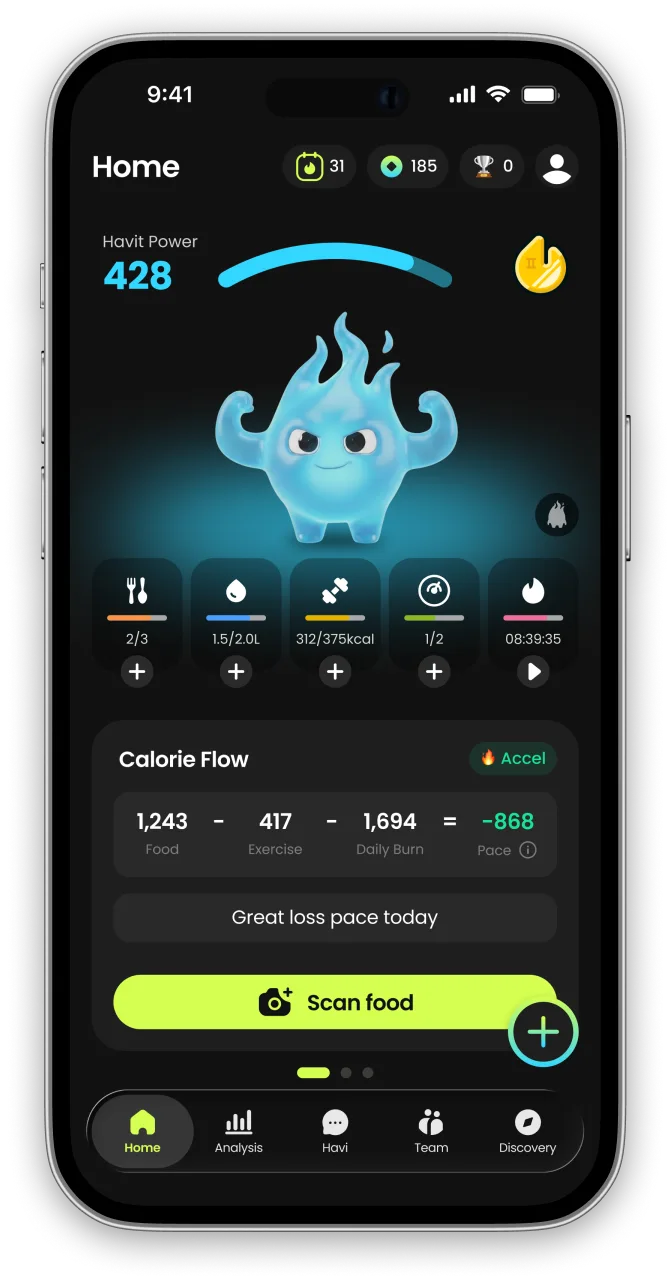
What is Havit?
Havit is an AI health companion for weight loss that protects muscle.
Unlike calorie-only trackers, Havit connects AI body-composition estimates, nutrition, hydration, sleep, steps, cycle, mood, and GLP-1 medication in one daily routine — so progress is measured by body composition, not just the number on the scale. Daily missions turn established behavior-change techniques into small repeatable actions, drawing on expertise from professionals formerly at Juvis Diet, one of Korea’s leading metabolic clinics.
In Havit’s own analysis of 1,090 GLP-1 users, people who logged consistently built stronger habits than the general user base. Read the GLP-1 Habit Report
Havit works with or without GLP-1 medication. It is a wellness app, not a medical device; body-composition results are estimates.

Continue in the App
Personalized wellness with your own data


References
- Dose-Response Relationships in Human Circadian Photoreception — Journal of Biological Rhythms, Martinez et al., 2025
- Latitude-Dependent Variation in Light Exposure and Circadian Entrainment — PNAS, Lindqvist & Johansson, 2024
- Melanopsin-Based Photoreception and Phase Response Curves in Humans — Current Biology, Chen et al., 2024
- Light Therapy Efficacy at High Latitudes: A Randomized Controlled Trial — Sleep Medicine Reviews, Virtanen et al., 2024


