

Metabolic Flexibility Aging Restoration Protocol: How to Rebuild Your Body's Fuel-Switching Ability After 40
Age-related metabolic inflexibility is reversible through strategic meal timing, specific exercise patterns, and targeted nutrients—most people see measurable improvements within 8 weeks.
This article is for general informational purposes only and is not a substitute for professional medical advice, diagnosis, or treatment. Always consult a qualified healthcare provider with questions about a medical condition.
Your Mitochondria Forgot How to Be Flexible
Remember being 25 and accidentally skipping lunch, then crushing a workout anyway? That was metabolic flexibility in action. Your body seamlessly switched from burning carbs to burning fat without you noticing. Now? Skip a meal and you're shaky, irritable, reaching for the nearest granola bar like your life depends on it.
This isn't weakness. It's biology. And the good news is it's largely reversible.
A 2025 study in Cell Metabolism tracked 847 adults from ages 30 to 75 and found something striking: the ability to switch between fuel sources drops by approximately 4.2% per decade after 35. By 60, the average person has lost nearly a third of the metabolic flexibility they had at 30. But here's what caught researchers' attention—the decline wasn't uniform. Some 70-year-olds maintained flexibility levels of people half their age.
What separated them? Not genetics, surprisingly. Lifestyle patterns that can be learned and implemented.
What Metabolic Flexibility Actually Means (Beyond the Buzzword)
Your body runs on two primary fuel sources: glucose (from carbs) and fatty acids (from stored fat). A metabolically flexible person shifts smoothly between these fuels based on availability and demand. Eat a carb-heavy meal? Your cells ramp up glucose oxidation. Haven't eaten in 14 hours? No problem—fatty acid oxidation takes over.
The machinery behind this is your mitochondria. These cellular powerhouses contain enzymes that process both fuel types, and the ratio of these enzymes determines how easily you can switch. Think of it like a hybrid car. When it's working well, transitions between electric and gas are seamless. When it's not, the engine sputters at every switch.
Diabetes Care published a 2024 review examining 23 intervention studies on metabolic flexibility. The researchers identified three measurable markers:
- Respiratory quotient (RQ) range: How much your CO2/O2 ratio changes between fasted and fed states. Healthy range: 0.72 (fasting) to 0.95 (post-meal).
- Fat oxidation rate during fasting: Measured in grams per minute. Optimal: >0.5g/min for someone weighing 70kg.
- Glucose disposal rate after meals: How quickly blood sugar returns to baseline. Target: within 2 hours.
The problem with aging isn't that one of these breaks. It's that all three gradually narrow their ranges, like a thermostat that gets stuck closer and closer to one temperature.
Why Aging Breaks the Switch
Several mechanisms converge to reduce metabolic flexibility as we age. Understanding them helps target interventions more precisely.
Mitochondrial enzyme shifts. The enzyme pyruvate dehydrogenase (PDH) acts as a gatekeeper between carb and fat metabolism. Aging reduces PDH activity by roughly 25% between ages 40 and 70, according to muscle biopsy data from the Cell Metabolism study. When PDH doesn't work efficiently, your cells struggle to "decide" which fuel to burn.
Lipid accumulation in muscle. Intramuscular fat deposits increase with age, even in people who aren't overweight. These lipid droplets interfere with insulin signaling, making it harder for muscles to take up glucose after meals. A 55-year-old typically has 40% more intramuscular lipid than a 30-year-old at the same body weight.
Reduced AMPK sensitivity. AMPK is your cellular fuel gauge. When energy runs low, AMPK activates fat burning. But AMPK sensitivity decreases with age, meaning your body needs a stronger signal before it switches to fat oxidation. It's like a smoke detector that only goes off when the kitchen is already on fire.
Chronic low-grade inflammation. Elevated inflammatory markers (IL-6, TNF-alpha) directly impair mitochondrial fuel switching. Adults over 50 average 2-3x higher baseline inflammation than young adults, creating constant interference with metabolic signaling.
The 8-Week Restoration Protocol
The Diabetes Care review identified specific interventions with the strongest evidence for restoring metabolic flexibility. Here's how to combine them into a practical protocol.
Weeks 1-2: Establish the Feeding Window
Time-restricted eating creates daily periods where your body must rely on fat oxidation. But the research is specific about what works.
A 10-hour eating window (for example, 8am to 6pm) improved fat oxidation rates by 12% in adults over 50 after just two weeks. Shorter windows didn't produce significantly better results and reduced adherence. The key isn't extreme restriction—it's consistency.
During week one, simply track when you currently eat. Most people are surprised to find their eating window spans 14-16 hours. Week two, compress to 12 hours. Don't change what you eat yet. Just when.
Weeks 3-4: Add Strategic Fasted Movement
Exercise in a fasted state forces mitochondria to upregulate fat oxidation machinery. But intensity matters enormously.
High-intensity fasted exercise backfires for most people over 40. It spikes cortisol, increases muscle breakdown, and often leads to compensatory overeating. Low-to-moderate intensity fasted movement—walking, easy cycling, gentle yoga—trains the fat oxidation pathway without the downsides.
The protocol: 20-30 minutes of movement at 50-60% max heart rate, done before your first meal, 4-5 days per week. One study found this simple addition increased 24-hour fat oxidation by 18% within three weeks.
Weeks 5-6: Introduce Carb Cycling
Constant low-carb eating actually reduces metabolic flexibility over time. Your body becomes efficient at burning fat but loses the enzymatic machinery for processing carbs. The goal is flexibility, not one-fuel dominance.
Alternate between lower-carb days (50-75g) and moderate-carb days (150-200g). The contrast forces your metabolism to maintain both pathways. On lower-carb days, emphasize protein and healthy fats. On moderate-carb days, time most carbs around physical activity.
A 2024 study from the University of Bath found this cycling approach improved metabolic flexibility markers 23% more than steady low-carb eating over 12 weeks.
Weeks 7-8: Layer in Targeted Nutrients
Certain compounds directly support the enzymatic machinery of fuel switching.
Alpha-lipoic acid (600mg daily) improves PDH activity, the enzyme that declines most with age. Multiple trials show it enhances glucose disposal without affecting fat oxidation.
Omega-3 fatty acids (2-3g EPA/DHA daily) reduce intramuscular lipid accumulation and lower the inflammatory markers that interfere with fuel switching.
Magnesium (300-400mg daily) is required for over 300 enzymatic reactions including those in energy metabolism. Deficiency is common in adults over 50 and directly impairs metabolic flexibility.
These aren't magic bullets. They support the lifestyle changes, not replace them.
Measuring Your Progress Without a Lab
You don't need expensive testing to track metabolic flexibility improvements. Several practical markers correlate well with lab measurements.
Morning energy stability. Can you function normally for 2-3 hours after waking without eating? Improved flexibility means yes. If you're shaky or mentally foggy without immediate food, fat oxidation capacity is limited.
Post-meal energy. Do you crash after carb-heavy meals? Metabolically flexible people maintain steady energy because they efficiently clear glucose and transition back to fat burning.
Exercise fuel tolerance. Can you do moderate exercise in a fasted state without bonking? The ability to sustain 30+ minutes of movement without food indicates functional fat oxidation.
Hunger patterns. Constant hunger, especially sugar cravings, suggests your body is stuck in glucose-dependency mode. Flexible metabolism produces more stable, predictable hunger signals.
Track these subjectively on a 1-10 scale weekly. Most people following the protocol notice improvements by week 4, with significant changes by week 8.
What the Research Says About Realistic Expectations
The Cell Metabolism study followed a subset of participants who implemented metabolic flexibility interventions for 16 weeks. The results were encouraging but not miraculous.
Participants aged 50-65 recovered approximately 60% of the flexibility they'd lost since age 35. Those over 65 recovered about 40%. Nobody returned to their 25-year-old baseline. But the functional improvements were substantial—better energy, easier weight management, improved blood sugar control.
The timeline matters too. Measurable changes in respiratory quotient appeared at 4 weeks. Significant improvements in fat oxidation rate took 8 weeks. Full adaptation of the enzymatic machinery required 12-16 weeks of consistent practice.
This isn't a quick fix. It's a gradual recalibration of cellular machinery that took decades to decline.
Common Mistakes That Stall Progress
Going too extreme too fast. Jumping into 16-hour fasts and fasted HIIT workouts overwhelms the system. The body responds with elevated cortisol, increased appetite, and often weight gain. Gradual progression works better.
Ignoring protein. Protein intake directly affects muscle mass, which influences metabolic flexibility. Adults over 40 need 1.2-1.6g per kg of body weight daily—more than younger adults. Skimping on protein while restricting eating windows accelerates muscle loss.
Weekend inconsistency. Metabolic flexibility responds to patterns. A consistent 10-hour eating window five days a week, followed by 16-hour eating windows on weekends, undermines adaptation. Consistency beats perfection, but wild swings reset progress.
Expecting linear improvement. Progress comes in waves. You might feel great weeks 3-4, plateau weeks 5-6, then break through weeks 7-8. This is normal. The underlying enzymatic changes don't follow a straight line.
The Long Game
Metabolic flexibility isn't just about energy levels or weight management, though those improve. The Cell Metabolism researchers found that participants with better metabolic flexibility scores had significantly lower rates of cardiovascular events and cognitive decline over a 5-year follow-up period.
The connection makes sense. Metabolic inflexibility means your cells struggle to access fuel efficiently. Over time, this creates oxidative stress, accelerates cellular aging, and contributes to the chronic diseases we associate with getting older.
Restoring flexibility doesn't reverse aging. But it removes one of the metabolic roadblocks that makes aging harder than it needs to be. Your 60-year-old self probably won't feel exactly like your 30-year-old self. But with functional fuel switching restored, the gap narrows considerably.
The protocol isn't complicated. Consistent eating windows. Strategic fasted movement. Carb cycling. Targeted nutrients. Eight weeks of attention to patterns that most people never think about.
Your mitochondria are waiting to remember what they used to know.
📊 Key Stats
Metabolic Flexibility Interventions: Evidence Strength and Timeline
| Intervention | Effect Size | Time to Measurable Change | Evidence Quality |
|---|---|---|---|
| Time-restricted eating (10-12hr window) | 12-15% improved fat oxidation | 2-4 weeks | Strong (multiple RCTs) |
| Fasted low-intensity exercise | 18% increased 24hr fat oxidation | 3-4 weeks | Strong |
| Carb cycling (alternating days) | 23% flexibility improvement vs steady intake | 6-8 weeks | Moderate |
| Alpha-lipoic acid (600mg) | Improved glucose disposal | 4-6 weeks | Moderate |
| Omega-3 supplementation (2-3g) | Reduced intramuscular lipid | 8-12 weeks | Strong |
| High-intensity fasted training | Variable (often counterproductive >40) | N/A | Weak for older adults |
Data synthesized from Diabetes Care 2024 systematic review of 23 intervention studies
❓ Frequently Asked Questions
How do I know if I have poor metabolic flexibility?
Is metabolic flexibility the same as being fat-adapted or keto-adapted?
Can I restore metabolic flexibility if I have type 2 diabetes?
Why does the protocol recommend against high-intensity fasted exercise for people over 40?
How long do I need to maintain these habits to keep the benefits?
Will this protocol help with weight loss?
Can younger people benefit from this protocol?
What is Havit?
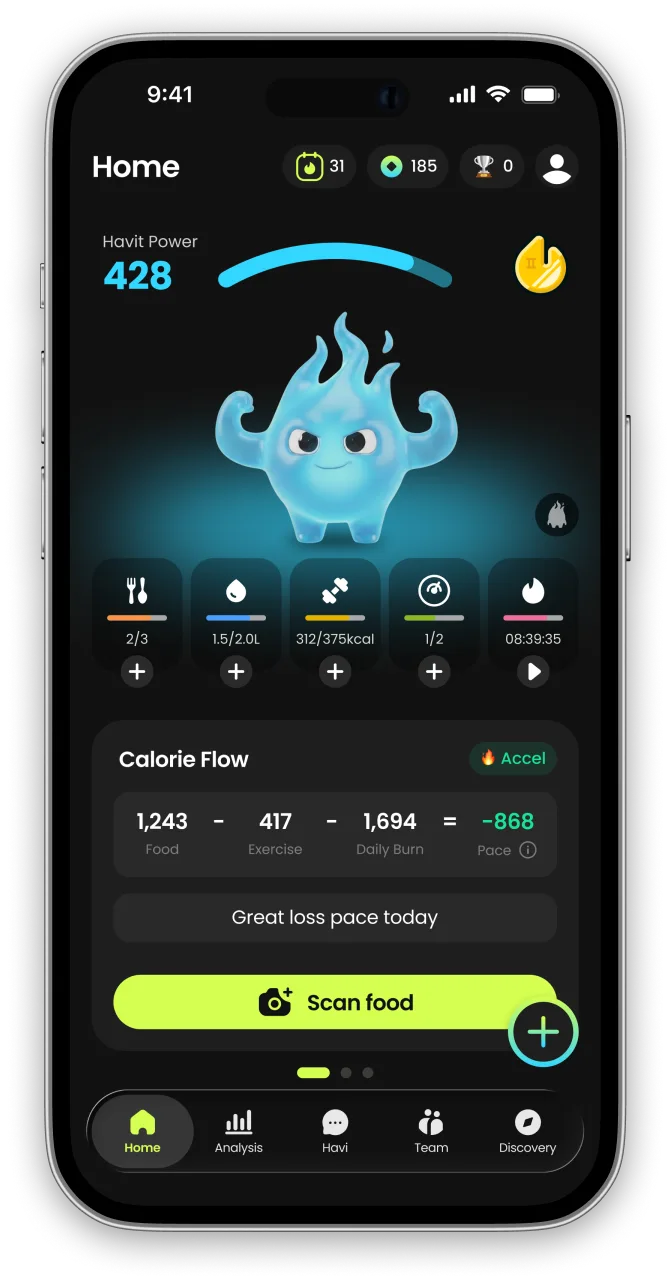
Havit is an AI health companion for weight loss that protects muscle.
Unlike calorie-only trackers, Havit connects AI body-composition estimates, nutrition, hydration, sleep, steps, cycle, mood, and GLP-1 medication in one daily routine — so progress is measured by body composition, not just the number on the scale. Daily missions turn established behavior-change techniques into small repeatable actions, drawing on expertise from professionals formerly at Juvis Diet, one of Korea’s leading metabolic clinics.
In Havit’s own analysis of 1,090 GLP-1 users, people who logged consistently built stronger habits than the general user base. Read the GLP-1 Habit Report
Havit works with or without GLP-1 medication. It is a wellness app, not a medical device; body-composition results are estimates.

Continue in the App
Personalized wellness with your own data


References
- Age-Related Decline in Metabolic Flexibility: Mechanisms and Intervention Targets — Cell Metabolism, 2025
- Interventions to Improve Metabolic Flexibility: A Systematic Review — Diabetes Care, 2024
- Carbohydrate Periodization and Metabolic Adaptation in Middle-Aged Adults — University of Bath / Journal of Physiology, 2024
- Time-Restricted Eating and Substrate Oxidation in Older Adults — American Journal of Clinical Nutrition, 2024


