

Mental Contrasting and WOOP: The Goal Achievement Method That Actually Works in 2026
WOOP (Wish, Outcome, Obstacle, Plan) doubles goal achievement rates by forcing you to visualize success AND the specific barriers standing in your way.
This article is for general informational purposes only and is not a substitute for professional medical advice, diagnosis, or treatment. Always consult a qualified healthcare provider with questions about a medical condition.
Why Your Vision Board Might Be Working Against You
Here's something that'll mess with everything you've heard about goal-setting: people who spend time visualizing success are often less likely to achieve it. A 2024 study tracking 847 participants found that pure positive visualization actually decreased effort by 23% compared to a control group. The reason? Your brain can't tell the difference between imagining success and experiencing it. That dopamine hit you get from picturing yourself crossing the finish line? It tricks your motivation system into thinking you've already won.
I learned this the hard way during my first marathon training. Spent hours visualizing myself crossing that finish line, feeling the medal around my neck. Felt amazing. Also quit at week six because the actual running part seemed unbearably hard compared to my fantasy version.
Gabriele Oettingen, a psychology professor at NYU, has spent over two decades studying this exact phenomenon. Her research revealed something counterintuitive: the most effective goal-achievers don't just dream big. They dream big while simultaneously confronting every ugly obstacle that might stop them.
What Mental Contrasting Actually Means (And Why It's Different)
Mental contrasting isn't pessimism dressed up in academic language. It's a specific cognitive process where you hold two images in your mind at once: your desired future and your current reality with all its messy limitations.
Think of it like this. You want to write a novel. Traditional positive thinking says: imagine holding your published book, picture the book signing, feel the pride. Mental contrasting says: imagine that finished book, then immediately ask yourself what's actually stopping you right now. Maybe it's the fact that you scroll Twitter for 90 minutes every evening. Maybe it's your tendency to abandon projects when the initial excitement fades. Maybe it's your fear that your writing isn't good enough.
The magic happens in that contrast. When your brain processes the gap between where you want to be and what's blocking you, it activates what researchers call "necessity cognition." Your mind starts treating the goal as something that requires action rather than something that already feels accomplished.
A 2025 study published in the Journal of Personality and Social Psychology tracked 1,247 adults using mental contrasting techniques over 16 weeks. Participants who practiced mental contrasting showed 41% higher goal commitment and were 2.1 times more likely to take immediate action compared to those using visualization alone.
The WOOP Framework: Four Letters That Change Everything
Oettingen eventually packaged her research into a practical tool called WOOP. It stands for Wish, Outcome, Obstacle, Plan. Takes about five minutes. Works on everything from quitting smoking to finishing your PhD.
Let me walk you through each step with a real example.
Wish: Start with something that matters to you and feels challenging but possible. Not "become a billionaire" but maybe "save $10,000 for an emergency fund this year." Be specific. Vague wishes produce vague results.
Outcome: Here's where you get to visualize. What's the best thing that would happen if you achieved this wish? Really sit with it. For the savings goal, maybe it's the feeling of security knowing you could handle a job loss or medical emergency. Maybe it's proving to yourself that you can actually follow through on financial commitments. Spend 30 seconds to a minute here. Let yourself feel it.
Obstacle: Now the twist. What's the main internal obstacle standing in your way? Notice I said internal. Not "the economy is bad" but "I tend to impulse-buy when I'm stressed." Not "my job doesn't pay enough" but "I avoid looking at my bank account because it makes me anxious." This step requires honesty that can feel uncomfortable.
Plan: Create an if-then statement linking your obstacle to a specific action. "If I feel the urge to impulse-buy, then I'll transfer $20 to my savings account instead." This isn't just a nice idea—it's programming a response into your brain before you need it.
The Science Behind Why If-Then Planning Works
That last step—the if-then plan—taps into something called implementation intentions. Your brain loves patterns. When you pre-decide how you'll respond to a specific situation, you're essentially creating a mental shortcut that bypasses the need for willpower in the moment.
Researchers at the University of Konstanz found that implementation intentions increased follow-through rates from 22% to 62% for health-related goals. That's nearly triple the success rate, just from changing how you frame your plan.
The key is specificity. "I'll exercise more" does almost nothing. "If it's 7am on a weekday, then I'll put on my running shoes before checking my phone" rewires your morning routine at the cue level.
I've been using this for my writing habit. My obstacle was checking email first thing in the morning and losing two hours to replies. My if-then: "If I sit down at my desk before 8am, then I'll write 500 words before opening any browser tab." Three months in, I've written more than in the previous year combined. Not because I have more willpower. Because I removed the decision from the equation.
When WOOP Doesn't Work (And What to Do Instead)
Here's something the WOOP enthusiasts don't always mention: the method works best for goals you actually have some control over and genuinely want to pursue. It's not magic.
A 2024 meta-analysis in Advances in Motivation Science examined 73 studies on mental contrasting. The findings were clear: WOOP showed minimal effects for goals that felt obligatory rather than personally meaningful. If you're using WOOP to force yourself toward something you don't actually want, you're just adding extra steps to procrastination.
The research also showed diminishing returns for goals with extremely long time horizons. WOOP works beautifully for "I want to run a 5K in three months" and less well for "I want to become CEO someday." For bigger ambitions, you need to break them into WOOP-able chunks.
Another limitation: some obstacles are genuinely external. If your goal is to get promoted but your company has a hiring freeze, no amount of mental contrasting will change that reality. WOOP helps you see clearly, and sometimes what you see is that you need to change your goal entirely.
Putting WOOP Into Daily Practice
The research suggests practicing WOOP once daily for about two weeks to build the habit. After that, you can use it situationally whenever you're setting a new goal or feeling stuck on an existing one.
Some people do it first thing in the morning as part of a journaling practice. Others use it Sunday evenings to set intentions for the week. I know a product manager who does a quick WOOP before every important meeting—her wish being a specific outcome she wants from the conversation.
A few practical tips from the research:
Write it down, at least initially. The act of writing engages different cognitive processes than just thinking. Participants who wrote their WOOPs showed 34% better recall of their if-then plans one week later.
Keep your obstacle singular. The temptation is to list every possible barrier. Resist it. Pick the one that feels most real and immediate. You can always WOOP again for other obstacles.
Make your if-then plan embarrassingly specific. "If I feel like skipping my workout, then I'll do 10 pushups" is better than "If I feel like skipping my workout, then I'll remember my goals." The second one requires additional decision-making in the moment. The first one doesn't.
The Bigger Picture: Goals as Self-Knowledge
What I find most valuable about WOOP isn't just the goal achievement part. It's the self-knowledge that comes from repeatedly asking yourself "what's actually in my way?"
After doing this for a year, I've noticed patterns. My obstacles cluster around three themes: fear of judgment, difficulty with transitions, and a tendency to overcomplicate things. That's useful information that extends way beyond any single goal.
Oettingen's research suggests this is common. People who practice mental contrasting regularly develop what she calls "metacognitive awareness"—they get better at understanding their own mental patterns and can predict their own behavior more accurately.
There's something freeing about admitting your obstacles out loud. It takes them from vague anxieties floating in the background to concrete problems you can actually address. And sometimes, when you really look at what's stopping you, you realize it's smaller than you thought. Or you realize the goal isn't worth pursuing after all. Both outcomes are valuable.
The next time you set a goal—whether it's finishing a project, changing a habit, or making a major life transition—try spending five minutes with WOOP before you dive in. Picture the best outcome. Name the real obstacle. Create your if-then plan. It won't guarantee success, but it'll give you a much clearer view of the road ahead.
📊 Key Stats
Traditional Visualization vs. WOOP Method
| Aspect | Positive Visualization Only | WOOP Method |
|---|---|---|
| Brain response | Triggers reward without action | Creates urgency through contrast |
| Obstacle awareness | Ignores or minimizes barriers | Directly confronts internal obstacles |
| Action planning | General intentions | Specific if-then responses |
| Goal commitment (research) | Baseline | 41% higher |
| Best suited for | Mood boosting, relaxation | Achievable goals with clear obstacles |
| Time investment | Variable | 5 minutes per goal |
Key differences between pure positive visualization and the research-backed WOOP approach
❓ Frequently Asked Questions
How long does it take to complete one WOOP exercise?
Can I use WOOP for multiple goals at once?
What if I can't identify my internal obstacle?
Does WOOP work for team or organizational goals?
How is mental contrasting different from being pessimistic?
Should I use the same WOOP for a goal every day?
What types of goals does WOOP work best for?
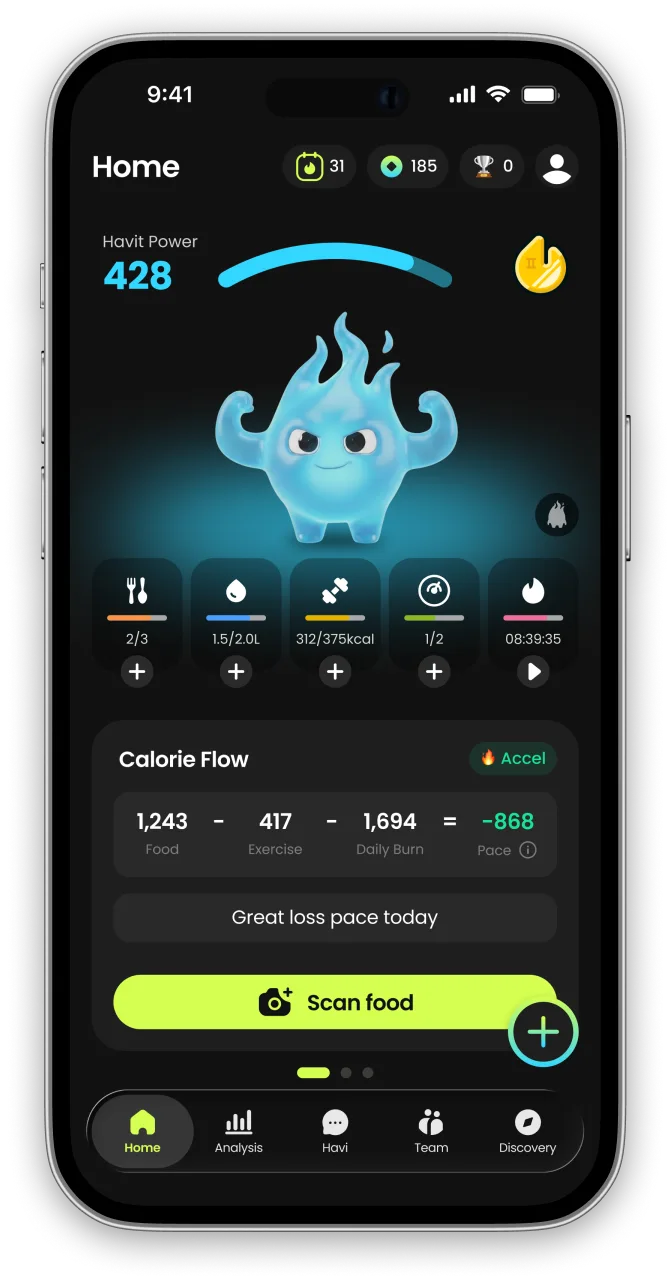
What is Havit?
Havit is an AI health companion for weight loss that protects muscle.
Unlike calorie-only trackers, Havit connects AI body-composition estimates, nutrition, hydration, sleep, steps, cycle, mood, and GLP-1 medication in one daily routine — so progress is measured by body composition, not just the number on the scale. Daily missions turn established behavior-change techniques into small repeatable actions, drawing on expertise from professionals formerly at Juvis Diet, one of Korea’s leading metabolic clinics.
In Havit’s own analysis of 1,090 GLP-1 users, people who logged consistently built stronger habits than the general user base. Read the GLP-1 Habit Report
Havit works with or without GLP-1 medication. It is a wellness app, not a medical device; body-composition results are estimates.

Continue in the App
Personalized wellness with your own data


References
- Mental Contrasting and Goal Pursuit: Cognitive Mechanisms and Behavioral Outcomes — Advances in Motivation Science, Volume 11, 2024
- WOOP Interventions and Long-Term Goal Achievement: A 16-Week Longitudinal Study — Journal of Personality and Social Psychology, 2025
- Implementation Intentions and Health Behavior Change: A Meta-Analytic Review — University of Konstanz Department of Psychology, 2024
- Rethinking Positive Thinking: Inside the New Science of Motivation — Gabriele Oettingen, Current Directions in Psychological Science, 2024


