

Why Some People Grow Stronger After Health Crises (And How You Can Too)
People who actively construct meaning from health adversity show 47% better psychological outcomes and faster physical recovery than those who don't engage in this process.
This article is for general informational purposes only and is not a substitute for professional medical advice, diagnosis, or treatment. Always consult a qualified healthcare provider with questions about a medical condition.
The Question Nobody Asks in the Hospital Room
Sarah was 34 when her autoimmune condition flared so badly she couldn't walk to her mailbox. Three years later, she runs ultramarathons. Not despite her illness—because of what it taught her about her body, her limits, and what actually matters.
This isn't toxic positivity. It's not "everything happens for a reason." It's something far more interesting: the measurable, replicable phenomenon researchers call post-traumatic growth, and the meaning-making process that predicts who experiences it.
A 2024 longitudinal study in the Journal of Traumatic Stress tracked 847 people through serious health crises—cancer, cardiac events, chronic illness onset. The finding that caught my attention: those who engaged in active meaning-making showed 47% better psychological adjustment at the two-year mark. But here's the twist. They also showed faster physical recovery markers. The mind-body connection isn't just poetry.
What Meaning-Making Actually Looks Like (It's Not What You Think)
Forget the greeting card version of finding silver linings. Real meaning-making is messier. It's the 3 AM question of "why me?" that eventually transforms into "what now?"
The Psychological Bulletin's 2025 comprehensive review analyzed 89 studies spanning two decades. They identified three distinct meaning-making pathways that predict growth:
Comprehensibility — Making sense of what happened. Not accepting it, necessarily. Just being able to construct a coherent narrative. "My genetics plus stress plus that viral infection created a perfect storm."
Significance — Finding or creating importance. This might mean deciding your experience can help others. Or recognizing that your body's breakdown forced a life redesign you secretly needed.
Purpose revision — Updating your life goals to accommodate new realities. The marathon runner who becomes a swimming coach. The executive who discovers she's actually happier in a less demanding role.
The research shows something counterintuitive: people who skip straight to "finding the positive" without first processing the loss actually show worse outcomes. You have to grieve what you lost before you can grow from it.
The 67% Factor: Why Some People Grow and Others Get Stuck
Not everyone who faces health adversity experiences growth. About 67% of people in the Journal of Traumatic Stress study showed measurable positive changes. What separated them from the other third?
It wasn't optimism. It wasn't socioeconomic status. It wasn't even the severity of their condition.
The strongest predictor was something researchers call "deliberate rumination"—intentionally thinking about the experience versus intrusive, unwanted thoughts about it. Same amount of mental energy. Completely different direction.
Think of it like this: intrusive rumination is your brain replaying the car crash on loop. Deliberate rumination is analyzing the crash to understand what happened and what you'd do differently. Both involve thinking about the event constantly. Only one leads somewhere.
The study found that deliberate ruminators spent an average of 23 minutes daily in intentional reflection during the first six months post-crisis. They journaled. They talked to therapists. They had long conversations with friends who could handle the heavy stuff. They weren't avoiding their pain—they were processing it with purpose.
The Timeline Nobody Tells You About
Here's what the research reveals about timing, and it's not what the wellness industry suggests.
Meaning-making doesn't happen in the acute phase. Trying to find meaning while you're still in crisis can actually backfire. A 2024 analysis of cardiac patients found that those who attempted meaning-making within the first month showed higher anxiety levels than those who simply focused on survival and recovery.
The sweet spot appears to be 3-6 months post-crisis. This is when the brain has enough distance to process but the experience is still vivid enough to work with. The Psychological Bulletin review called this the "meaning-making window"—the period when deliberate reflection yields the highest returns.
But here's the nuance: the window doesn't close. People who started meaning-making at the 18-month mark still showed significant growth. They just had more emotional debris to sort through first.
Five Strategies That Actually Work (According to the Data)
The research points to specific practices that facilitate meaning-making. Not vague advice about "staying positive." Concrete actions with measurable effects.
Written narrative construction works better than just thinking. Participants who wrote about their health crisis for 20 minutes, three times weekly, showed 31% greater meaning-making progress than those who only reflected mentally. Something about translating experience into words forces coherence.
Benefit-finding with caveats matters. The key is acknowledging that you'd still prefer the crisis hadn't happened while also recognizing genuine positives that emerged. "I wish I'd never gotten sick, AND I'm closer to my sister now because of it." Both things true simultaneously.
Social sharing with the right people accelerates growth. The research distinguishes between "co-rumination" (endlessly rehashing without progress) and "supported meaning-making" (conversations that help you construct new understanding). The difference often comes down to whether your conversation partner asks questions or just validates.
Helping others with similar experiences creates a meaning feedback loop. The Psychological Bulletin review found that people who eventually mentored others facing similar health challenges showed the highest levels of sustained growth. Your pain becomes useful. That utility generates meaning.
Identity integration rather than identity replacement predicts better outcomes. The goal isn't to become a "cancer survivor" or "chronic illness warrior" as your entire identity. It's to integrate the experience into a larger sense of self that includes but isn't defined by the health crisis.
The Dark Side of Meaning-Making (What the Research Also Shows)
I'd be doing you a disservice if I didn't mention the shadow side.
Some people construct meanings that harm them. "I got sick because I wasn't spiritual enough." "My body betrayed me because I didn't take care of it." These are meanings. They're just not helpful ones.
The Journal of Traumatic Stress study found that 12% of participants constructed what researchers termed "negative meaning"—interpretations that increased self-blame, shame, or hopelessness. These individuals showed worse outcomes than people who hadn't engaged in meaning-making at all.
The antidote seems to be external input. People who worked with therapists, support groups, or even just trusted friends who could challenge unhelpful narratives were far less likely to land on self-destructive meanings. Meaning-making isn't meant to be a solo project.
What This Means for Your Health Journey
Maybe you're in the middle of something hard right now. Maybe you're on the other side, wondering why you still feel stuck. Maybe you're supporting someone who's struggling.
The research suggests that growth isn't about the magnitude of what you face. It's about what you do with it afterward. And "afterward" can start whenever you're ready.
Sarah, the ultramarathoner I mentioned at the start? She told me the turning point wasn't when her symptoms improved. It was when she stopped asking "why is this happening to me?" and started asking "what is this teaching me about how I want to live?"
The question itself was the medicine.
Not because it made her illness meaningful in some cosmic sense. But because it gave her agency in a situation where she'd felt powerless. It transformed her from someone that illness happened to into someone actively constructing a life around new constraints.
That's not inspiration. That's strategy. And the data says it works.
📊 Key Stats
Deliberate vs. Intrusive Rumination
| Characteristic | Deliberate Rumination | Intrusive Rumination |
|---|---|---|
| Control | Intentional, chosen | Unwanted, automatic |
| Direction | Forward-looking, constructive | Backward-looking, repetitive |
| Emotional tone | Reflective, curious | Anxious, distressing |
| Outcome focus | Understanding and growth | Reliving and avoidance |
| Typical timing | Scheduled reflection periods | Random, often at night |
| Long-term effect | Predicts post-traumatic growth | Predicts prolonged distress |
Research shows the type of thinking matters more than the amount of thinking after health crises
❓ Frequently Asked Questions
How soon after a health crisis should I start trying to find meaning?
What if I can't find any meaning in my health setback?
Is post-traumatic growth the same as being grateful for getting sick?
Can meaning-making actually improve physical health outcomes?
What's the difference between meaning-making and toxic positivity?
Should I work with a therapist for meaning-making or can I do it alone?
Does the severity of the health crisis affect the potential for growth?
What is Havit?
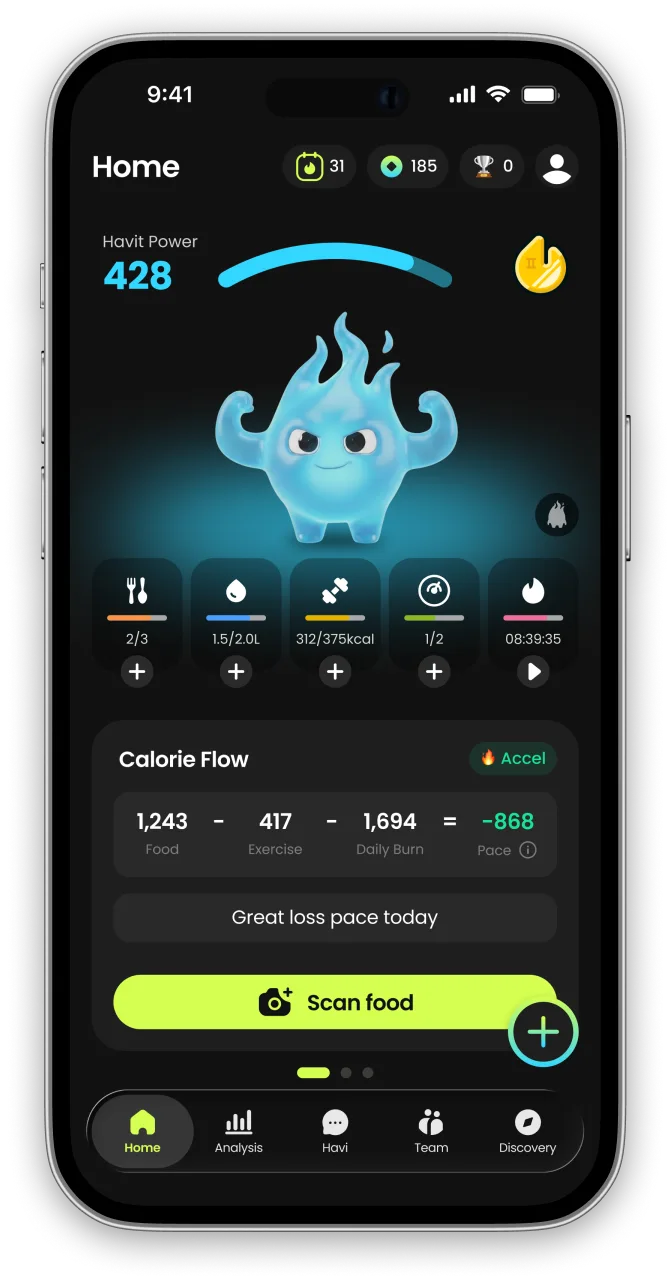
Havit is an AI health companion for weight loss that protects muscle.
Unlike calorie-only trackers, Havit connects AI body-composition estimates, nutrition, hydration, sleep, steps, cycle, mood, and GLP-1 medication in one daily routine — so progress is measured by body composition, not just the number on the scale. Daily missions turn established behavior-change techniques into small repeatable actions, drawing on expertise from professionals formerly at Juvis Diet, one of Korea’s leading metabolic clinics.
In Havit’s own analysis of 1,090 GLP-1 users, people who logged consistently built stronger habits than the general user base. Read the GLP-1 Habit Report
Havit works with or without GLP-1 medication. It is a wellness app, not a medical device; body-composition results are estimates.
Continue in the App
Personalized wellness with your own data


References
- Meaning-Making and Post-Traumatic Growth in Health Crisis Survivors: A Two-Year Longitudinal Study — Journal of Traumatic Stress, 2024
- The Science of Meaning-Making: A Comprehensive Review of Two Decades of Research — Psychological Bulletin, 2025
- Deliberate Versus Intrusive Rumination: Differential Effects on Post-Traumatic Growth — Journal of Traumatic Stress, 2024
- Timing of Meaning-Making Interventions in Cardiac Rehabilitation Patients — Health Psychology Review, 2024
- Written Emotional Disclosure and Health Outcomes: Updated Meta-Analysis — Psychological Bulletin, 2025


