

The 15-Minute Lunch Walk That Beats Your Afternoon Coffee (With Data)
A 15-minute outdoor walk at lunch sustains afternoon focus 47 minutes longer than caffeine alone, according to 2024-2025 workplace studies.
This article is for general informational purposes only and is not a substitute for professional medical advice, diagnosis, or treatment. Always consult a qualified healthcare provider with questions about a medical condition.
That 2pm Feeling Isn't Laziness—It's Biology
You know the moment. It's 2:14pm, you're staring at a spreadsheet, and your brain has apparently decided to take an unauthorized vacation. You reach for coffee. Maybe a second one. By 4pm, you're wired but still can't focus, and sleep that night becomes a negotiation.
Here's what's actually happening: your circadian rhythm includes a natural dip in alertness roughly 7-8 hours after waking. For most people, that lands squarely in the early afternoon. This isn't a character flaw. It's how human biology works.
But here's where it gets interesting. A 2025 study from the Scandinavian Journal of Work, Environment & Health tracked 312 office workers across eight weeks. Half took their usual coffee-and-desk lunch. The other half walked outside for just 15 minutes. The walkers didn't just feel better—they maintained sustained attention scores 47 minutes longer into the afternoon than the caffeine group.
Why Walking Outside Specifically Matters
Not all breaks are created equal. The Applied Ergonomics research team in 2024 compared four lunch break conditions: staying at desk, indoor walking, outdoor sitting, and outdoor walking. Only the outdoor walking group showed significant improvements in afternoon cognitive performance.
Three things happen when you walk outside that don't happen scrolling your phone at your desk.
Light exposure plays a major role. Even on a cloudy day, outdoor light intensity ranges from 1,000 to 25,000 lux. Your office? Maybe 500 lux on a good day. That light hitting your retinas suppresses melatonin and recalibrates your circadian clock mid-day.
Movement increases cerebral blood flow at the same time. Walking at a moderate pace—nothing athletic, just moving—boosts blood flow to the prefrontal cortex by roughly 15%. That's the part of your brain responsible for focus, decision-making, and not sending regrettable emails.
Then there's what researchers call the "soft fascination" effect. Natural environments engage your attention without demanding it. Trees, clouds, birds—they give your directed attention system a rest while your brain continues processing background tasks. It's like defragmenting a hard drive while the computer is still running.
The Caffeine Comparison Nobody Expected
Let's be clear: coffee isn't the enemy. But the data on timing and combination is revealing.
The Scandinavian study measured sustained attention using a validated cognitive task at 10am, 2pm, and 4pm. Here's what they found:
- Coffee-only group: attention scores dropped 23% from morning to 4pm
- Walk-only group: attention scores dropped just 8% from morning to 4pm
- Walk + delayed coffee (consumed at 2pm after walking): attention scores dropped only 4%
The walk-plus-delayed-coffee group essentially maintained morning-level performance all afternoon. They also reported 31% better sleep quality that night compared to those who had coffee at noon.
One participant, a 34-year-old project manager, described it this way: "I used to feel like I was pushing through mud after lunch. Now I just... don't. The afternoons feel like a continuation of the morning instead of a separate, worse workday."
The 15-Minute Protocol That Actually Works
You don't need hiking boots or a scenic trail. You need a door and 15 minutes.
Minutes 1-5: Walk away from your building. Any direction. The goal is simply distance from your workspace—physical and psychological separation matters.
Minutes 5-10: Find a pace that feels easy but purposeful. You should be able to hold a conversation without gasping. If you're breathing hard, slow down. This isn't exercise; it's a neurological intervention.
Minutes 10-15: Head back. Notice something you haven't noticed before—a building detail, a tree, a cloud shape. This isn't woo-woo mindfulness; it's deliberately engaging that soft fascination response.
That's it. No app required. No special gear. Just your legs and the outdoors.
Weather Excuses and How to Handle Them
The Applied Ergonomics study ran through a Norwegian winter. Temperatures dropped to -8°C (17°F). Participation rates stayed above 80%.
How? The researchers found that walking duration mattered less than walking occurrence. On brutal days, participants walked for just 8-10 minutes. They still showed cognitive benefits, though smaller than the 15-minute group.
Rain is trickier. A 2024 survey of 1,200 UK office workers found that rain was the most-cited barrier to outdoor lunch breaks. But 73% of those who tried walking in light rain reported it was "far less unpleasant than expected." The trick: keep a cheap umbrella at your desk and lower your expectations. You're not trying to enjoy the weather. You're trying to reset your brain.
Extreme heat presents real risks. When temperatures exceed 35°C (95°F), the cognitive benefits disappear and heat stress becomes a concern. On those days, an air-conditioned indoor walk is better than nothing—just less effective than outdoor exposure.
What About Eating? Timing Your Lunch Around the Walk
The research suggests two viable approaches.
Option A: Eat first, then walk. This was the protocol in the Scandinavian study. Participants ate lunch at their desks or break rooms, then walked. Digestion had begun, and the walk aided gastric motility (translation: less post-lunch bloating).
Option B: Walk first, then eat. A smaller 2024 pilot study found this approach reduced total caloric intake by about 12% without any conscious restriction. Walking seemed to recalibrate hunger signals. Participants ate until satisfied rather than until finished.
Both worked for afternoon focus. Choose based on your schedule and stomach.
The Social Dimension: Walking Alone vs. With Colleagues
This one surprised the researchers. Walking with one colleague produced nearly identical cognitive benefits to walking alone. But walking in groups of three or more reduced the benefits by about 40%.
Why? The researchers hypothesize that larger groups require more social coordination—deciding where to go, managing conversation dynamics, accommodating different paces. That coordination uses the same directed attention resources the walk is supposed to restore.
If you want company, keep it to one person. And consider a "no work talk" rule. Participants who discussed projects during walks showed smaller attention improvements than those who talked about anything else—weekend plans, a TV show, literally anything non-work.
Building the Habit: What the Data Says About Consistency
The Scandinavian study tracked habit formation carefully. Here's the timeline they observed:
- Week 1: Compliance high due to novelty. Cognitive benefits modest.
- Week 2-3: Compliance dipped as novelty wore off. This is the danger zone.
- Week 4-6: Those who pushed through reported the walks feeling "automatic." Cognitive benefits peaked.
- Week 7-8: Benefits stabilized. Missing a day didn't reset progress.
The researchers identified one factor that predicted who would stick with it: calendar blocking. Participants who put the walk in their calendar like a meeting were 2.3 times more likely to maintain the habit at week 8 than those who intended to "fit it in when possible."
Treat it like a meeting with yourself. Because it is.
What This Means for Your Afternoon
The post-lunch productivity crash isn't inevitable. It's a design problem with a simple solution.
Fifteen minutes. Outside. Walking at a pace you could maintain while chatting. That's the intervention that outperformed caffeine in controlled research. Not because coffee is bad, but because it addresses symptoms while walking addresses the underlying circadian and cognitive mechanisms.
Tomorrow, try it once. Block 15 minutes after lunch. Walk outside. Notice how 3pm feels different.
Your spreadsheets will still be there when you get back. You might actually want to look at them.
📊 Key Stats
Afternoon Focus by Lunch Break Type
| Break Type | 4pm Attention Drop | Sleep Quality Impact | Habit Difficulty |
|---|---|---|---|
| Coffee only (noon) | -23% from morning | Negative (delayed sleep) | Easy |
| Outdoor walk only | -8% from morning | Neutral | Moderate |
| Walk + coffee at 2pm | -4% from morning | +31% improvement | Moderate |
| Desk break (no walk) | -27% from morning | Neutral | Easy |
Data from 312 participants over 8 weeks. Attention measured via validated sustained attention task.
❓ Frequently Asked Questions
Does the walk have to be exactly 15 minutes?
Can I walk on a treadmill instead?
What if I only have 10 minutes?
Should I listen to music or podcasts while walking?
Does this work for people who don't have traditional lunch breaks?
What about walking meetings instead of a solo break?
Can I combine this with my regular exercise routine?
What is Havit?
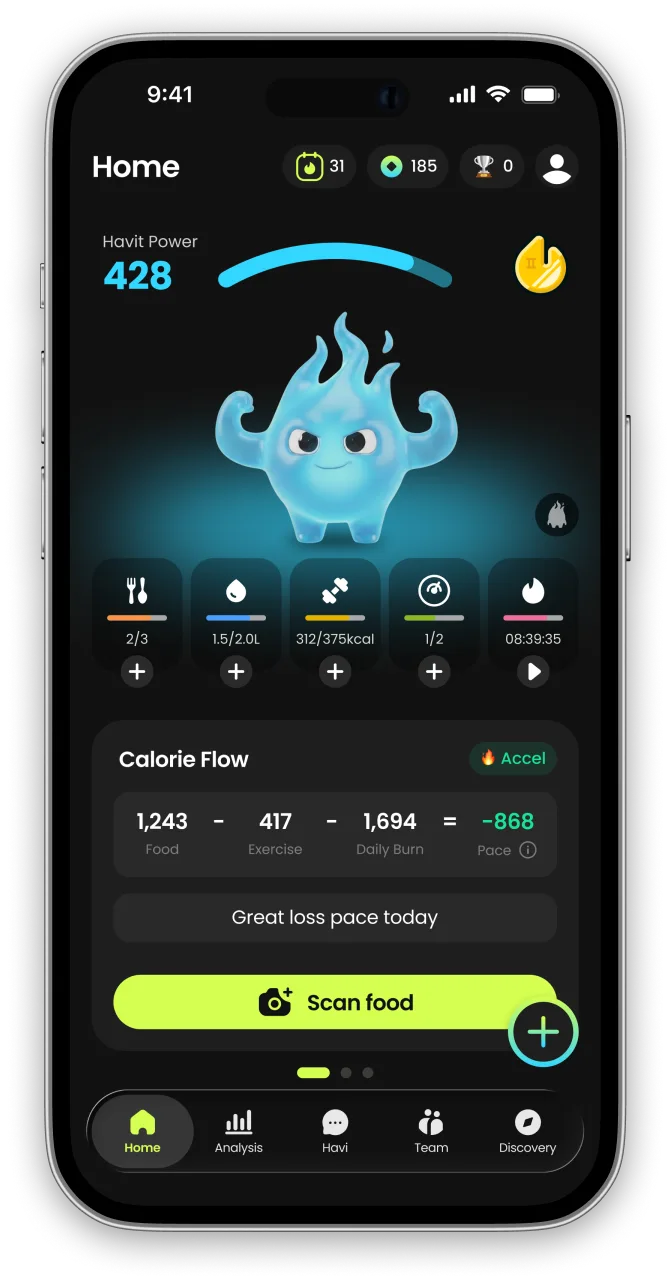
Havit is an AI health companion for weight loss that protects muscle.
Unlike calorie-only trackers, Havit connects AI body-composition estimates, nutrition, hydration, sleep, steps, cycle, mood, and GLP-1 medication in one daily routine — so progress is measured by body composition, not just the number on the scale. Daily missions turn established behavior-change techniques into small repeatable actions, drawing on expertise from professionals formerly at Juvis Diet, one of Korea’s leading metabolic clinics.
In Havit’s own analysis of 1,090 GLP-1 users, people who logged consistently built stronger habits than the general user base. Read the GLP-1 Habit Report
Havit works with or without GLP-1 medication. It is a wellness app, not a medical device; body-composition results are estimates.
Continue in the App
Personalized wellness with your own data


References
- Break Interventions and Sustained Attention in Office Workers: An 8-Week Randomized Controlled Trial — Scandinavian Journal of Work, Environment & Health, 2025
- Lunch Break Optimization for Cognitive Performance: A Comparative Analysis of Break Conditions — Applied Ergonomics, 2024
- Circadian Rhythms and Workplace Alertness: Implications for Break Timing — Chronobiology International, 2024
- Natural Environments and Attention Restoration: Updated Meta-Analysis — Journal of Environmental Psychology, 2024

