

The Leucine Threshold: Why 2.5-3g Per Meal Actually Matters for Muscle Building
Your muscles need 2.5-3g of leucine per meal to flip the mTOR switch and maximize muscle protein synthesis—anything less leaves gains on the table.
This article is for general informational purposes only and is not a substitute for professional medical advice, diagnosis, or treatment. Always consult a qualified healthcare provider with questions about a medical condition.
That Chicken Breast Might Be Letting You Down
You ate 20 grams of protein at lunch. Solid, right? Here's the thing: your muscles might have barely noticed. The secret isn't just protein quantity—it's whether you crossed a specific amino acid threshold that tells your body to actually build muscle. That threshold revolves around leucine, and most people have never heard of it.
I spent years eating "enough protein" while wondering why my progress stalled. Turns out I was spreading my intake too thin across six small meals, never hitting the leucine trigger point in any of them. Once I understood the science, everything changed.
What Makes Leucine the Master Switch
Amino acids aren't created equal. Out of the 20 we need, leucine holds a unique position as the primary activator of mTOR (mechanistic target of rapamycin)—the cellular pathway that initiates muscle protein synthesis. Think of mTOR as a construction foreman. Without leucine showing up in sufficient quantities, the foreman stays home and no building happens.
A 2024 study in the Journal of Nutrition mapped this relationship precisely. Researchers gave participants varying doses of leucine and tracked muscle protein synthesis rates over six hours. The results showed a clear inflection point: below 2.5 grams, muscle building barely budged above baseline. Hit 2.5-3 grams, and synthesis rates jumped by 25-30%. Go beyond 3 grams? Diminishing returns kicked in fast.
The mechanism is elegant. Leucine binds to Sestrin2, a cellular sensor that normally suppresses mTOR activity. Once enough leucine accumulates, Sestrin2 releases its brake, and mTOR springs into action. It's binary in nature—either you've got enough leucine to release that brake, or you don't.
The Numbers Behind Your Protein Sources
Not all protein sources deliver leucine equally. This matters more than most nutrition advice acknowledges.
Whey protein contains roughly 11% leucine by weight. A 25-gram scoop delivers about 2.75 grams of leucine—right in the sweet spot. Chicken breast runs around 8% leucine, meaning you need approximately 31-38 grams of protein from chicken to hit threshold. Beans and lentils? They hover around 6-7% leucine content, requiring significantly larger portions.
Here's where it gets practical. That 3-ounce chicken breast you had for lunch (roughly 26 grams of protein) delivered about 2.1 grams of leucine. Close, but potentially below the threshold for maximal mTOR activation. Add a small Greek yogurt (another 0.5g leucine), and suddenly you've crossed the line.
The American Journal of Clinical Nutrition published a comprehensive protein quality review in 2025 that ranked common foods by their "leucine density"—the amount of leucine per calorie. Egg whites topped the list, followed by whey isolate and lean fish. Quinoa, despite its reputation as a complete protein, ranked surprisingly low.
Why Meal Timing Suddenly Makes Sense
The leucine threshold concept explains something that confused researchers for years: why meal distribution affects muscle mass even when total daily protein stays constant.
A Canadian research team tracked two groups eating identical daily protein (120 grams). Group A consumed 40-40-40 across three meals. Group B ate 10-20-90, front-loading breakfast and lunch lightly while cramming most protein into dinner. After 12 weeks, Group A gained measurably more lean mass despite zero difference in total intake or training.
The explanation is straightforward. Group A triggered mTOR three times daily. Group B only crossed the leucine threshold once—at dinner. Two-thirds of their muscle-building opportunities were essentially wasted.
This doesn't mean you need perfect distribution. But consistently eating 15-gram protein snacks throughout the day while calling it "high protein eating" misses the point entirely. Each eating occasion needs to count.
Age Changes Everything About This Equation
At 25, your muscles respond eagerly to the leucine signal. At 65, they've become skeptical. This phenomenon, called anabolic resistance, means older adults need higher leucine doses to achieve the same mTOR activation.
Research from 2024 quantified this shift. Young adults showed maximal protein synthesis at 2.5 grams of leucine per meal. Adults over 60 required 3.5-4 grams to reach equivalent activation levels. The mTOR pathway still works—it just needs a louder signal.
This has profound implications for aging populations. The standard recommendation of 0.8g protein per kilogram bodyweight becomes genuinely inadequate for maintaining muscle mass in older adults, not because of total protein needs, but because typical portion sizes fail to concentrate enough leucine in single meals.
My 68-year-old father was eating "plenty of protein" while losing muscle mass yearly. When we restructured his meals around leucine thresholds—adding whey to his morning oatmeal, choosing Greek yogurt over regular—the decline stopped within months.
Plant-Based Eating Requires Extra Strategy
Vegan and vegetarian athletes face a genuine challenge here. It's not insurmountable, but it requires awareness.
Plant proteins average 6-8% leucine content versus 8-11% for animal sources. More importantly, plant proteins often come packaged with fiber and carbohydrates that increase meal volume before leucine thresholds are met. Eating 50 grams of protein from lentils means consuming a genuinely large quantity of food.
The practical solutions work, though. Combining complementary plant proteins in single meals helps. Adding leucine-rich seeds (pumpkin seeds contain 8% leucine) boosts meals toward threshold. Some athletes use isolated leucine supplements—typically 2-3 grams added to plant-based meals—to guarantee mTOR activation without excessive caloric intake.
A 2025 study compared muscle protein synthesis in vegans using standard meals versus leucine-matched meals. The leucine-matched group showed protein synthesis rates statistically identical to omnivores. The limitation wasn't plant protein itself—it was leucine concentration.
Practical Application Without Obsession
Knowing about leucine thresholds shouldn't turn every meal into a math problem. Here's the simplified approach that actually works in daily life.
Aim for 30-40 grams of high-quality protein at each main meal. This virtually guarantees you'll cross the leucine threshold regardless of protein source. If you're eating smaller protein portions (under 25 grams), pair them with leucine-dense additions: a handful of pumpkin seeds, a small serving of cottage cheese, or a partial scoop of whey in your coffee.
For post-workout nutrition, prioritize fast-digesting proteins with high leucine content. Whey protein earned its reputation for a reason—it delivers leucine rapidly and in concentrated form. A 25-30 gram serving post-training hits the threshold efficiently.
Skip the leucine supplements unless you're over 60 or eating exclusively plant-based. Whole food proteins provide the full amino acid spectrum that isolated leucine cannot. The threshold matters, but so does everything else that comes with real food.
The Ceiling Effect Nobody Mentions
More isn't always better. This principle applies forcefully to leucine.
Once you've crossed the threshold, additional leucine doesn't proportionally increase muscle protein synthesis. A 2024 dose-response study showed that 5 grams of leucine produced virtually identical synthesis rates to 3 grams. The extra 2 grams simply got oxidized for energy—expensive fuel with no muscle-building benefit.
This ceiling effect has practical implications. Those 50-gram protein shakes marketed to bodybuilders? They deliver roughly 5.5 grams of leucine—nearly double what's needed for maximal mTOR activation. You're not building more muscle; you're just creating expensive urine.
The sweet spot appears to be 2.5-3 grams of leucine per meal, achieved through 25-40 grams of high-quality protein depending on source. Beyond this, your money and stomach space are better allocated to the next meal.
What This Means for Your Next Grocery Trip
Understanding leucine thresholds changes shopping priorities. Instead of fixating on total protein content, consider leucine density.
Greek yogurt beats regular yogurt not just for protein content but for leucine concentration per serving. Chicken thighs and breasts deliver similar leucine despite different fat content—choose based on preference. Eggs remain underrated; two whole eggs plus two whites approach threshold territory while providing nutrients that protein powders lack.
For snacks, the threshold concept suggests eating fewer, more substantial protein portions rather than grazing on small amounts throughout the day. That 100-calorie yogurt cup with 5 grams of protein? It's not triggering anything. Save your appetite for meals that actually count.
📊 Key Stats
Leucine Content by Protein Source
| Protein Source | Leucine Content (%) | Protein Needed for 2.5g Leucine | Typical Serving |
|---|---|---|---|
| Whey Protein Isolate | 11% | 23g | 1 scoop (25g) |
| Chicken Breast | 8% | 31g | 4 oz cooked |
| Eggs (whole) | 8.5% | 29g | 4-5 eggs |
| Greek Yogurt | 9% | 28g | 1.5 cups |
| Beef (lean) | 8% | 31g | 4 oz cooked |
| Salmon | 8.5% | 29g | 4 oz cooked |
| Lentils (cooked) | 6.5% | 38g | 2 cups |
| Tofu (firm) | 7% | 36g | 10 oz |
Protein amounts needed to reach the 2.5g leucine threshold for mTOR activation. Data compiled from USDA nutrient database and protein quality research.
❓ Frequently Asked Questions
Can I just take leucine supplements instead of worrying about protein sources?
Does the leucine threshold apply to every meal, including snacks?
How does cooking affect leucine content in foods?
Is there a maximum useful amount of leucine per day?
Do BCAAs provide enough leucine to hit the threshold?
How quickly after eating does leucine trigger mTOR?
Does the threshold change if I'm in a caloric deficit?
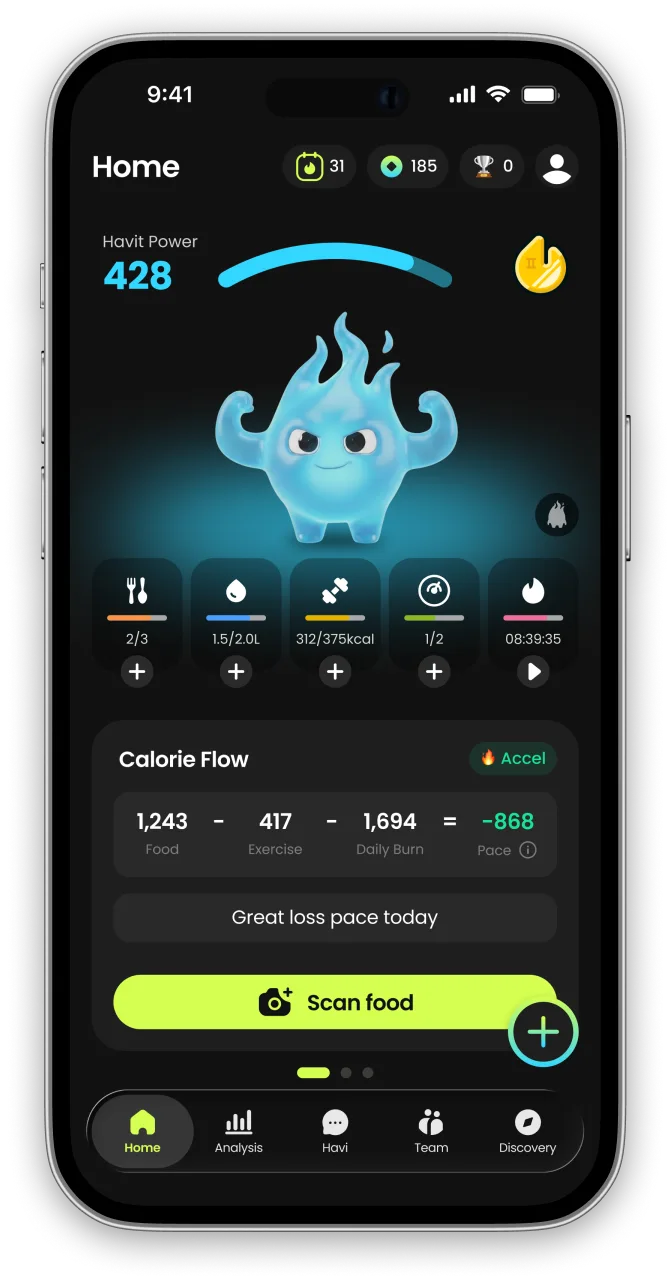
What is Havit?
Havit is an AI health companion for weight loss that protects muscle.
Unlike calorie-only trackers, Havit connects AI body-composition estimates, nutrition, hydration, sleep, steps, cycle, mood, and GLP-1 medication in one daily routine — so progress is measured by body composition, not just the number on the scale. Daily missions turn established behavior-change techniques into small repeatable actions, drawing on expertise from professionals formerly at Juvis Diet, one of Korea’s leading metabolic clinics.
In Havit’s own analysis of 1,090 GLP-1 users, people who logged consistently built stronger habits than the general user base. Read the GLP-1 Habit Report
Havit works with or without GLP-1 medication. It is a wellness app, not a medical device; body-composition results are estimates.

Continue in the App
Personalized wellness with your own data


References
- Leucine Dose-Response Relationship in Muscle Protein Synthesis: A Randomized Controlled Trial — Journal of Nutrition, 2024
- Protein Quality Assessment and Amino Acid Requirements for Muscle Health: A Comprehensive Review — American Journal of Clinical Nutrition, 2025
- mTORC1 Signaling and Amino Acid Sensing in Skeletal Muscle — Annual Review of Nutrition, 2024
- Age-Related Anabolic Resistance and Leucine Requirements in Older Adults — Journal of Gerontology: Biological Sciences, 2024
- Plant-Based Protein Strategies for Optimizing Muscle Protein Synthesis — Nutrients, 2025


